Construction Site Safety Checklist Pakistan 2026: 9 Essential Inspection Areas
A construction site safety checklist in Pakistan helps Safety Officers identify hazards, protect workers and improve workplace safety. In 2026, construction projects in Lahore, Karachi, Islamabad, Rawalpindi and Faisalabad need systematic inspections to control risks associated with working at height, excavation, lifting operations, electricity and moving machinery.
Whether you are a new Safety Officer or an experienced HSE professional, a practical checklist helps you identify unsafe conditions, assign corrective actions and verify that controls work effectively. Moreover, regular inspections encourage workers, supervisors and contractors to take responsibility for workplace safety.
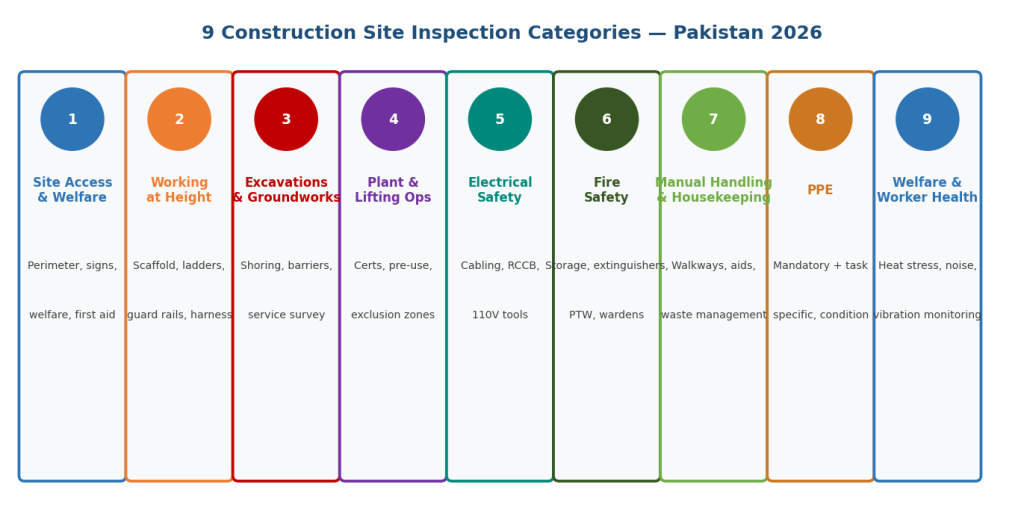
In this guide, you will learn how to inspect nine essential construction safety areas, determine suitable inspection frequencies and manage corrective actions. Additionally, you will discover how NEBOSH International General Certificate (IGC) knowledge can support construction safety careers in Pakistan and the Gulf.
What Is a Construction Site Safety Checklist?
A construction site safety checklist is a practical tool that helps Safety Officers assess working conditions, identify hazards and document safety issues. Project managers, supervisors and HSE teams can use it to monitor workplace conditions and improve safety performance.
For example, an inspection at a construction project in DHA Lahore or Bahria Town Rawalpindi might reveal an unprotected slab edge, an unstable material stack or an excavation without suitable barriers.
The Safety Officer should record each finding, assess the associated risk, assign corrective action and verify the result. Consequently, the team can address hazards before they cause injuries or damage.
Remember: A checklist alone cannot guarantee a safe workplace. Effective safety management also requires competent supervision, suitable risk controls, worker participation and timely corrective action.
1. Site Access, Security and Welfare
First, check whether workers, visitors and contractors can enter, leave and move around the site safely.
- Inspect perimeter fencing, hoarding and access gates.
- Display safety signs, site rules and emergency contact details.
- Separate pedestrian routes from moving vehicles wherever practicable.
- Provide clean toilets, washing facilities and drinking water.
- Maintain suitable rest areas that protect workers from adverse weather.
- Keep first-aid supplies accessible and ensure trained first-aiders are available as required.
- Mark emergency assembly points and keep them clear.
- Maintain unobstructed emergency access routes.
Practical example: At a construction project in Karachi, a delivery truck might reverse through an area used by pedestrians. Therefore, inspect traffic routes, reversing alarms, driver visibility and the use of trained banksmen where the risk assessment requires them. should check traffic routes, reversing controls, visibility and the use of trained banksmen where required.
2. Working at Height and Scaffolding Safety
Falls from height can cause serious injuries or fatalities. For this reason, inspect scaffolds, ladders, roofs, floor openings and elevated work platforms before work begins and whenever site conditions change.
- Protect open edges and floor openings with suitable guardrails, secure covers or other effective fall-prevention measures.
- Allow competent workers to erect, alter and dismantle scaffolds.
- Check scaffold foundations, stability, bracing and platform capacity.
- Ensure platforms provide suitable decking and safe access.
- Install guardrails, intermediate protection and toe boards where the risk assessment or applicable requirements demand them.
- Arrange scaffold inspections at required intervals and after events that could affect stability.
- Use suitable ladders and secure them where necessary.
- Inspect harnesses, lanyards and anchor systems before use, following the manufacturer’s instructions.
- Prepare a rescue plan whenever workers use personal fall-arrest systems.
Safety Officer tip: Never rely solely on a scaffold inspection tag. Instead, examine the actual structure, access, foundations, bracing and platform protection. A tag cannot make an unsafe scaffold safe.
3. Excavation and Groundwork Safety
Excavation work exposes workers to cave-ins, falling materials, underground utilities and potentially hazardous atmospheres. Therefore, inspect the excavation and surrounding area before authorising entry.
- Identify underground electrical cables, gas lines, water pipes and other services before digging.
- Select suitable excavation support or protective systems based on ground conditions, design and collapse risk.
- Keep spoil heaps, vehicles and heavy equipment at safe distances from excavation edges.
- Install barriers and warning signs to prevent accidental entry.
- Provide safe access and exit arrangements.
- Arrange competent inspections at appropriate intervals and after significant changes.
- Control water accumulation, unstable ground and nearby vibration.
- Assess atmospheric hazards and provide testing and emergency arrangements where necessary.
Important: Do not assume that one depth threshold automatically determines every excavation safety requirement. Instead, consider local requirements, ground conditions, excavation design and competent assessment. Never allow workers to enter an excavation while serious collapse risks remain uncontrolled.
4. Plant, Machinery and Lifting Operations
Cranes, excavators, forklifts and other construction equipment can cause crushing injuries, collisions, overturning incidents and falling-load accidents. Consequently, inspect equipment condition and work arrangements before operations begin.
- Verify that operators have the necessary competence and authorisation.
- Complete equipment pre-use checks and report defects immediately.
- Review maintenance and examination records where required.
- Inspect slings, shackles, hooks and other lifting accessories.
- Check safe working load markings and follow rated capacities.
- Require competent personnel to plan, supervise and perform lifting operations.
- Establish exclusion zones around hazardous machinery and lifting activities.
- Use trained banksmen or signalers when necessary.
- Check reversing alarms, visibility aids and traffic controls.
- Remove defective equipment from service until competent personnel repair and check it.
Never allow workers to stand beneath suspended loads. Similarly, never use lifting accessories beyond their rated capacity or outside their intended purpose.
5. Electrical Safety Checklist
Construction sites often rely on temporary electrical supplies, extension leads and portable tools. However, damaged cables, moisture and unsafe connections can expose workers to electric shock, burns and fires.
Inspect the following items:
- Ensure competent personnel install and maintain temporary electrical systems.
- Protect cables from vehicles, sharp edges, water and other damage.
- Remove damaged plugs, exposed conductors and improvised connections from service.
- Provide suitable protective devices, including residual-current protection where required.
- Select portable tools that suit the working environment.
- Follow applicable inspection, testing and maintenance requirements.
- Secure electrical panels and restrict access to authorised personnel.
- Identify and control underground and overhead electrical services.
- Apply suitable isolation and lockout procedures before electrical maintenance.
Where appropriate, consider reduced-voltage equipment or other protective systems for construction activities. Nevertheless, select controls according to the task, equipment and applicable electrical safety requirements.
6. Fire Safety and Hot Work
Welding, cutting, grinding, fuel storage and temporary electrical installations can create ignition sources. Therefore, assess fire hazards before work begins and maintain appropriate precautions throughout the activity.
- Store flammable materials away from ignition sources.
- Secure and handle gas cylinders according to applicable requirements.
- Keep suitable fire extinguishers accessible and maintain them according to instructions.
- Use a hot work permit where the site’s procedures or risk assessment require one.
- Remove combustible materials or protect them against sparks and heat.
- Assign fire watchers when the risk assessment or permit requires them.
- Keep emergency exits and escape routes clear.
- Explain alarm arrangements and evacuation procedures to workers.
- Maintain post-work fire checks for the period specified by the risk assessment or permit.
A hot work permit should identify the location, hazards, required precautions, responsible personnel and authorisation conditions. However, the permit does not replace a physical inspection of the work area.
7. Housekeeping and Manual Handling
Poor housekeeping increases the risk of slips, trips, falls and material-handling injuries. In addition, clutter can obstruct emergency routes and delay evacuation.
During each inspection:
- Keep walkways, stairways and access routes clear.
- Stack construction materials securely.
- Remove waste and debris regularly.
- Control protruding nails and sharp materials.
- Provide suitable lifting aids for heavy or awkward loads.
- Train workers in safe material-handling techniques.
- Control dust generated by cutting, grinding and similar activities.
- Keep emergency equipment and electrical panels accessible.
Good housekeeping becomes especially important when multiple contractors and subcontractors share the same construction area. Assign clear responsibilities so every team knows who must remove waste and maintain access routes.
8. Personal Protective Equipment (PPE)
EPPE helps reduce exposure to hazards, but employers should prioritise hazard elimination and other effective controls wherever practicable. Therefore, select PPE according to the risk assessment rather than issuing the same equipment for every task.
Check that workers:
- Wear suitable hard hats, safety footwear and high-visibility clothing where required.
- Use eye and face protection for cutting, grinding and similar activities.
- Wear appropriate hearing protection in hazardous noise areas.
- Use suitable respiratory protective equipment when required, with appropriate selection and fit.
- Inspect fall-protection equipment and use it according to the fall-protection plan.
- Replace damaged or unsuitable PPE promptly.
- Understand how to use, clean, maintain and store their equipment.
- Follow site procedures for PPE issue and replacement records.
For example, workers cutting concrete may need water suppression or suitable dust extraction alongside correctly selected respiratory protection. Simply handing out disposable masks without assessing exposure may not adequately control the risk.
9. Worker Health, Heat Stress and Emergency Preparedness
Construction workers in Pakistan can face significant heat exposure, especially during hot weather in Punjab and Sindh. Accordingly, Safety Officers should assess environmental conditions alongside immediate physical hazards.
- Provide accessible drinking water throughout the shift.
- Arrange shaded or cool rest areas.
- Adjust work-rest arrangements to reflect heat, workload and environmental conditions.
- Train supervisors to recognise warning signs of heat-related illness.
- Communicate emergency contacts and first-aid arrangements.
- Give workers suitable instruction before hazardous tasks.
- Assess and control noise and vibration risks.
- Conduct emergency drills and review evacuation arrangements.
- Encourage workers to report near misses, incidents and unsafe conditions.
- Investigate reports and implement suitable corrective measures.
If a worker shows signs of serious heat illness, arrange urgent medical assistance and follow the site’s emergency response procedure. Meanwhile, supervisors should review working conditions and implement additional controls when necessary.
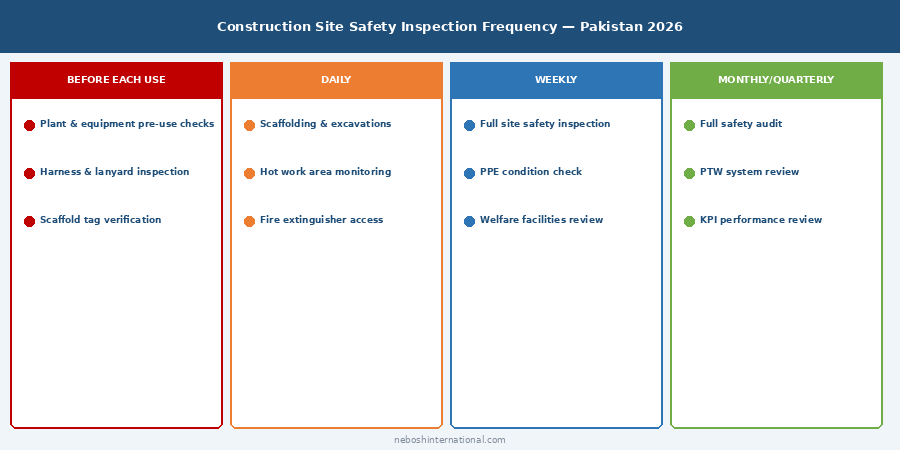
How Often Should a Safety Officer Inspect a Construction Site in Pakistan?
Inspection frequency should be determined by applicable requirements, the risk assessment, site conditions, equipment instructions and the construction project’s safety procedures.
| Inspection activity | Suggested approach |
|---|---|
| General site inspection | Use a documented schedule, commonly weekly, with more frequent checks when risk requires |
| High-risk activities | Check before work starts and monitor during the activity |
| Excavations and scaffolds | Inspect at required intervals and after relevant changes or damaging events |
| Plant and machinery | Complete pre-use checks as required by the equipment and site procedure |
| PPE and fall-protection equipment | Check before use and undertake additional inspections as required |
| Emergency routes and housekeeping | Monitor daily and whenever site conditions change |
These are practical planning recommendations, not a universal legal timetable. Confirm specific requirements with applicable Pakistani legislation, project specifications and competent safety professionals.
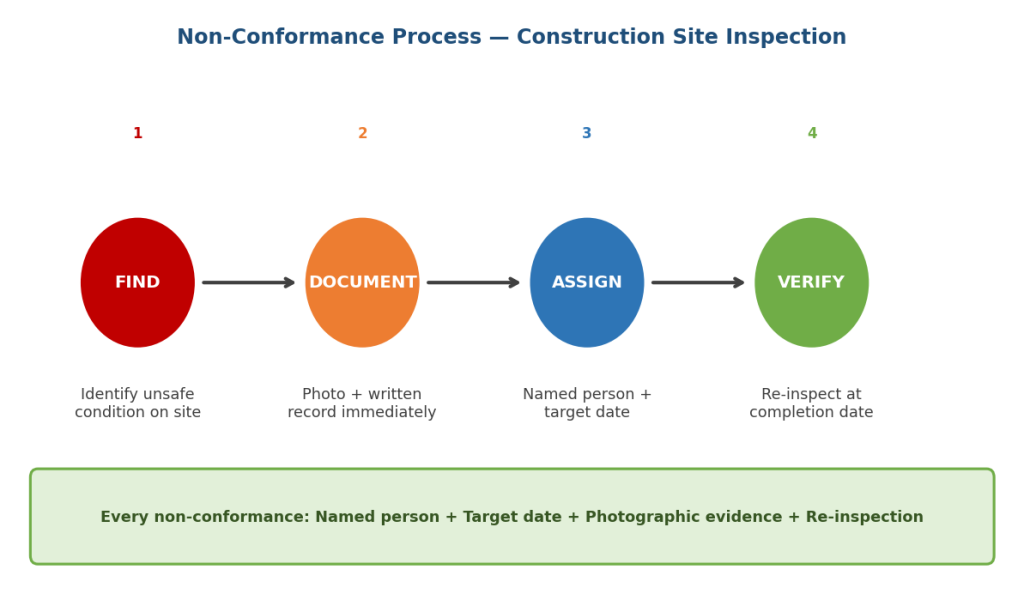
What Should a Safety Officer Do After Finding a Hazard?
An inspection only adds value when the team addresses its findings. Use the following six steps to manage corrective actions effectively.
- Identify the hazard. Describe the unsafe condition, activity and location clearly.
- Assess the risk. Consider the likelihood of harm, potential severity and number of people exposed.
- Control immediate danger. Stop the affected activity when necessary and protect workers from further exposure.
- Record the finding. Document the date, location, evidence and responsible person.
- Assign corrective action. Specify the required improvement, accountable person and deadline.
- Verify completion. Reinspect the area and confirm that the controls adequately reduce the risk.
For example, if an inspection reveals an unprotected slab edge, stop access to the affected area when necessary. Then arrange suitable edge protection, assign responsibility and inspect the completed work before allowing the activity to resume.
For serious or unresolved risks, escalate the issue through the project’s safety management arrangements. Above all, do not allow work to resume while unacceptable danger remains.
How Does NEBOSH IGC Help with Construction Site Inspections?
The NEBOSH International General Certificate helps learners develop knowledge of workplace hazards, risk assessment and practical health and safety management. These skills are relevant to construction inspections in Pakistan and to HSE roles across Gulf countries.
However, a qualification alone does not replace site experience, task-specific training or legal authorisation. Employers may also require experience with permits to work, working at height, excavation safety, lifting operations and incident reporting.
Explore these related resources on NEBOSH International:
- NEBOSH IGC course fees in Pakistan
- Best NEBOSH institutes in Pakistan
- How to deliver a toolbox talk
- NEBOSH certificate verification guidance
NEBOSH International is an independent information and learner referral platform, not NEBOSH itself. Check the official NEBOSH website to verify qualification details and find authorised Learning Partners.
For additional technical guidance, consult the International Labour Organization and its resources on occupational safety and health in construction. Also verify relevant requirements with the competent authorities in the province where the project operates.
Frequently Asked Questions
A construction site safety checklist typically covers site access, welfare, scaffolding, working at height, excavations, machinery, lifting operations, electrical safety, fire prevention, housekeeping, PPE and emergency preparedness.
High-risk work should be checked before it starts and monitored as necessary. General inspections should follow a documented risk-based schedule, while equipment and structural inspections must meet applicable requirements.
Document the issue, communicate the required corrective action and deadline, and escalate unresolved risks to the responsible project management level. Stop or suspend affected work when necessary to protect people from serious danger.
No. A checklist supports hazard identification, but effective prevention also requires risk assessment, competent supervision, worker training, suitable controls and verification that corrective actions have worked.
NEBOSH IGC can strengthen your health and safety knowledge and support applications for relevant HSE roles. However, employment depends on experience, employer requirements, practical competence and any additional training or authorisations required for the position.
Conclusion
A construction site safety checklist in Pakistan helps Safety Officers identify hazards before they cause injuries, equipment damage or project delays. By inspecting high-risk activities systematically, safety teams can identify problems early and improve workplace conditions.
Whether you work in Lahore, Karachi, Islamabad, Rawalpindi or another Pakistani city, record significant findings, assign responsibility and set clear deadlines for corrective action. Furthermore, verify that every corrective measure works before closing the inspection.
For aspiring HSE professionals, combining practical inspection skills with relevant training, supervised site experience and risk assessment knowledge can strengthen career opportunities in Pakistan and the Gulf. Ultimately, a checklist supports safety management, while effective risk controls and competent supervision help prevent accidents.

NEBOSH International General Certificate (IGC) certified HSE professional focused on occupational health and safety, workplace risk assessment, hazard identification, and safety management systems. The content published on NeboshInternational.com is based on current industry guidance, recognized safety best practices, and practical workplace examples to help professionals in Pakistan and the Gulf prepare for NEBOSH qualifications and build successful HSE careers.




One Comment
Comments are closed.