Safety Leadership in Pakistani Workplaces: How Managers Build a Strong Safety Culture in 2026
A construction site in Lahore may have safety signs, personal protective equipment (PPE), trained workers and written procedures. However, if a supervisor allows an unsafe task to continue simply to meet a deadline, those safety measures lose much of their value. This is where safety leadership in Pakistan becomes essential.
Workplace safety depends on more than rules and inspections. It also depends on the decisions managers make, the behaviour supervisors demonstrate and the confidence workers have to report hazards without fear.
In Pakistan, safety leadership is particularly important in construction, manufacturing, textiles, engineering, logistics and oil and gas operations. These industries involve changing work conditions, equipment hazards, contractor activities and production targets that can create serious risks when safety controls are overlooked.
This guide explains what safety leadership means, how managers can improve workplace safety culture, and how safety officers can develop the leadership skills needed for HSE careers in Pakistan and the Gulf region.
What Is Safety Leadership in the Workplace?
Safety leadership is the ability to influence people, decisions and workplace behaviour so that health and safety remain priorities in everyday operations. It involves setting a positive example, listening to workers, addressing hazards and ensuring that production targets never justify unnecessary exposure to risk.
Effective safety leaders do not simply tell employees to follow procedures. They make sure workers have the training, equipment, time and support required to work safely.
For example, a factory manager in Faisalabad may discover that workers regularly remove machine guards because the equipment becomes difficult to clean. A weak response would be to warn the workers and close the investigation. A stronger leadership response would examine the equipment design, maintenance arrangements, supervision and available safe-working procedures before implementing corrective measures.
This approach addresses the underlying problem rather than focusing exclusively on individual behaviour.
Safety Leadership vs Safety Management
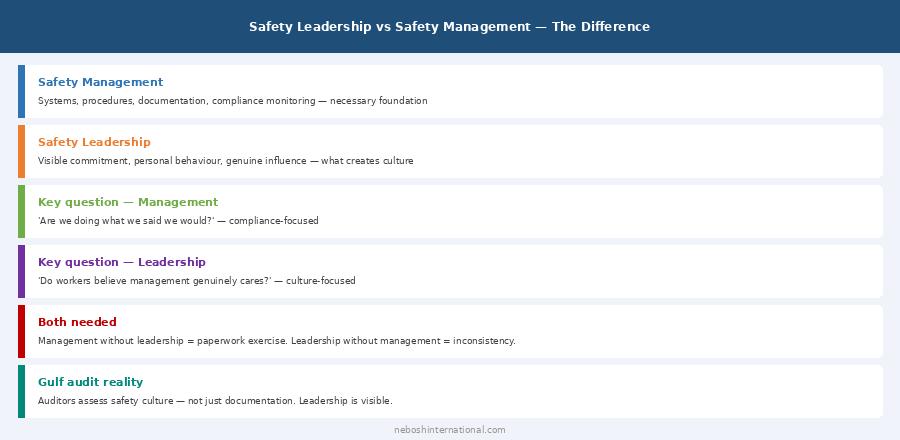
Safety management and safety leadership support the same objective, but they perform different functions.
| Safety management | Safety leadership |
|---|---|
| Establishes policies and procedures | Demonstrates commitment through actions |
| Conducts inspections and risk assessments | Encourages workers to report hazards |
| Monitors compliance and performance | Influences decisions and workplace behaviour |
| Records incidents and corrective actions | Promotes learning and accountability |
| Establishes safety responsibilities | Ensures managers take ownership of those responsibilities |
Both are essential. Without effective management systems, safety practices become inconsistent. Without strong leadership, even well-designed systems can become paperwork exercises.
Consider a construction project in Rawalpindi. The company may have an approved work-at-height procedure, but workers still need suitable fall protection, safe access and effective supervision. Managers must ensure that these controls remain in place when deadlines become difficult to meet.
A safety officer can identify gaps and recommend improvements. However, operational managers must support the changes, allocate resources and ensure that their teams follow the agreed controls.
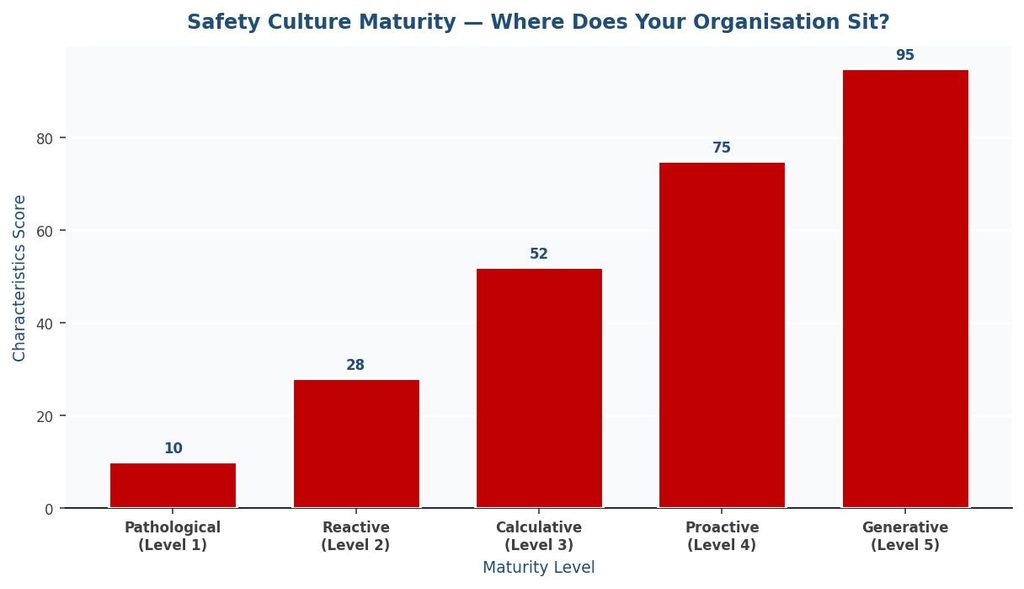
Five Levels of Workplace Safety Culture
Safety culture describes the shared attitudes, expectations and behaviours that influence how people manage workplace risks.
A commonly used safety culture maturity model describes five stages:
- Pathological: Management focuses on avoiding blame or punishment rather than preventing harm.
- Reactive: The organisation takes safety seriously mainly after an accident occurs.
- Calculative: Formal procedures, audits, inspections and performance indicators guide safety activities.
- Proactive: Managers identify emerging risks and address problems before incidents occur.
- Generative: Safety becomes an integral part of operational planning and everyday decisions.
These stages provide a useful framework for reviewing organisational performance. However, not every Pakistani workplace fits neatly into one level, and the model should be used as a guide rather than a national ranking.
For example, an oil and gas facility may have sophisticated safety procedures while contractor supervision remains inconsistent. Similarly, a manufacturing business may conduct regular inspections but discourage workers from reporting near-misses.
Moving towards a proactive safety culture requires consistent management behaviour, open communication and evidence that reported concerns lead to meaningful action.
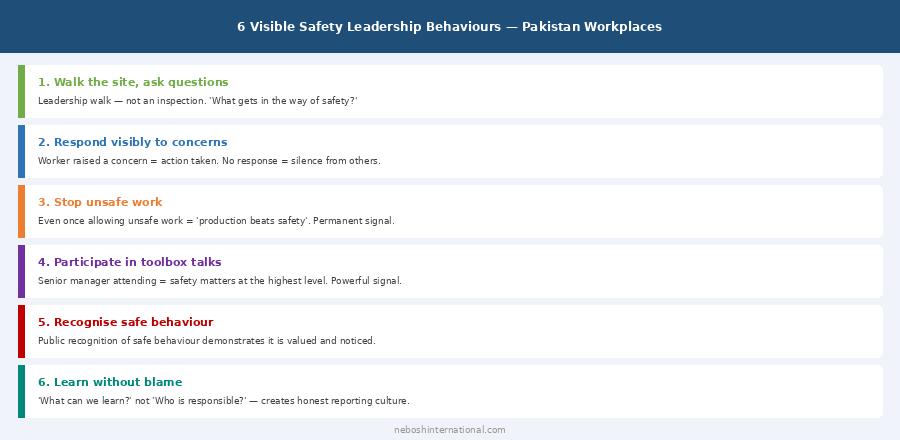
Six Ways Managers Can Improve Safety Leadership in Pakistan
1. Conduct Meaningful Safety Leadership Walks
Managers should regularly visit operational areas to understand the risks workers face. These visits should involve conversations, observations and follow-up rather than inspections alone.
Instead of asking, “Are you following the procedure?”, a manager might ask:
- What hazards make your job difficult?
- Are the equipment and protective measures adequate?
- Have you reported any safety concerns recently?
- What changes would help you work more safely?
A manager visiting a Karachi warehouse may discover that emergency access routes repeatedly become blocked because delivery schedules leave insufficient storage space. Correcting the planning and storage arrangements is more effective than repeatedly reminding employees to keep the routes clear.
The key is follow-up. Workers need to see that management takes their concerns seriously.
2. Respond Positively to Reported Hazards
Employees are more likely to report hazards when managers respond fairly and constructively. Dismissing concerns, blaming the person reporting them or repeatedly delaying corrective action can discourage future reporting.
In Pakistani workplaces where temporary labour and subcontractors are common, managers should make reporting arrangements clear and accessible to everyone on site.
For example, if a worker identifies damaged electrical equipment, the supervisor should ensure that the equipment is assessed, isolated where necessary and returned to service only when it is safe. The organisation should also investigate why the damage occurred and whether similar equipment presents the same risk.
A strong reporting culture helps organisations identify weaknesses before they result in injuries or operational disruption.
3. Stop Unsafe Work Despite Production Pressure
One of the clearest tests of safety leadership is how managers respond when a task becomes unsafe.
Suppose a lifting operation at a construction project in Lahore is due to finish before the end of a shift. The appointed team discovers that the planned lifting area is obstructed and the required controls cannot be maintained.
A responsible manager supports stopping the operation until the hazards have been assessed and suitable controls are restored. Continuing simply to meet the schedule would expose workers to avoidable danger.
Managers should establish clear arrangements for stopping unsafe work, escalating concerns and restarting activities after appropriate checks.
Safety and productivity are not opposing objectives. Good planning, suitable equipment and effective supervision help organisations avoid injuries, delays, damaged assets and costly interruptions.
4. Participate in Toolbox Talks
Toolbox talks help communicate task-specific hazards, precautions and responsibilities. However, they are more effective when managers participate and encourage discussion.
Before maintenance work begins at a textile factory, for instance, the supervisor could discuss hazardous energy, isolation requirements, moving machinery and emergency arrangements relevant to the task.
Managers should invite questions and check whether workers understand the precautions. They should also address language barriers and provide explanations that match the team’s experience and literacy levels.
A short, practical discussion is often more useful than asking workers to sign an attendance sheet without confirming their understanding.
5. Recognise Safe Decisions and Responsible Reporting
Managers should acknowledge workers who follow safe procedures, report near-misses, identify defective equipment or challenge unsafe instructions appropriately.
Recognition can be as simple as thanking an employee during a team meeting or explaining how a reported hazard helped prevent a potential incident.
However, recognition programmes should not encourage workers to hide incidents to maintain a zero-accident target. Organisations should reward transparency, effective risk control and learning rather than treating the absence of reported incidents as proof that a workplace is safe.
6. Investigate Incidents to Identify Underlying Causes
After an incident, managers should establish what happened, identify contributing factors and determine which corrective actions will prevent recurrence.
For example, if a worker falls from an unsafe platform, an investigation should examine access arrangements, platform condition, fall-prevention measures, supervision, training and the planning of the task.
Simply stating that the worker was careless does not explain why the incident occurred or how the organisation can prevent a similar event.
A fair approach still requires accountability when deliberate misconduct occurs. However, effective investigations also examine equipment, procedures, management decisions and organisational weaknesses.
What Is the Role of a Safety Officer in Developing Leadership?
Safety officers provide technical advice, monitor workplace conditions and help managers understand their safety responsibilities. They can also influence how leaders communicate, respond to incidents and make operational decisions.
Practical steps include:
- Presenting safety performance data in terms of operational risk and business impact.
- Briefing managers before site visits and safety meetings.
- Identifying recurring hazards and assigning corrective actions to responsible managers.
- Monitoring whether reported concerns receive timely responses.
- Tracking management participation in safety activities.
- Reviewing near-miss reporting, corrective-action completion and worker feedback.
Organisations should measure both lagging indicators, such as recorded injuries, and leading indicators, such as hazard reporting, risk-control verification and corrective-action completion.
Safety officers should not become the sole owners of workplace safety. Supervisors manage daily activities, while operational managers must ensure that their teams have the resources and authority to work safely.
For professionals considering NEBOSH IGC in Pakistan, understanding management commitment, risk control and workplace culture can help connect theoretical knowledge with practical HSE responsibilities.
Why Safety Leadership Matters for Pakistani HSE Careers
Employers need safety professionals who can do more than complete inspection checklists. They also need people who can explain risks clearly, challenge unsafe decisions professionally and influence supervisors without creating unnecessary conflict.
These capabilities are valuable across construction projects, textile factories, manufacturing plants, logistics operations and oil and gas facilities.
They are also relevant to Pakistani HSE professionals seeking opportunities in Saudi Arabia, the United Arab Emirates, Qatar and other Gulf markets. Candidates should be prepared to explain how they have improved risk controls, communicated with operational teams, investigated incidents and supported management decisions.
A recognised qualification can provide a foundation for developing these skills, but practical experience, communication and sound judgement remain important.
Learners comparing NEBOSH course fees in Pakistan should consider the qualification’s relevance to their career goals, alongside training quality, assessment support and opportunities to apply what they learn.
Frequently Asked Questions
Safety leadership improves workplace safety by ensuring managers set a positive example, respond to hazards, support safe working practices and involve employees in risk control. Consistent leadership can strengthen reporting, improve compliance and help prevent incidents.
Safety management establishes systems, procedures and monitoring arrangements. Safety leadership influences behaviour, demonstrates commitment and encourages people to apply those systems consistently. Both are necessary for effective workplace safety.
Yes. Organisations can improve safety culture by assessing existing practices, addressing barriers to safe work, involving employees and ensuring managers consistently support risk controls. Progress should be evaluated using workplace observations, worker feedback and safety performance data.
Managers establish expectations, provide resources, support risk assessments, ensure corrective actions are completed and stop activities when required controls are inadequate. They must also make sure production targets do not undermine safe working practices.
NEBOSH International General Certificate learning covers important principles of health and safety management, including organisational responsibilities and factors that influence workplace safety. Candidates should consult the current official syllabus for the exact learning outcomes and assessment requirements.
Official course information is available from NEBOSH.
A safety officer can explain the risks and potential consequences of unsafe decisions, present practical corrective measures and communicate the operational benefits of effective risk control. However, lasting improvement requires managers to accept responsibility and support the necessary changes.
Conclusion:
Safety leadership in Pakistani workplaces is demonstrated through decisions, not policies alone. Managers build a stronger safety culture when they listen to workers, stop unsafe activities, investigate incidents fairly and provide the resources required to control risks.
For organisations in Lahore, Karachi, Rawalpindi, Faisalabad and other industrial centres, the goal should be to make safe working practices part of routine operational decisions rather than leaving safety entirely to the HSE department.
For aspiring and experienced safety professionals, developing these skills can strengthen practical competence and support progression towards supervisory and management responsibilities.
NEBOSH International provides independent NEBOSH course information and learner guidance in Pakistan, helping prospective learners explore relevant qualifications and training options. Visit NEBOSHInternational.com to learn more about NEBOSH IGC and its relevance to your HSE career.

NEBOSH International General Certificate (IGC) certified HSE professional focused on occupational health and safety, workplace risk assessment, hazard identification, and safety management systems. The content published on NeboshInternational.com is based on current industry guidance, recognized safety best practices, and practical workplace examples to help professionals in Pakistan and the Gulf prepare for NEBOSH qualifications and build successful HSE careers.