Safety Induction Programme in Pakistan (2026): Complete Workplace Guide
Imagine a construction worker arriving at a project in Lahore for his first shift. He knows how to perform his job, but nobody has explained the site’s emergency exits, vehicle routes, mandatory personal protective equipment (PPE), or accident reporting procedures. If an emergency occurs, this lack of information could put him and his colleagues at risk.
This is why a safety induction programme in Pakistan is an essential part of workplace health and safety management. Before employees, contractors or visitors enter a work area, they need clear instructions about site rules, foreseeable hazards and emergency arrangements.
A safety induction is a structured introduction to the safety requirements of a particular workplace. It helps people understand the risks they may encounter, the controls they must follow and the actions they should take if something goes wrong.
This guide explains the essential induction topics, effective training methods, documentation requirements and practical considerations for Pakistani construction sites, factories, warehouses and oil and gas facilities.
What Is a Safety Induction Programme?
A safety induction programme is an organised briefing that provides new workers and other relevant personnel with the information they need to enter and work safely at a particular site.
It typically covers workplace hazards, emergency procedures, PPE, restricted areas, incident reporting and individual safety responsibilities.
For example, a textile factory in Faisalabad may emphasise machinery guarding, noise exposure, fire prevention and chemical handling. A construction project in Rawalpindi may focus on work at height, lifting operations, excavation, electrical hazards and vehicle movements.
Quick answer: A safety induction should take place before a person starts work or enters a hazardous work area. Its content and duration should reflect the person’s role, the workplace risks and the level of access permitted.
Why Is Safety Induction Important in Pakistani Workplaces?
A well-planned safety induction helps employers communicate essential precautions before workers encounter unfamiliar hazards.
The main benefits include:
- Accident prevention: Workers learn about hazards and the controls required to reduce risk.
- Emergency preparedness: New arrivals understand evacuation routes, assembly points and emergency contacts.
- Consistent site rules: Employees and contractors receive clear instructions about PPE, access restrictions and safe working practices.
- Improved communication: Workers know how to report unsafe conditions, incidents and near misses.
- Better documentation: Employers can demonstrate that appropriate induction and instruction took place.
- Client and audit readiness: Organised records support internal audits, client inspections and occupational health and safety management systems.
These measures are particularly relevant to Pakistani workplaces with changing contractor teams, multilingual workforces and activities involving heavy machinery, electricity, chemicals or work at height.
7 Essential Steps in a Safety Induction Programme
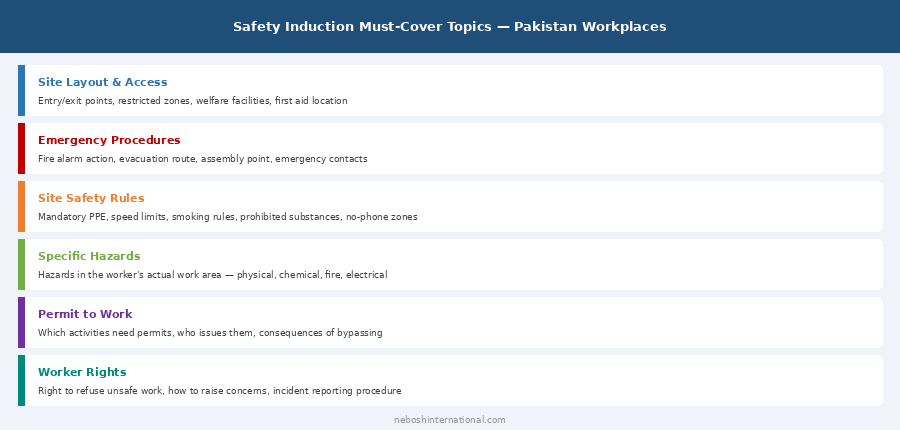
1. Explain the Site Layout and Facilities
Begin by introducing the workplace and explaining how people can move around it safely.
Cover the following points:
- Main entrance, exits and authorised access routes.
- Pedestrian walkways and vehicle movement areas.
- Emergency assembly points and evacuation routes.
- First aid facilities and designated first aiders.
- Drinking water, toilets and welfare facilities.
- Restricted areas and locations requiring special authorisation.
Where possible, show workers the actual locations rather than relying entirely on slides or verbal instructions.
For example, a worker joining a construction project in Lahore should understand how to avoid reversing vehicles, mobile equipment and lifting operations.
2. Explain Emergency Procedures
Every induction should explain what workers must do when an emergency occurs.
Include:
- Fire alarm signals and evacuation arrangements.
- Emergency exits and assembly points.
- Accident and near-miss reporting procedures.
- Emergency contact numbers and responsible personnel.
- First aid arrangements.
- Procedures for chemical spills or other relevant emergencies.
Explain the correct response for the specific workplace. Do not assume that workers already understand the emergency arrangements because they have completed training elsewhere.
Related reading: Emergency Evacuation Planning in Pakistani Workplaces.
3. Explain PPE and Mandatory Site Rules
Workers must know which PPE is required, when to wear it and how to use it correctly.
Depending on the workplace, PPE may include:
- Safety helmets and protective footwear.
- High-visibility clothing.
- Safety glasses or face shields.
- Suitable gloves.
- Hearing protection.
- Respiratory protective equipment.
Explain site rules concerning smoking, mobile phone use, housekeeping, speed limits, authorised access and prohibited substances.
Also explain the permit-to-work system where applicable. Activities such as hot work, confined-space entry and certain electrical maintenance tasks may require formal authorisation and additional precautions.
PPE should complement appropriate engineering and administrative controls rather than replace them.
4. Identify Workplace Hazards and Control Measures
A safety induction must address the actual hazards that workers may encounter in their assigned areas.
Common examples include:
| Workplace | Important hazards |
|---|---|
| Construction sites | Falls from height, falling objects, excavation and moving plant |
| Textile factories | Unguarded machinery, noise, fire and fibres or dust |
| Manufacturing plants | Moving equipment, chemicals, electrical hazards and manual handling |
| Warehouses | Forklift movements, falling loads and blocked walkways |
| Oil and gas facilities | Flammable substances, hazardous atmospheres and high-pressure systems |
Explain the relevant control measures, including machine guarding, barriers, ventilation, safe access, isolation procedures and supervision.
For instance, workers entering an industrial facility in Karachi should understand which areas contain hazardous substances, which controls apply and how to report leaks or unsafe conditions.
Where tasks or working conditions change, provide additional instruction or task-specific training.
5. Explain Worker Responsibilities and Reporting
Every worker should understand their responsibilities for maintaining a safe workplace.
During induction, explain how to:
- Follow site safety rules and supervisor instructions.
- Use equipment only when trained and authorised.
- Report hazards, near misses, injuries and unsafe conditions.
- Keep work areas clean and access routes clear.
- Avoid interfering with safety equipment.
- Raise concerns when a task appears unsafe.
Workers should also know whom to contact if they need clarification or believe the available controls are inadequate.
A positive reporting culture encourages people to raise concerns before a hazard causes harm.
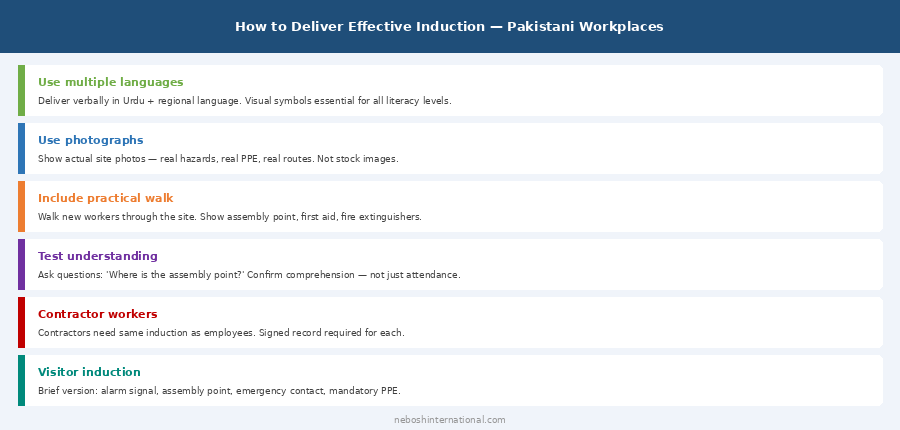
6. Deliver the Induction in a Language Workers Understand
Effective safety induction training requires clear communication, not simply a completed presentation.
In Pakistan, Urdu may be appropriate for many workforces, while Punjabi, Pashto, Sindhi or other languages may be necessary depending on workers’ needs.
Use photographs, diagrams, demonstrations and examples from the actual workplace. Avoid technical language that workers may not understand.
A practical site walk can reinforce the briefing by showing workers the assembly point, fire extinguishers, pedestrian routes and relevant hazards.
7. Check Understanding and Maintain Records
Before allowing a worker to start the assigned activity, check whether they understand the important safety instructions.
Ask simple questions such as:
- Where is the emergency assembly point?
- Who should you contact after an accident?
- Which PPE must you wear in this area?
- What should you do if you identify an unsafe condition?
Demonstrations and short verbal assessments can be useful where reading ability varies.
Finally, record the induction and identify any additional training required before the worker performs higher-risk tasks.
How Long Should a Safety Induction Take?
There is no single duration suitable for every workplace. The time required depends on the hazards, the complexity of the site and the worker’s responsibilities.
As a practical planning guide:
- Office environments: Approximately 30–45 minutes.
- Construction sites: Approximately 60–90 minutes, with additional instruction where necessary.
- Factories and industrial facilities: Approximately 45–90 minutes or longer for complex operations.
- Visitors: A short briefing covering emergency arrangements, access restrictions and relevant PPE.
These are suggested planning ranges, not universal legal requirements. A high-risk workplace may need a longer induction, a practical site tour or additional task-specific instruction.
Safety Induction Documentation Checklist
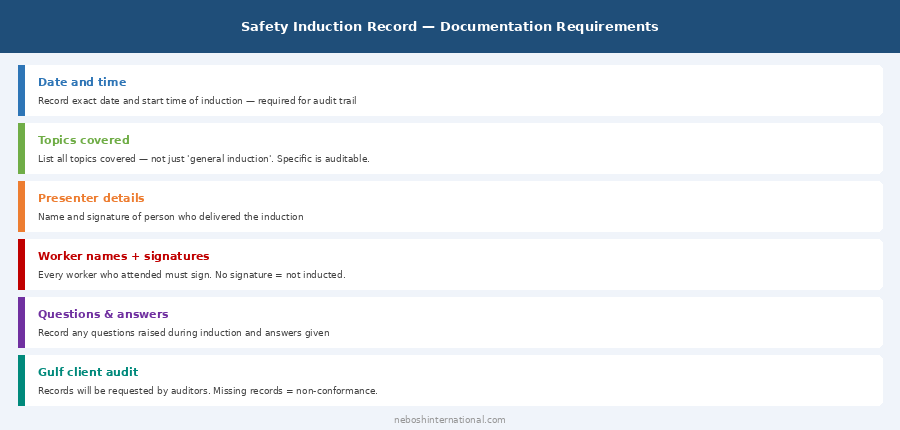
A safety officer should maintain an accurate record of each induction. The following checklist can help standardise documentation.
- Worker or visitor’s full name and identification details, where appropriate.
- Employer, contractor or department.
- Induction date and time.
- Name of the person delivering the induction.
- Site rules and topics covered.
- Relevant hazards and control measures explained.
- Emergency procedures and assembly point explained.
- PPE requirements communicated.
- Understanding checked through questions or demonstration.
- Additional training or restrictions identified.
- Worker acknowledgement and trainer’s signature, where applicable.
Keep records securely and make them available to authorised personnel when required. Update induction arrangements when significant site changes, new hazards or revised emergency procedures affect workers.
A signed attendance sheet is useful evidence, but it does not independently prove that the worker understood the instructions or was competent to perform a task.
Safety Induction and ISO 45001: What Employers Should Know
ISO 45001 provides an internationally recognised framework for occupational health and safety management systems. Its requirements address worker competence, awareness, communication and documented information.
An induction programme can support these objectives by helping organisations communicate workplace hazards, safety arrangements and individual responsibilities.
However, ISO 45001 does not prescribe one universal induction format or duration. Employers should determine the information, training and records appropriate to their activities and applicable requirements.
For official guidance, consult the ISO 45001 occupational health and safety management systems page and the International Labour Organization’s occupational safety and health resources.
Employers in Pakistan should also check the applicable federal or provincial occupational safety legislation, relevant industry requirements and contractual obligations. Requirements can vary by jurisdiction and workplace.
Safety Induction for Pakistani Safety Officers and NEBOSH Candidates
Safety officers are often responsible for preparing induction materials, delivering briefings, coordinating with supervisors and maintaining training records.
These responsibilities require more than theoretical knowledge. Professionals need to communicate clearly, recognise site hazards, explain practical controls and confirm that workers understand their instructions.
Studying the NEBOSH International General Certificate (IGC) can help learners develop occupational health and safety knowledge relevant to risk management, workplace controls and safety training.
Candidates exploring training options can visit NEBOSH International for independent guidance about NEBOSH courses and learning opportunities in Pakistan.
Frequently Asked Questions
It is a structured introduction to workplace hazards, safety rules, PPE, emergency arrangements and reporting procedures. It helps employees, contractors and visitors understand the precautions relevant to their workplace.
Applicable legal, regulatory and contractual requirements depend on the workplace and jurisdiction. Employers should ensure that workers receive the information and instruction necessary for their safety before undertaking relevant activities. Site-specific induction is a sound safety management practice.
Yes. The induction should use a language and delivery method workers understand. Urdu, regional languages, visual materials and practical demonstrations can help improve comprehension.
Contractors should receive induction covering the site-specific hazards, rules and emergency arrangements relevant to their work. Previous training from their employer does not automatically replace the need to understand the site they are entering.
Visitors should receive instructions appropriate to their access and exposure. These commonly include emergency alarms, evacuation routes, assembly points, restricted areas, escort arrangements and any mandatory PPE.
Provide induction before initial site access or work, and repeat or update it when significant changes affect hazards, work activities, site rules or emergency arrangements. Refresher frequency should reflect risk, applicable requirements and organisational procedures.
NEBOSH IGC study develops knowledge of occupational health and safety principles that can support safety officers in planning and communicating workplace precautions. Effective induction delivery also requires practical workplace knowledge, communication skills and familiarity with the specific site’s procedures.
Conclusion
A well-designed safety induction programme in Pakistan helps workers understand their surroundings, recognise workplace hazards and respond appropriately to emergencies. It also gives employers a structured way to communicate expectations and maintain evidence of safety instruction.
Whether you manage a construction project in Lahore, a textile factory in Faisalabad, a warehouse in Karachi or an industrial facility in Rawalpindi, focus on the same essentials: explain the actual hazards, demonstrate the relevant controls, use language workers understand, check comprehension and maintain reliable records.
Safety induction should never be treated as paperwork completed merely to satisfy an audit. It is an important first step in helping every worker begin their job with the knowledge needed to work safely.

NEBOSH International General Certificate (IGC) certified HSE professional focused on occupational health and safety, workplace risk assessment, hazard identification, and safety management systems. The content published on NeboshInternational.com is based on current industry guidance, recognized safety best practices, and practical workplace examples to help professionals in Pakistan and the Gulf prepare for NEBOSH qualifications and build successful HSE careers.