Machinery Safety and Guarding in Pakistan: Complete Guide for Safety Officers (2026)
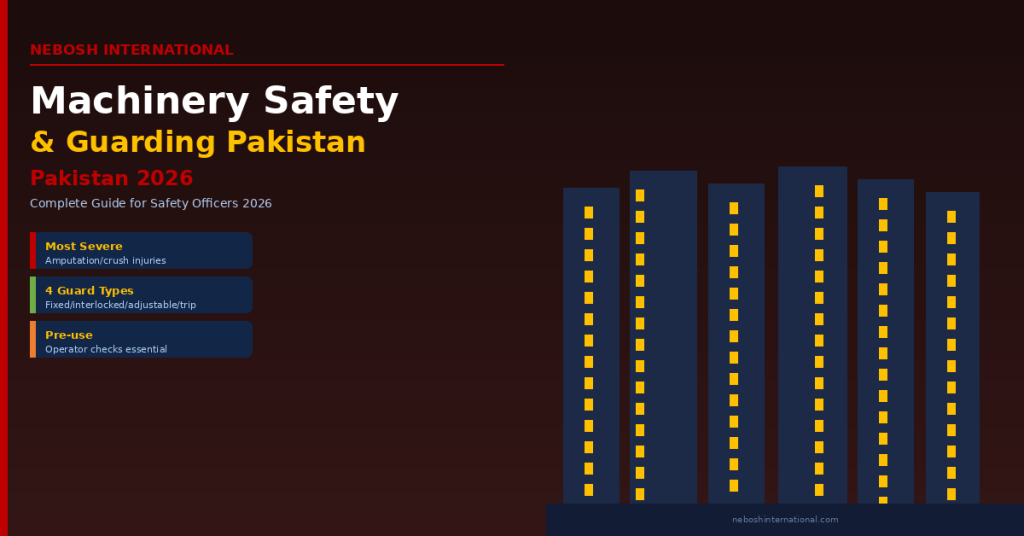
Machinery safety and guarding in Pakistan help prevent serious workplace injuries by controlling access to dangerous moving parts. Safety officers must understand machine hazards, select suitable guards, inspect safety devices and ensure that maintenance activities follow safe procedures. These controls are particularly important in Pakistan’s textile factories, manufacturing plants, construction projects and engineering workshops.
Consider a factory in Lahore where an operator removes a machine guard to clear a blockage quickly. Although production may resume sooner, the exposed moving parts can cause entanglement, crushing injuries or amputation. Therefore, safety officers must address both the immediate hazard and the reasons behind unsafe practices.
This guide explains the main machinery hazards, types of machine guards, risk assessment methods, inspection procedures and relevant legal considerations for Pakistani workplaces. It also explains how machinery safety knowledge supports practical HSE responsibilities and NEBOSH IGC preparation.
What Is Machinery Safety and Guarding?
Machinery safety involves identifying and controlling hazards associated with operating, cleaning, adjusting and maintaining equipment. Machine guarding uses physical barriers and safety devices to prevent workers from contacting dangerous machine parts.
Effective machinery safeguarding should:
- Prevent access to hazardous moving components.
- Protect workers from flying materials, chips and sparks.
- Reduce the risk of entanglement, crushing and cutting injuries.
- Prevent unexpected machine operation where appropriate.
- Allow safe operation, inspection and maintenance.
- Remain effective throughout the machine’s working life.
According to the US Occupational Safety and Health Administration (OSHA) machine guarding guidance, safeguards should protect workers from hazards such as rotating parts, ingoing nip points and flying materials.
For Pakistani safety officers, the objective is straightforward: identify how a worker could be injured and ensure that suitable controls prevent exposure to that hazard.
Common Machinery Hazards in Pakistani Workplaces
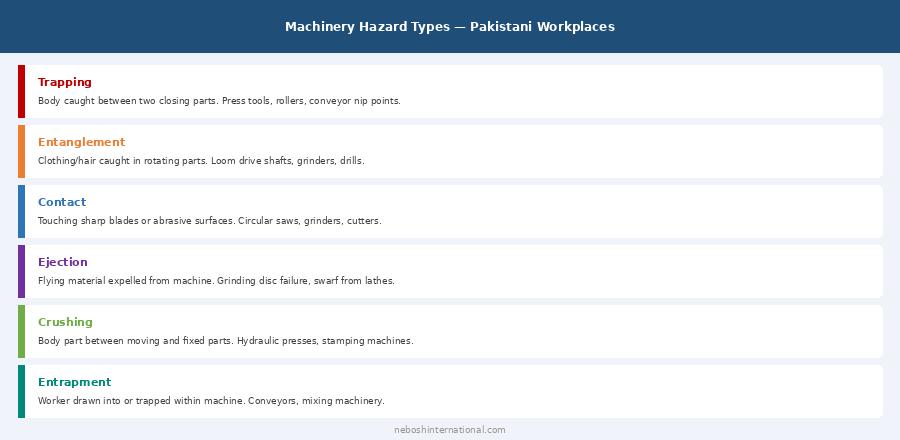
Different industries present different machinery risks. For example, textile mills in Faisalabad may operate looms and rollers, while construction projects in Islamabad may use cutting equipment, concrete mixers and powered tools.
| Machinery hazard | Example | Possible injury |
|---|---|---|
| Entanglement | Rotating shafts, belts and textile machinery | Severe tissue damage or amputation |
| Trapping | Conveyor rollers and moving belts | Crushed fingers or hands |
| Crushing | Hydraulic presses and stamping machines | Fractures or crush injuries |
| Cutting | Circular saws and cutting machines | Deep wounds or amputations |
| Impact and ejection | Flying metal fragments or broken grinding discs | Eye and facial injuries |
| Shearing | Moving blades and press mechanisms | Severe cuts or amputations |
Safety officers should also assess hazards during cleaning, lubrication, adjustment and fault-finding. A machine that appears safe during normal production may expose workers to additional risks during maintenance.
Furthermore, workers may approach machinery from the side, underneath or behind it. Consequently, a guard must prevent access to the actual danger zone rather than simply cover the most visible moving part.
Types of Machine Guards and Safeguarding Devices
Selecting the correct safeguard requires an assessment of the machine, its operating cycle and the tasks workers perform.
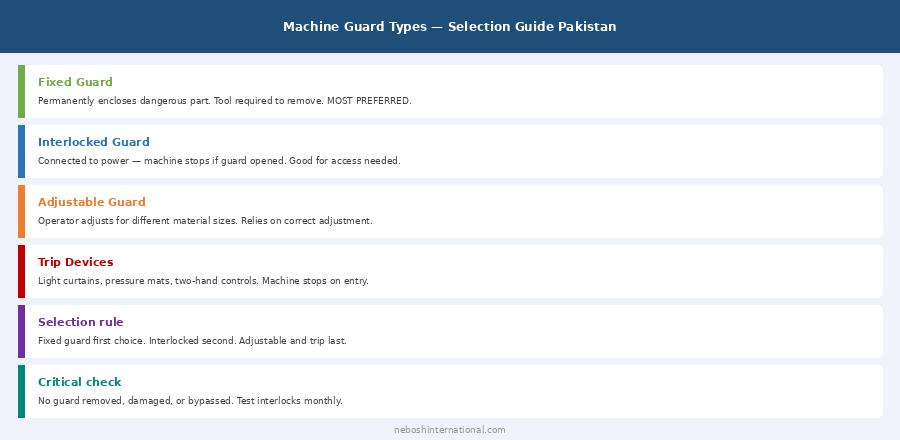
1. Fixed guards
Fixed guards are securely attached barriers that normally require tools for removal. They are suitable for dangerous components that workers do not need to access during routine operation.
For example, a fixed metal cover can protect workers from exposed belts, pulleys and chain drives in a Pakistani manufacturing plant.
The guard should be strong, secure and appropriately designed for the machinery. Workers must not remove it while dangerous components are moving.
2. Interlocked guards
Interlocked guards connect to a machine’s control system. Opening the guard initiates the designed safety response, such as stopping hazardous movement or preventing a cycle from starting.
These guards are useful when operators need periodic access to an enclosed machine for setting or clearing blockages.
However, an interlock must be correctly selected, installed, maintained and tested according to the manufacturer’s instructions and risk assessment. Workers must not bypass it to maintain production.
3. Adjustable guards
Adjustable guards allow the opening or position of a guard to change for different materials or operations.
For example, a suitable adjustable blade guard can help protect an operator using a cutting machine. However, its effectiveness depends on correct adjustment and proper use.
Safety officers should check that operators understand how to position the guard and that the adjustment does not expose hazardous moving parts unnecessarily.
4. Light curtains and presence-sensing devices
Light curtains use sensing technology to detect entry into a protected area. Depending on the system design, detection triggers a safety response intended to prevent or stop dangerous movement.
These devices may suit automated production lines where frequent access is necessary. Nevertheless, their suitability depends on stopping time, positioning, access routes and the machine’s safety design.
5. Two-hand controls and trip devices
Two-hand controls require an operator to use both hands to initiate a machine cycle. Properly designed systems can help keep the operator’s hands away from a danger zone during the relevant operation.
Other trip devices include pressure-sensitive mats and emergency stopping devices designed for particular applications.
Important: An emergency stop is a supplementary safety measure, not a substitute for appropriate machine guarding. Select each safeguard according to the machine-specific risk assessment.
Machinery Risk Assessment: A Practical Approach
A machinery risk assessment identifies hazards, determines who could be harmed and establishes suitable controls.
Safety officers in Karachi, Lahore, Rawalpindi and other industrial centres can follow these steps:
- Identify the machine and its tasks. Record how workers operate, clean, adjust and maintain the equipment.
- Identify hazardous parts. Examine rotating shafts, belts, rollers, cutting blades, press mechanisms and other dangerous components.
- Identify exposed people. Consider operators, maintenance technicians, cleaners, contractors and nearby workers.
- Assess existing safeguards. Check whether guards prevent access and whether safety devices operate as intended.
- Select additional controls. Prioritise effective engineering safeguards and safe isolation procedures.
- Assign corrective actions. Identify who will complete the work and establish a suitable deadline.
- Verify effectiveness. Inspect the completed controls and review the assessment after significant changes or incidents.
The UK Health and Safety Executive’s risk assessment guidance provides further information about identifying hazards, recording findings and reviewing controls.
For NEBOSH IGC candidates, this approach also helps structure scenario-based answers. Explain the specific hazard, identify who may be harmed and recommend a control that addresses the actual risk.
Machinery Safety Inspection Checklist for Safety Officers
A practical inspection should cover both the physical condition of the machine and the way workers use it.
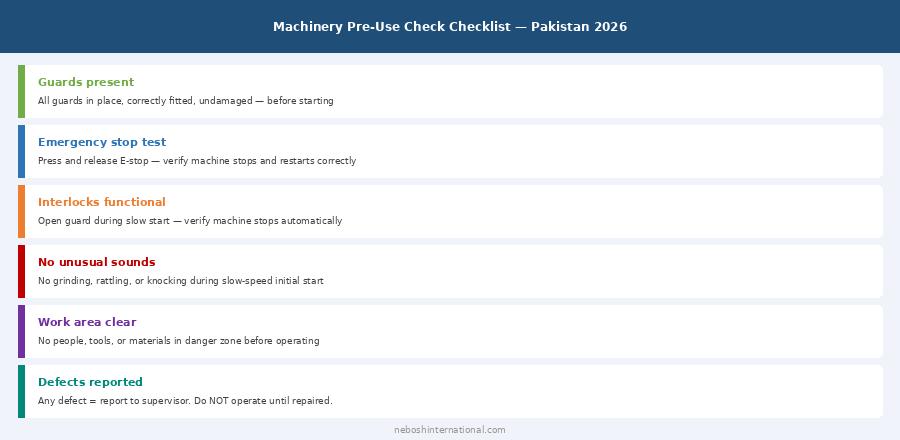
Use the following checklist during routine inspections:
- All required machine guards are fitted and secure.
- Guards show no damage that compromises protection.
- Workers cannot readily reach hazardous moving parts.
- Interlocks and other safety devices function correctly.
- No one has bypassed or disabled a safeguard.
- Emergency stops are accessible and unobstructed.
- Warning signs and operating instructions remain legible.
- Operators complete required pre-use checks.
- Defects are reported and recorded.
- Maintenance and corrective actions are documented.
- Safe isolation procedures are available for maintenance.
- Workers have received task-specific training.
An inspection should not end when someone ticks every box. If a guard is repeatedly removed, investigate why. Perhaps it obstructs the task, makes cleaning difficult or has not been designed for the actual production process.
Addressing the underlying problem can help prevent repeated unsafe conditions.
Safe Maintenance and Machine Isolation
Maintenance can expose workers to hazardous movement, electricity, hydraulic pressure, pneumatic energy and unexpected start-up.
Before maintenance begins, follow the workplace’s approved energy-isolation procedure. Where required, stop the machine, isolate its energy sources, apply lockout/tagout controls, release or secure stored energy and verify that isolation is effective.
Only authorised and competent personnel should carry out the relevant work. Never assume that pressing a stop button has isolated every energy source.
After maintenance, the responsible team should verify that tools have been removed, guards are correctly refitted and safety devices are functional before returning the machine to service.
The OSHA machine guarding guidance explains safeguarding, training and energy-control considerations. Pakistani workplaces should also follow applicable local requirements, manufacturer instructions and their approved procedures.
Machinery Safety Laws and Standards in Pakistan
Section 26 of Pakistan’s Factories Act, 1934 addresses the fencing of machinery in factories. It covers specified moving parts and dangerous machinery and provides for alternative protective measures in certain circumstances.
Read the Factories Act, 1934, on the official Pakistan Code website.
Employers should confirm which federal or provincial legislation, rules and amendments apply to their workplace. Requirements may vary according to location, industry and the legal status of the establishment.
ISO 45001 can also support a systematic occupational health and safety management approach. However, certification does not replace the need to control individual machine hazards or comply with applicable law.
Organisations supplying international clients should additionally review relevant contractual requirements and applicable machinery safety standards.
Machinery Safety in NEBOSH IGC and HSE Careers
Machinery safety is a useful practical topic for people studying occupational health and safety. Understanding machine hazards, existing controls and suitable improvements helps learners develop structured risk assessment skills.
For engineers and technical professionals, our guide to NEBOSH IGC for Engineers in Pakistan explains how the qualification can support a move toward HSE responsibilities.
Candidates can strengthen their preparation by practising how to identify hazards, explain potential consequences and recommend specific controls rather than listing generic safety measures.
For professionals exploring employment opportunities, see our guide to Safety Officer Jobs in Pakistan for NEBOSH-Certified Professionals.
Machinery safety knowledge can be relevant across textile manufacturing in Faisalabad, industrial operations in Karachi, construction projects in Lahore and Rawalpindi, and engineering facilities throughout Pakistan. It can also provide useful practical knowledge for professionals pursuing opportunities in Saudi Arabia, the UAE, Qatar and other Gulf markets.
Frequently Asked Questions
Machine guarding prevents workers from contacting hazardous moving parts and helps protect them from crushing, cutting, entanglement and other machinery-related injuries.
Prevent use of the affected machine where the missing guard creates a serious risk. Follow the workplace’s shutdown and reporting procedures, arrange repair or replacement, and verify that the safeguard works before restarting the equipment.
Operators should perform required pre-use checks, normally before each shift or use as specified by the workplace procedure. Safety officers should conduct planned inspections based on risk, while competent personnel should perform additional examinations or tests when required.
Section 26 of the Factories Act, 1934 addresses machinery fencing. Employers must confirm the legislation and rules applicable to their particular location and establishment.
No. PPE provides supplementary protection against relevant residual hazards. It does not replace a suitable guard or safeguarding device where one is required.
Yes. Understanding machinery hazards and controls can help students develop risk assessment and hazard-control skills that are useful for relevant workplace scenarios and practical HSE responsibilities.
Conclusion
Machinery safety and guarding in Pakistan require more than installing a metal cover around moving equipment. Employers and safety officers must identify hazards, select suitable safeguards, inspect equipment, control maintenance risks and investigate repeated unsafe practices.
From textile mills in Faisalabad to construction projects in Lahore and industrial facilities in Karachi, effective machine guarding helps reduce exposure to preventable injuries.
For HSE professionals, these skills support safer workplaces and stronger practical risk management. For NEBOSH IGC students, they also provide a useful way to connect hazard identification with effective control measures.
Explore more workplace safety guidance and NEBOSH resources at NEBOSH International.

NEBOSH International General Certificate (IGC) certified HSE professional focused on occupational health and safety, workplace risk assessment, hazard identification, and safety management systems. The content published on NeboshInternational.com is based on current industry guidance, recognized safety best practices, and practical workplace examples to help professionals in Pakistan and the Gulf prepare for NEBOSH qualifications and build successful HSE careers.