Ergonomics in Pakistani Workplaces: Complete Guide for Safety Officers (2026)
Imagine a safety officer walking through a textile factory, in Faisalabad. A worker is seated at the workbench for eight hours straight. The worker keeps moving their hands and bending their neck to check the materials. There is no accident but after a few weeks the worker starts feeling pain in their neck, shoulders and wrists.
This situation shows why ergonomics, in workplaces needs the focus of safety officers, employers and HSE professionals. Poor workstation design, repetitive movements, heavy lifting and long awkward postures can slowly lead to work‑related disorders (MSDs).
Ergonomics involves designing jobs, tools and workstations to suit the people performing the work. Instead of expecting workers to adapt to unsuitable working conditions, employers should identify the causes of physical strain and improve how tasks are performed.
In Pakistan, ergonomic hazards can affect textile mills in Faisalabad, manufacturing units in Lahore, construction projects in Rawalpindi, offices in Islamabad and industrial facilities in Karachi. Therefore, ergonomics should form part of routine workplace risk assessments rather than being treated as a concern limited to office chairs.
This guide explains common ergonomic hazards, practical assessment methods and effective controls that Pakistani safety officers can apply in 2026.
What Are Ergonomic Hazards in the Workplace?
Ergonomic hazards arise when a task, workstation or working method places excessive or repeated physical demands on the body. Over time, these demands may contribute to pain, fatigue and musculoskeletal injuries.
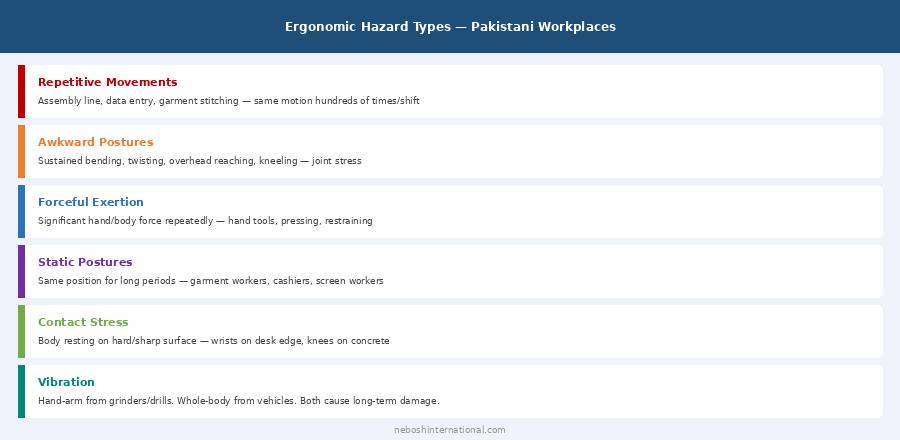
The main ergonomic hazards include:
- Repetitive movements: Repeating the same hand, wrist or arm movement during sewing, assembly or data entry.
- Awkward postures: Bending, twisting, kneeling or reaching into uncomfortable positions.
- Forceful exertion: Lifting heavy objects, using forceful hand tools or pushing resistant equipment.
- Static postures: Remaining seated or standing in the same position for extended periods.
- Contact stress: Pressing body parts against hard edges, tool handles or unsuitable work surfaces.
- Vibration: Using vibrating tools or operating vehicles and mobile plant for prolonged periods.
- Manual handling: Lifting, carrying, pushing or pulling loads without suitable equipment or task planning.
These hazards often occur together. For example, a factory worker may repeatedly lift materials while twisting their back and reaching across a production line. Consequently, assessing each hazard separately may overlook the combined demands of the task.
Common Ergonomic Risks in Pakistani Industries
1. Textile and Garment Factories
Textile and garment workers may perform repetitive sewing, cutting, packing and inspection tasks for long periods. Poor seating, unsuitable table heights and inadequate task variation can increase physical strain.
In Faisalabad, a safety officer inspecting a garment production line should examine seating arrangements, lighting, foot positioning, reach distances and the frequency of repetitive movements.
The objective is not simply to instruct employees to sit straight. Instead, employers should adjust workstations, provide suitable seating and organise tasks to reduce unnecessary repetition and sustained awkward postures.
2. Offices and Data Entry Departments
Office workers in Lahore, Karachi and Islamabad can also experience ergonomic problems. Incorrect monitor positioning, poorly arranged keyboards, unsuitable chairs and prolonged computer use may contribute to neck, shoulder and wrist discomfort.
A chair alone cannot solve every problem. For example, an employee may have an adjustable chair but still bend their neck because the screen is too low. Similarly, a keyboard positioned too far away may encourage repeated reaching.
Safety officers should assess the entire workstation, including screen height, keyboard placement, mouse position, lighting and the employee’s normal working posture.
3. Construction Sites
Construction workers face ergonomic risks during material handling, floor finishing, bricklaying, overhead installation and repetitive tool use.
On a construction project in Rawalpindi or Karachi, workers may repeatedly carry cement bags or bend to collect materials stored at ground level. These tasks can place unnecessary demands on the back, shoulders and knees.
Practical improvements include:
- Moving materials closer to the point of use.
- Using mechanical lifting aids where appropriate.
- Storing materials at suitable working heights.
- Reducing unnecessary carrying distances.
- Planning work to limit prolonged kneeling and overhead reaching.
Safety officers can complement these measures with a manual handling risk assessment in Pakistan.
4. Manufacturing and Industrial Operations
Production workers may operate hand tools, assemble components, package products or maintain machinery. Repetition, force, vibration and unsuitable working heights can combine to create ergonomic risks.
For example, a worker repeatedly using a heavy hand tool may experience discomfort because of the tool’s design, excessive force requirements or prolonged exposure. Reviewing the equipment, maintenance arrangements and task duration can help identify more effective controls.
How to Conduct an Ergonomic Risk Assessment
An ergonomic risk assessment helps employers identify physical demands, evaluate potential harm and select appropriate improvements.
Safety officers can follow these steps.
Step 1: Identify Tasks and Exposed Workers
Observe normal work activities and identify tasks involving repetition, force, awkward posture, vibration or manual handling.
Include workers from different shifts and departments because the physical demands of a job may vary according to production targets, equipment and staffing arrangements.
Step 2: Observe the Actual Working Method
Watch how employees perform tasks rather than relying only on written procedures. Record the duration, frequency and physical demands of important movements.
For example, a packaging worker may repeatedly twist to collect products because the materials are stored behind the workstation. The assessment should identify this underlying problem.
Step 3: Consult Workers
Ask employees whether they experience discomfort, fatigue or difficulty performing specific tasks. Review relevant incident records, sickness trends and reported symptoms where appropriate.
Repeated complaints from workers performing the same job may indicate a problem with the workstation, equipment or task design. However, a lack of complaints does not automatically mean the task is safe.
Step 4: Evaluate the Risk
Consider the intensity and duration of physical effort, frequency of movements, posture, recovery time and number of workers exposed.
Safety professionals may use recognised observational tools such as RULA (Rapid Upper Limb Assessment) and REBA (Rapid Entire Body Assessment) to help screen posture-related risks. These tools support assessment but do not replace professional judgement or a complete evaluation of the task.
Step 5: Recommend and Review Controls
Prioritise improvements that address the source of the hazard. Assign responsibility, establish a realistic completion date and check whether the changes reduce physical strain.
A safety audit guide for Pakistan can also help safety officers review whether ergonomic controls are implemented and maintained.
Effective Controls for Ergonomic Hazards
Employers should follow the hierarchy of controls when deciding how to reduce ergonomic risks.
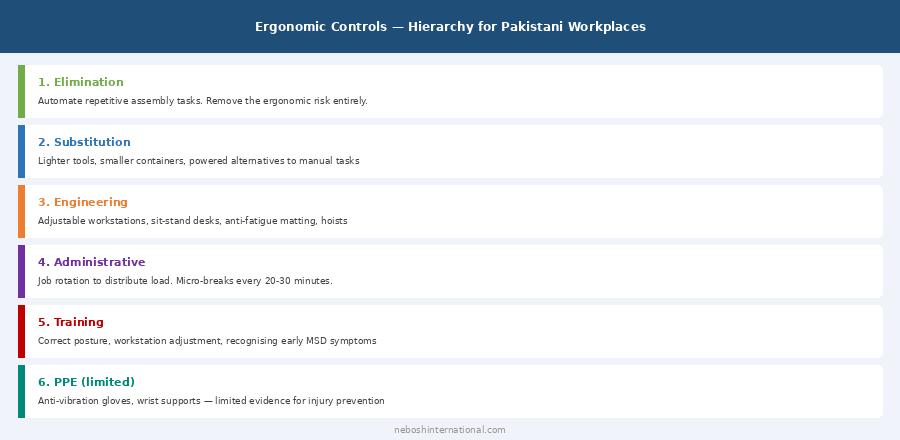
1. Elimination
Remove unnecessary physical demands wherever possible. For instance, redesign a workflow so employees no longer need to repeatedly move materials between distant workstations.
2. Substitution
Replace unsuitable equipment or methods with alternatives that require less force or reduce awkward movements. A lighter, appropriately designed tool may be suitable for a task involving frequent manual operation.
3. Engineering Controls
Engineering improvements change the equipment or physical working environment. Examples include adjustable workstations, mechanical lifting aids, suitable tool handles and correctly positioned production equipment.
For office workers, adjusting monitor height and arranging keyboards within comfortable reach may reduce unnecessary bending and reaching.
4. Administrative Controls
Organise work to manage exposure. Appropriate measures may include task variation, suitable rest breaks, reasonable workloads and training. Job rotation should distribute physical demands rather than simply transfer workers between equally demanding tasks.
5. Training and Personal Protective Equipment
Train employees to recognise ergonomic hazards, adjust workstations and report discomfort early. Select PPE according to the task and its assessed risks.
However, PPE should not replace effective engineering improvements. For example, gloves may not adequately control vibration exposure if the underlying problem involves unsuitable tools, poor maintenance or excessive exposure duration.
Office Workstation Ergonomics Checklist
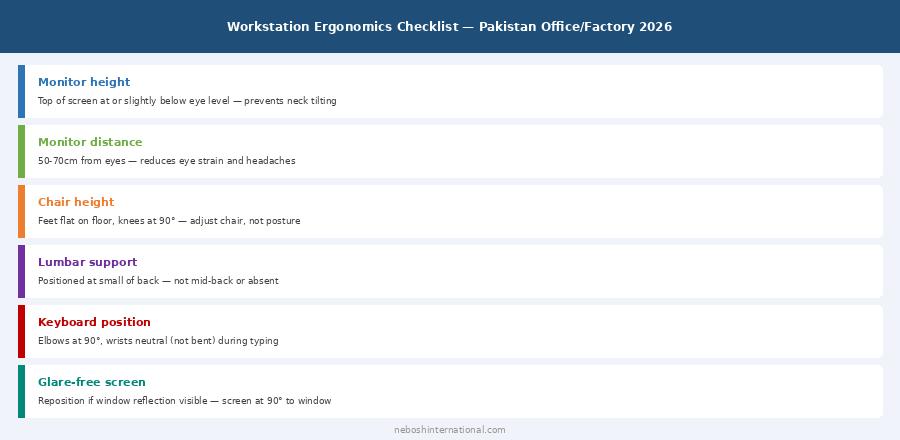
Safety officers can use this checklist during office inspections in Pakistan.
- Adjust the chair to support a comfortable sitting posture.
- Keep feet supported on the floor or a suitable footrest.
- Position the monitor to avoid sustained neck bending.
- Place the keyboard and mouse within comfortable reach.
- Keep wrists in a reasonably neutral position while typing.
- Arrange frequently used materials to reduce repeated reaching.
- Adjust lighting to reduce glare and uncomfortable screen viewing.
- Provide opportunities to change posture and move throughout the working day.
- Ask employees whether their workstation causes discomfort.
- Record identified issues and track corrective actions.
A workstation should suit the individual and the task. Therefore, safety officers should involve employees when deciding which adjustments are appropriate.
How NEBOSH IGC Helps Safety Officers Understand Ergonomics
NEBOSH International General Certificate (IGC) learners develop knowledge relevant to identifying workplace hazards, assessing risks and recommending suitable controls.
Ergonomics provides a practical example of how this knowledge applies to real working conditions. A safety officer should be able to identify an awkward posture, explain the potential harm, assess who may be affected and recommend an improvement that addresses the underlying cause.
For example, telling a worker to avoid bending may have limited value when materials are stored at floor level. Raising the storage position or introducing a suitable handling aid may address the cause more effectively.
Candidates can also explore the NEBOSH IGC exam format and assessment guide to understand the assessment structure and develop broader workplace safety knowledge.
For further guidance, the following external resources are useful:
- US Occupational Safety and Health Administration (OSHA): Ergonomics — information about ergonomic hazards and workplace prevention.
- UK Health and Safety Executive (HSE): Musculoskeletal Disorders — guidance on reducing work-related musculoskeletal risks.
These resources provide general guidance. Employers should also consider applicable Pakistani legal requirements and relevant industry standards.
Frequently Asked Questions
Ergonomics in Pakistani workplaces means designing jobs, workstations, equipment and working methods to suit employees and reduce unnecessary physical strain. It applies to factories, offices, construction sites and industrial operations.
Common hazards include repetitive movements, awkward postures, forceful exertion, prolonged sitting or standing, vibration and unsafe manual handling. The specific risks depend on the industry and the tasks workers perform.
A safety officer can observe work activities, consult employees, identify physical demands, review reported discomfort and use suitable assessment methods. The officer should then recommend controls, assign corrective actions and review their effectiveness.
Textile factories can improve workstation heights, provide suitable seating, reduce unnecessary reaching, review repetitive tasks and introduce appropriate task variation. The most effective measures depend on the actual working conditions.
Employers should review ergonomic risks according to the level of risk and applicable requirements. Reassessments are particularly important when tasks, equipment or workstations change, when new hazards appear or when workers report work-related discomfort. Routine observations should continue between formal reviews.
NEBOSH IGC develops knowledge of workplace health and safety, including hazard identification and risk control. Learners should practise applying these principles to real tasks, including manual handling, workstation design and repetitive work.
Conclusion
Ergonomics in Pakistani workplaces is an important part of protecting workers in textile factories, manufacturing facilities, offices and construction projects. Although ergonomic hazards may not cause an immediate accident, repeated physical strain can contribute to longer-term health problems.
For safety officers, the priority is to observe how work is actually performed, consult employees, assess physical demands and select controls that address the causes of risk. Better workstation design, suitable handling equipment and effective work organisation can make tasks safer and more manageable.
Whether you work in Lahore, Rawalpindi, Karachi, Faisalabad, Islamabad or another industrial area of Pakistan, ergonomic risk assessment can strengthen your practical HSE skills.
NEBOSH IGC can help build a foundation in occupational health and safety, while applying that knowledge at work helps turn hazard identification into meaningful improvements.
Explore NEBOSH International for additional course information and practical HSE learning resources for Pakistani safety professionals.

NEBOSH International General Certificate (IGC) certified HSE professional focused on occupational health and safety, workplace risk assessment, hazard identification, and safety management systems. The content published on NeboshInternational.com is based on current industry guidance, recognized safety best practices, and practical workplace examples to help professionals in Pakistan and the Gulf prepare for NEBOSH qualifications and build successful HSE careers.