Confined Space Safety in Pakistan: 10 Essential Steps for Safety Officers (2026)
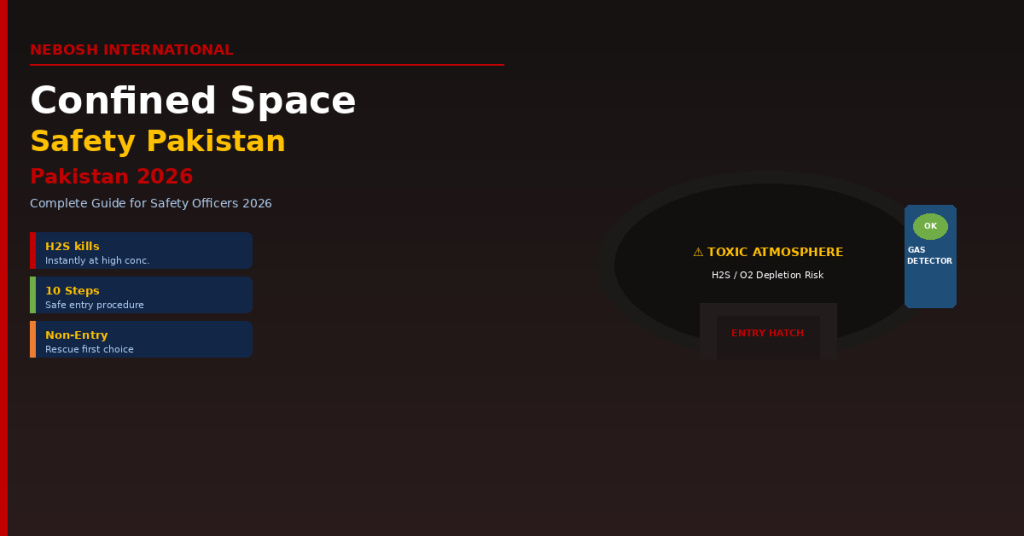
Confined space safety in Pakistan is essential for protecting workers during maintenance, inspection, cleaning and repair activities in tanks, sewers, underground chambers and industrial vessels. These environments can contain toxic gases, low oxygen levels, flammable vapours or materials that can engulf workers. Without proper controls, a routine task can become a life-threatening emergency.
For safety officers, supervisors and NEBOSH IGC candidates, understanding confined space entry procedures is an important part of workplace risk management. This guide explains confined space hazards, permit-to-work requirements, atmospheric testing and emergency rescue planning, with practical examples relevant to Pakistan’s construction, manufacturing and oil and gas industries.
What Is a Confined Space?
A confined space is an enclosed or partially enclosed area that presents specific risks because of its design, access, atmosphere or contents. Depending on the applicable regulations and site procedures, it may include spaces that are difficult to enter or leave, are not intended for continuous occupancy, or can develop dangerous atmospheric conditions.
Common examples in Pakistan include:
- Underground water tanks and sewage chambers
- Manholes, drains and municipal sewer systems
- Fuel storage tanks and chemical vessels
- Boilers, silos and industrial hoppers
- Pipelines, ducts and underground culverts
- Some excavations, tunnels and enclosed process areas
These spaces may be found on construction sites in Rawalpindi and Lahore, manufacturing facilities in Karachi and Faisalabad, cement plants, food-processing facilities and oil and gas installations.
However, not every enclosed space automatically meets the applicable definition of a confined space. Employers should assess each location according to its hazards, access conditions and relevant requirements.
Why Is Confined Space Safety Important?
Confined spaces can develop dangerous conditions without obvious warning. A worker may be unable to recognise oxygen deficiency, toxic gas exposure or a developing fire hazard before becoming incapacitated.
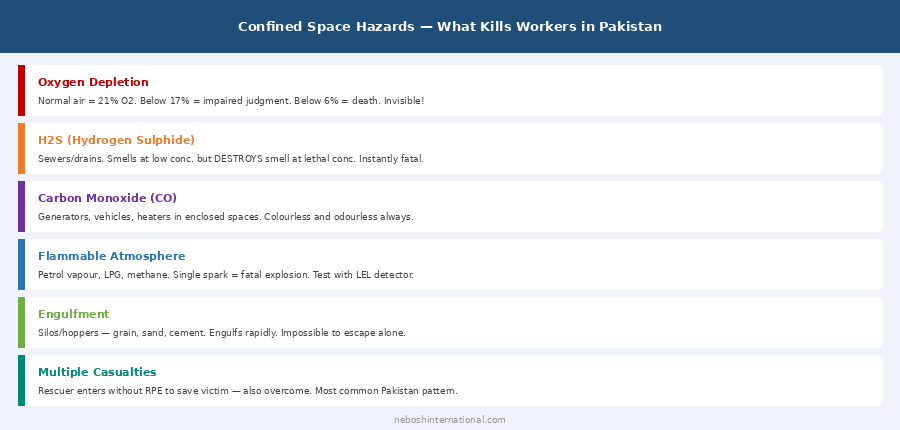
The main hazards include:
1. Oxygen deficiency or enrichment
Normal atmospheric air contains approximately 20.9% oxygen. Oxygen deficiency can occur when gases displace oxygen or chemical and biological processes consume it. Rusting, decomposition and certain industrial operations may contribute to these conditions.
Oxygen enrichment is also dangerous because it can make materials ignite more easily and burn more intensely. Workers must follow the applicable entry limits and site procedures rather than assuming that normal-looking air is safe.
2. Toxic gases
Hydrogen sulphide (H₂S) may occur in sewers, wastewater systems and certain oil and gas operations. At high concentrations, it can rapidly incapacitate or kill workers. Its smell must never be used as a safety test because exposure can impair the sense of smell.
Carbon monoxide (CO) is another serious hazard. It can accumulate when engines, generators or combustion equipment operate near enclosed areas.
3. Fire and explosion
Methane, fuel vapours, flammable gases and combustible dust can create explosive atmospheres. Sparks from equipment, electrical installations or hot work may ignite these mixtures.
4. Engulfment and physical hazards
Grain, cement powder, sand and other loose materials can trap or engulf workers. Additional hazards include heat stress, moving machinery, electrical energy, falling objects and restricted escape routes.
Confined Space Entry Procedure in Pakistan: 10 Essential Steps
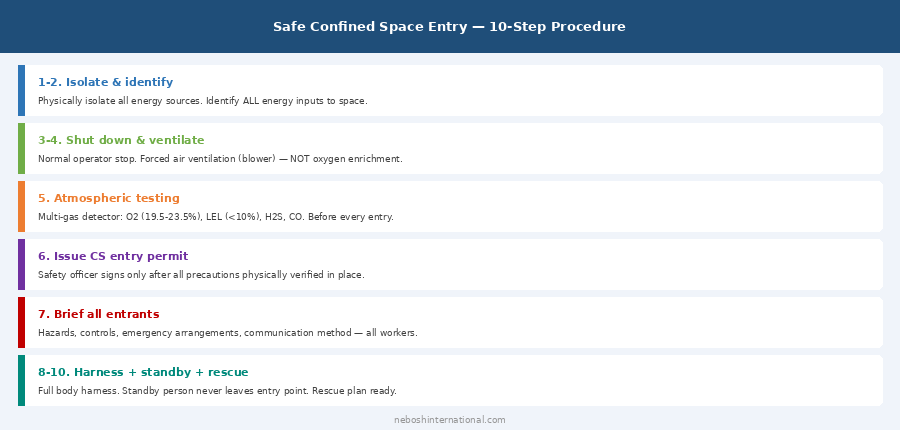
Safety officers should use the following 10 steps to plan and control confined space work. The exact controls must reflect the risk assessment, site conditions and applicable requirements.
Step 1: Identify the confined space and assess the risks
Inspect the area before planning the job. Identify the space’s contents, access points, previous uses, connected pipelines and potential atmospheric hazards.
Consider the work itself, including cleaning chemicals, welding, cutting and equipment that may introduce additional risks.
Record the findings in a task-specific risk assessment and communicate the hazards to everyone involved.
Step 2: Avoid entry wherever possible
Ask whether workers can complete the task from outside the space. Remote inspection cameras, external cleaning systems and suitable mechanical tools may eliminate the need for entry.
Avoiding entry is often the most effective control because it removes the worker’s exposure to hazards inside the space.
Step 3: Isolate all hazardous energy sources
Before entry, isolate relevant electrical, mechanical, hydraulic and pneumatic equipment. Secure connected pipelines and prevent liquids, gases or bulk materials from entering the space.
Use lockout/tagout procedures where appropriate. Verify that the isolation is effective and address stored energy before work begins.
Simply switching off a machine or closing a valve may not provide adequate isolation.
Step 4: Empty, clean and ventilate the space
Remove hazardous residues where necessary and use suitable forced-air ventilation to improve atmospheric conditions. Select ventilation equipment according to the hazards and the risk of introducing ignition sources.
Never use pure oxygen to ventilate a confined space. Oxygen enrichment can create a serious fire hazard.
Ventilation does not replace atmospheric testing, and it must not be treated as proof that the space is safe.
Step 5: Test the atmosphere before entry
A trained and competent person should use a suitable, properly maintained gas detector to assess the atmosphere.
Testing should generally consider:
- Oxygen concentration
- Flammable gases and vapours, measured against the applicable lower explosive limit (LEL)
- Toxic gases such as H₂S and CO
- Other substances identified in the risk assessment
Follow the detector manufacturer’s instructions and the site’s approved testing procedure. Where stratification is possible, test appropriate levels of the space using a safe method.
Check the instrument’s condition, calibration status and required function or bump test before use. A single reading at the entrance may not represent the atmosphere throughout the space.
Step 6: Issue the confined space entry permit
A competent, authorised person should issue the permit only after verifying that the required controls are in place.
The permit should identify:
- The space, task and authorised entrants
- The hazards and required isolation measures
- Atmospheric testing results and monitoring arrangements
- Required PPE and respiratory protective equipment
- Communication methods and standby personnel
- Permit validity, authorisation and emergency arrangements
A permit is not a substitute for risk assessment, competent supervision or effective controls. Stop work and reassess if conditions change.
For more information, read our guide to the permit-to-work system in Pakistan.
Step 7: Provide suitable PPE and entry equipment
Select equipment according to the identified risks. This may include suitable protective clothing, a full-body harness, retrieval equipment, appropriate respiratory protective equipment and intrinsically safe monitoring equipment where required.
Respiratory protection must be selected, maintained and used by trained personnel. An ordinary dust mask does not protect against oxygen deficiency or most hazardous gases.
Where a harness and retrieval system are appropriate, ensure that the equipment and recovery method are suitable for the space and do not create additional hazards.
Step 8: Assign a trained standby person
A trained attendant should remain outside the confined space for the duration of entry, as required by the entry plan.
The standby person’s responsibilities include:
- Maintaining communication with entrants
- Tracking who is inside the space
- Monitoring relevant conditions and alarms
- Initiating the emergency response when necessary
- Preventing unauthorised entry
- Calling the rescue team without delay
The attendant must not enter the space impulsively to rescue a colleague. Unplanned rescues can create multiple casualties.
Step 9: Monitor conditions throughout the job
Atmospheric conditions can change because of ventilation failure, disturbed residues, chemical reactions or nearby operations.
Use continuous monitoring when required by the risk assessment and entry procedure. Withdraw workers immediately if an alarm activates, communication fails, symptoms develop or conditions become unsafe.
Suspend entry when the ventilation system fails or isolation becomes uncertain. Reassess and reauthorise the work before restarting.
Step 10: Prepare and verify the rescue plan
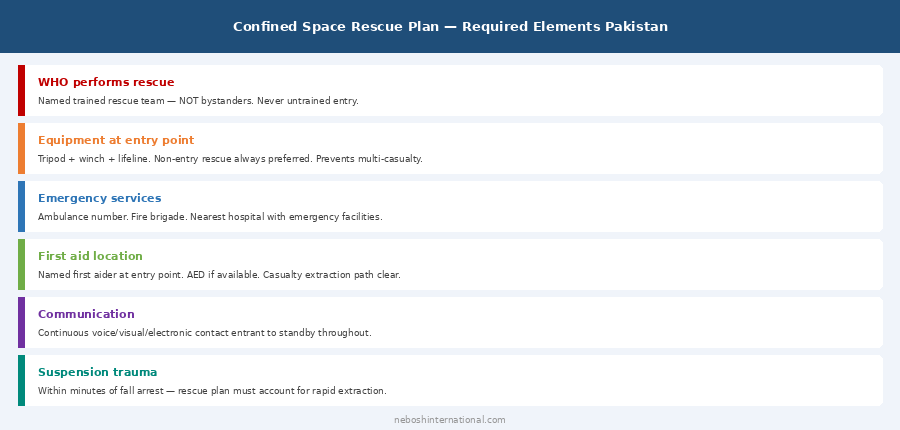
Develop the rescue plan before entry begins. Identify trained rescuers, suitable retrieval equipment, communication arrangements and access for emergency services.
The plan should cover:
- Alarm activation and emergency communication
- Non-entry retrieval where feasible and safe
- Rescue methods for spaces where retrieval from outside is not possible
- Appropriate breathing apparatus and other equipment for rescuers
- First aid, casualty transfer and emergency medical support
A tripod and winch may support non-entry rescue in suitable vertical spaces, but they are not appropriate for every layout. Test the proposed rescue method against the actual entry configuration.
Do not rely solely on the public emergency services to perform a rescue that requires specialist confined space capability. Verify that the planned response can be delivered in time.
Confined Space Safety Checklist for Pakistani Workplaces
Before authorising entry, the supervisor should confirm that the relevant items below have been completed.
- The space has been assessed and entry is necessary.
- A task-specific risk assessment is available.
- Hazardous energy and connected services are isolated.
- Cleaning and ventilation arrangements are suitable.
- Atmospheric testing has been completed by a competent person.
- The entry permit is authorised and valid.
- Entrants and attendants have received a briefing.
- Required PPE, communication and retrieval equipment are available.
- Monitoring arrangements and evacuation triggers are understood.
- The rescue plan has been checked and is ready to use.
If a critical control is missing, do not authorise entry until the issue has been resolved.
What Is the Role of a Safety Officer in Confined Space Work?
A safety officer helps identify hazards, review risk assessments, verify control measures and check that workers understand the entry permit and emergency procedures.
The officer may also coordinate atmospheric testing, inspect PPE, confirm isolation arrangements, monitor compliance and stop work when unsafe conditions arise. However, the responsibilities for authorising entry, testing the atmosphere and conducting rescue must be assigned to appropriately competent and authorised personnel.
These skills are relevant to HSE roles in construction, manufacturing, utilities and oil and gas operations across Pakistan, as well as employers in Saudi Arabia, the UAE, Qatar and Oman.
Candidates considering professional training can explore our NEBOSH IGC in Pakistan guide and introduction to the NEBOSH course.
Frequently Asked Questions
Never enter a hazardous confined space without assessing the risks, verifying the required controls, testing the atmosphere and following an authorised entry procedure. A rescue plan must also be ready before work begins.
Where the site’s risk assessment and applicable requirements call for a permit, entry must not proceed without authorisation. Reassess conditions before every entry, even when workers have entered the same space previously.
A trained and competent person should conduct atmospheric testing using a suitable instrument and the approved testing procedure. The person must understand the detector, sampling method, relevant hazards and interpretation of readings.
No. A normal face mask or dust mask does not protect workers against oxygen deficiency or most toxic gases. Respiratory protection must be selected according to the identified hazards and the task-specific risk assessment.
NEBOSH IGC develops knowledge of workplace hazards, risk assessment and control measures. Candidates should also receive suitable practical training and follow their employer’s confined space procedures before undertaking safety-critical duties.
Conclusion
Confined space safety in Pakistan depends on effective planning, verified isolation, atmospheric testing, an authorised entry permit, suitable equipment, competent supervision and a reliable rescue plan.
Whether work takes place at a construction site in Rawalpindi, a factory in Lahore, an industrial facility in Karachi or an oil and gas installation, the same principle applies: never allow time pressure or previous experience to replace verified safety controls.
For safety officers and NEBOSH IGC candidates, understanding these 10 steps provides a practical foundation for recognising hazards and helping prevent avoidable workplace fatalities.
Authoritative References
- UK Health and Safety Executive: Confined spaces
- OSHA: Permit-Required Confined Spaces — 29 CFR 1910.146
- NEBOSH official website
Note: Apply the legislation and technical standards relevant to the site and jurisdiction. This guide provides general safety information and does not replace a competent risk assessment, specialist training or an approved site procedure.

NEBOSH International General Certificate (IGC) certified HSE professional focused on occupational health and safety, workplace risk assessment, hazard identification, and safety management systems. The content published on NeboshInternational.com is based on current industry guidance, recognized safety best practices, and practical workplace examples to help professionals in Pakistan and the Gulf prepare for NEBOSH qualifications and build successful HSE careers.