Lifting Operations Safety in Pakistan: Essential Crane Safety Guide 2026
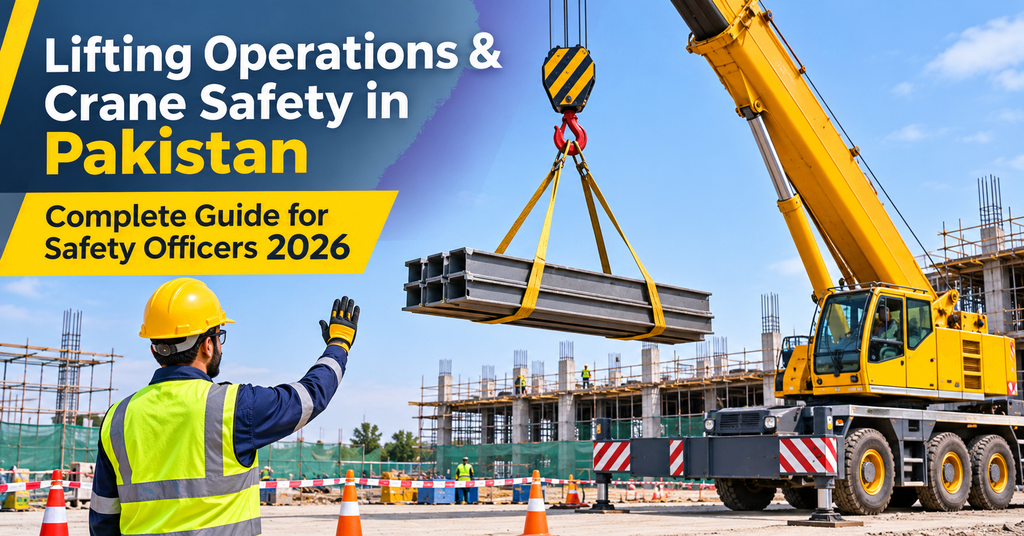
Lifting operations safety Pakistan is an essential part of workplace risk management, particularly on construction sites, industrial facilities, manufacturing plants and oil and gas projects. A poorly planned lift can cause dropped loads, crane overturning, serious injuries, equipment damage and fatalities.
Whether a site uses mobile cranes, tower cranes, overhead cranes, forklifts or chain blocks, every lifting activity requires proper planning, competent workers and suitable equipment.
This guide explains crane hazards, lifting plans, rigging responsibilities, sling angles, equipment inspections and practical safety precautions for Pakistani HSE professionals.
What Is a Lifting Operation?
A lifting operation involves raising, lowering or moving a load using mechanical lifting equipment. Common examples include:
- Mobile and tower cranes
- Overhead and gantry cranes
- Forklifts used for lifting
- Hoists and chain blocks
- Slings, shackles, hooks and lifting beams
Effective lifting operations safety Pakistan requires employers to identify hazards before work begins and ensure that equipment is suitable for the intended task.
The UK’s Lifting Operations and Lifting Equipment Regulations 1998 (LOLER) provide an important international reference for safe lifting practices. They require a competent person to plan each lifting operation, a supervisor to oversee the work and the lifting team to follow safe procedures. Pakistani employers should also check applicable local requirements, project specifications and client procedures.
7 Major Hazards in Crane and Lifting Operations
Understanding hazards is the first step towards preventing accidents.
| Hazard | Common cause |
|---|---|
| Crane overturning | Unstable ground, overloading or incorrect outrigger setup |
| Dropped loads | Damaged slings, incorrect rigging or unsecured loads |
| Electrical contact | Crane boom or load approaching overhead power lines |
| Struck-by injuries | Swinging loads and inadequate exclusion zones |
| Crushing injuries | Workers positioned between loads and fixed structures |
| Equipment failure | Poor maintenance or defective lifting accessories |
| Crane collisions | Overlapping operating areas and blind lifting |
A lifting operations risk assessment should consider the load, working environment, equipment limitations and people who could be affected.
Who Is Responsible for Safe Lifting?
A lifting team needs clearly defined responsibilities. Common roles described in recognised crane safety guidance include:
1. Appointed Person
Plans the lifting activity, assesses the risks, selects appropriate equipment and prepares the lifting plan.
2. Lift Supervisor
Controls the operation at the workplace, briefs workers and checks that the approved plan is followed.
3. Crane Operator
Operates the crane within its rated capacity, follows agreed signals and stops work whenever conditions become unsafe.
4. Slinger or Signaller
Attaches the load correctly, checks lifting accessories and communicates instructions to the crane operator.
Good crane safety Pakistan practices depend on teamwork. Workers must understand their responsibilities before lifting begins.
How to Prepare a Safe Lifting Plan
A lifting plan explains how the team will raise, move and position a load without exposing workers to unnecessary risks.
For additional guidance, the UK Health and Safety Executive explains the requirements for planning, organising and supervising lifting operations, including competent personnel and suspended-load precautions.
Before starting, check these ten important points:
- Confirm the actual weight of the load.
- Identify the load’s centre of gravity.
- Determine the lifting points and attachment method.
- Calculate the maximum working radius.
- Check crane capacity using the manufacturer’s load chart.
- Assess ground stability and outrigger requirements.
- Select suitable, certified lifting accessories.
- Identify overhead power lines and nearby structures.
- Establish an exclusion zone and communication system.
- Define emergency arrangements and weather limitations.
Routine lifts may be managed through a suitable generic plan and briefing where appropriate. Complex, heavy, unusual or tandem lifts require a task-specific assessment and detailed planning.
Never estimate a load’s weight simply by looking at it. Use engineering drawings, manufacturer information, delivery documentation or verified calculations.
Understanding Crane Capacity and Working Radius
A crane’s advertised capacity does not mean it can lift that weight at every position.
For example, a crane rated at 50 tonnes may only achieve that capacity under particular boom configurations and working conditions. As the working radius increases, its lifting capacity generally decreases.
The operator and lifting supervisor must check:
- Boom length and configuration
- Actual working radius
- Manufacturer’s load chart
- Ground conditions and crane level
- Outrigger extension and support
- Total lifted weight, including applicable lifting attachments
Never exceed the manufacturer’s rated capacity or bypass safety devices to complete a lifting task.
Sling Angle and Load Tension Explained
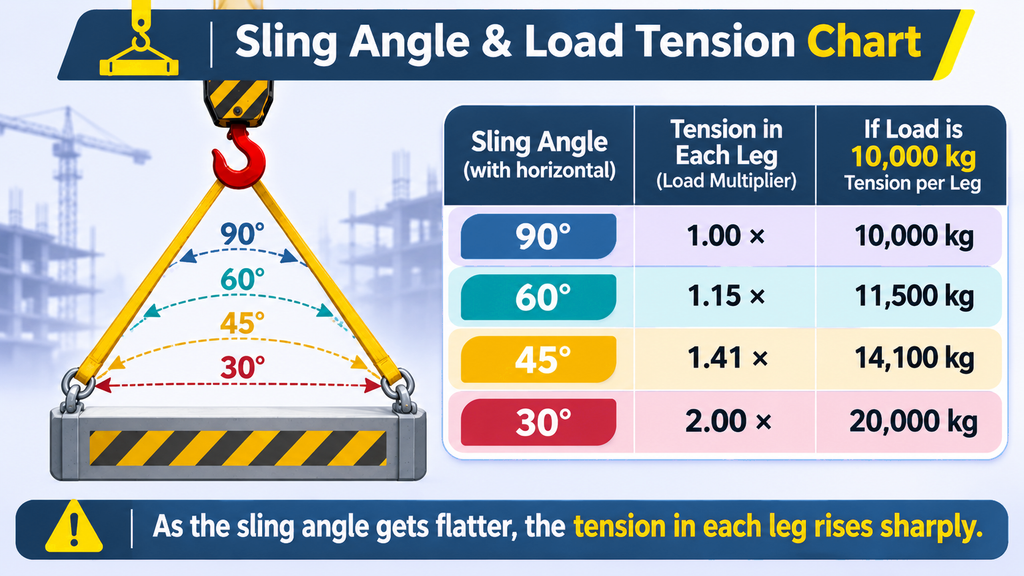
Rigging safety is particularly important when using two-leg lifting slings. As the sling legs become flatter, tension in each leg increases.
For a symmetrical two-leg sling, the approximate tension in each leg is:
Tension = Load weight ÷ (2 × sin θ)
Here, θ represents the angle of each sling leg measured from the horizontal.
| Sling angle | Tension in each leg |
|---|---|
| 90° | 50% of load weight |
| 60° | 58% of load weight |
| 45° | 71% of load weight |
| 30° | 100% of load weight |
For example, when lifting a 2-tonne load using two equally loaded sling legs at 30° to the horizontal, each leg experiences approximately 2 tonnes of tension.
Actual rigging capacity must also account for manufacturer ratings, sling configuration, load distribution, attachment points and other applicable reductions.
Never use damaged or underrated slings. Where sling angles are unsuitable, obtain competent rigging advice and consider an appropriate spreader beam or alternative lifting arrangement.
Lifting Equipment Inspection and Thorough Examination
Regular inspection helps identify defects before they cause equipment failure.
Two important checks are:
Pre-use inspection: A visual and functional check by the user before using the equipment. Check for visible damage, missing identification labels and other defects.
Thorough examination: A systematic examination performed by a competent person at appropriate intervals under the applicable requirements.
Under the UK LOLER benchmark, the usual thorough examination intervals are:
- Every 6 months for lifting accessories.
- Every 6 months for equipment used to lift people.
- Every 12 months for other lifting equipment.
Read the HSE guidance on thorough examinations and inspections of lifting equipment for further information about competent persons, examination intervals and inspection responsibilities.
Where regulations allow, a competent person may establish a different examination scheme
Remove defective equipment from service immediately. Look for broken wires, damaged webbing, stretched chains, cracked shackles, deformed hooks and missing safety latches.
Equipment without identifiable capacity markings or suitable supporting documentation should not be used until its suitability is established.
Ground Conditions, Power Lines and Weather
Ground conditions: Cranes require stable, suitable ground. Outriggers should be positioned according to the manufacturer’s instructions and supported using properly selected mats or pads. Assess underground services, excavations and recently backfilled areas.
Overhead power lines: Electrical contact can cause fatal injuries. Identify nearby lines before positioning the crane. Arrange isolation through the relevant utility where necessary and maintain the required clearance.
As an international reference, OSHA’s US construction crane standard provides clearance requirements based on power-line voltage. For power lines up to 50 kV, Table A requires a minimum clearance of 10 feet when employers choose this compliance option. This is not a universal Pakistani clearance rule; applicable local and project requirements must be checked.
Weather: Strong winds can make loads difficult to control, particularly large panels and sheets. Follow the crane manufacturer’s operating limits and stop lifting when conditions become unsafe.
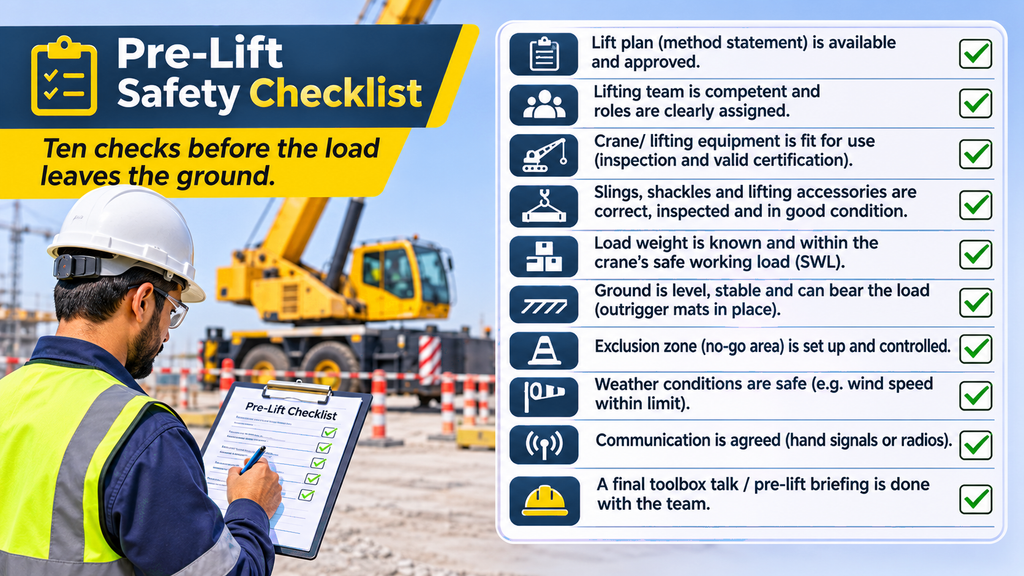
Pre-Lift Safety Checklist
Before authorising a lifting operation, confirm:
- The lifting plan has been approved and communicated.
- Load weight and centre of gravity are known.
- Crane capacity is suitable for the working radius.
- Equipment and accessories have valid examination records where required.
- Slings, hooks and shackles are suitable and undamaged.
- Ground conditions and outrigger arrangements are acceptable.
- The exclusion zone is established.
- Power-line clearances have been assessed.
- A designated signaller is available.
- Communication and emergency arrangements are understood.
Where appropriate, perform a controlled trial lift just clear of the ground to check load balance, rigging and stability before proceeding.
Nobody should stand or walk beneath a suspended load.
Why Lifting Operations Safety Matters for NEBOSH IGC Professionals
Understanding lifting operations safety Pakistan helps HSE professionals identify workplace hazards, evaluate risks and recommend practical control measures.
These skills are useful in construction, manufacturing, warehousing, engineering and oil and gas environments.
NEBOSH IGC learners can also use lifting activities as practical examples when studying workplace hazards, risk assessment, safe systems of work and equipment-related controls.
For further professional development, explore the NEBOSH IGC course information.
Frequently Asked Questions
A lifting plan is a documented method explaining how a lifting operation will be completed safely. It covers load details, crane selection, rigging arrangements, ground conditions, hazards, responsibilities and emergency procedures.
Working Load Limit (WLL) is the manufacturer’s specified maximum load for an item under stated conditions. Safe Working Load (SWL) is a term commonly used for the permitted load in a particular application. Always follow the applicable equipment markings and manufacturer instructions.
Under the UK LOLER benchmark, lifting accessories are normally subject to thorough examination every six months unless an appropriate examination scheme specifies otherwise.
No. Workers must remain outside the suspended-load danger zone. Establish an exclusion area and plan the lifting route to prevent loads passing over people wherever reasonably practicable.
The designated signaller should provide normal operating instructions using an agreed communication method. Anyone who identifies an emergency should be able to give the stop signal.
Conclusion
Safe lifting depends on preparation, competent supervision, suitable equipment and effective communication. Every crane operation should begin with a proper assessment of load weight, working radius, ground conditions, rigging arrangements and surrounding hazards.
Applying recognised lifting operations safety Pakistan practices can help employers reduce accidents, protect workers and improve site safety performance.
Want to strengthen your HSE knowledge? Explore NEBOSH learning and professional safety resources through NEBOSH International.

NEBOSH International General Certificate (IGC) certified HSE professional focused on occupational health and safety, workplace risk assessment, hazard identification, and safety management systems. The content published on NeboshInternational.com is based on current industry guidance, recognized safety best practices, and practical workplace examples to help professionals in Pakistan and the Gulf prepare for NEBOSH qualifications and build successful HSE careers.