Excavation Safety Pakistan 2026: Complete Trenching and Collapse Prevention Guide
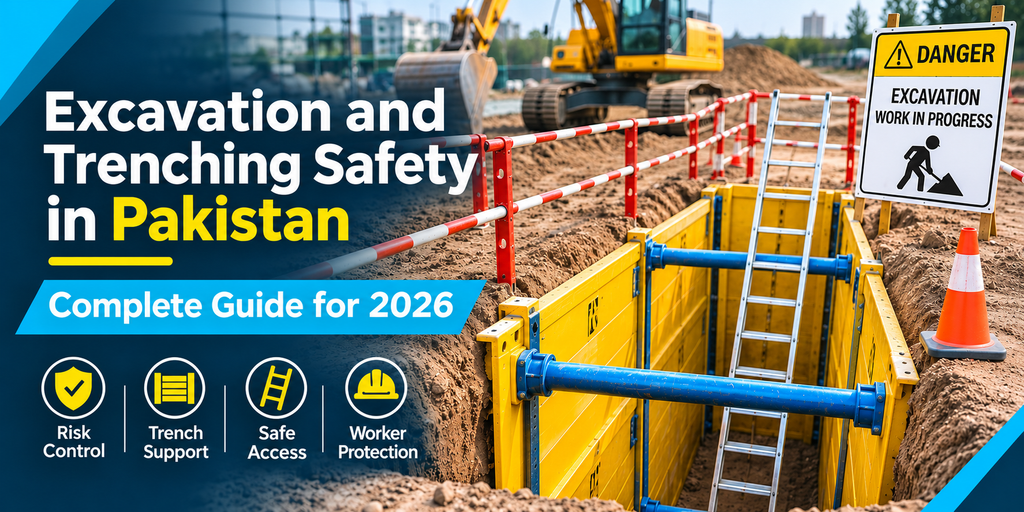
Excavation safety Pakistan is an essential part of construction site safety because trench collapses, underground utility strikes, falling materials and water accumulation can cause fatal workplace accidents. This guide explains excavation hazards, trench protection methods, shoring, sloping, safe access, inspection procedures and practical safety controls for Pakistani construction projects.
Quick Answer: What Is Excavation Safety?
Excavation safety is the process of identifying and controlling hazards associated with digging trenches, foundations, pits and other ground openings. It involves preventing soil collapse, locating underground services, controlling water, providing safe access, protecting excavation edges and conducting inspections before workers enter.
The most important excavation safety measures are:
- Assess soil conditions before excavation begins.
- Use suitable sloping, benching, shoring or trench boxes.
- Keep excavated soil and heavy equipment away from trench edges.
- Locate underground electrical cables, gas pipes and water lines.
- Provide secured ladders and edge barriers.
- Inspect excavations before every shift and after rainfall.
- Stop work immediately if unsafe conditions develop.
Key Takeaways: Excavation Safety Pakistan
- Trench collapse can bury workers within seconds.
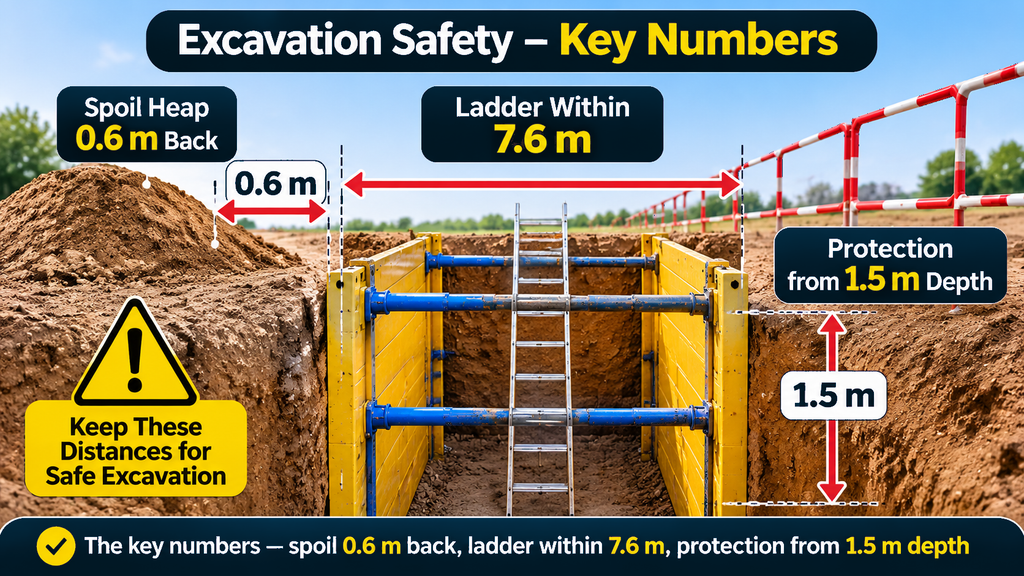
- OSHA generally requires protective systems in trenches 5 feet (1.52 metres) or deeper, subject to specified exceptions.
- Keep spoil heaps at least 2 feet (0.6 metres) from excavation edges as an OSHA benchmark.
- Provide safe access and exit for trenches 4 feet (1.22 metres) or deeper.
- Underground utilities must be identified before mechanical digging.
- Rainfall, vibration and nearby vehicle loads can destabilise trench walls.
- A competent person must inspect excavation conditions regularly.
1. Why Is Excavation Safety Important in Pakistan?
Excavation work is common throughout Pakistan’s construction and infrastructure sectors. Workers regularly dig trenches for sewerage systems, water pipelines, gas distribution, electrical cables, road construction and building foundations.
Projects in Lahore, Karachi, Islamabad, Rawalpindi, Faisalabad and other developing cities frequently involve excavation in congested areas where underground services and nearby structures create additional risks.
The major concern is soil collapse. Soil is extremely heavy, and a worker trapped beneath collapsed material may suffer crushing injuries, restricted breathing or death.
Even a trench that appears stable can collapse because of:
- Loose or previously disturbed soil.
- Heavy rainfall and water accumulation.
- Excavators and vehicles operating near the edge.
- Vibration from nearby machinery.
- Incorrect excavation angles.
- Missing or poorly installed trench supports.
For this reason, excavation safety must be planned before digging begins rather than treated as an inspection activity after work has started.
2. What Are the Main Excavation Hazards?
Understanding excavation hazards helps safety officers develop an effective risk assessment and select appropriate control measures.
| Excavation hazard | Possible consequences | Recommended safety controls |
|---|---|---|
| Trench collapse | Burial, crushing and fatal injuries | Shoring, sloping, benching or trench boxes |
| Falling materials | Head injuries and crushing | Edge protection and spoil setbacks |
| Falls into excavations | Fractures and serious injuries | Barriers, warning signs and lighting |
| Vehicle movement | Workers struck by machinery | Banksmen, exclusion zones and stop blocks |
| Underground cables | Electrocution and burns | Utility drawings, cable locators and safe digging |
| Gas pipeline damage | Fire, explosion and poisoning | Gas line identification and emergency procedures |
| Water accumulation | Flooding and soil instability | Dewatering, pumps and drainage |
| Hazardous atmosphere | Oxygen deficiency and toxic exposure | Atmospheric testing and ventilation |
| Structural collapse | Damage to nearby buildings | Engineering assessment and temporary support |
3. How to Prevent Trench Collapse
Trench collapse prevention is one of the most important parts of excavation safety Pakistan procedures.
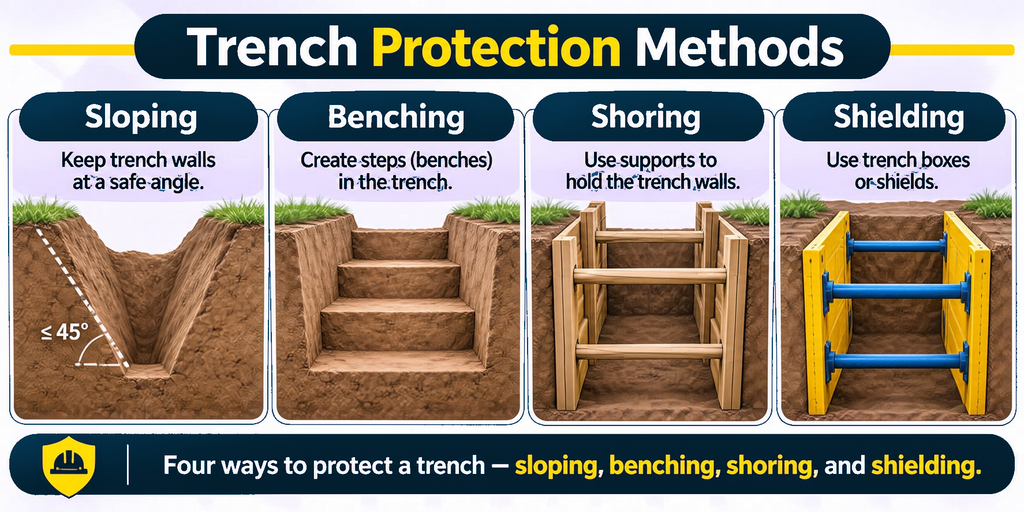
There are four commonly recognised methods of protecting workers from collapsing soil.
A. Sloping
Sloping involves cutting excavation sides at an appropriate angle to reduce the possibility of soil sliding into the trench.
The required angle depends on soil classification, ground conditions, water content and excavation depth.
Sloping is useful where sufficient working space is available.
B. Benching
Benching involves cutting excavation walls into horizontal steps or levels.
It can reduce the risk of soil movement in suitable ground conditions. However, benching must only be used where the soil classification and protective-system design permit it.
C. Shoring
Shoring uses structural supports to prevent excavation walls from collapsing.
Common systems include:
- Timber shoring.
- Hydraulic shoring.
- Steel sheet supports.
- Mechanical support systems.
Shoring is particularly useful for narrow trenches in urban construction projects where there is insufficient space for sloping.
Installation and removal must follow an approved sequence and protective-system design.
D. Shielding or Trench Boxes
A trench box is a protective structure installed inside an excavation to provide workers with a protected working area.
Unlike shoring, a trench box does not necessarily prevent the surrounding soil from collapsing. It provides a protective enclosure for workers.
Workers should remain within the protected area and follow the manufacturer’s instructions and site-specific safety arrangements.
4. Important Excavation Safety Measurements
Safety officers should understand internationally recognised excavation safety benchmarks.
The following measurements are based on the US OSHA construction excavation standard, 29 CFR 1926 Subpart P. They are not automatically Pakistani legal requirements.
| Safety requirement | OSHA benchmark |
|---|---|
| Protective system | Generally required at 5 feet (1.52 m) or deeper unless an applicable exception applies |
| Engineering design | Protective systems over 20 feet (6.1 m) require design by a registered professional engineer |
| Safe access and exit | Required in trenches 4 feet (1.22 m) or deeper |
| Maximum lateral travel to exit | 25 feet (7.6 m) |
| Spoil and equipment setback | At least 2 feet (0.6 m), or suitable retaining protection |
| Atmospheric testing | Required before entry into excavations deeper than 4 feet where a hazardous atmosphere exists or could reasonably be expected |
Important: A trench below 1.52 metres is not automatically safe. Loose soil, water, vibration and other hazards may require protective measures at shallower depths. A competent person must assess actual conditions.
5. Underground Utility Safety During Excavation
Underground services are a major concern for construction contractors in Pakistan.
Damaging an electrical cable can cause electrocution, burns or electrical arcing. Striking a gas pipeline can result in fire, explosion or serious injuries.
Before excavation begins:
- Obtain available underground utility drawings.
- Contact relevant electricity, gas, water and telecommunications service providers.
- Use suitable cable and pipe detection equipment.
- Mark identified underground services clearly.
- Dig trial holes carefully to confirm service locations.
- Use suitable hand-digging techniques near identified services.
- Protect and support exposed cables and pipes.
- Stop work if an unidentified service is discovered.
Never assume that underground utility drawings show every buried service. Plans should be supported by appropriate locating and verification methods.
6. Monsoon and Rainfall Excavation Risks in Pakistan
Monsoon rainfall creates additional excavation hazards across Pakistan.
Water entering a trench can weaken soil, increase instability and cause sudden flooding. Excavations near canals, drainage channels, coastal areas and locations with high groundwater levels require particular attention.
During rainy conditions, excavation safety Pakistan procedures should include:
- Inspecting excavation walls after rainfall.
- Diverting surface water away from trench edges.
- Maintaining suitable dewatering equipment.
- Checking pumps and discharge arrangements.
- Monitoring cracks, soil movement and water seepage.
- Keeping heavy vehicles away from unstable edges.
- Evacuating workers when conditions become unsafe.
- Resuming work only after reassessment and approval.
Never allow workers to enter a flooded or visibly unstable excavation simply because work has been delayed.
7. Safe Access, Edge Protection and Excavation Equipment
Every excavation must have suitable arrangements to prevent workers, pedestrians and vehicles from falling inside.
Safe access: Provide secured ladders, steps or ramps where required. Under the OSHA benchmark, trenches 4 feet or deeper require a means of egress positioned so workers do not travel more than 25 feet laterally to reach it.
Edge protection: Install suitable barriers, warning signs and night-time lighting around open excavations, especially near public roads and pedestrian routes.
Vehicle safety: Establish equipment exclusion zones, use trained banksmen where necessary and install suitable stop blocks when vehicles approach excavation edges.
Spoil management: Keep excavated material away from the edge and prevent loose soil, tools and construction materials from falling into the trench.
Equipment inspection: Check excavators, lifting equipment, access ladders and temporary support systems before use.
8. Daily Excavation Safety Inspection Checklist
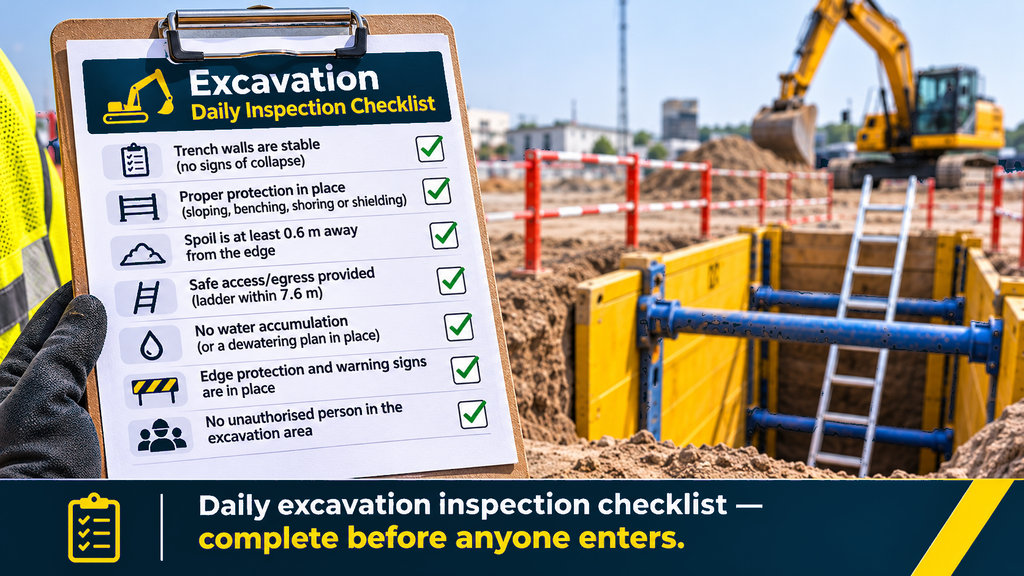
A competent person should inspect excavation conditions before work begins and whenever changing conditions may affect safety.
Use this practical excavation safety checklist:
| Inspection point | What to verify |
|---|---|
| Soil conditions | Ground stability and soil classification assessed |
| Protective system | Correct shoring, sloping, benching or shielding |
| Excavation walls | No dangerous cracks, bulging or soil movement |
| Spoil heaps | Safe setback or suitable retaining protection |
| Underground services | Utilities identified, marked and protected |
| Access and exit | Suitable, secured ladders or alternative access |
| Edge protection | Barriers and warning signs installed |
| Water control | No unsafe accumulation or uncontrolled seepage |
| Atmospheric conditions | Testing completed where necessary |
| Vehicle movement | Plant and vehicles controlled near edges |
| Emergency arrangements | Rescue and evacuation procedures available |
Record inspection findings and corrective actions. Workers must not enter until dangerous conditions have been corrected.
9. What Should You Do If a Trench Collapses?
A trench collapse is an emergency. Untrained rescuers must never enter an unstable excavation to rescue a buried worker.
Follow these steps:
- Raise the alarm immediately.
- Stop nearby machinery and vehicle movement.
- Evacuate workers from the surrounding danger area.
- Contact emergency services, including Rescue 1122 where available.
- Prevent additional people from entering the excavation.
- Inform the site emergency response team.
- Allow trained rescue personnel to conduct the rescue using suitable protection.
A secondary collapse can kill rescuers as well as the original victim.
10. Excavation Safety and NEBOSH IGC
Excavation hazards provide useful practical examples for people studying occupational health and safety qualifications, including the NEBOSH International General Certificate.
NEBOSH IGC learners and practising safety officers should understand how to:
- Identify excavation-related hazards.
- Evaluate the likelihood and severity of workplace risks.
- Recommend suitable preventive and protective controls.
- Explain safe systems of work.
- Recognise the importance of inspections and supervision.
- Develop emergency arrangements for construction activities.
For a construction risk assessment, consider trench collapse, underground services, vehicle movement, falling materials, flooding and hazardous atmospheres.
Understanding these hazards helps safety professionals apply risk assessment principles to real construction activities.
Frequently Asked Questions:
Under OSHA, protective systems are generally required in trenches 5 feet (1.52 metres) or deeper, unless an applicable exception applies. The actual protection method depends on soil conditions, excavation depth and engineering requirements.
The OSHA benchmark is at least 2 feet (0.6 metres) from the excavation edge, or suitable retaining protection must be provided to prevent material from falling or rolling inside.
The four commonly recognised methods are sloping, benching, shoring and shielding. Selection depends on soil conditions, depth, space and the protective-system design.
A competent person with appropriate knowledge and experience should inspect the excavation, protective systems and surrounding conditions. This person must have the authority to stop work and arrange corrective action.
Rainwater can weaken soil, increase pressure and cause flooding. Excavations must be reassessed after rainfall before workers are allowed to re-enter.
Many construction companies require an excavation permit before digging, particularly near underground utilities or existing structures. Requirements depend on applicable regulations, contracts and company procedures.
Workers must leave the excavation immediately using a safe exit, warn others, stop nearby activities and report the condition to the supervisor. Nobody should enter an unstable trench to attempt an unprotected rescue.
Conclusion:
Excavation safety Pakistan requires proper planning, competent supervision, suitable protective systems and regular inspections. Trench collapses are preventable when contractors identify soil conditions, locate underground services, control water and protect workers before excavation begins.
For safety officers, supervisors and construction professionals, understanding these controls is an essential part of effective workplace risk management.
Learn More About NEBOSH IGC
Explore NEBOSH International for independent NEBOSH course information and student guidance in Pakistan. The platform connects prospective learners with approved NEBOSH Learning Partners.
You can also explore the NEBOSH course fees in Pakistan guide to understand available learning options.
Official References and Further Reading
- OSHA – Trenching and Excavation Safety
- OSHA – 29 CFR 1926 Subpart P: Excavations
- UK HSE – Excavations Safety Guidance
- UK HSE – HSG47: Avoiding Danger from Underground Services
- NEBOSH – International General Certificate
Disclaimer: This article provides general occupational safety information and is not a substitute for applicable Pakistani legislation, competent engineering advice, site-specific risk assessments or approved excavation procedures.

NEBOSH International General Certificate (IGC) certified HSE professional focused on occupational health and safety, workplace risk assessment, hazard identification, and safety management systems. The content published on NeboshInternational.com is based on current industry guidance, recognized safety best practices, and practical workplace examples to help professionals in Pakistan and the Gulf prepare for NEBOSH qualifications and build successful HSE careers.