Fire Risk Assessment in Pakistan: Complete Guide for Safety Officers (2026)
A fire risk assessment in Pakistan is a systematic process of identifying fire hazards, determining who could be harmed, evaluating existing safety measures and implementing controls to prevent fires and protect people. It is essential for safety officers working in textile factories, construction projects, warehouses, offices, oil and gas facilities and manufacturing plants.
For example, a safety officer working in a Faisalabad textile factory may identify overloaded electrical circuits, accumulated fabric waste and blocked emergency exits. A documented assessment helps prioritise these hazards, assign corrective actions and prepare workers for an emergency.
This guide explains how to conduct a practical fire risk assessment in Pakistan, select appropriate controls, prepare evacuation arrangements and maintain records that support workplace safety management.
What Is a Fire Risk Assessment?
A fire risk assessment examines the likelihood of a fire starting, how it could spread and the potential consequences for workers, contractors, visitors and property.
The main objectives are to:
- Identify combustible materials and ignition sources.
- Recognise people who may need additional evacuation assistance.
- Evaluate existing fire prevention and protection measures.
- Introduce controls to reduce fire risks.
- Prepare and communicate emergency procedures.
- Review findings when workplace conditions change.
Although requirements vary by jurisdiction, industry and building type, employers should identify the applicable Pakistani legislation, provincial occupational safety requirements, building and fire codes, and client standards before finalising an assessment.
Understanding the Fire Triangle and Fire Tetrahedron
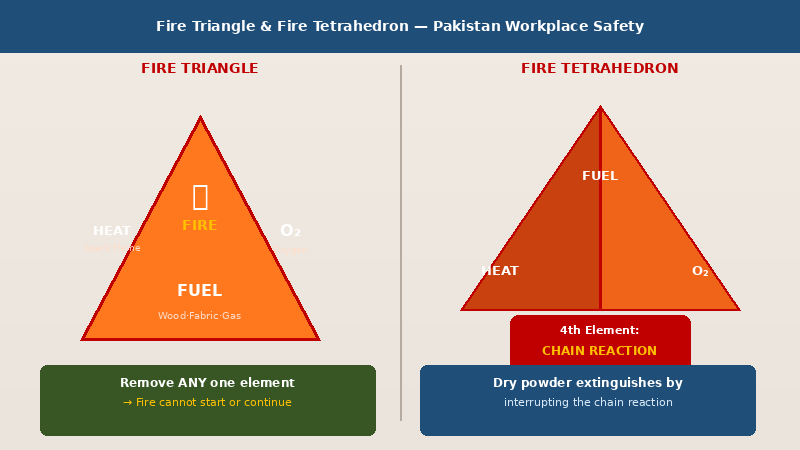
A fire normally requires three elements, known as the fire triangle:
- Fuel: Materials that can burn, including paper, wood, fabric, cardboard, flammable liquids and combustible dust.
- Heat: An ignition source such as a spark, hot surface, welding activity or electrical fault.
- Oxygen: Usually supplied by the surrounding air.
Removing or controlling one of these elements can prevent ignition or help extinguish a fire when the method is appropriate.
The fire tetrahedron adds a fourth element: the chemical chain reaction that sustains combustion. Some extinguishing agents interrupt this reaction.
For example, a textile factory should control fabric waste, maintain electrical equipment and separate hot work from combustible materials. These measures reduce the opportunity for a fire to start.
How to Conduct a Fire Risk Assessment: Five Essential Steps
Step 1: Identify Fire Hazards
Inspect the entire workplace rather than relying on previous reports. Check production areas, electrical rooms, storage facilities, kitchens, workshops and temporary work locations.
Common fire hazards in Pakistan include:
- Overloaded sockets and damaged electrical cables.
- Welding, grinding and cutting without suitable precautions.
- Improper storage of LPG cylinders and flammable liquids.
- Accumulated fabric waste in textile mills.
- Combustible packaging in warehouses.
- Poor housekeeping around machinery.
- Hot surfaces near combustible materials.
For construction projects in Rawalpindi and Lahore, inspect temporary electrical supplies, hot work areas and material storage. At oil and gas facilities, assess flammable liquids, gases and specialist process hazards.
Step 2: Identify People at Risk
Consider everyone who could be affected by a fire, including workers, contractors, visitors and members of the public where relevant.
Pay particular attention to:
- Night-shift and lone workers.
- Employees working in isolated or noisy production areas.
- People unfamiliar with emergency exits.
- Workers with disabilities or limited mobility.
- Contractors and visitors who may not understand the evacuation procedure.
Record how alarms will reach these individuals and how assistance will be provided without placing other workers at unnecessary risk.
Step 3: Evaluate Risks and Select Controls
Assess the likelihood of a fire and the severity of its potential consequences. Consider existing controls, their reliability and any gaps that require corrective action.
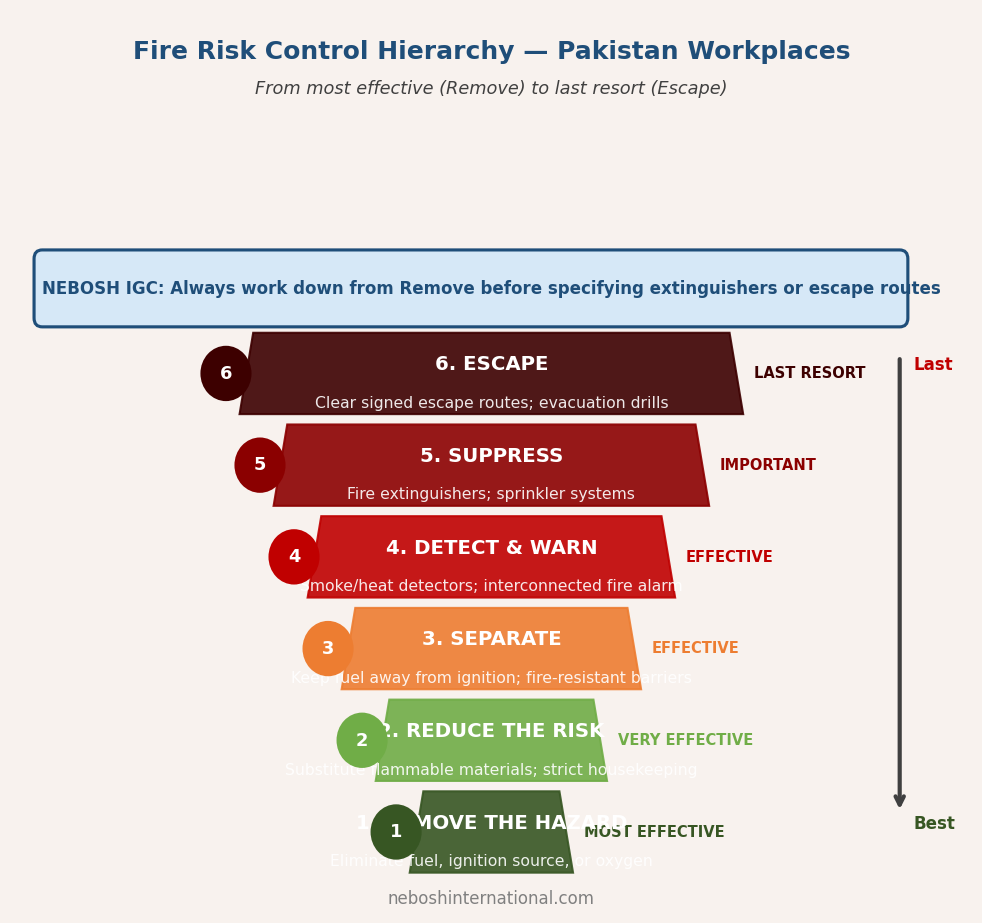
Apply the following hierarchy of practical fire prevention measures:
- Eliminate: Remove unnecessary combustible waste and avoid unnecessary ignition sources.
- Reduce: Substitute hazardous materials where practical and improve housekeeping.
- Separate: Keep flammable materials away from heat sources and hot work.
- Detect and warn: Provide suitable fire detection and alarm systems.
- Protect and suppress: Install appropriate fire protection equipment based on the assessed hazards and applicable standards.
- Prepare for escape: Keep suitable escape routes clear, provide exit signage and establish emergency procedures.
For instance, if welding takes place near stored packaging, stop the unsafe activity, clear combustible materials, implement an appropriate hot work permit procedure and verify precautions before work resumes.
Step 4: Prepare an Emergency Evacuation Plan
A fire assessment should lead to a practical emergency plan that workers understand.
The plan should identify:
- Escape routes and emergency exits.
- Suitable assembly points outside the danger area.
- Alarm activation and emergency communication procedures.
- Trained fire wardens or designated emergency personnel.
- Arrangements for assisting people who need support.
- Procedures for contacting emergency services.
- Headcounts and reporting missing persons.
- Fire drills, training and follow-up actions.
Escape routes must remain unobstructed. The number, location and capacity of exits should be determined by the building layout, occupancy, applicable requirements and assessment findings rather than assuming that every workplace has the same exit requirements.
Conduct drills at intervals appropriate to the risks and applicable requirements. Record observations, identify weaknesses and assign actions to improve emergency readiness.
Step 5: Record Findings and Review the Assessment
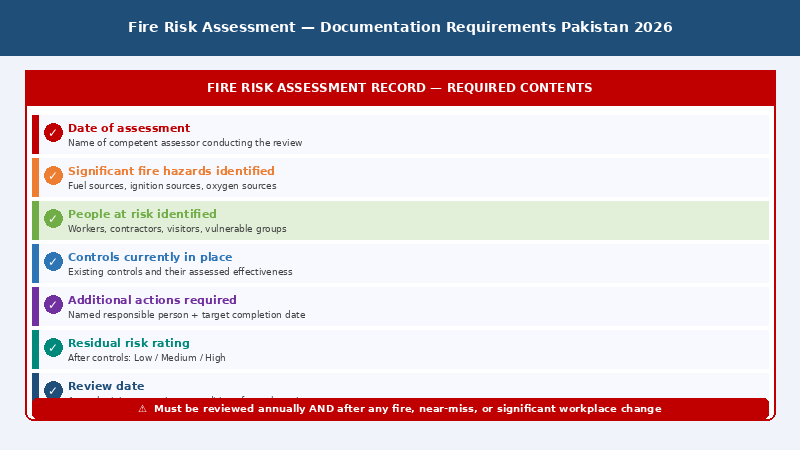
A useful fire risk assessment must produce clear, actionable records.
Include the following information:
- Assessment date and workplace location.
- Name of the assessor and relevant qualifications or experience.
- Identified fire hazards and people at risk.
- Existing controls and their effectiveness.
- Further actions required.
- The person responsible for each action.
- Target completion dates and verification records.
- Remaining risks and the review date.
Review the assessment after a fire, a significant near miss, building alterations, changes in processes, new chemical storage arrangements or other changes that could affect fire safety. Follow any additional review intervals required by applicable rules.
An assessment should be reviewed whenever necessary; an annual review can be a useful management practice but is not a universal substitute for applicable legal requirements or reviews triggered by changes.
Fire Extinguisher Types and Their Uses
Selecting the correct extinguisher is an important part of workplace fire safety. Suitability depends on the fuel involved, the electrical or chemical hazards present and the applicable fire classification system.
| Extinguisher type | Typical application | Important precaution |
|---|---|---|
| Water | Ordinary combustible materials such as wood and paper | Do not use on energised electrical equipment or incompatible liquid fires |
| Foam | Suitable solid-material and flammable-liquid fires | Check compatibility with the specific liquid |
| Carbon dioxide (CO₂) | Certain flammable-liquid and electrical-equipment fires | Limited cooling can allow re-ignition; avoid unsafe use in confined spaces |
| Dry chemical powder | Types of fires specified on the extinguisher label | Powder may reduce visibility and damage sensitive equipment |
| Wet chemical | Certain cooking-oil and fat fires | Use the correctly rated unit for the specific hazard |
Never choose an extinguisher based on colour alone. Check its label, fire rating and manufacturer’s instructions. Employees should only attempt to extinguish a small, developing fire when trained, authorised and able to do so safely with a clear escape route. Otherwise, raise the alarm and evacuate.
Arrange inspections, maintenance and testing in accordance with applicable requirements and manufacturer guidance. Remove defective or discharged units from service and arrange replacement or servicing promptly.
Fire Risk Assessment Examples in Pakistan
Textile factories in Faisalabad: Inspect fabric storage, waste accumulation, electrical equipment, machinery and escape routes. Introduce housekeeping controls, appropriate detection and emergency drills.
Construction projects in Rawalpindi and Lahore: Review hot work permits, temporary electrical installations, fuel storage, waste disposal and changing site layouts. Reassess risks as construction progresses.
Warehouses in Karachi: Examine storage arrangements, combustible packaging, access to fire equipment, emergency exits and the suitability of detection and suppression systems.
Oil and gas facilities: Assess flammable gases and liquids, process-specific ignition sources, hazardous areas and emergency response arrangements. Complex process hazards require appropriately qualified specialist input.
These examples are starting points, not substitutes for a site inspection and a risk assessment tailored to the actual workplace.
Fire Risk Assessment and NEBOSH IGC
Fire safety knowledge is relevant to safety officers who need to recognise hazards, evaluate risks and recommend suitable controls. The NEBOSH International General Certificate develops broader workplace risk assessment and health and safety management skills.
Under the revised 2026 qualification, the relevant units are GIC1 and GIC2. GIC2 involves a practical risk assessment and action plan. Learners should consult the official syllabus and assessment guidance for current requirements.
Explore the NEBOSH International General Certificate and our NEBOSH course fees in Pakistan guide.
NEBOSH International is an independent information and learner referral platform, not NEBOSH itself and not a certificate-issuing body.
Frequently Asked Questions
A documented assessment is an important part of effective fire safety management. The precise legal duties depend on the applicable provincial legislation, industry, building requirements and other relevant rules. Employers should verify the requirements that apply to their particular workplace.
Review it whenever hazards or workplace conditions change, after a fire or significant near miss, and whenever findings may no longer be reliable. Follow applicable legal and organisational review requirements.
Examples include defective electrical installations, overloaded circuits, combustible waste, unsafe hot work, poorly stored flammable materials and obstructed escape routes. The most significant hazards vary by industry and site.
A NEBOSH qualification can support relevant risk assessment knowledge. However, competence depends on the person’s training, practical experience, knowledge of the specific hazards and the complexity of the workplace. Specialist facilities may require additional expertise.
A fire risk assessment identifies hazards, evaluates risks and determines necessary controls at a workplace. A fire safety audit systematically checks fire safety arrangements against defined requirements or standards. The two activities complement each other.
Conclusion
A thorough fire risk assessment in Pakistan helps safety officers identify hazards before they cause injury, damage or business disruption. By inspecting the workplace, evaluating people at risk, selecting suitable controls, preparing evacuation arrangements and reviewing records, organisations can strengthen their fire prevention systems.
Whether you work in Faisalabad’s textile industry, a Karachi warehouse or a construction project in Lahore, focus on practical controls that address the actual hazards. Combine regular inspections, worker training and effective emergency planning to maintain safer workplaces.
For further learning, visit NEBOSH International and consult the official NEBOSH qualification guidance.

NEBOSH International General Certificate (IGC) certified HSE professional focused on occupational health and safety, workplace risk assessment, hazard identification, and safety management systems. The content published on NeboshInternational.com is based on current industry guidance, recognized safety best practices, and practical workplace examples to help professionals in Pakistan and the Gulf prepare for NEBOSH qualifications and build successful HSE careers.



3 Comments
Comments are closed.