Fire Extinguisher Types in Pakistan: Complete 2026 Safety Guide
Choosing the correct fire extinguisher is an essential responsibility for safety officers, supervisors and facility managers. For example, a construction site in Rawalpindi may contain timber, welding equipment, fuel containers and temporary electrical installations. Meanwhile, textile factories in Faisalabad may face different risks involving combustible fabrics, machinery and electrical panels. Since each workplace presents unique fire hazards, selecting extinguishers without a proper risk assessment may leave workers and property inadequately protected.
Understanding fire extinguisher types in Pakistan helps HSE professionals identify suitable firefighting equipment, improve emergency preparedness and reduce the risk of injury and property damage. Therefore, this guide explains fire classes, extinguisher types, workplace selection, placement, inspection and maintenance for Pakistani workplaces in 2026.
What Are the Main Types of Fire Extinguishers?
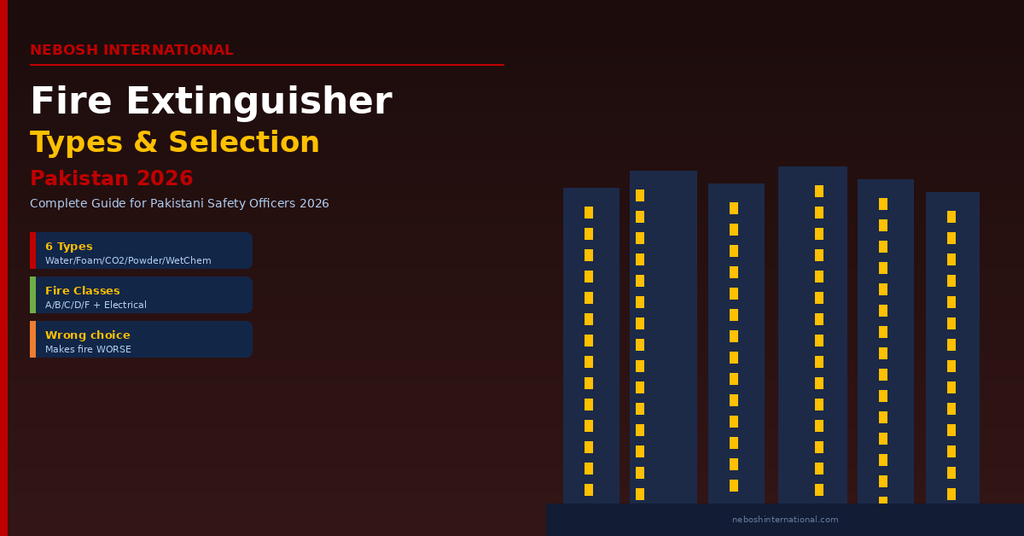
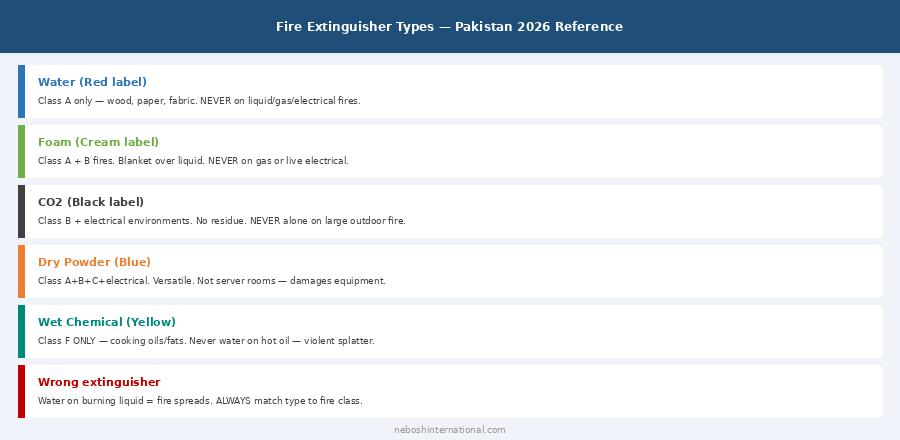
The main portable fire extinguisher types include water, foam, carbon dioxide (CO2), dry powder and wet chemical extinguishers. Each uses a different extinguishing agent and is designed for particular fire hazards.
The correct choice depends on the burning material, electrical risks, workplace conditions and the manufacturer’s instructions. A single extinguisher type should not automatically be installed throughout an entire facility.
Understanding Fire Extinguisher Classes
Before selecting equipment, a safety officer should identify the types of fires that could occur in the workplace.
| Fire class | Type of fire | Common workplace examples |
|---|---|---|
| Class A | Ordinary solid combustibles | Paper, wood, cardboard and textiles |
| Class B | Flammable liquids | Petrol, solvents, paint and oils |
| Class C | Flammable gases in commonly used UK-style classifications | LPG and propane |
| Class D | Combustible metals | Magnesium and certain metal-processing materials |
| Class F | Cooking oils and fats | Deep-fat fryers and commercial kitchens |
Important: Fire classification systems can differ by country and standard. Electrical equipment is not a separate fire class in the UK-style system shown above; it describes a hazard that affects extinguisher selection. Always check the applicable Pakistani requirements, the extinguisher label and competent fire-safety advice.
For example, a workshop in Lahore may face liquid-fuel and electrical hazards, while a commercial kitchen in Karachi may need specific protection against burning cooking oil. Assessors should identify each hazard separately during the risk assessment.
Five Main Fire Extinguisher Types and Their Uses
1. Water Fire Extinguishers
Water extinguishers cool burning materials and generally tackle Class A fires involving paper, wood and textiles. For this reason, they may suit offices, warehouses and storage areas where ordinary combustible materials pose the main risk. However, never use water on burning flammable liquids, cooking oil or energised electrical equipment.
Before installation, safety officers should verify that each water-based extinguisher matches the workplace’s actual fire hazards.
2. Foam Fire Extinguishers
Safety officers commonly select foam extinguishers for Class A and Class B risks when the product carries the appropriate fire ratings. Foam helps cool burning material and forms a layer that suppresses flammable liquid vapours.
Workshops, garages, paint-storage areas and facilities handling certain combustible liquids may benefit from suitable foam extinguishers.
However, conventional foam extinguishers should not be used on flammable gas fires or energised electrical equipment unless the equipment is specifically approved for that application. Selection should also consider chemical compatibility and environmental requirements.
3. Carbon Dioxide (CO2) Fire Extinguishers
Safety professionals often choose CO2 extinguishers for certain flammable liquid fires and electrical equipment risks. They leave no powder residue, making them useful around electrical panels and some sensitive equipment.
However, CO2 can create an asphyxiation hazard in confined spaces and is less effective outdoors because the gas disperses quickly. Its discharge horn can also become extremely cold.
For server rooms and control rooms, the fire protection plan should consider the room’s occupancy, equipment, ventilation and the suitability of alternative clean-agent systems. CO2 should not automatically be treated as the only appropriate option.
4. Dry Powder Fire Extinguishers
Dry powder extinguishers offer broad protection, but the powder type and the unit’s ratings determine which fires they can tackle. Some dry powder extinguishers tackle Class A, B and C fires, while other models handle different combinations of hazards.
They are commonly considered for construction sites, workshops, vehicle areas and certain industrial operations.
Nevertheless, powder can reduce visibility, irritate the respiratory system and contaminate machinery, electronic equipment and food-preparation surfaces. A versatile extinguisher does not necessarily offer the best protection at every location.
5. Wet Chemical Fire Extinguishers
Wet chemical extinguishers are specifically designed for cooking oils and fats, particularly fires involving deep-fat fryers. The agent helps cool the hot oil and forms a surface layer that reduces the chance of re-ignition.
Commercial kitchens, factory canteens, restaurants and workplace cooking facilities should be assessed for this hazard.
Never throw water onto burning cooking oil. It can cause violent splashing and spread the fire, potentially causing severe burns. Staff should follow the emergency procedure and use only suitable equipment if conditions permit safe intervention.
Which Fire Extinguisher Is Suitable for Different Pakistani Workplaces?
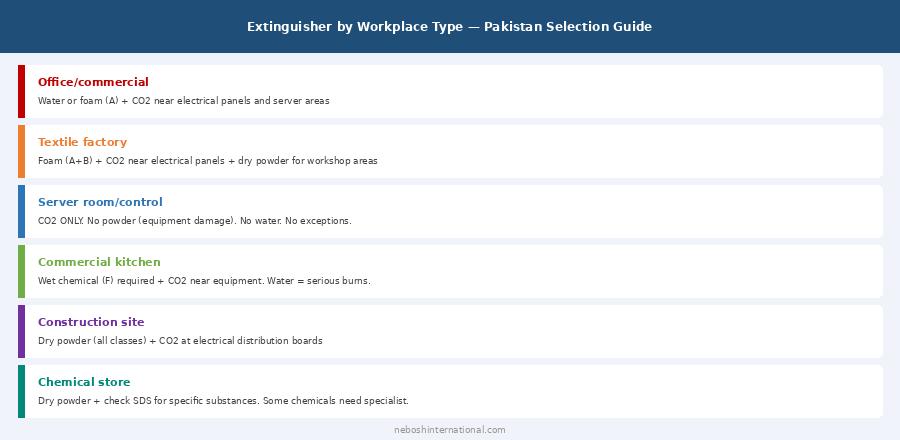
Safety officers can use the following table as a starting point for workplace fire-risk assessments. It is not a substitute for a competent assessment or confirmation of applicable local requirements.
| Workplace | Fire hazards to assess | Equipment considerations |
|---|---|---|
| Offices in Islamabad or Rawalpindi | Paper, furniture and electrical equipment | Water-based units for suitable Class A risks; CO2 or another approved option for electrical risks |
| Textile factories in Faisalabad | Fabric, packaging, machinery and electrical systems | Suitable Class A coverage and additional protection based on machinery and electrical hazards |
| Construction sites in Lahore | Timber, welding, fuel and temporary electrics | Appropriately rated extinguishers near relevant work areas, with hot-work controls |
| Workshops and garages in Karachi | Fuels, oils, solvents and electrical equipment | Suitable foam or dry powder units, depending on the identified hazards |
| Commercial kitchens | Burning cooking oils and ordinary combustibles | Wet chemical protection for cooking oil fires and suitable supplementary equipment |
| Server rooms and control rooms | Sensitive electronics and electrical equipment | CO2 or a suitable clean-agent system following a specialist assessment |
| Chemical storage areas | Flammable or reactive substances | Match each extinguisher to the chemical hazards and consult the relevant safety data sheets before selecting equipment. |
A workplace in Multan, Peshawar or another industrial city requires the same risk-based approach. Safety officers should match the extinguisher arrangement to the site’s actual activities rather than relying solely on its location or industry.
For a more detailed assessment process, read our related guide: Fire Risk Assessment in Pakistan: Complete Guide for Safety Officers.
Fire Extinguisher Placement Requirements
Correct placement helps workers locate equipment quickly during an emergency. Safety officers should position extinguishers in visible, accessible locations where users can reach them without facing unnecessary danger.
Safety officers should check the following points:
- Accessibility: Keep extinguishers clear of stored materials, vehicles, machinery and locked doors.
- Visibility: Provide suitable signs where equipment is difficult to see.
- Mounting: Use suitable brackets or stands and follow the manufacturer’s installation instructions and applicable standards.
- Risk-based positioning: Place equipment near relevant hazards and escape routes where appropriate, without requiring users to approach a developing fire.
- Changing conditions: Reassess placement when construction activities, storage arrangements or machinery locations change.
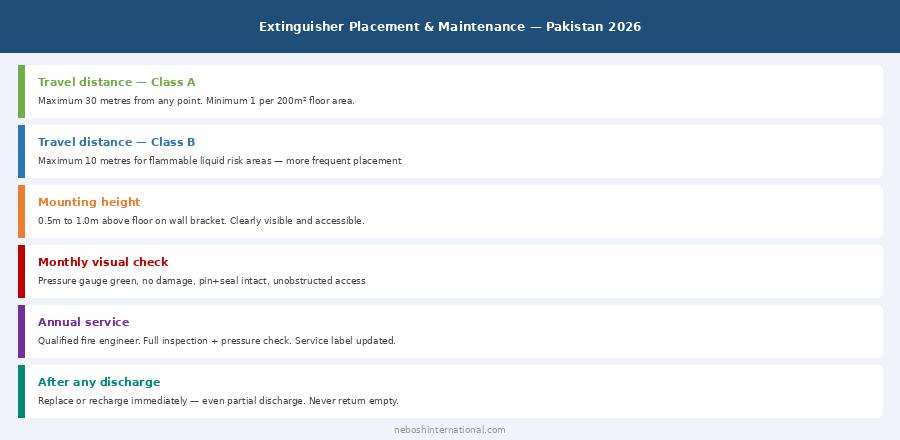
Do not apply one travel-distance or mounting-height figure universally. The applicable standard, extinguisher rating, building layout and risk assessment determine the requirements.
Fire Extinguisher Inspection and Maintenance
An extinguisher is useful only when it is suitable, accessible and in working condition. A practical inspection programme helps safety officers identify problems before an emergency occurs. During monthly checks, a competent person should inspect the extinguisher’s condition, pressure indicator where fitted, safety pin, tamper seal, hose and accessibility. In addition, staff should record defects and arrange corrective action promptly.
Monthly visual inspections
A designated, competent person should follow the inspection schedule and the manufacturer’s requirements. Typical checks include:
- Confirming the extinguisher is in its designated location.
- Checking for visible damage, corrosion or leakage.
- Checking the pressure indicator where fitted.
- Confirming the pin and tamper seal are intact.
- Ensuring the hose, nozzle and instructions are in satisfactory condition.
- Checking that access has not been obstructed.
- Recording defects and arranging corrective action.
Professional servicing
Ask a qualified fire-equipment service provider to service extinguishers at the intervals specified by applicable standards and the manufacturer. Keep service records and arrange all required testing.
Remove any extinguisher that has discharged, even partially, from service. Arrange a replacement or professional recharge before returning it to use. Do not assume that every extinguisher has the same expiry date or pressure-testing interval.
For further guidance, consult the National Fire Protection Association’s NFPA 10 standard, which addresses portable fire extinguisher selection, installation, inspection and maintenance.
What Should a Safety Officer Check During a Fire Safety Inspection?
During a workplace inspection, a safety officer should evaluate the complete fire protection arrangement rather than merely count the extinguishers on the walls.
Use this checklist as a starting point:
- Identify combustible materials, flammable liquids, gases and electrical hazards.
- Confirm that the extinguishers are rated for the identified risks.
- Check access, visibility, signage and mounting.
- Review inspection labels and maintenance records.
- Check whether employees understand alarm procedures and evacuation routes.
- Confirm that workers receive appropriate training and know when not to fight a fire.
- Record defects, assign corrective actions and follow up until they are resolved.
Fire extinguishers are only one part of workplace fire safety. Housekeeping, ignition-source control, hot-work permits, suitable storage, fire detection and safe evacuation arrangements are also important.
The UK government’s fire safety guidance for workplaces provides additional information about firefighting equipment, maintenance, drills and staff training. Use it as supplementary guidance, not as a replacement for Pakistani legal requirements.
How Does Fire Safety Knowledge Help NEBOSH IGC Candidates in Pakistan?
Fire safety knowledge is relevant to HSE professionals working in construction, manufacturing, warehousing, oil and gas, and commercial facilities. Candidates should understand how to identify fire hazards, assess risk and justify appropriate control measures.
The NEBOSH International General Certificate develops workplace health and safety knowledge, including risk assessment and the management of common hazards. Learners should consult the current syllabus and assessment guidance for the qualification they are studying.
For exam preparation, read our guide on How to Pass the NEBOSH Open Book Exam (IG1).
If you are comparing learning options, our NEBOSH IGC Pakistan course fees guide can help you explore course-cost considerations.
Frequently Asked Questions
The main types include water, foam, CO2, dry powder and wet chemical extinguishers. The correct choice depends on the fire risk and the product’s approved ratings.
CO2 is commonly used for suitable electrical-equipment fires. However, the equipment must be appropriate for the specific hazard, and electrical supplies should be isolated when safe to do so.
A suitable wet chemical extinguisher is commonly designed for cooking oil and fat fires. Never use water on burning cooking oil.
Workplaces should conduct routine visual checks and arrange professional servicing at the intervals required by applicable standards and manufacturer instructions. Monthly visual inspections are a common workplace practice.
The number depends on the building layout, fire risk, extinguisher rating, travel distances and applicable requirements. A competent assessment should determine the required number and placement.
No. Different areas may contain different fuels, electrical hazards or specialist risks. A combination of extinguisher types may be necessary.
Yes. Fire extinguisher knowledge helps safety officers identify fire hazards, inspect emergency equipment and support workplace fire prevention. Furthermore, this knowledge strengthens their ability to conduct risk assessments, explain emergency procedures and guide workers during fire safety training.
Conclusion
Choosing the right fire extinguisher plays an important role in protecting workers, property and business operations. Therefore, safety officers in Pakistan should identify potential fire hazards, select extinguishers with suitable ratings, maintain clear access and arrange regular inspections and professional servicing.
For example, a construction site in Rawalpindi may require different extinguishers from a textile factory in Faisalabad, a workshop in Karachi or an office in Lahore. By assessing each location’s specific risks, safety officers can improve fire preparedness and help workers respond appropriately during emergencies.
Finally, professionals who want to strengthen their workplace safety knowledge can explore NEBOSH International. Our platform provides independent NEBOSH course information and student guidance for people exploring health, safety and environmental (HSE) learning opportunities in Pakistan.

NEBOSH International General Certificate (IGC) certified HSE professional focused on occupational health and safety, workplace risk assessment, hazard identification, and safety management systems. The content published on NeboshInternational.com is based on current industry guidance, recognized safety best practices, and practical workplace examples to help professionals in Pakistan and the Gulf prepare for NEBOSH qualifications and build successful HSE careers.