Contractor Safety Management in Pakistan: Complete Guide for Safety Officers (2026)
Contractor safety management in Pakistan is the process of selecting competent contractors, assessing workplace risks, communicating safety requirements, monitoring work activities, and reviewing safety performance throughout a contract. It helps construction companies, factories, manufacturing plants, and oil and gas facilities protect employees, subcontractors, and other people affected by their operations.
In Pakistan, contractor management is particularly important on construction projects in Lahore, Karachi, Rawalpindi, Islamabad, Faisalabad, and other industrial centres. Multiple contractors may work in the same area, operate different equipment, and follow different procedures. Without proper coordination, these activities can create serious hazards.
For safety officers and HSE professionals, effective contractor management involves more than checking helmets and safety shoes. It requires planning, risk assessment, supervision, communication, and corrective action.
This guide explains how to manage contractors safely, develop a practical checklist, monitor performance, and apply health and safety principles in Pakistani workplaces.
What Is Contractor Safety Management?
Contractor safety management is a systematic approach to controlling the health and safety risks associated with work performed by external companies and subcontractors.
It begins before a contract is awarded and continues until the contractor completes the work and leaves the site.
A typical contractor management system includes:
- Contractor pre-qualification and competency checks.
- Risk assessments and method statements.
- Contractual health and safety requirements.
- Site induction and mobilisation.
- Permit-to-work controls for designated high-risk activities.
- Workplace inspections and toolbox talks.
- Incident reporting and corrective actions.
- Contractor performance reviews and closeout.
For example, a construction project in Lahore may employ separate contractors for scaffolding, electrical installation, welding, and lifting operations. The main contractor needs to coordinate their activities so that one team’s work does not expose another team to uncontrolled risks.
Why Is Contractor Safety Management Important in Pakistan?
Contractors often work in unfamiliar environments and may face hazards associated with changing work locations, tight deadlines, and coordination between several employers.
Common risks include:
- Falls from scaffolds, ladders, and unprotected edges.
- Electric shock from damaged cables or unsafe electrical work.
- Fire and explosions during hot work.
- Crushing injuries involving cranes, forklifts, and other machinery.
- Confined-space hazards, including oxygen deficiency.
- Exposure to chemicals, dust, excessive noise, and heat.
- Poor coordination between contractors working simultaneously.
These hazards can lead to injuries, operational disruption, property damage, and financial losses.
Pakistan’s construction sector also has a relevant regulatory development: in April 2026, the International Labour Organization reported government approval of a national Occupational Safety and Health Code of Practice for the construction sector. Employers and safety professionals should consult the applicable official requirements when developing project procedures.
External reference: International Labour Organization — Pakistan’s construction OSH Code of Practice.
Step 1: Contractor Pre-Qualification
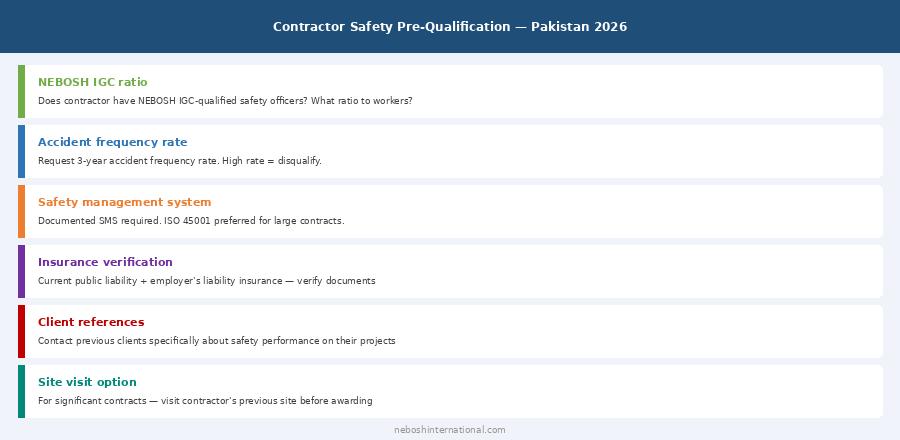
Contractor safety management should begin before a company awards the contract. Selecting a contractor solely because it offers the lowest price can create problems if it lacks suitable equipment, trained workers, or effective safety supervision.
Before approval, review the contractor’s:
- Previous health and safety performance.
- Relevant experience and project references.
- Safety management procedures.
- Worker training and competency records.
- Risk assessment and method statement capability.
- Equipment inspection and maintenance records.
- Emergency arrangements and incident reporting procedures.
- Insurance and other documentation required for the project.
For example, before appointing a scaffolding contractor in Karachi, check whether its workers have the required competency, its equipment is suitable, and its supervision arrangements match the complexity of the work.
Do not accept paperwork without checking whether it reflects the contractor’s actual capabilities.
Step 2: Establish Contractual Safety Requirements
Once the contractor has been selected, define safety responsibilities in the contract and supporting project documents.
Specify:
- Who prepares and approves risk assessments.
- Which activities require permits to work.
- What training and induction workers must complete.
- Which PPE and protective equipment are mandatory.
- How incidents and near misses must be reported.
- Who can stop unsafe work.
- How inspections and corrective actions will be managed.
- What happens when serious or repeated safety violations occur.
Responsibilities should be clear between the client, principal contractor, subcontractors, and site management.
Avoid treating a fixed safety-officer-to-worker ratio as a universal legal requirement. Staffing should reflect applicable law, client specifications, project risk, workforce size, and the nature of the work. Where a project specifies a minimum ratio, document and verify that requirement before mobilisation.
Step 3: Conduct Risk Assessments and Prepare Method Statements
Before work begins, assess the hazards associated with each contractor’s activities.
A suitable risk assessment identifies the hazard, who may be harmed, the existing controls, any additional measures required, and the person responsible for implementation.
A method statement should explain how the work will be carried out safely, including the sequence of activities, equipment, workforce, supervision, and relevant precautions.
For instance, a contractor carrying out welding at a manufacturing facility in Faisalabad may need controls for ignition sources, combustible materials, fire protection, ventilation, and nearby workers.
The safety officer should verify that the documents are suitable for the actual workplace. If conditions change, reassess the risks and revise the controls before continuing affected work.
Step 4: Complete Contractor Induction and Mobilisation
Every contractor worker should receive the required site induction before starting work.
The induction should cover:
- Site access, traffic routes, and restricted areas.
- Emergency alarms, evacuation routes, and assembly points.
- Mandatory PPE and site-specific hazards.
- Permit-to-work arrangements.
- Incident and near-miss reporting.
- First-aid facilities and emergency contacts.
- Housekeeping and prohibited activities.
Keep induction records and verify that workers understand the instructions. Where necessary, use demonstrations, visual materials, or a language the workforce understands.
A worker who has completed an induction at another project should not automatically be considered familiar with the new site’s hazards.
In addition, repeat briefings may be needed when work methods, equipment, site conditions, or emergency arrangements change.
Step 5: Monitor Contractor Activities on Site
Induction and documentation alone cannot guarantee safe work. Contractors must be monitored throughout the project.
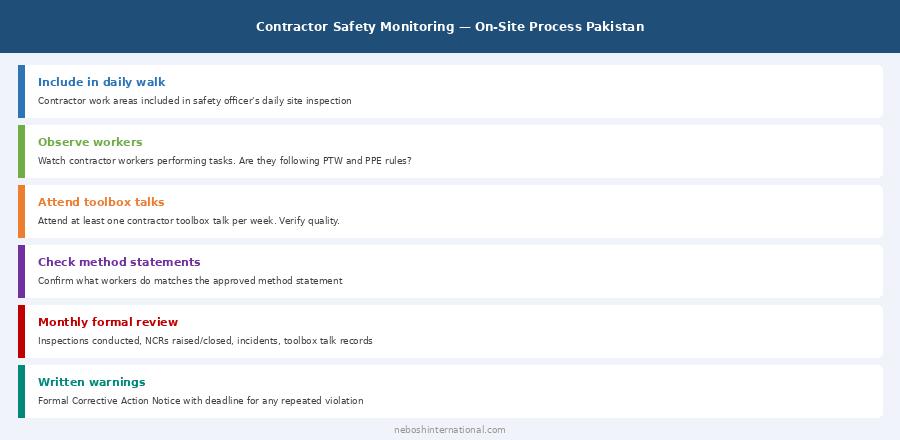
Daily monitoring
The safety officer or responsible supervisor should:
- Inspect contractor work areas.
- Check PPE and equipment condition.
- Verify compliance with permits and approved work methods.
- Observe lifting, work at height, electrical work, and other high-risk activities.
- Check housekeeping and access routes.
- Discuss unsafe conditions with supervisors and workers.
- Record findings and assign corrective actions.
Consider a multi-storey construction project in Rawalpindi. A contractor may have an approved scaffolding method statement, but an inspection could reveal a missing guardrail or an unsafe access point. The responsible team should control the immediate danger and correct the problem before the affected work resumes.
Permit-to-work coordination
Use a permit-to-work system for activities identified by site procedures as requiring formal authorisation, such as hot work, confined-space entry, or certain electrical and maintenance tasks.
A permit does not replace risk assessment, competent supervision, isolation, or other necessary controls.
Where several contractors share a work area, coordinate permits and simultaneous operations. For example, welding above another team’s work area may introduce falling-object and fire hazards that neither team can manage independently.
Step 6: Use a Contractor Safety Checklist
A consistent checklist helps safety officers verify that essential controls remain in place.
| Checkpoint | What to verify |
|---|---|
| Contractor approval | Competency, experience, and required documents |
| Risk assessment | Hazards, controls, and responsible persons |
| Method statement | Safe work sequence and suitable equipment |
| Induction | Required workers inducted and records retained |
| PPE | Suitable equipment provided and correctly used |
| Permits | Required permits authorised and conditions followed |
| Equipment | Inspection, maintenance, and safe operation |
| Supervision | Competent supervisors available |
| Emergency readiness | Procedures, communication, and access understood |
| Corrective actions | Findings assigned, tracked, and closed |
Adapt this checklist to the workplace and the contractor’s activities. A routine painting contractor and a confined-space maintenance contractor will not need identical controls.
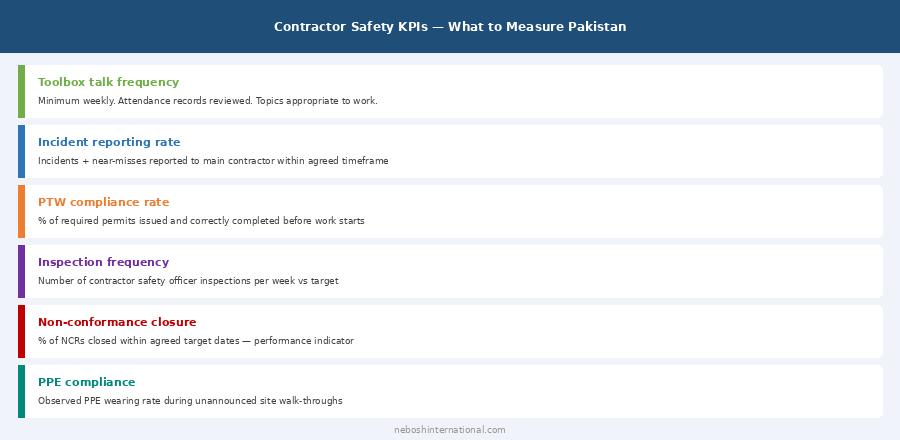
Step 7: Measure Contractor Safety Performance
A monthly performance review can help identify recurring problems and determine whether corrective actions are effective. High-risk projects may require more frequent reviews.
Useful performance indicators include:
- Inspections completed against the planned schedule.
- Safety observations and significant hazards identified.
- Corrective actions completed by their deadlines.
- Permit-to-work compliance.
- Induction and training completion.
- Reported incidents and near misses.
- Repeat findings and overdue actions.
Do not measure contractor performance only by the number of incidents. Low reporting figures do not necessarily prove that work is safe. Encourage honest reporting and investigate recurring hazards.
When the same violation continues, examine the underlying causes. The contractor may need better supervision, clearer procedures, additional training, suitable equipment, or more realistic work planning.
For serious uncontrolled hazards, stop the affected activity using the site’s established authority and escalation procedures. Document the decision, communicate with the responsible manager, and verify that the required controls are in place before work resumes.
Contractor Safety Management and NEBOSH IGC Pakistan
Contractor management is a practical application of health and safety management, risk assessment, safe systems of work, workplace monitoring, and incident prevention.
The official NEBOSH International General Certificate page explains how the qualification develops knowledge and skills for managing workplace risks and improving health and safety.
For Pakistani HSE professionals, applying these principles may be useful in construction, manufacturing, textiles, facilities management, and oil and gas operations. Employers in Pakistan and Gulf countries may also expect candidates to explain how they coordinate contractors, manage permits, investigate incidents, and close corrective actions.
For further reading, explore these related resources on NEBOSH International:
Frequently Asked Questions
Contractor safety management is the process of selecting competent contractors, assessing their work-related risks, communicating site requirements, monitoring activities, and reviewing safety performance throughout a contract.
Responsibilities depend on applicable law, contractual arrangements, and the role of each organisation. The client, principal contractor, subcontractors, and employers may have separate or overlapping duties. These responsibilities should be clearly established and verified against the requirements applicable to the project.
Common documents include risk assessments, method statements, worker competency records, equipment inspection documents, emergency arrangements, and any required insurance or approvals. The exact list depends on the activity, site rules, and applicable requirements.
Daily checks may be appropriate for active or high-risk work areas, while formal performance reviews may take place monthly. Inspection frequency should reflect the project’s risks, work activities, incidents, and client requirements.
No. A permit supports the control of designated hazardous activities, but it does not replace risk assessment, competent supervision, training, isolation, or physical safety precautions.
NEBOSH IGC develops knowledge relevant to risk assessment and health and safety management. Safety officers can apply this knowledge to contractor coordination, workplace inspections, safe systems of work, and performance monitoring. Practical experience and knowledge of site-specific requirements remain important.
Conclusion
Contractor safety management in Pakistan requires a planned system that covers contractor selection, risk assessment, contractual requirements, induction, site monitoring, and performance review. Each stage helps organisations identify hazards before they cause harm and clarify who must take action.
Whether you work on a construction project in Lahore, a manufacturing facility in Faisalabad, or an industrial site in Karachi, apply controls that match the actual risks and verify that workers follow them.
For HSE professionals, combining sound safety knowledge with practical contractor-management skills can strengthen workplace performance and support career development in Pakistan and the Gulf region. Use the checklist in this guide as a starting point, adapt it to your project, and review it whenever conditions change.

NEBOSH International General Certificate (IGC) certified HSE professional focused on occupational health and safety, workplace risk assessment, hazard identification, and safety management systems. The content published on NeboshInternational.com is based on current industry guidance, recognized safety best practices, and practical workplace examples to help professionals in Pakistan and the Gulf prepare for NEBOSH qualifications and build successful HSE careers.