How to Score a NEBOSH IGC Distinction in Pakistan: 7 Proven Tips for 2026
Scoring a NEBOSH IGC Distinction in Pakistan requires more than memorising health and safety definitions. Candidates need to understand the syllabus, interpret the examination scenario, answer command words correctly and apply their knowledge to realistic workplace situations.
For safety professionals in Karachi, Lahore, Islamabad, Rawalpindi, Faisalabad and other Pakistani cities, a strong NEBOSH result can be a valuable addition to their professional profile. It may also help when applying for health and safety roles in Saudi Arabia, the UAE, Qatar and other Gulf countries. However, employers also consider practical experience, technical knowledge, communication skills and the requirements of each vacancy.
The key to achieving a Distinction is to develop a repeatable exam technique. This guide explains the current GIC1 grade boundaries, seven practical preparation tips, common mistakes and a study plan for Pakistani candidates targeting a high result in 2026.
What Is a NEBOSH IGC Distinction?
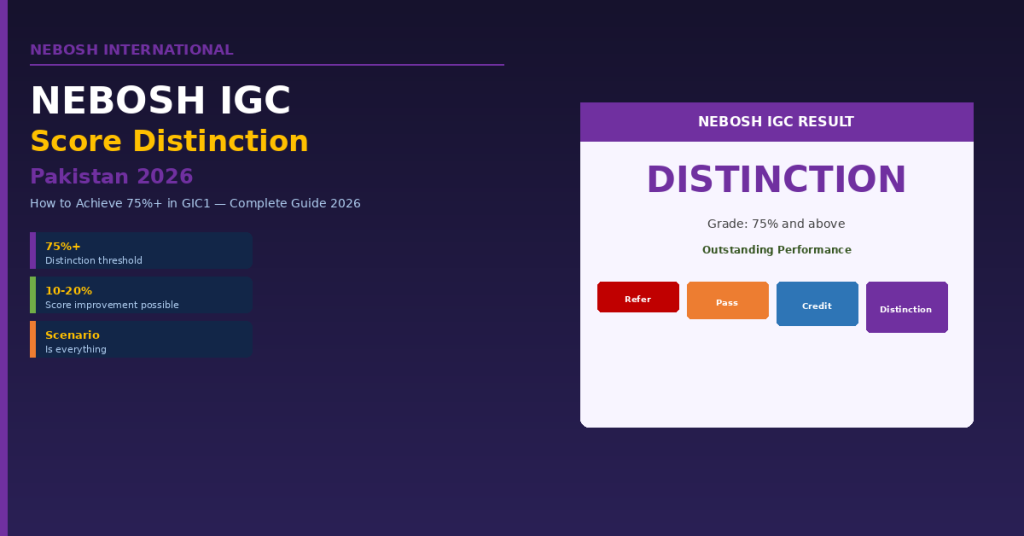
A NEBOSH International General Certificate Distinction is the highest qualification grade awarded under the applicable grading structure. For the revised General Certificate specification, the overall qualification grade is based on the GIC1 result, provided that the learner successfully completes both required units.
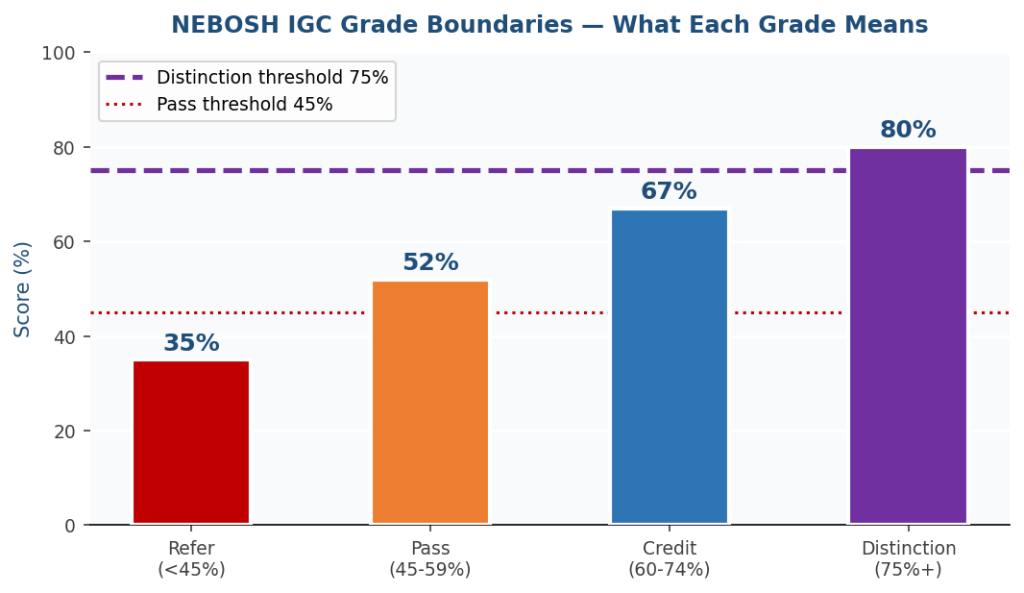
According to NEBOSH’s published grading information, the grade boundaries are:
| GIC1 result | Qualification grade |
|---|---|
| 75 marks or above | Distinction |
| 65–74 marks | Credit |
| 45–64 marks | Pass |
| Below the applicable pass standard | Refer |
These are the published boundaries; the final assessment outcome follows NEBOSH’s marking and standardisation procedures. A Distinction therefore requires a result of at least 75 marks in GIC1, alongside a successful GIC2 assessment.
For the latest qualification information, consult the official NEBOSH International General Certificate page.
Why Does a Distinction Matter for Pakistani HSE Professionals?
Pakistan’s health and safety professionals work across construction, manufacturing, textiles, engineering, logistics, energy and oil and gas. These industries require workers who can recognise hazards, assess risks and recommend effective controls.
A strong NEBOSH result can demonstrate that you have developed a good understanding of occupational health and safety principles. It may help distinguish your application when employers compare candidates with similar qualifications.
For example, a safety officer applying for a construction role in Rawalpindi may need to demonstrate an understanding of working at height, equipment safety and incident prevention. Similarly, a candidate applying to a textile factory in Faisalabad may need to understand machinery guarding, chemical exposure and workplace inspections.
However, a Distinction does not guarantee a job, a higher salary or selection for Gulf employment. Treat it as one part of your wider professional development.
7 Proven Tips to Score a NEBOSH IGC Distinction
1. Understand the GIC1 Assessment Before You Start
Before revising individual topics, understand how your assessment works. Under the revised specification, GIC1 assesses the management of health and safety through an open-book, scenario-based examination. NEBOSH also describes a closing interview as part of the assessment process.
Although the assessment is open-book, it is not simply an exercise in finding information. You must interpret the scenario, identify relevant issues and develop answers that demonstrate your understanding.
Start by reviewing the syllabus, assessment instructions and official learner guidance. Create a revision checklist covering the learning outcomes and topics you need to study.
Use the official NEBOSH digital assessments guidance to check the arrangements that apply to your assessment.
2. Connect Every Answer to the Scenario
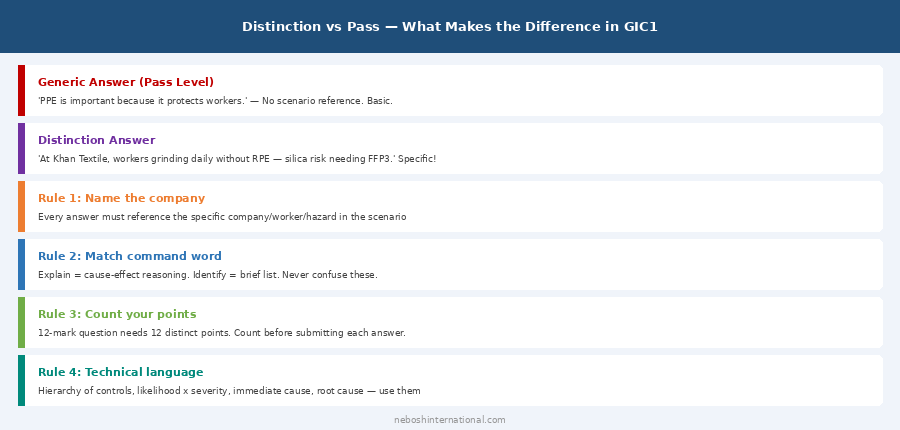
One of the most important skills in NEBOSH examinations is applying knowledge to the circumstances described in the question.
Consider a fictional textile factory in Faisalabad where workers operate machinery, handle cleaning chemicals and report repeated minor injuries.
A general answer might say:
“Regular safety inspections help identify hazards and prevent accidents.”
A stronger, scenario-based answer might say:
“Regular inspections of the factory’s machinery could identify missing guards before workers suffer entanglement injuries. Inspecting chemical storage could also reveal damaged containers or inadequate labelling, allowing management to correct the problems before workers experience harmful exposure.”
The second answer explains how inspections address the actual hazards in the example.
For every practice question, ask yourself three things:
- What specific detail from the scenario supports my answer?
- What health and safety principle applies?
- What consequence or improvement does my point explain?
This approach helps turn textbook knowledge into relevant, well-developed answers.
3. Follow the Command Word
Command words tell you what the question requires. Ignoring them can lead to incomplete answers or wasted time.
| Command word | What your answer should do |
|---|---|
| Identify | Name the relevant item or issue clearly. |
| Outline | Give the main features or key details. |
| Describe | Explain what something is like or how it occurs. |
| Explain | Give the reason or mechanism and develop the point. |
| Assess | Examine the relevant factors and reach a reasoned judgement where required. |
Always follow the wording and instructions in your actual assessment. Do not assume that every question requires a long paragraph.
For example, if a question asks you to explain why machinery guarding is important, writing only “it prevents injuries” may be insufficient. Develop the point by explaining how a suitable guard prevents contact with moving parts and reduces the risk of entanglement or crushing.
Practise answering different command words separately before combining them in a full mock examination.
4. Develop a Mark-Focused Answering Technique
Use the marks available to guide the depth and number of points in your response.
If a question carries 10 marks, aim to develop enough distinct, relevant points to address the question fully. However, do not assume that writing exactly 10 short sentences automatically earns 10 marks. Each point must be valid, relevant and sufficiently developed for the command word.
For an explanation question, a useful structure is:
Scenario detail → safety issue → reason or consequence.
For example:
- Scenario detail: Workers use a machine with an ineffective guard.
- Safety issue: The exposed moving parts create an entanglement hazard.
- Consequence: A worker’s clothing or hand could become caught, potentially causing serious injury.
Avoid repeating the same idea in different words. Instead, identify separate issues and explain each one clearly.
Before submitting an answer, check that you have addressed every part of the question and included enough relevant detail.
5. Use Technical Health and Safety Terminology Correctly
Accurate terminology helps you communicate your understanding clearly. However, technical words alone do not guarantee marks; you must use them appropriately.
Prioritise important concepts such as:
- Hazard identification and risk assessment.
- The hierarchy of controls.
- Elimination, substitution and engineering controls.
- Safe systems of work.
- Incident investigation and underlying causes.
- Monitoring, supervision and worker consultation.
- Emergency arrangements and incident prevention.
For example, when discussing a chemical hazard, distinguish between the hazardous substance, the route of exposure and the potential harm. Then explain how suitable controls could reduce exposure.
Similarly, when discussing working at height, consider whether the work can be avoided, whether collective fall prevention is suitable and what additional precautions are required.
Relate each concept to the question instead of inserting technical terms simply to make your answer sound more professional.
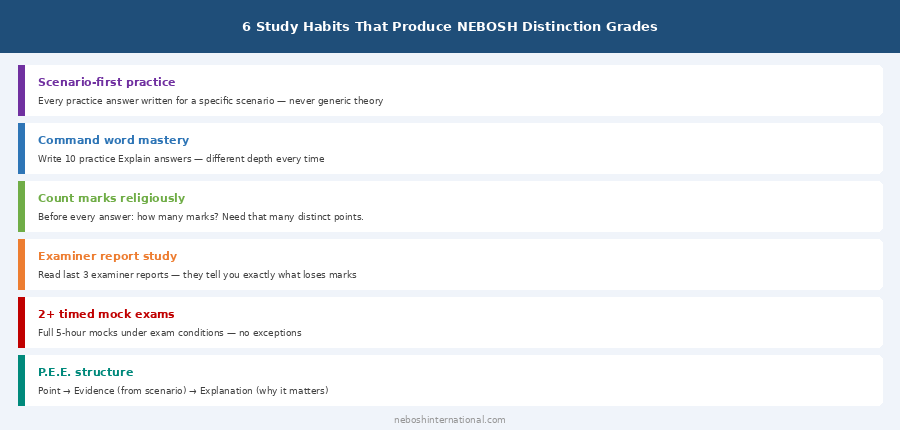
6. Practise Mock Assessments and Review Your Mistakes
Reading study notes can help you understand the syllabus, but written practice develops the skills needed for the assessment.
Complete practice questions under realistic time constraints. Afterwards, review your answers against the question requirements, relevant learning outcomes and feedback from a suitably qualified tutor.
Maintain a mistake log with four columns:
| Mistake | Why it matters | Improvement |
|---|---|---|
| Generic answer | Does not apply the scenario | Add specific evidence from the question. |
| Wrong command word | Does not meet the task requirement | Practise the command word separately. |
| Repeated points | Adds little new information | Identify distinct hazards or consequences. |
| Poor time management | Leaves tasks incomplete | Allocate time according to marks and complexity. |
Where available, review official NEBOSH assessment guidance and examiner feedback. These resources can help you understand common weaknesses and improve your approach.
Do not judge your readiness by the number of hours you study alone. Measure progress by the quality, relevance and completeness of your answers.
7. Follow a Realistic Revision Plan
Pakistani candidates often prepare while working full-time in construction, manufacturing, engineering or other demanding roles. A manageable study routine is therefore more useful than an unrealistic timetable.
Here is a four-week revision framework that you can adapt to your course schedule.
| Week | Main focus | Practical target |
|---|---|---|
| Week 1 | Syllabus and core concepts | Prepare topic summaries and a revision checklist. |
| Week 2 | Command words and scenario application | Complete short questions and review each answer. |
| Week 3 | Timed practice | Attempt longer questions and identify recurring weaknesses. |
| Week 4 | Final review | Revisit weak topics, practise answer planning and confirm assessment instructions. |
This is a suggested study plan, not an official NEBOSH timetable. Adjust it according to your existing knowledge, available study time and tutor’s advice.
If you work on a construction project in Rawalpindi, for example, you could use familiar workplace situations to practise identifying hazards and selecting suitable controls. Candidates in Karachi’s industrial areas or Faisalabad’s textile sector can use relevant workplace examples in the same way.
Remember, examples should support your understanding. In the examination, your answers must address the scenario actually provided.
Common Mistakes That Prevent Candidates from Achieving a Distinction
Even well-prepared candidates can lose marks when their exam technique is weak. Watch out for these common problems:
- Memorising model answers: A different scenario may require a different application of the same principle.
- Writing irrelevant information: Extra detail does not necessarily improve an answer if it does not address the question.
- Ignoring part of a question: Read the entire task and identify all its requirements before drafting a response.
- Repeating the same point: Rewording one idea does not automatically create several distinct answers.
- Relying entirely on notes: Open-book assessment still requires independent understanding and clear reasoning.
- Skipping review: A final check can reveal missing points, unclear explanations and incomplete responses.
To improve, review every practice answer critically. Ask whether it answers the exact question, uses relevant scenario evidence and explains the safety issue clearly.
Frequently Asked Questions
Under the revised General Certificate grading structure, a learner needs at least 75 marks in GIC1 for a Distinction, as well as a successful GIC2 assessment to complete the qualification. Check the official NEBOSH guidance for the specification under which you are registered.
Yes. Working full-time does not automatically prevent you from achieving a Distinction. A structured revision plan, regular practice and focused review can help you prepare around your working hours. Your result will depend on your understanding, preparation and assessment performance.
No. Employers set their own recruitment requirements. A Distinction may strengthen your academic profile, but relevant experience, communication skills, industry knowledge and the vacancy’s qualification requirements also matter.
NEBOSH provides arrangements for resitting units, including for grade improvement, subject to its applicable rules and deadlines. Before registering, confirm the current policy with NEBOSH or your Learning Partner. Review the official NEBOSH qualification and assessment information before making a decision.
Study all the required learning outcomes rather than relying on predictions about which topics will appear. Pay particular attention to applying risk assessment principles, selecting appropriate controls, understanding management responsibilities and explaining how hazards can lead to harm.
Conclusion: Prepare for the Result You Want
Achieving a NEBOSH IGC Distinction in Pakistan starts with a clear understanding of the assessment and consistent practice. Focus on scenario-based answers, command words, relevant technical terminology and a sensible allocation of time.
Whether you are preparing in Lahore, Karachi, Rawalpindi, Islamabad, Faisalabad or elsewhere in Pakistan, use your revision time to improve the quality of your answers rather than simply memorising more notes.
Start with the official NEBOSH International General Certificate guidance, then practise applying the concepts to realistic workplace situations.
For further preparation, read our NEBOSH IGC open-book examination guide and explore our NEBOSH IGC guide for engineers in Pakistan.
Once you have completed your qualification, you can also explore our guide to safety officer jobs in Pakistan for NEBOSH professionals to understand potential career paths.
Your goal should be more than achieving a high mark. Build the practical knowledge and clear reasoning skills that help you become a capable health and safety professional.

NEBOSH International General Certificate (IGC) certified HSE professional focused on occupational health and safety, workplace risk assessment, hazard identification, and safety management systems. The content published on NeboshInternational.com is based on current industry guidance, recognized safety best practices, and practical workplace examples to help professionals in Pakistan and the Gulf prepare for NEBOSH qualifications and build successful HSE careers.