Workplace Incident Investigation in Pakistan: 6 Steps for Safety Officers (2026)
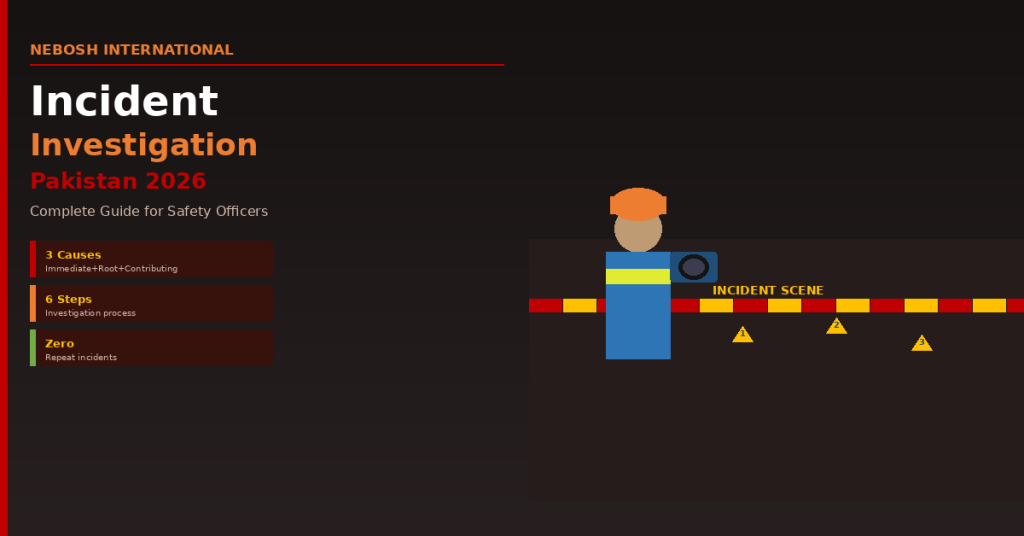
A workplace incident can reveal serious weaknesses in a company’s health and safety arrangements, even when nobody suffers an injury. For safety officers in Pakistan, workplace incident investigation is an essential skill for identifying hazards, understanding why an event occurred and preventing similar incidents.
Consider a construction project in Lahore where a worker slips while carrying materials across an untidy access route. The worker escapes with a minor injury, but the investigation reveals that housekeeping inspections were irregular, walkways were obstructed and supervisors had not corrected previously reported hazards.
Blaming the worker would overlook these failures. A proper investigation examines both the immediate circumstances and the underlying reasons behind them.
This guide explains the seven steps of workplace incident investigation in Pakistan, including near-miss reporting, evidence collection, root cause analysis, corrective actions and practical applications for NEBOSH IGC learners.
What Is Workplace Incident Investigation?
Workplace incident investigation is a systematic process used to establish what happened, identify the factors that contributed to an event and determine how similar incidents can be prevented.
The investigation may cover workplace injuries, occupational illnesses, dangerous occurrences, property damage and near-misses. Its purpose is not simply to complete paperwork or identify someone to blame. Instead, it should reveal weaknesses in risk controls, work procedures, supervision, equipment or management arrangements.
The International Labour Organization (ILO) incident investigation guidance explains how systematic investigations can identify causes and support preventive action.
In Pakistan, this approach is relevant to construction projects in Lahore and Rawalpindi, textile factories in Faisalabad, manufacturing facilities in Karachi and industrial operations involving hazardous energy or equipment.
Why Should Safety Officers Investigate Near-Misses?
A near-miss is an unplanned event that causes no injury or damage but could have produced harmful consequences under slightly different circumstances.
For example, a suspended load may swing close to a worker without striking anyone. Although no injury occurs, the event could reveal problems with lifting arrangements, exclusion zones, communication or supervision.
Investigating near-misses helps organisations identify weaknesses before they lead to more serious outcomes. The ILO recommends investigating incidents to understand why existing controls failed and what improvements are necessary.
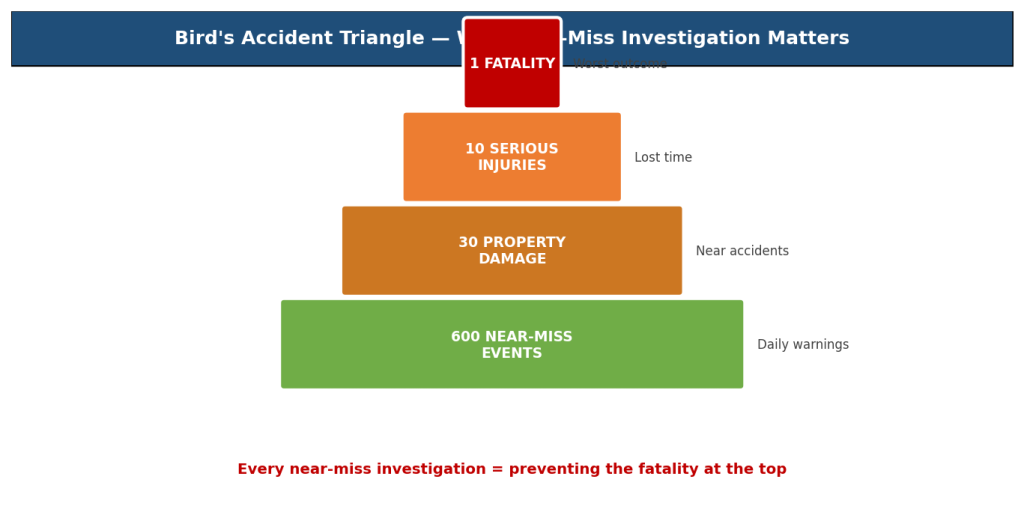
The accident triangle, sometimes associated with Heinrich or Bird, is also discussed in safety training. However, its numerical ratios should not be treated as universal predictions of how many near-misses will precede a serious accident.
Practical rule: Report and assess near-misses according to their potential consequences, not only the harm that actually occurred.
Six Steps in the Workplace Incident Investigation Process
Step 1: Make the Area Safe and Arrange Medical Assistance
The first priority is protecting people from further harm. Arrange first aid or emergency medical assistance, stop dangerous activities and isolate affected equipment where necessary.
Secure the scene and restrict access until the responsible personnel determine that it is safe. Preserve the original conditions as far as reasonably possible, but never delay lifesaving assistance to protect evidence.
For example, after an electrical incident at a Karachi factory, the team should isolate the electrical supply safely before inspecting the equipment. Only competent, authorised personnel should handle electrical isolation and testing.
Record any changes made to the scene during emergency response so that investigators can distinguish original conditions from subsequent safety measures.
Step 2: Collect and Preserve Evidence
Reliable evidence helps investigators establish the sequence of events instead of relying on assumptions.
Collect relevant information as soon as practicable, including:
- Photographs and videos: Record the work area, equipment, access routes and relevant hazards.
- Witness statements: Interview people separately and ask open questions about what they saw or heard.
- Physical evidence: Examine damaged equipment, failed components, tools or materials when safe.
- Workplace records: Review risk assessments, permits to work, inspection reports, maintenance logs and training records.
- Environmental information: Record relevant lighting, weather, noise, visibility and working conditions.
For example, an incident during lifting operations may require a review of the lifting plan, equipment inspection records, operator competence and communication arrangements.
Keep a record of who collected each item of evidence and when it was obtained. Protect confidential information and avoid altering or discarding relevant evidence.
Step 3: Establish What Happened
Prepare a factual timeline showing the activities before, during and after the incident.
Investigators should establish who was involved, where and when the event occurred, what happened, how the event developed and why the existing controls did not prevent it.
Separate confirmed facts from witness interpretations and assumptions. Where accounts differ, investigate the differences rather than forcing witnesses to agree.
For instance, if a worker falls from a scaffold, establish the platform condition, access arrangements, edge protection, inspection history and work activity. Avoid blaming the worker without first examining the underlying causes of the incident.
A clear timeline creates the foundation for meaningful root cause analysis.
Step 4: Identify Immediate, Underlying and Root Causes
One of the most important incident investigation skills is distinguishing the event’s immediate cause from the conditions and management failures behind it.
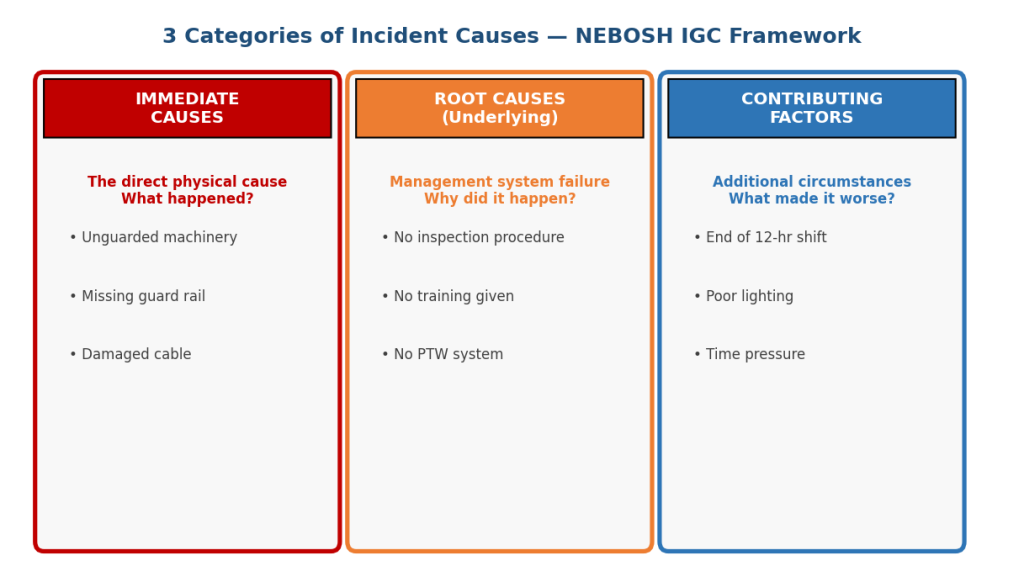
Immediate causes are the direct hazardous conditions or actions associated with the event. Examples include an obstructed walkway, missing edge protection or contact with moving machinery.
Underlying causes are contributing weaknesses, such as inadequate supervision, insufficient training, poor maintenance or an ineffective inspection process.
Root causes are the deeper organisational or system failures that allowed those weaknesses to remain. These might include unclear responsibilities, inadequate resource allocation or a risk management process that does not identify and correct recurring hazards.
Consider the following example:
- Incident: A worker slips on a construction access route.
- Immediate cause: Loose materials obstruct the walkway.
- Underlying cause: Workers repeatedly leave materials in the access route.
- Possible root cause: The site lacks effective material storage arrangements, clear housekeeping responsibilities and routine inspections.
The investigator should verify these findings using evidence. A root cause must not simply be assumed because it sounds plausible.
Ask “Why? Continue investigating until you identify a root cause that can be corrected through practical action. More than one root cause may contribute to an incident.
Step 5: Recommend Effective Corrective Actions
Corrective actions should address the identified causes and reduce the likelihood of recurrence.
For the obstructed walkway example, possible measures include:
- Remove the materials and restore safe access immediately.
- Establish designated storage areas close to work activities.
- Assign responsibility for maintaining access routes.
- Introduce documented housekeeping inspections.
- Review the site risk assessment and check whether the arrangements work across other areas.
Apply the hierarchy of controls when selecting measures. Eliminating the hazard or introducing suitable engineering controls will often provide more reliable protection than relying exclusively on warnings, PPE or worker reminders.
Assign each action to a named responsible person, set a realistic completion date and identify the evidence required to demonstrate completion.
Avoid vague recommendations such as “be more careful” or “improve safety awareness” unless they form part of a specific, evidence-based plan.
Step 6: Prepare the Report, Share Findings and Verify Actions
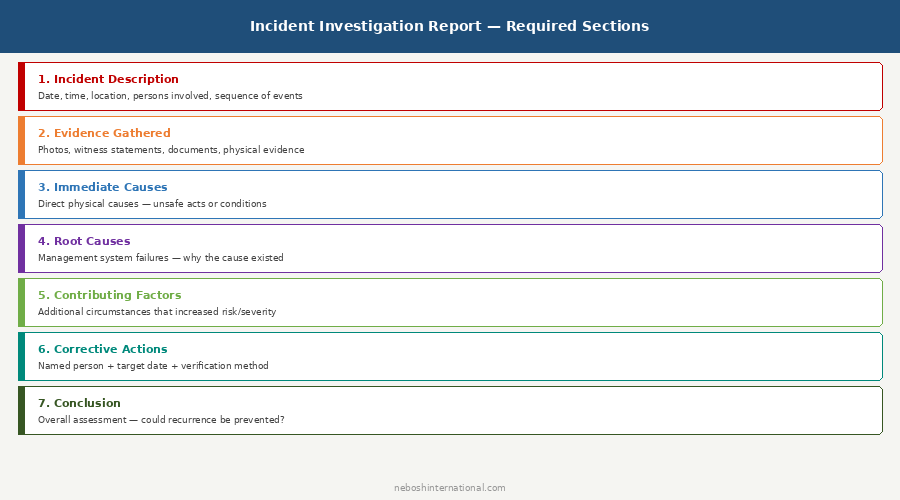
An incident investigation report should explain what happened, identify the causes and describe the corrective actions required to prevent recurrence.
Include the incident date, time and location, evidence collected, immediate and root causes, corrective actions, responsible persons and completion deadlines.
Share relevant findings through toolbox talks, safety meetings and other appropriate communication channels. For example, a manufacturing facility in Faisalabad could use lessons from a machine-guarding incident to inspect similar equipment across other production lines.
However, completing the report is not the final step. Verify that corrective actions have been implemented and are effective. Inspect the affected area, review updated procedures and check maintenance or training records where relevant. If a new machine guard has been installed, confirm that it provides the intended protection.
Review the risk assessment when the investigation identifies ineffective controls or previously unrecognised hazards. Record outstanding actions and escalate overdue measures.
The ILO guidance on corrective action provides further guidance on implementing improvements and checking their effectiveness.
Workplace Incident Investigation and NEBOSH IGC
Incident investigation is relevant to health and safety training because it develops the ability to analyse workplace conditions, evaluate risk controls and recommend preventive measures.
NEBOSH IGC learners can apply these skills when studying workplace scenarios and preparing answers that require them to identify hazards, explain failures in existing arrangements or recommend improvements.
For example, a scenario involving a fall from height may require consideration of edge protection, safe access, supervision, inspection arrangements and the adequacy of the risk assessment.
Candidates should follow the current assessment instructions and apply their knowledge to the evidence presented in each question. A generic list of safety precautions will not necessarily address the particular problems described in a scenario.
Learners in Pakistan can explore the NEBOSH IGC course and fee guide for information about studying with an appropriate learning provider.
Frequently Asked Questions
The six steps are making the area safe, collecting evidence, establishing what happened, identifying causes, recommending corrective actions, reporting and sharing findings, and verifying that corrective actions work.
Yes, near-misses should be reported and assessed under the workplace’s incident management arrangements. Events with serious potential consequences may warrant a detailed investigation even when nobody was injured.
A competent person with suitable knowledge, authority and access to relevant evidence should lead the investigation. Serious or complex incidents may require management, technical specialists, worker representatives and other relevant parties.
The timescale depends on the incident’s severity, complexity, evidence requirements and applicable reporting obligations. Secure the scene and preserve evidence promptly. Set a documented deadline for the full investigation rather than treating one universal timeframe as suitable for every event.
Legal duties depend on the applicable federal or provincial legislation, the type of workplace and the nature of the incident. Certain events may require notification to the relevant authority. Employers should verify the applicable requirements rather than assume that every incident follows the same reporting procedure.
An immediate cause is directly associated with the incident, such as an obstructed walkway. A root cause is a deeper system failure that allowed the hazard to persist, such as ineffective housekeeping responsibilities or inadequate inspection arrangements.
Conclusion
Workplace incident investigation in Pakistan helps safety officers move beyond recording injuries and identifying immediate hazards. A systematic process examines evidence, identifies underlying failures, establishes effective corrective actions and checks whether those actions prevent recurrence.
Whether you work on a construction project in Lahore, a textile factory in Faisalabad or an industrial site in Karachi, the objective remains the same: learn from incidents and improve workplace risk controls.
For further guidance, explore the NEBOSH International website for independent information about NEBOSH qualifications, course options and health and safety learning in Pakistan.

NEBOSH International General Certificate (IGC) certified HSE professional focused on occupational health and safety, workplace risk assessment, hazard identification, and safety management systems. The content published on NeboshInternational.com is based on current industry guidance, recognized safety best practices, and practical workplace examples to help professionals in Pakistan and the Gulf prepare for NEBOSH qualifications and build successful HSE careers.