Mental Health at Work in Pakistan 2026: A Practical Guide for Safety Officers
Mental health at work in Pakistan is an important part of occupational health and safety in 2026. Workplace stress, excessive workloads, fatigue, bullying and poor communication can affect workers’ wellbeing, concentration and ability to perform tasks safely. Therefore, safety officers must understand how psychosocial hazards arise, how to assess workplace risks and how to recommend effective controls.
Consider a construction site in Lahore where workers face tight deadlines, extended shifts and constant pressure to complete activities. The scaffolding may be secure, the personal protective equipment (PPE) may be available, and the machinery may pass inspection. However, tired workers and unclear instructions can still contribute to mistakes and incidents.
This is why modern HSE management must address both physical hazards and psychosocial risks. For professionals researching NEBOSH International Pakistan, this topic also demonstrates how occupational health and safety extends beyond traditional inspections, fire prevention and PPE compliance.
This guide explains common workplace mental health risks in Pakistan, practical prevention measures, and the role of safety officers in construction, manufacturing, textiles and oil and gas.
What Is Mental Health at Work?
Mental health at work refers to how workplace conditions can affect a person’s psychological wellbeing, ability to cope with work demands, relationships and performance. A supportive workplace can promote wellbeing, while poor working conditions can increase the risk of stress and other mental health difficulties.
The World Health Organization (WHO) identifies excessive workloads, long working hours, low job control, job insecurity, bullying and limited management support as potential risks to mental health at work.
Psychosocial hazards are workplace conditions or practices that can cause psychological or physical harm. They should be considered alongside conventional occupational hazards during workplace risk assessments.
For example, a worker operating machinery may have received suitable training but still face increased risk if they are exhausted, distracted or afraid to report a fault. Consequently, effective risk management must examine not only equipment and procedures but also how work is organised.
Common Psychosocial Hazards in Pakistani Workplaces
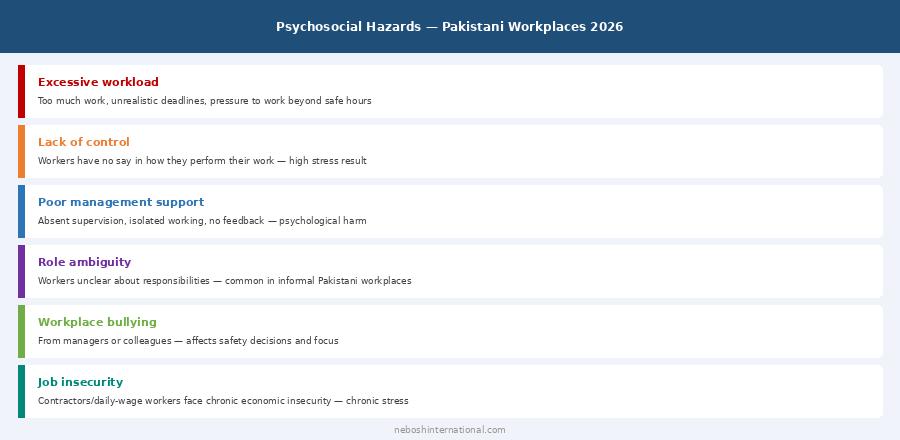
The main psychosocial hazards that safety officers should consider include:
- Excessive workload: Unrealistic targets, understaffing and persistent pressure to finish tasks quickly.
- Long working hours: Extended shifts, frequent overtime and insufficient recovery between shifts.
- Poor supervision: Aggressive communication, unclear instructions and limited support from managers.
- Bullying and harassment: Intimidation, humiliation, discrimination or inappropriate behaviour by colleagues or supervisors.
- Low job control: Workers have little opportunity to raise concerns or influence how tasks are completed.
- Job insecurity: Fear of losing employment, particularly among temporary, contract and daily-wage workers.
- Role confusion: Workers do not understand their responsibilities, reporting lines or safety instructions.
- Poor work-life balance: Shift patterns, commuting demands and excessive overtime leave inadequate time for recovery.
These risks may occur in any sector. However, their practical effects can differ between workplaces.
For example, construction projects in Lahore and Rawalpindi may experience pressure from project deadlines and subcontractor coordination. Textile facilities in Faisalabad may need to consider shift schedules, repetitive tasks, noise and production targets. Industrial operations in Karachi may need to examine fatigue, staffing arrangements and the quality of supervision.
These are risk scenarios to assess rather than assumptions about every Pakistani workplace.
Why Mental Health Matters for Workplace Safety
Work-related stress and fatigue can affect attention, communication, decision-making and reaction time. In safety-critical environments, these effects can increase the likelihood of mistakes.
Consider three examples:
- Construction: An exhausted worker may overlook a change in working-at-height conditions or fail to follow an established access procedure.
- Manufacturing: A distracted machine operator may miss a warning signal or make an error while handling equipment.
- Oil and gas: Fatigue during demanding operational schedules may affect communication, handovers and responses to abnormal conditions.
Mental health concerns can also affect attendance, teamwork, morale and staff retention. Nevertheless, an accident or performance problem should never automatically be attributed to a worker’s mental health. Safety officers should investigate the immediate and underlying causes, including equipment, procedures, training, workload and supervision.
For further reading, see our guide to Contractor Safety Management in Pakistan and review the relevant contractor management resources available on NEBOSH International.
Signs of Work-Related Stress Safety Officers Should Recognise
Safety officers are not responsible for diagnosing mental health conditions. Their role is to identify potential workplace risks, listen to concerns and refer workers to the appropriate support.
Individual warning signs
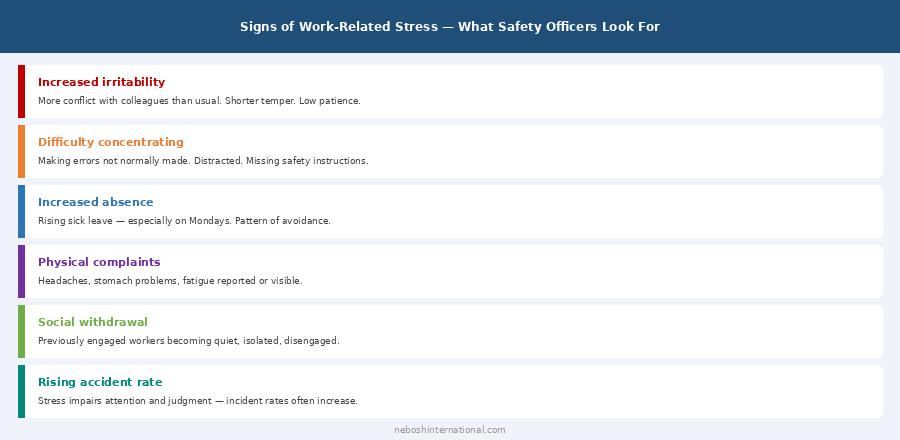
Possible warning signs include:
- Unusual irritability or increased conflict with colleagues.
- Difficulty concentrating or repeated errors.
- Persistent tiredness or reports of inadequate rest.
- Withdrawal from normal workplace communication.
- Frequent absence or changes in attendance patterns.
- Workers reporting that workload or supervision is affecting their ability to work safely.
These signs are not proof of a mental health condition. A worker may be experiencing a medical problem, a temporary personal difficulty or another workplace issue.
Organisational warning signs
Safety officers should also review broader workplace patterns, including:
- An increase in near misses or recurring procedural errors.
- Rising absence or employee turnover.
- Repeated complaints about workload or supervisor behaviour.
- Poor communication during shift handovers.
- Frequent overtime and inadequate staffing.
- Workers avoiding hazard reporting because they fear negative consequences.
If several workers report similar problems, management should investigate the work system rather than assuming the issue is limited to individual behaviour.
How to Control Psychosocial Hazards at Work
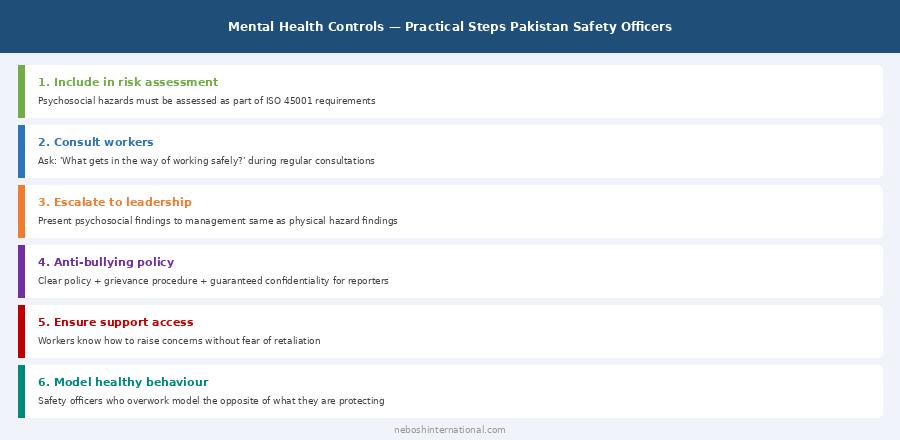
The preferred approach is to identify and reduce the workplace conditions creating the risk. General wellbeing advice alone cannot correct unsafe staffing levels, bullying or unrealistic deadlines.
1. Review workloads and shift patterns
Management should assess staffing levels, overtime, shift duration, rest opportunities and the demands of safety-critical tasks. Where fatigue is identified, revise schedules and work arrangements according to the risk and applicable requirements.
2. Improve supervision and communication
Supervisors should provide clear instructions, reasonable expectations and respectful feedback. Workers should have practical ways to raise concerns without fear of retaliation.
3. Prevent bullying and harassment
Establish clear behavioural standards, confidential reporting options and fair investigation procedures. Managers should communicate that intimidation and harassment are unacceptable.
4. Involve workers in risk assessments
Consult employees about workload, task demands, shift arrangements and workplace communication. Workers often identify problems that a routine physical inspection cannot reveal.
5. Provide appropriate support
Explain how workers can access HR, occupational health services, counselling or qualified mental health professionals where available. Mental health awareness training can help staff recognise concerns and understand how to seek assistance.
6. Monitor whether controls work
Review complaints, overtime records, absence trends, near-miss reports and worker feedback. Protect confidential information and avoid using these indicators to label or punish individual workers.
For a wider overview of safety management, read our resources on NEBOSH IGC and occupational health and safety.
Practical Mental Health Risk Assessment Checklist for Safety Officers
Use the following checklist during workplace consultations, risk assessments and safety management reviews.
- Are staffing levels suitable for the work being performed?
- Are workloads and project deadlines realistic?
- Are workers receiving adequate rest and recovery opportunities?
- Are shift handovers and safety-critical instructions clear?
- Can workers report hazards, bullying and excessive pressure safely?
- Are supervisors trained to communicate respectfully?
- Are reporting and grievance procedures accessible to contract workers?
- Is appropriate support available to workers who request it?
- Have identified psychosocial risks been recorded in the risk assessment?
- Have responsible persons and review dates been assigned to corrective actions?
Record the hazard, people potentially affected, existing controls, further action required, responsible person and review date. Maintain confidentiality when documenting individual concerns.
For instance, if workers repeatedly report fatigue during a night shift, the safety officer should document the concern and recommend a review of working hours, staffing, task allocation and rest arrangements. Management should then assess the findings and implement suitable controls.
The Role of NEBOSH International Pakistan in HSE Learning
For candidates researching NEBOSH International Pakistan, understanding psychosocial hazards can complement broader occupational health and safety knowledge. Safety professionals need to assess risks systematically, communicate findings clearly and recommend controls that address underlying causes.
The NEBOSH International website provides independent course information and student guidance for people exploring NEBOSH qualifications and learning options in Pakistan. Candidates should confirm course delivery, assessment arrangements, registration and qualification details with the relevant approved NEBOSH Learning Partner.
When comparing NEBOSH IGC Pakistan options, review the syllabus, learning support, assessment preparation, provider status and total course costs. NEBOSH fees in Pakistan may vary by provider and course package, so obtain a current written fee breakdown before enrolling.
A qualification can support professional development, but employment depends on several factors, including practical experience, communication skills, industry requirements and employer selection criteria.
Safety professionals planning to work in Saudi Arabia, the UAE, Qatar or other Gulf markets may also benefit from understanding fatigue management, worker consultation and broader HSE responsibilities.
Explore our NEBOSH course information and student guidance and our Safety Officer Jobs in Pakistan guide for related learning and career information.
Frequently Asked Questions
Psychosocial hazards are workplace conditions such as excessive workloads, long working hours, bullying, poor supervision and job insecurity that may harm psychological or physical health.
It matters because workplace stress and fatigue can affect worker wellbeing, communication, concentration and safe task performance. Addressing these risks supports a healthier working environment across construction, manufacturing, textiles and other industries.
A safety officer can recognise potential warning signs and investigate workplace conditions that may contribute to distress. However, safety officers should not diagnose mental health conditions unless separately qualified and authorised to provide that service.
Employers can review workload, staffing, shift patterns, management practices and reporting procedures. They should consult workers, prevent bullying, provide appropriate support and monitor the effectiveness of corrective actions.
Yes. Understanding worker wellbeing, fatigue and psychosocial risks complements occupational health and safety learning. Candidates should consult the current official NEBOSH syllabus and assessment guidance for the exact qualification requirements.
Listen respectfully, explain the available reporting channels, follow the organisation’s grievance procedure and protect confidentiality as far as practicable. Escalate immediate threats or safety concerns through the appropriate procedures.
Yes. Excessive working hours and insufficient recovery may contribute to fatigue and reduced alertness. Employers should assess working patterns and introduce suitable controls based on the tasks and risks involved.
Conclusion
Mental health at work in Pakistan should form part of a comprehensive occupational health and safety approach. Excessive workloads, fatigue, bullying, unclear responsibilities and poor supervision can affect both worker wellbeing and workplace performance.
Safety officers in Lahore, Karachi, Rawalpindi, Faisalabad, Islamabad and other industrial centres can help by identifying psychosocial hazards, consulting workers, documenting risks and recommending practical controls. They should also understand the limits of their role and refer individual mental health concerns to appropriate support services.
For professionals exploring NEBOSH International Pakistan or comparing NEBOSH IGC Pakistan learning options, psychosocial risk awareness is a useful addition to broader HSE knowledge. Effective safety management protects workers by addressing both the physical conditions in which they work and the way work is organised.
Next step: Review your workplace risk assessment, identify any overlooked psychosocial hazards and agree on practical corrective actions with the responsible management team.

NEBOSH International General Certificate (IGC) certified HSE professional focused on occupational health and safety, workplace risk assessment, hazard identification, and safety management systems. The content published on NeboshInternational.com is based on current industry guidance, recognized safety best practices, and practical workplace examples to help professionals in Pakistan and the Gulf prepare for NEBOSH qualifications and build successful HSE careers.