PPE Selection Guide for Safety Officers in Pakistan 2026: 8 Essential Types

Personal protective equipment (PPE) helps protect workers from workplace hazards when risks cannot be adequately controlled through other measures. In Pakistan, Safety Officers need to select suitable PPE for construction, manufacturing, oil and gas, textiles, warehousing, and other industrial environments.
A practical PPE selection guide for Pakistan should explain more than which helmet, gloves, or safety shoes workers need. It should help safety professionals identify hazards, assess risks, select certified equipment, train workers, and maintain inspection records.
For example, a construction project in Lahore may require helmets, eye protection, safety footwear, and high-visibility clothing. However, workers cutting concrete may also need suitable respiratory protection, while employees working with chemicals require gloves and eye protection compatible with the substances they handle.
This guide explains the 8 main types of PPE, their applications, selection criteria, and management responsibilities. It is also useful for Pakistani Safety Officers preparing for NEBOSH IGC assessments and HSE job interviews.
What Is PPE in Occupational Health and Safety?
Personal protective equipment (PPE) includes equipment and clothing designed to reduce a worker’s exposure to workplace hazards. Examples include safety helmets, goggles, hearing protection, respirators, gloves, safety footwear, protective clothing, and fall-protection equipment.
PPE does not normally eliminate a hazard. Instead, it creates a protective barrier between the worker and the hazard.
Employers should therefore begin with a suitable risk assessment and consider whether hazards can be eliminated, substituted, or controlled through engineering and administrative measures before relying on PPE.
8 Types of PPE Used in Pakistani Workplaces
1. Head Protection
Safety helmets protect workers against specified head injuries, including impacts from falling objects. They are commonly required on construction projects, industrial sites, warehouses, and oil and gas facilities.
Common equipment:
- Safety helmets designed for the relevant impact hazards.
- Helmets with chin straps where retention is necessary.
- Bump caps for minor head bumps against fixed objects in low-risk environments.
Selection criteria: Check the applicable product standard, impact protection, fit, compatibility with hearing or face protection, and suitability for the working environment. Electrical work may require helmets with appropriate electrical protection.
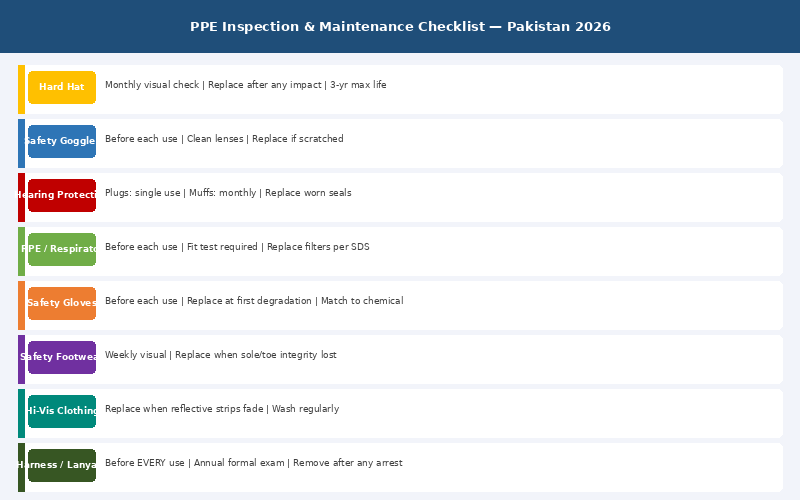
A bump cap is not a substitute for a safety helmet where falling-object hazards exist. Workers should inspect helmets for cracks, damage, deterioration, and other defects according to the manufacturer’s instructions. Replace damaged helmets and those involved in an impact when required by the manufacturer.
2. Eye and Face Protection
Eye and face protection is essential during grinding, welding, cutting, drilling, chemical handling, and dusty operations.
Common equipment:
- Safety spectacles for suitable flying-particle hazards.
- Sealed goggles for appropriate dust or chemical-splash hazards.
- Welding helmets with the correct filter shade.
- Face shields for additional protection against splashes or flying debris.
Selection criteria: Match the equipment to the hazard, check the relevant standard, and ensure that it fits comfortably without compromising other PPE.
For example, workers grinding metal in a Karachi workshop may need impact-rated eye protection and a face shield. A face shield alone may not provide sufficient eye protection, so suitable safety spectacles or goggles may also be necessary.
3. Hearing Protection
Prolonged exposure to excessive noise can cause permanent hearing damage. Construction machinery, compressors, generators, manufacturing equipment, and metalworking operations can create significant noise exposure.
Common equipment:
- Disposable foam earplugs.
- Reusable earplugs.
- Ear defenders or earmuffs.
- Compatible combinations of earplugs and earmuffs for specific high-noise tasks.
Selection criteria: Assess noise exposure before choosing protection. Select equipment that reduces exposure adequately without creating unnecessary overprotection or preventing workers from hearing essential warning signals.
Do not choose hearing protection based on its advertised attenuation rating alone. Actual protection depends on fit, correct use, maintenance, and continuous wear during exposure. Where necessary, arrange hearing conservation measures and exposure monitoring.
4. Respiratory Protective Equipment (RPE)
Respiratory protection helps reduce exposure to harmful airborne contaminants, including dust, fumes, aerosols, gases, and vapours.
Common equipment:
- Filtering facepiece respirators.
- Reusable half-mask respirators with compatible filters.
- Full-face respirators.
- Powered air-purifying respirators.
- Supplied-air respirators and self-contained breathing apparatus (SCBA) for appropriate specialist applications.
Selection criteria: Identify the contaminant, its concentration, the required protection factor, oxygen availability, and the limitations of the selected equipment.
For example, concrete cutting and stone processing can generate respirable crystalline silica, which can cause silicosis. Suitable respiratory protection may be necessary alongside effective dust suppression, local exhaust ventilation, and other controls.
Do not assume that an FFP1, FFP2, or FFP3 respirator is automatically suitable for every dust or chemical hazard. These classifications relate to particular filtration standards and do not establish suitability for every exposure. Particulate filters do not protect against gases or vapours unless the equipment includes the appropriate approved protection.
Tight-fitting respirators require a suitable face seal and appropriate fit testing. Facial hair that crosses the sealing surface can prevent an effective seal. Oxygen-deficient or immediately dangerous atmospheres require specialist respiratory protection and trained personnel; ordinary filtering masks must not be used in these conditions.
5. Hand Protection
Workers may face cuts, abrasions, burns, chemical exposure, biological hazards, and electrical risks. Selecting the wrong gloves can leave workers exposed or introduce additional hazards.
Common equipment:
- Cut-resistant gloves for suitable cutting hazards.
- Chemical-resistant gloves for handling hazardous substances.
- Heat-resistant gloves for appropriate hot-work tasks.
- Electrical insulating gloves for specified electrical work.
- General-purpose gloves for suitable low-risk handling activities.
Selection criteria: Match glove material and performance to the substance, task, exposure duration, temperature, and mechanical hazard. Consult the manufacturer’s chemical compatibility information and relevant safety data sheet.
Nitrile gloves may suit some oils and chemicals, but they are not universally resistant to all solvents. Similarly, cut-resistant gloves do not automatically protect against chemicals, heat, or electrical hazards.
Inspect gloves before use and replace damaged or contaminated pairs. Electrical insulating gloves require the inspection and testing arrangements specified by applicable requirements and the manufacturer.
6. Foot Protection
Safety footwear helps protect workers against crushing injuries, punctures, slips, and other foot hazards.
Common equipment:
- Safety shoes or boots with protective toecaps.
- Penetration-resistant footwear.
- Slip-resistant footwear.
- Chemical-resistant boots.
- Specialist electrical-hazard footwear where appropriate.
Selection criteria: Consider dropped objects, sharp materials, wet floors, chemicals, uneven ground, and the need for electrical protection.
On construction projects in Lahore, Rawalpindi, or Islamabad, workers may need footwear with protective toecaps and penetration-resistant midsoles. Warehouse employees may need slip-resistant footwear, while chemical-handling workers may require compatible protective boots.
Choose footwear that meets the applicable standard and task requirements. Inspect the soles, upper material, seams, and protective components regularly. Replace footwear when its protective performance is compromised.
7. High-Visibility Clothing and Protective Workwear
High-visibility clothing makes workers easier to see around moving vehicles, mobile plant, roadworks, and poorly lit work areas. Other protective clothing may protect against heat, chemicals, sparks, or contamination.
Common equipment:
- High-visibility vests and jackets.
- Reflective trousers or coveralls.
- Flame-resistant clothing for suitable fire or flash-fire hazards.
- Chemical-protective coveralls.
- Weather-resistant protective clothing.
Selection criteria: Consider background conditions, lighting, vehicle speed, weather, task requirements, and the hazard against which the clothing must protect.
ISO 20471 provides a recognized framework for high-visibility clothing. The required class should be determined by the risk assessment and applicable site requirements rather than assuming that one class suits every workplace.
Replace clothing when fluorescent material, reflective elements, closures, or protective properties deteriorate. Ordinary high-visibility clothing does not automatically provide flame, chemical, or arc-flash protection.
8. Fall-Protection and Specialist PPE
Workers operating at height may require fall-prevention systems or personal fall-protection equipment when safer methods cannot adequately control the risk.
Common equipment:
- Full-body harnesses.
- Compatible lanyards and energy absorbers.
- Suitable connectors and anchorage systems.
- Specialist rescue equipment.
- Task-specific protective equipment for confined spaces or hazardous operations.
Selection criteria: Assess fall distance, clearance, anchorage strength, equipment compatibility, rescue arrangements, and the worker’s training.
A harness alone does not prevent a fall. It must form part of a properly designed system, and equipment must be compatible with the anchorage and other components.
Where practicable, prioritize collective protection such as suitable guardrails and properly designed working platforms. Inspect personal fall-protection equipment before use and arrange documented examinations at the intervals required by applicable rules and manufacturer instructions.

PPE Selection and the Hierarchy of Controls
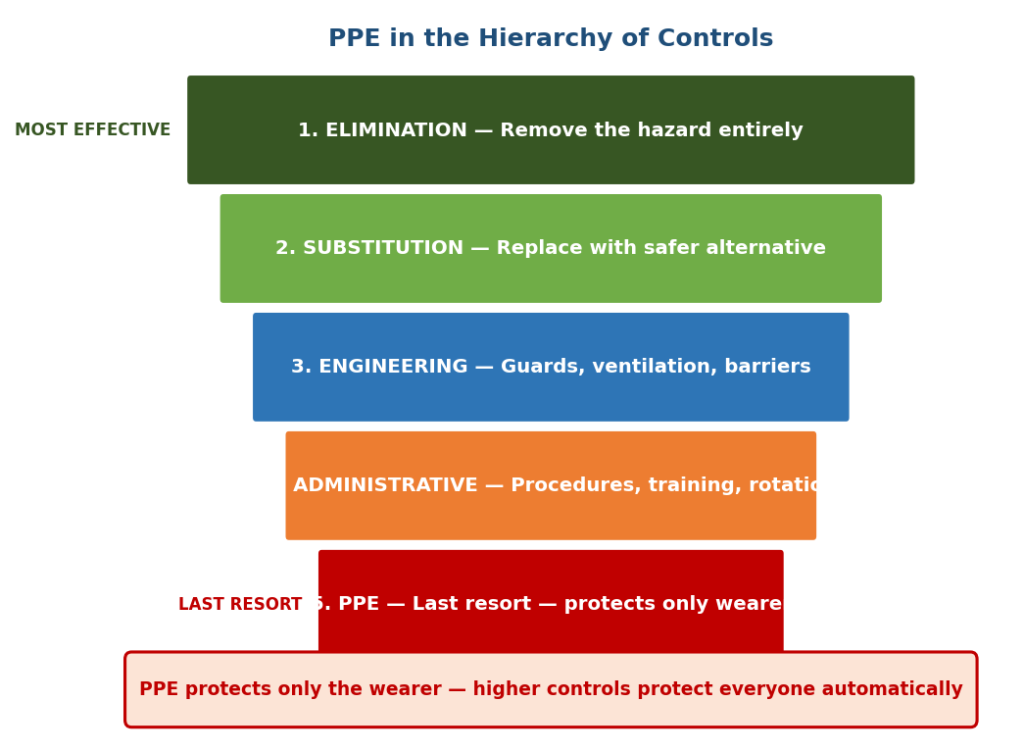
PPE is generally the least preferred level in the hierarchy of controls because it protects the individual without removing the hazard. Safety Officers should consider the following measures in order:
- Elimination: Remove the hazard entirely.
- Substitution: Replace it with a less hazardous material or process.
- Engineering controls: Isolate the hazard using guards, enclosures, barriers, or ventilation.
- Administrative controls: Use safe procedures, training, supervision, and exposure management.
- PPE: Provide suitable protection against remaining risks.
For example, a factory exposed to airborne dust should first consider eliminating unnecessary dust-generating work and installing suitable extraction or suppression systems. Respiratory protection may still be required for residual exposure.
For NEBOSH IGC candidates, explain why a control is appropriate and how it reduces risk. Do not simply list PPE items when a scenario calls for a broader risk-control strategy.
PPE Management Responsibilities for Safety Officers
Selecting PPE is only one part of effective PPE management. Safety Officers should help employers implement a system that includes:
- Risk assessment: Identify hazards and determine the protection required.
- Correct selection: Check applicable standards, suitability, fit, and compatibility.
- Worker consultation: Consider comfort, usability, and task requirements.
- Training: Explain correct use, limitations, cleaning, storage, and replacement.
- Inspection: Follow manufacturer guidance and relevant legal requirements.
- Recordkeeping: Maintain appropriate issue, training, inspection, and maintenance records.
- Defect management: Remove defective equipment from service and arrange replacement.
- Review: Reassess PPE whenever tasks, materials, equipment, or working conditions change.
Employers should provide the necessary protection in accordance with applicable legal requirements. Do not assume that one inspection interval or replacement date applies to every PPE item.
In Pakistan, these practices are relevant to construction, manufacturing, textiles, oil and gas, and logistics operations. They can also help candidates prepare for HSE interviews with contractors working on local projects and Gulf assignments.
PPE Checklist for Pakistani Workplaces
Before a task begins, a Safety Officer should confirm that:
- The risk assessment identifies the relevant hazards.
- Higher-level controls have been considered.
- Selected PPE is suitable for the specific task.
- Equipment meets the applicable standard and fits the wearer.
- Different PPE items work together correctly.
- Workers understand the correct use and limitations.
- Inspection, cleaning, storage, and replacement arrangements are in place.
- Defective equipment is removed from use.
- Additional controls remain effective throughout the task.
This checklist can support routine site inspections in Lahore, Karachi, Faisalabad, Multan, Peshawar, and other industrial areas of Pakistan.
Frequently Asked Questions
The eight categories in this guide are head protection, eye and face protection, hearing protection, respiratory protection, hand protection, foot protection, high-visibility clothing and protective workwear, and fall-protection or specialist PPE. The precise categories used in a workplace may differ according to its hazards.
No. PPE is generally the last level in the hierarchy of controls. Candidates should explain how elimination, substitution, engineering controls, and administrative measures can reduce risk before describing the additional protection provided by PPE.
Requirements depend on the risk assessment and applicable site rules. Common examples include safety helmets, suitable eye protection, protective footwear, high-visibility clothing, task-specific gloves, and hearing or respiratory protection where necessary.
Inspection frequency depends on the equipment, its use, the manufacturer’s instructions, and applicable requirements. Workers should check equipment before use where required, and employers should establish suitable inspection and maintenance arrangements. Damaged or defective PPE should not remain in service.
No. FFP3 is a particulate-filtering classification under the relevant standard. It does not, by itself, provide protection against gases or vapours. Select respiratory protection for the actual contaminant and exposure conditions.
Start with official occupational safety guidance, applicable Pakistani requirements, and the NEBOSH website. Candidates can also use structured HSE study resources and practice explaining the hierarchy of controls through workplace scenarios.
Conclusion
Effective PPE selection requires a clear understanding of hazards, risk assessments, equipment standards, correct fit, training, and maintenance. For Safety Officers in Pakistan, the goal is not simply to distribute helmets and safety shoes; it is to ensure that workers receive appropriate protection while employers address hazards through effective control measures.
Whether you work in construction in Lahore, manufacturing in Faisalabad, oil and gas in Pakistan, or an HSE role in the Gulf, understanding these eight PPE categories can strengthen your workplace safety practice and NEBOSH IGC preparation.
For further learning, explore independent NEBOSH course guidance at NEBOSH International and HSE career resources at Safety Jobs Pakistan.

NEBOSH International General Certificate (IGC) certified HSE professional focused on occupational health and safety, workplace risk assessment, hazard identification, and safety management systems. The content published on NeboshInternational.com is based on current industry guidance, recognized safety best practices, and practical workplace examples to help professionals in Pakistan and the Gulf prepare for NEBOSH qualifications and build successful HSE careers.