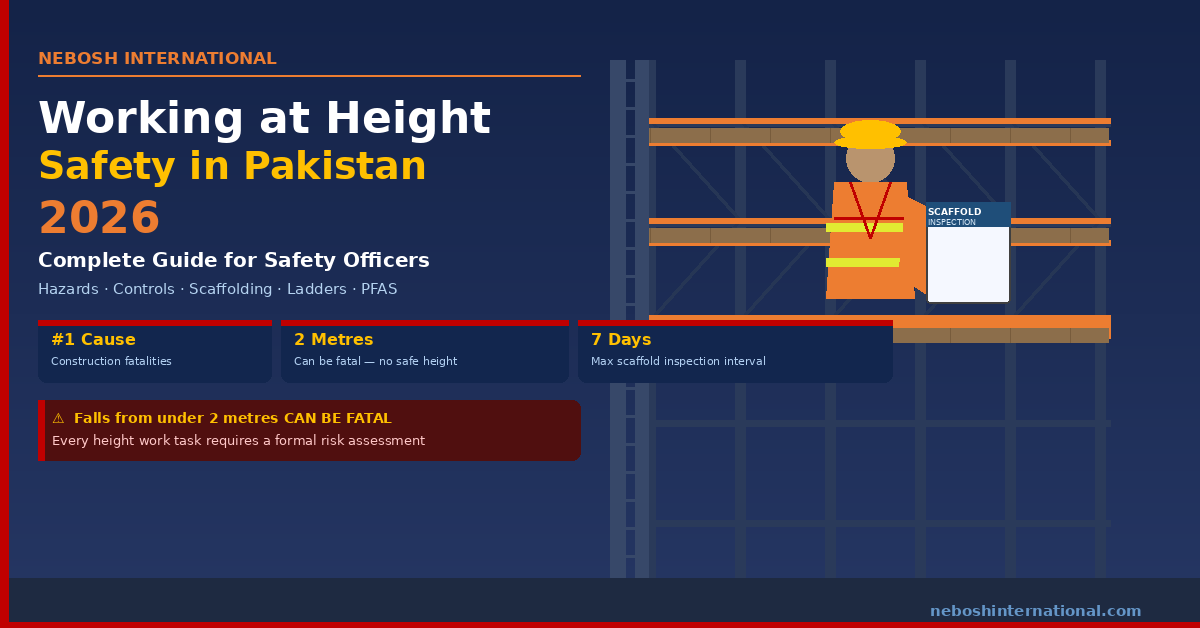
Working at Height Safety in Pakistan: A Practical Guide for Safety Officers (2026)
Working at height safety in Pakistan is an essential part of workplace risk management for construction companies, factories, maintenance teams and industrial contractors. A worker repairing a roof in Lahore, installing equipment in a Karachi factory or inspecting scaffolding on a Rawalpindi construction site may face serious fall hazards if the work is not properly planned.
Consider a construction team preparing to work beside an open floor edge. The scaffold is available, but one section lacks complete edge protection. Meanwhile, another worker is climbing a ladder while carrying materials. Even if the team has completed similar jobs before, these conditions can lead to a serious injury.
The solution is not simply to issue safety helmets and harnesses. Effective height safety requires a risk assessment, suitable access equipment, fall prevention measures, competent supervision and a realistic emergency rescue plan.
This guide explains the working at height safety procedures that safety officers should understand and apply across Pakistani workplaces in 2026.
What Is Working at Height?
Working at height refers to work in a location where a person could fall a distance that may cause personal injury. The risk can arise from a roof, ladder, scaffold, elevated platform, floor opening or fragile surface. A fall hazard can also exist at or below ground level, such as near an inadequately protected excavation.
The important factor is the possibility of a harmful fall, rather than a fixed height measurement.
For example, a maintenance worker accessing rooftop equipment in Karachi may face a fall hazard near an unprotected edge. Similarly, a technician working beside an uncovered floor opening in a Faisalabad factory may be at risk even when the opening is relatively close to the surrounding floor.
According to the UK Health and Safety Executive (HSE), work at height should be properly planned, supervised and performed by competent people using suitable equipment. Its guidance provides useful technical principles for Pakistani safety professionals, although UK regulations should not automatically be treated as Pakistani law.
External reference: HSE — Introduction to Working at Height Safely.
Common Working at Height Hazards in Pakistan
Safety officers should identify hazards before authorising work. Conditions vary between construction projects, manufacturing plants and maintenance activities, but common risks include:
- Unprotected edges: Workers may fall from rooftops, balconies, slabs or elevated platforms without suitable barriers.
- Unsafe scaffolding: Missing guardrails, unstable bases, damaged components and inadequate access can expose workers to falls.
- Incorrect ladder use: Overreaching, climbing with heavy materials and using ladders on unstable surfaces increase risk.
- Fragile roof surfaces: Weak roofing sheets and rooflights may collapse under a person’s weight.
- Uncovered openings: Floor openings, service ducts and access hatches can create serious fall hazards.
- Falling objects: Tools and materials may strike people working below elevated activities.
- Adverse weather: Strong winds, rain and slippery surfaces can make outdoor work more dangerous.
- Inadequate rescue arrangements: A suspended worker may remain in danger if the team cannot carry out a prompt, planned rescue.
These hazards can occur on construction sites in Lahore and Rawalpindi, industrial facilities in Karachi and Faisalabad, and maintenance projects across Pakistan. A site-specific risk assessment helps determine which controls are appropriate.
Hierarchy of Controls for Working at Height
The hierarchy of controls helps safety officers select effective measures instead of relying on personal protective equipment alone.
1. Avoid working at height
First, determine whether the task can be completed from ground level. Workers may be able to use extendable tools, lower equipment for maintenance or assemble components at ground level before lifting them into position.
Avoiding the exposure removes the need for workers to access the hazardous location.
2. Prevent falls
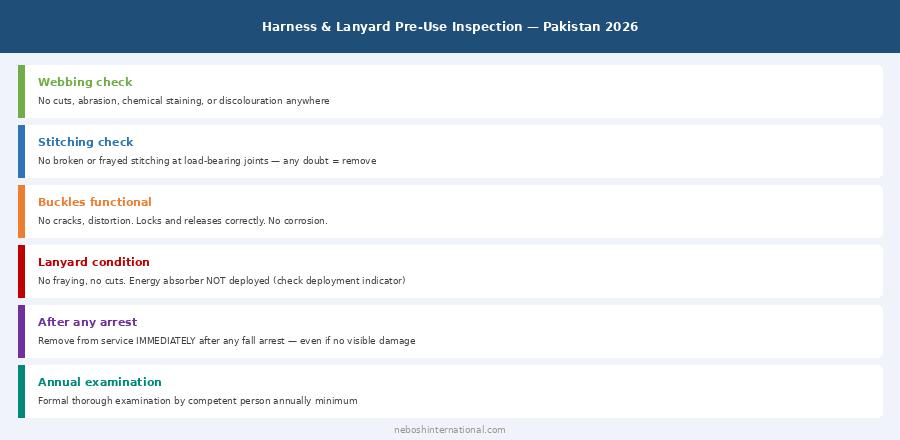
If working at height is necessary, prioritise measures that prevent a person from falling. Suitable examples include properly installed scaffolding, guarded working platforms, secure edge protection and mobile elevating work platforms (MEWPs).
Collective protection is generally preferred because it protects multiple workers without depending entirely on each person’s actions.
3. Minimise the consequences of a fall
When the risk cannot be eliminated or adequately controlled through fall prevention alone, consider suitable measures to reduce the distance and consequences of a fall. These may include safety nets and correctly designed personal fall protection systems.
The equipment must match the task, anchorage arrangements, available clearance and foreseeable risks.
For example, a contractor carrying out maintenance on an industrial building should assess whether a guarded platform can provide safer access before selecting a personal fall arrest system.
Read the HSE step-by-step guide to working at height for further guidance.
Scaffolding and Collective Fall Protection
Scaffolding provides a working platform for activities such as masonry, painting, installation and building maintenance. However, its presence alone does not make the work safe.
Before workers use a scaffold, the safety officer should verify that:
- The scaffold has a stable foundation and suitable structural support.
- Working platforms are properly installed and suitable for the intended load.
- Required guardrails, intermediate protection and toe boards are in place.
- Safe access is available.
- Components are free from defects that could affect stability or strength.
- Inspection and handover requirements have been met.
- The scaffold has not been altered without proper authorisation.
Where necessary, restrict access until a competent person has assessed and corrected the problem.
Safety officers should also protect people working below scaffolding. Secure tools and materials, use suitable toe boards or other falling-object controls, and establish exclusion zones where required.
For additional guidance, read our Scaffold Safety Guide for Pakistan.
Harnesses and Personal Fall Arrest Equipment
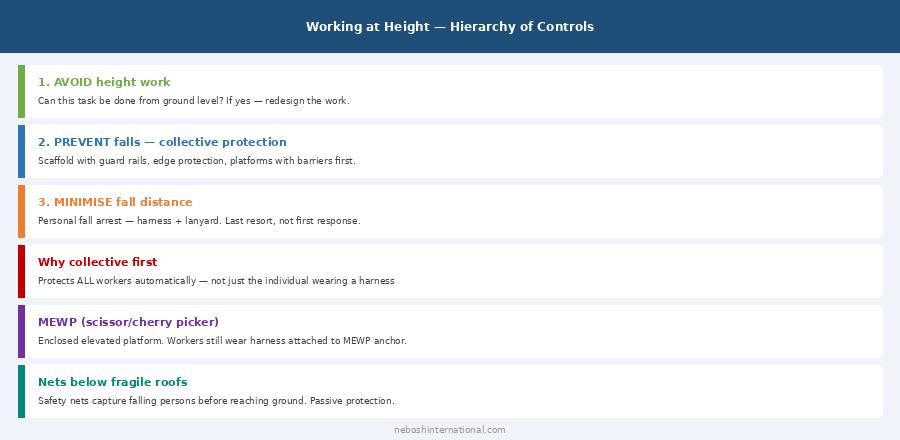
A full-body harness, suitable connecting equipment and an appropriate anchorage may be necessary when collective protection cannot adequately control the remaining fall risk.
However, issuing a harness does not automatically make a job safe. The complete system must be suitable for the activity and used by trained workers.
Before work begins, check the following:
Full-body harness: Confirm that the harness fits correctly and that the webbing, stitching and buckles show no signs of damage.
Lanyard and connectors: Check for cuts, fraying, deformation or other defects. Verify that the equipment is suitable for the intended system.
Anchorage: Use an approved anchorage suitable for the fall protection system. Never assume that a scaffold tube, handrail or ordinary pipe is safe simply because it appears strong.
Fall clearance: Check whether sufficient clearance exists to prevent the worker from striking the ground or another obstruction during a fall.
Compatibility: Confirm that the harness, connectors, lanyard and anchorage work together as a complete system.
Rescue arrangements: Establish how the team will recover a worker following a fall.
Workers should inspect their equipment before every use according to the manufacturer’s instructions and site procedures. A competent person should conduct formal examinations at the intervals required by applicable requirements and the manufacturer’s guidance. Equipment involved in a fall must be removed from service pending appropriate assessment and must not be reused unless authorised under the applicable procedure.
Ladder Safety Procedures
Ladders are useful for certain access tasks, but they should not automatically be selected because they are quick to position. A risk assessment should determine whether a ladder is appropriate or whether a scaffold or MEWP would provide safer access.
Follow these ladder safety practices:
- Select a ladder suitable for the task, environment and expected load.
- Inspect the ladder for damaged rungs, loose fittings and other defects.
- Position it on firm, level ground and prevent slipping.
- Secure the ladder where practicable using a suitable method.
- Maintain three points of contact while climbing whenever possible.
- Avoid overreaching; reposition the ladder instead.
- Keep hands free for climbing and use an appropriate method to raise tools or materials.
- Never use a damaged ladder or unstable objects to gain additional height.
- Keep access routes clear of obstructions and other workplace hazards.
The familiar 1-in-4 rule is a useful positioning guide for leaning ladders where applicable: position the base approximately one unit out for every four units of working ladder height. Always follow the ladder manufacturer’s instructions and the site’s safe system of work.
Ladders are generally most appropriate for low-risk, short-duration tasks. If a job requires heavy materials, prolonged work or awkward positioning, reassess the access method.
Risk Assessment and Permit-to-Work Requirements
Before work begins, the safety officer should assess the task, surrounding conditions, access arrangements, equipment and people involved. A method statement may also be needed for complex or higher-risk activities.
The assessment should address:
- The location and nature of the fall hazards.
- Existing guardrails, covers and other protective measures.
- Equipment selection, inspection and safe access.
- Worker competence and supervision.
- Falling objects and risks to people below.
- Weather conditions where relevant.
- Communication, emergency response and rescue arrangements.
- Coordination between contractors and other work teams.
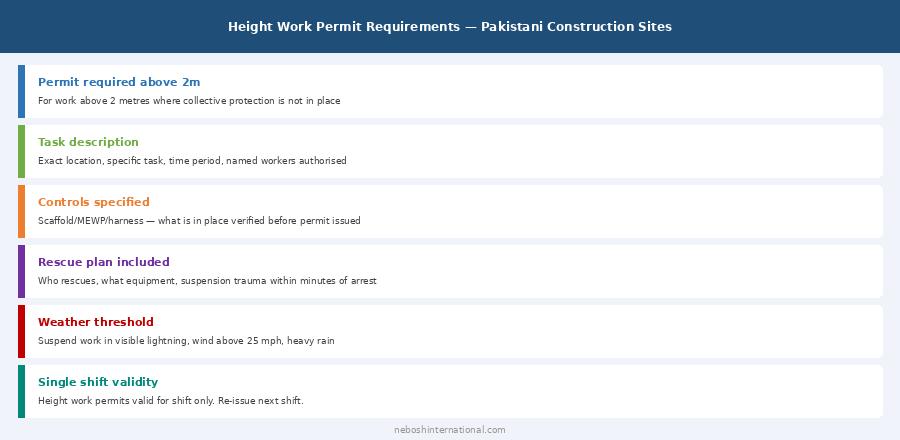
A permit-to-work system may be required by the employer, client, contract or site procedure for specified high-risk activities. The permit should identify the work, responsible persons, hazards, controls and conditions under which the job must stop.
There is no single height threshold that should be assumed to trigger every permit requirement across all Pakistani workplaces. Safety officers should check applicable legislation, project specifications and organisational procedures before deciding whether a permit is necessary.
For more information, see our Permit-to-Work System Guide for Pakistan.
Weather Conditions and Emergency Rescue Planning
Outdoor work can become unsafe when conditions change. Strong winds may affect workers on scaffolds or elevated platforms, while rain can make ladders and walking surfaces slippery. Lightning and other severe weather can introduce additional hazards.
The site procedure should define when work must stop, who makes that decision and how workers can descend safely. Supervisors should reassess conditions throughout the activity rather than relying only on the weather at the start of the shift.
A rescue plan is equally important when personal fall arrest equipment is used. A worker who remains suspended after a fall may suffer serious harm, so the team needs a practical method of recovery.
The rescue plan should identify:
- Who will initiate and coordinate the rescue.
- Which rescue equipment is available.
- How rescuers will safely reach the suspended worker.
- How the worker will be recovered.
- How emergency services will be contacted when needed.
- What training and practice the rescue team requires.
Do not rely solely on an ambulance or external emergency responders to recover a suspended worker. Rescue arrangements must be planned for the actual site and carried out by suitably trained people.
Working at Height Safety Checklist for Safety Officers
Use this checklist during pre-task planning and site inspections.
- Can the work be completed from ground level?
- Has a suitable risk assessment been completed?
- Are edges, openings and fragile surfaces adequately protected?
- Is the selected access equipment suitable and inspected?
- Are scaffolds and platforms safe for use?
- Are ladders appropriate for the task and secured against slipping?
- Have harnesses and other fall protection equipment been checked?
- Are anchorage and fall-clearance requirements satisfied?
- Are workers trained, competent and supervised?
- Are people below protected from falling objects?
- Have weather conditions and stop-work criteria been considered?
- Is a practical rescue plan available where required?
If a critical control is missing, stop the affected activity until the risk has been assessed and the required control is restored.
How NEBOSH IGC Knowledge Supports Height Safety
The NEBOSH International General Certificate (IGC) helps learners develop knowledge of workplace hazards, risk assessment and control measures. These principles can support safety officers who work in construction, manufacturing, maintenance and other safety-critical industries.
For Pakistani candidates, the value lies in applying the principles to real situations. A safety officer should be able to recognise inadequate edge protection, challenge unsafe ladder use, assess the suitability of fall protection equipment and verify that emergency arrangements are practical.
Qualification alone does not replace relevant experience, task-specific training or competence. Employers may also require practical skills and additional training for specialised equipment and high-risk work.
Explore our NEBOSH IGC exam format guide to understand the qualification and its assessment structure.
Frequently Asked Questions
Working at height safety involves planning tasks and controlling hazards where a person could fall and suffer injury. Common controls include avoiding unnecessary height work, providing guarded platforms, securing access equipment, inspecting fall protection systems and preparing for emergencies.
No. The appropriate control depends on the risk assessment and the work being performed. Where practicable, avoiding height work or using collective protection to prevent falls should be considered before relying on a personal fall arrest system.
Ladders can be suitable for certain low-risk, short-duration tasks when correctly selected, positioned and secured. Scaffolding or a MEWP may be more appropriate for prolonged work, heavy materials or tasks requiring awkward positioning.
Permit requirements depend on applicable legislation, employer procedures, client specifications and the risks of the task. Safety officers should confirm the relevant site requirements rather than applying one universal height threshold.
Users should inspect their harness and associated equipment before each use. Formal examinations should follow the manufacturer’s instructions, applicable requirements and the site’s inspection programme, with additional checks when damage or other concerns arise.
A rescue plan establishes how a worker will be recovered if a fall protection system arrests a fall and the worker remains suspended. The plan should identify trained rescuers, available equipment, communication arrangements and a suitable recovery method.
NEBOSH IGC develops knowledge of workplace health and safety risks and their control. Candidates should consult the current official syllabus and assessment guidance to confirm the exact learning outcomes relevant to their examination.
Conclusion
Working at height safety in Pakistan requires more than personal protective equipment or a signed inspection form. It depends on identifying hazards early, selecting suitable equipment, prioritising fall prevention and ensuring that workers understand the safe system of work.
Whether the task takes place on a construction project in Rawalpindi, a factory in Faisalabad or an industrial maintenance site in Karachi, the same practical priorities apply: plan the job, control access, inspect equipment, supervise the work and prepare for emergencies.
For aspiring and experienced safety officers, applying these principles can strengthen practical HSE knowledge and support safer workplace decisions. Explore NEBOSH International for independent NEBOSH course information and student guidance in Pakistan.

NEBOSH International General Certificate (IGC) certified HSE professional focused on occupational health and safety, workplace risk assessment, hazard identification, and safety management systems. The content published on NeboshInternational.com is based on current industry guidance, recognized safety best practices, and practical workplace examples to help professionals in Pakistan and the Gulf prepare for NEBOSH qualifications and build successful HSE careers.