Is NEBOSH IGC Hard in Pakistan? 5 Biggest Challenges (2026)
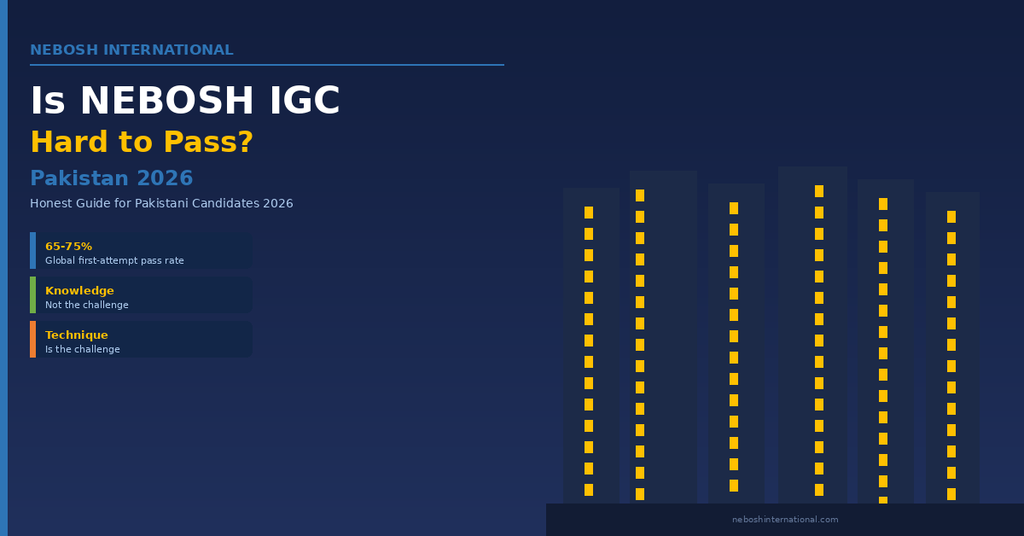
Is NEBOSH IGC hard in Pakistan? Yes, NEBOSH IGC can be challenging because candidates must understand health and safety principles, apply their knowledge to realistic scenarios and complete a practical workplace risk assessment. However, with consistent preparation, regular practice and suitable tutor support, Pakistani candidates can build the skills needed to approach both assessments confidently.
The NEBOSH International General Certificate in Occupational Health and Safety is a recognised qualification for people developing their health and safety knowledge. For candidates considering a NEBOSH course in Pakistan, understanding the assessment requirements before enrolling can make preparation more manageable.
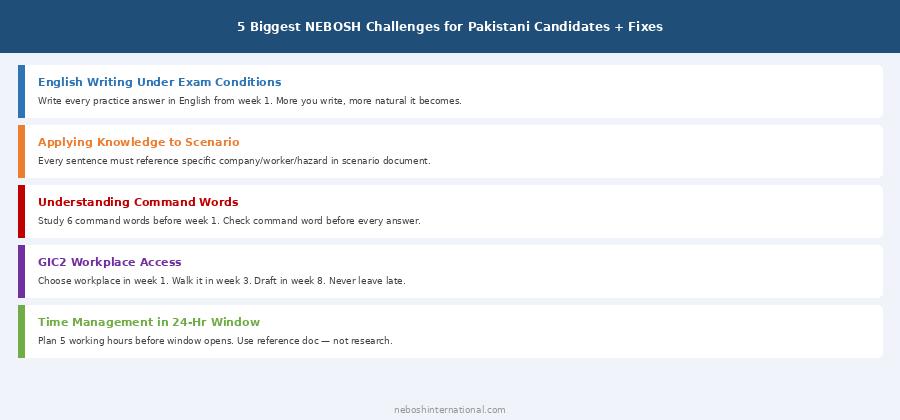
Whether you live in Rawalpindi, Lahore, Karachi, Faisalabad, Multan or Peshawar, the main challenges are similar. English writing, scenario-based answers, command words, workplace risk assessment and time management all deserve attention.
Is NEBOSH IGC Difficult for Beginners in Pakistan?
NEBOSH IGC is not simply a memorisation-based qualification. Learners need to understand workplace hazards, evaluate risks, explain safety problems and recommend appropriate controls.
The qualification has two units under the revised 2026 structure: GIC1, which assesses management of health and safety through a scenario-based open-book examination, and GIC2, which assesses practical risk assessment skills.
According to the official NEBOSH International General Certificate guidance, there are no formal entry requirements. However, learners need sufficient English language ability to understand and communicate the concepts covered in the syllabus.
Beginners can therefore work towards the qualification, although those without previous safety knowledge may need additional study time. The key is to understand the subject before attempting complex assessment questions.
Quick answer: NEBOSH IGC is challenging but achievable. Start with the syllabus, practise written answers and prepare separately for GIC1 and GIC2.
The 5 Biggest NEBOSH IGC Challenges for Pakistani Candidates
1. Writing in English Under Exam Conditions
English writing is a common concern for Pakistani candidates whose first language is Urdu, Punjabi, Pashto or another regional language. Understanding a safety topic is one skill; explaining it clearly in English is another.
For example, a candidate may understand why an unguarded machine is dangerous but struggle to explain the potential injury, the reason for installing a suitable guard and the importance of safe operating procedures.
Fortunately, you do not need unnecessarily complicated English. Clear, relevant explanations are more useful than long sentences filled with difficult vocabulary.
How to overcome this challenge:
- Write one practice answer in English every day.
- Learn important health and safety terms.
- Use short sentences to explain hazards and controls.
- Review your grammar, clarity and technical accuracy.
- Ask your tutor for feedback on practice answers.
Start writing during the first weeks of your course rather than waiting until the assessment approaches.
2. Applying Knowledge to the Scenario
Another major challenge is applying safety knowledge to the information provided in the GIC1 scenario. Some learners write general answers that could apply to almost any workplace, even when the question describes a specific situation.
For example, imagine a textile factory in Faisalabad where workers operate machinery without suitable guarding. A general statement about providing training may not fully address the problem. A stronger answer would connect the machinery hazard to the risk of contact with moving parts and explain why suitable guarding and safe working procedures are necessary.
The important point is to answer the question using the scenario rather than simply reproducing information from study notes.
How to overcome this challenge:
- Read the scenario carefully before answering.
- Identify relevant workers, equipment, activities and hazards.
- Connect each answer point to the facts provided.
- Explain why a particular risk or control matters.
- Practise with different workplace scenarios.
For candidates working in construction in Rawalpindi or manufacturing in Lahore, real workplace experience can help with understanding safety principles. However, assessment answers must still address the actual scenario presented.
3. Understanding NEBOSH Command Words
Command words indicate the type of response a question requires. Misunderstanding them can lead to answers that contain relevant information but lack the necessary explanation.
For example, identify generally asks you to state a relevant point, while explain requires you to develop the point and show why or how it matters. Other command words may require a description, outline or discussion.
Candidates sometimes write a short list when a question requires a detailed explanation. As a result, their answers may not demonstrate the required depth.
How to overcome this challenge:
- Learn the command words used in your current syllabus.
- Read each question carefully before writing.
- Check the marks available and plan your response.
- Practise answering the same topic using different command words.
- Review your answers against tutor feedback and official guidance.
Do not assume that every question requires the same answer structure. Match the depth of your response to the actual instruction.
4. Completing the GIC2 Workplace Risk Assessment
GIC2 presents a different challenge because it requires learners to apply risk assessment principles to a workplace. Candidates need to understand the assessment format, identify relevant hazards and develop a suitable action plan.
Some learners experience difficulty because they have limited access to a workplace or delay planning their observations until late in their preparation.
For example, a candidate working at a Karachi warehouse might assess vehicle movements, manual handling, storage arrangements and emergency access. A construction worker may encounter work-at-height hazards, moving equipment and falling objects. The appropriate assessment depends on the actual workplace and the official submission requirements.
How to overcome this challenge:
- Read the current GIC2 guidance and submission template.
- Arrange suitable workplace access early.
- Record genuine observations rather than inventing findings.
- Evaluate existing controls and identify further actions.
- Ask your Learning Partner to clarify assessment requirements.
Plan the assessment early, but follow the official instructions and deadlines rather than relying on an assumed week-by-week timetable.
5. Managing Time During the GIC1 Assessment
Time management is another important factor. The revised GIC1 assessment is scenario-based and open book, with a 24-hour assessment window. However, this does not mean that candidates should spend the entire window searching for information.
Searching through notes, reading unrelated material and repeatedly rewriting answers can consume valuable time. Candidates also need to balance assessment preparation with work and family responsibilities.
How to overcome this challenge:
- Study the syllabus before the assessment begins.
- Organise your notes for quick reference.
- Complete practice questions under timed conditions.
- Allocate time for reading, planning, writing and checking.
- Keep answers relevant to the scenario and command word.
Use the assessment window according to the official instructions. A well-prepared candidate should already understand the subject and use reference materials to clarify specific points rather than learn the entire syllabus during the assessment.
For additional advice, read our NEBOSH open-book exam preparation guide.
How Long Should Pakistani Candidates Prepare for NEBOSH IGC?
Preparation time depends on your previous knowledge, English skills, available study hours and learning arrangements. Some candidates progress more quickly, while beginners may need additional time to understand the fundamentals.
An illustrative eight-week study plan could look like this:
| Study period | Main preparation task |
|---|---|
| Weeks 1–2 | Understand the syllabus and basic safety principles. |
| Weeks 3–4 | Study hazards, risk controls and management principles. |
| Weeks 5–6 | Practise scenario-based answers and command words. |
| Weeks 7–8 | Complete mock assessments and review feedback. |
This is a suggested study structure, not an official NEBOSH timetable. Your Learning Partner should help you plan the course and assessments according to the current requirements.
You should also arrange workplace access for GIC2 early and check the official submission deadline. Regular preparation is generally more useful than trying to study everything immediately before an assessment.
Is NEBOSH IGC Worth the Difficulty in Pakistan?
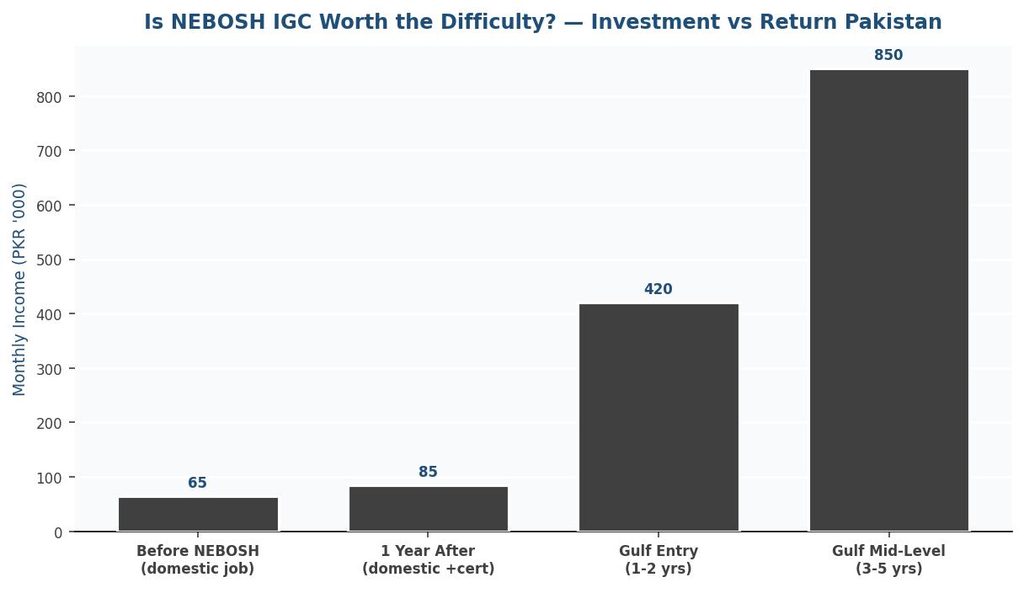
For many Pakistani candidates, NEBOSH IGC can be a valuable step towards building a career in occupational health and safety. It can help develop knowledge relevant to construction, manufacturing, textiles, warehousing, logistics and other industries.
The qualification may also support applications for relevant jobs in Saudi Arabia, the UAE, Qatar and other Gulf countries. However, employers consider several factors, including experience, technical skills, communication, job responsibilities and additional qualifications.
There is no guaranteed salary increase or automatic job placement after completing NEBOSH IGC. Before enrolling, compare course fees, tutor support, assessment guidance and the provider’s accreditation.
You can explore our NEBOSH IGC online vs classroom guide for Pakistan to understand the learning options available.
Frequently Asked Questions
Yes. Previous safety employment is not a formal entry requirement. Beginners should study the fundamentals, practise applying safety principles and seek feedback on their assessment preparation.
It can require extra effort. Practise writing clear answers, learn technical vocabulary and focus on explaining safety points accurately. NEBOSH recommends an English standard equivalent to IELTS 6.0 or higher.
GIC1 is a scenario-based open-book examination. Candidates must still demonstrate their own understanding and follow the assessment instructions. GIC2 is a practical risk assessment.
The difficulty depends on your strengths. GIC1 focuses on scenario-based responses, while GIC2 requires practical risk assessment skills. Both units need dedicated preparation.
Online and distance-learning arrangements may be available through suitable Learning Partners. Confirm accreditation, tutor support, assessment arrangements and total fees before enrolling.
No. The qualification may strengthen your profile, but employment depends on the employer’s requirements, experience, technical competence and other relevant factors.
Conclusion:
NEBOSH IGC requires effort, but its challenges can be managed with a structured preparation plan. Pakistani candidates should focus on five areas: English writing, scenario application, command words, GIC2 risk assessment and GIC1 time management.
Whether you are preparing in Lahore, Rawalpindi, Karachi, Faisalabad or another city, begin by reviewing the current syllabus and practising realistic assessment questions.
Visit NEBOSH International for further course information and student guidance. Before registering, confirm that your chosen Learning Partner is accredited for the qualification and can explain the current assessment requirements.
The best way to prepare is to understand the safety principles, practise applying them and improve your answers through feedback—not simply memorise notes.

NEBOSH International General Certificate (IGC) certified HSE professional focused on occupational health and safety, workplace risk assessment, hazard identification, and safety management systems. The content published on NeboshInternational.com is based on current industry guidance, recognized safety best practices, and practical workplace examples to help professionals in Pakistan and the Gulf prepare for NEBOSH qualifications and build successful HSE careers.