How to Become an HSE Manager in Pakistan 2026: Complete Career Guide
Imagine you are working as a Safety Officer on a construction project in Rawalpindi. You have completed NEBOSH IGC, you are conducting toolbox talks, inspecting work areas, following up on unsafe acts, and preparing daily reports. But when a senior management meeting takes place, you realise that the HSE Manager is dealing with a completely different level of responsibility — budgets, contractors, audits, client requirements, incident investigations, KPIs, and decisions that can affect the entire project. This is the point where many Pakistani safety professionals start asking themselves: “What do I actually need to do to move from Safety Officer to HSE Manager?” If you are researching how to become HSE manager Pakistan, this is an important question to answer before choosing your next qualification or career move.
HSE Manager is one of the most financially rewarding and professionally respected roles in Pakistan’s industrial landscape. In the Gulf, senior HSE Managers earn AED 22,000–50,000 per month. In Pakistan’s oil and gas sector, domestic HSE Manager salaries reach PKR 400,000–700,000 monthly.
However, reaching management level in health and safety requires a clear, deliberate career strategy. It takes time, the right qualifications, and the right experience. A person can spend several years working in safety and still struggle to move into management if they focus only on certificates and do not develop leadership, communication, commercial, and management skills.
This guide explains how to become HSE manager Pakistan professionals can build their careers step by step — from your first safety qualification to the HSE Manager role.
What Does an HSE Manager Do?
An HSE Manager leads an organisation’s entire approach to occupational health, safety, and environment. The role is much broader than simply conducting workplace inspections or checking whether workers are wearing PPE.
Key responsibilities include:
- Developing and implementing the safety management system
- Leading a team of safety officers and coordinators
- Managing relationships with regulatory authorities and client HSE teams
- Setting safety performance targets and monitoring KPIs
- Overseeing incident investigations at a senior level
- Presenting safety performance to senior leadership and boards
- Managing the safety budget and resource allocation
In a large Pakistani construction project, for example, an HSE Manager may have to coordinate several contractors, review safety performance, investigate incidents, and communicate directly with the client. The same management approach can look different in manufacturing, textiles, oil & gas, or other industrial environments.
What we consistently see in Pakistan’s HSE market is that professionals who want management positions need to demonstrate that they can manage people, systems, and business expectations, not just identify workplace hazards.
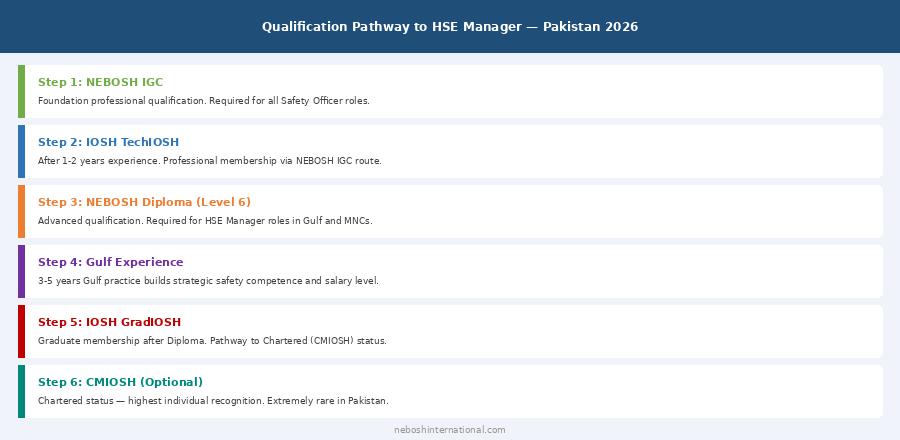
The Qualification Pathway to HSE Manager
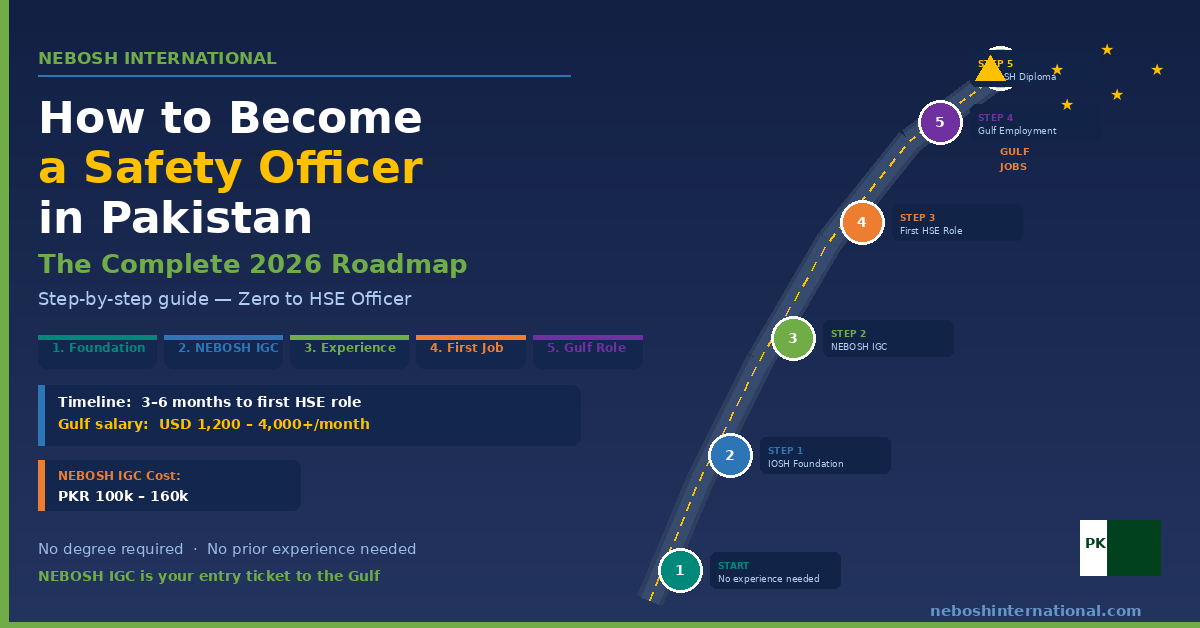
Step 1 — NEBOSH IGC (Foundation)
NEBOSH IGC is the essential starting point. It qualifies you as a competent safety practitioner. It is required for entry-level Safety Officer roles. Furthermore, it is the foundational qualification recognised by employers as the starting point for a professional HSE career.
For someone starting in Pakistan, NEBOSH IGC Pakistan is a popular starting point for building a professional HSE pathway across construction, manufacturing, textiles, oil & gas, and other sectors. A candidate working around Lahore, for example, may initially use an NEBOSH IGC course to target Safety Officer opportunities before building the experience needed for senior positions.
Once you have completed NEBOSH IGC, the next step is gaining relevant workplace experience and finding the right entry-level opportunity. You can also explore our guide to Top 10 Safety Officer Jobs in Pakistan for NEBOSH Professionals to understand where NEBOSH-qualified professionals can look for opportunities.
Professionals researching NEBOSH course in Pakistan should also understand that the qualification is only the first stage of the career pathway. The goal should be to combine recognised training with relevant workplace experience and progressively greater responsibility.
Most HSE managers in Pakistan and the Gulf hold NEBOSH IGC as their minimum base qualification. Many achieved Credit or Distinction.
The important point is that NEBOSH IGC should be viewed as the beginning of your HSE career rather than the final qualification. It gives you a professional foundation, but management responsibility comes through a combination of qualification, experience, and leadership ability.
Step 2 — IOSH Membership (TechIOSH)
After gaining 1–2 years of documented safety experience, apply for IOSH TechIOSH membership. NEBOSH IGC is the primary qualifying route for TechIOSH.
TechIOSH demonstrates professional commitment. Additionally, it provides access to IOSH’s continuing professional development framework and professional network.
For Pakistani professionals, professional membership can also help demonstrate that your career is developing beyond an entry-level position. However, membership should support your practical experience rather than replace it. Employers still want evidence that you have worked on real safety problems and can take responsibility in the workplace.
Step 3 — NEBOSH Diploma or Equivalent (Advanced)
The NEBOSH National or International Diploma is the advanced professional qualification for aspiring safety managers. It is a Level 6 qualification — equivalent to a university degree in academic level.
The Diploma covers strategic safety management, advanced risk management, and organisational safety leadership. Most HSE Manager job postings in the Gulf and Pakistan MNCs list the NEBOSH Diploma as required or strongly preferred.
From speaking with HSE professionals in Rawalpindi and Lahore, one common career question is whether they should wait until they become a Senior Safety Officer before starting the Diploma. There is no single answer for everyone, but professionals should think about how the qualification fits into their overall career plan rather than collecting qualifications without a clear objective.
For someone comparing NEBOSH certification Pakistan options and planning for management-level work, the advanced qualification stage should be considered part of a longer professional development strategy.
For someone targeting major organisations or large projects, advanced knowledge becomes increasingly important because the job involves strategic decisions rather than only day-to-day safety monitoring.
Step 4 — IOSH Chartered Membership (CMIOSH)
After several years of senior safety practice, CMIOSH (Chartered Member of IOSH) is achievable. It is the highest individual professional recognition in occupational safety. Very few Pakistani safety professionals currently hold CMIOSH — making it a powerful differentiator for senior Gulf roles.
This stage is about professional maturity as much as qualifications. By the time a professional reaches this level, employers are likely to expect evidence of leadership, strategic decision-making, continual professional development, and the ability to influence safety culture across an organisation.
Experience Required for HSE Manager Roles
Qualifications matter, but experience is what allows a safety professional to take on increasing levels of responsibility.
| Years of Experience | Typical Role | Qualification |
|---|---|---|
| 0–2 years | Safety Officer | NEBOSH IGC |
| 3–5 years | Senior Safety Officer / Safety Supervisor | NEBOSH IGC + IOSH TechIOSH |
| 5–8 years | HSE Engineer / HSE Coordinator | NEBOSH IGC + Diploma (partial or complete) |
| 8–12 years | HSE Manager | NEBOSH Diploma + IOSH membership |
| 12+ years | Senior HSE Manager / Head of HSE | NEBOSH Diploma + CMIOSH preferred |
These timelines are a useful career framework rather than a guarantee. Some professionals progress faster because they gain responsibility early, work on major projects, or move into Gulf roles. Others take longer because their roles provide limited exposure to management responsibilities.
In our experience reviewing Gulf job postings in 2026, employers often look beyond the qualification list. They want to know what the candidate has actually managed: contractors, audits, investigations, safety teams, client relationships, KPIs, risk assessments, and HSE systems.
This is not straightforward — many Pakistani candidates struggle with gaining the right management-level experience, especially when their current role is heavily focused on routine inspections, paperwork, and toolbox talks. The solution is not simply another certificate. Professionals need to deliberately seek opportunities where they can lead people, participate in investigations, manage contractors, contribute to audits, and present safety information to management.
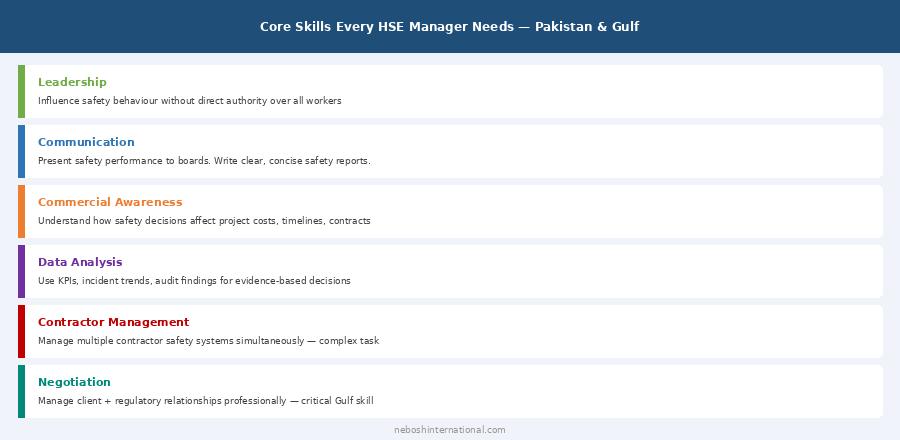
Key Skills for HSE Manager Success
Technical knowledge is necessary but not sufficient for management roles. Additionally, HSE Managers need strong competencies in these areas:
- Leadership — ability to influence safety behaviour across an organisation without direct line authority over all workers
- Communication — presenting safety performance to boards and senior teams; writing clear, concise safety reports
- Commercial awareness — understanding how safety decisions affect project costs, timelines, and contracts
- Data analysis — using safety KPIs, incident trends, and audit findings to drive evidence-based decisions
- Audit experience also becomes increasingly important as you move toward management. Understanding how to plan, conduct, and follow up on workplace audits can strengthen your HSE management skills. Our Safety Auditing in Pakistani Workplaces: Complete Guide for Safety Officers explains the audit process in more detail.
- Contractor management — managing multiple contractor safety management systems simultaneously
- Negotiation — managing client and regulatory relationships professionally
These skills become particularly important in large construction and infrastructure environments. A professional working on a project involving a company such as Bahria Town, for example, may interact with contractors, consultants, supervisors, workers, and management. The ability to communicate safety requirements clearly can become just as important as technical knowledge.
Similarly, in Pakistan’s oil & gas industry, safety managers may need to understand operational risks while also communicating with senior management and client representatives. Experience with companies and environments such as OGDC or PPL can expose professionals to a very different level of operational responsibility.
Pakistani professionals often ask us whether qualifications alone can secure a management position. The honest answer is that qualifications open doors, but your ability to perform at management level is what helps you stay in those roles and progress further.
For professionals comparing NEBOSH training Pakistan options, it is worth looking beyond the initial course and asking how the qualification will fit into your longer-term HSE career.
HSE Manager Salaries in Pakistan and the Gulf
Salary is one of the main reasons Pakistani safety professionals consider progressing toward HSE Manager and Head of HSE positions.
| Market | Senior Safety Officer | HSE Manager | Head of HSE |
|---|---|---|---|
| Pakistan domestic | PKR 175,000–320,000 | PKR 300,000–700,000 | PKR 600,000–1,200,000+ |
| UAE | AED 13,000–22,000 | AED 22,000–45,000 | AED 40,000–80,000+ |
| Saudi Arabia | SAR 12,000–22,000 | SAR 20,000–50,000 | SAR 40,000–100,000+ |
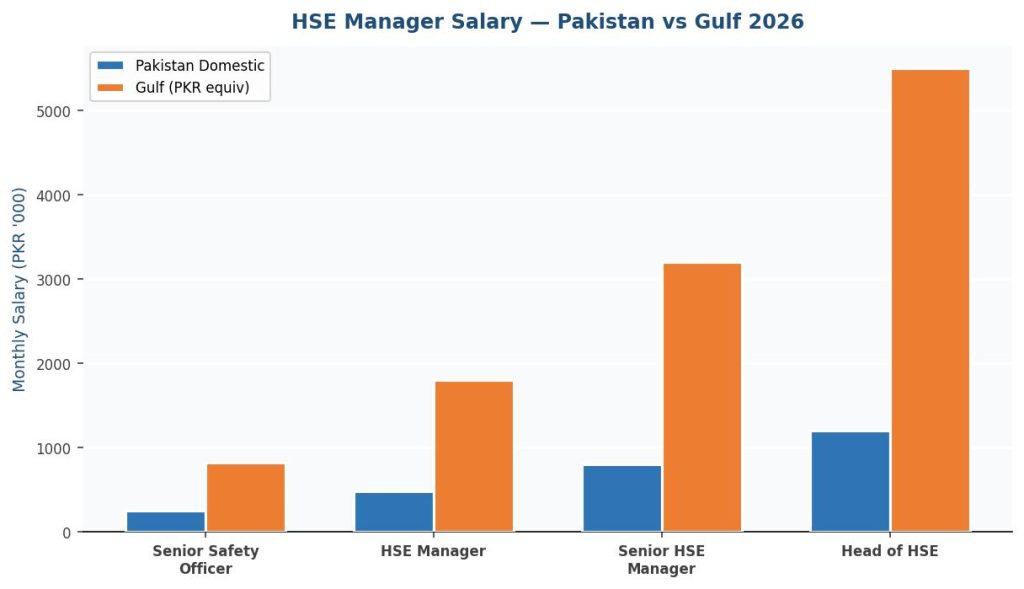
The actual package can vary depending on experience, industry, employer, project size, qualifications, location, and the level of responsibility attached to the position.
For Pakistani professionals considering the Gulf, it is also important to understand that the competition increases as the salary level increases. Employers are not simply looking for someone who has completed NEBOSH IGC. At management level, they want professionals who can demonstrate practical leadership and a history of handling complex HSE responsibilities.
In our experience reviewing Gulf job postings in 2026, candidates with a combination of recognised qualifications, relevant industry experience, strong communication skills, and genuine management exposure are better positioned for senior opportunities.
Frequently Asked Questions
Can someone from Faisalabad study NEBOSH IGC online and still get a Saudi Arabia job in 2026?
Typically, 8–12 years from starting as a Safety Officer with NEBOSH IGC. The timeline is shorter for engineering graduates who combine technical credentials with NEBOSH qualifications, and for those who build Gulf experience early in their careers.
Studying from Faisalabad or another Pakistani city does not by itself prevent someone from building a Gulf career. What matters is the combination of qualification, relevant experience, professional development, and the ability to meet employer requirements.
I live in Pakistan — can I study the NEBOSH Diploma without moving to another city?
Yes. The NEBOSH National Diploma and International Diploma are available through accredited Learning Partners in Pakistan. Online delivery is available, making it accessible from all cities. Check nebosh.org.uk for current accredited providers.
This can be useful for professionals who are already working full-time and cannot easily relocate. However, candidates should always verify that their chosen provider is an accredited Learning Partner.
If I have just completed NEBOSH IGC, can I really become an HSE Manager within five years?
Yes — with deliberate career strategy. Build Gulf experience in years 1–3. Pursue NEBOSH Diploma alongside Gulf experience in years 3–5. Target HSE Supervisor or Senior Safety Officer roles. The timeline is achievable with consistent effort and the right qualification progression.
It is an ambitious target, so professionals should focus on the quality of their experience rather than simply counting years. Taking responsibility for teams, contractors, investigations, audits, and safety systems can make a significant difference to career progression.
Which industries in Pakistan should I target if I want a higher HSE Manager salary?
Oil and gas (OGDC, PPL, international operators) and multinational FMCGs (Unilever, Nestlé, P&G, Abbott) offer the highest domestic HSE Manager salaries. In the Gulf, oil and gas (ADNOC, Saudi Aramco, Qatar Energy) and petrochemicals offer the highest management-level packages.
For someone starting their career, it is worth considering the type of experience an industry can provide, not only the starting salary. Construction, manufacturing, textiles, and oil & gas can all provide valuable safety experience, but the responsibilities and career pathways can be very different.
Is NEBOSH IGC enough for me to apply for an HSE Manager position?
NEBOSH IGC alone is typically insufficient for HSE Manager roles. Employers expect NEBOSH Diploma or equivalent advanced qualification for management positions. NEBOSH IGC is the essential foundation — the Diploma is the next step.
The key is to treat NEBOSH IGC as the starting point of a longer professional pathway. As your responsibilities increase, your qualifications, experience, and professional recognition should develop alongside them.
Conclusion:
Becoming an HSE Manager in Pakistan is not about collecting as many certificates as possible. It is about building a career in stages: start with NEBOSH IGC, gain solid practical experience, develop professional membership, progress toward the NEBOSH Diploma, strengthen your leadership and communication skills, and gradually move into positions where you are responsible for people, systems, contractors, and business-level HSE decisions.
If you are reading this from Rawalpindi, Lahore, Karachi, Peshawar, or Faisalabad and wondering whether NEBOSH IGC is worth it in 2026 — here is our honest answer: yes, it can be a strong starting point, but it should be part of a bigger career plan. NEBOSH IGC can help you enter the profession, but becoming an HSE Manager requires experience, leadership, advanced qualifications, and the confidence to take responsibility when safety decisions become more complex.
If you are also comparing NEBOSH institute Pakistan options, NEBOSH course fees in Pakistan, or the right NEBOSH International General Certificate pathway, make sure you evaluate the training provider, course structure, accreditation, and how the qualification fits into your long-term career goals.
Start with the qualification you need today, but keep your long-term HSE Manager goal in sight.
Start your journey to HSE Manager with the NEBOSH IGC. NEBOSH International provides the accredited training that begins your professional pathway. Enrol today at neboshinternational.com

NEBOSH International General Certificate (IGC) certified HSE professional focused on occupational health and safety, workplace risk assessment, hazard identification, and safety management systems. The content published on NeboshInternational.com is based on current industry guidance, recognized safety best practices, and practical workplace examples to help professionals in Pakistan and the Gulf prepare for NEBOSH qualifications and build successful HSE careers.