Safety Auditing in Pakistani Workplaces: Complete Guide for Safety Officers (2026)
A safety audit helps organisations identify weaknesses in their health and safety management systems before those weaknesses contribute to workplace accidents, injuries, or operational disruption. In Pakistan, safety officers working in construction, manufacturing, textiles, warehouses, and oil and gas need to understand how audits evaluate safety procedures, training, risk assessments, and corrective actions.
This safety audit guide Pakistan 2026 explains the difference between audits and inspections, the main types of HSE audits, practical audit procedures, reporting methods, and the skills safety officers need to improve workplace safety.
Whether you work in Lahore, Karachi, Rawalpindi, Faisalabad, or another industrial area, understanding safety auditing can help you contribute to stronger safety management systems. It can also complement your professional development if you are studying for NEBOSH IGC or preparing for HSE roles in Pakistan and the Gulf.
What Is a Safety Audit?
A safety audit is a systematic evaluation of an organisation’s occupational health and safety arrangements against defined requirements. It examines whether policies, procedures, responsibilities, training, and risk controls are properly implemented and effective.
Unlike a basic workplace inspection, a safety audit investigates how the safety management system operates. It reviews documented evidence, interviews employees, observes work activities, and identifies gaps that require corrective action.
For example, a safety officer on a Lahore construction project may repeatedly find workers using damaged ladders. An inspection identifies the immediate hazard. An audit investigates whether the company has an effective ladder inspection procedure, competent supervisors, equipment defect reporting, and a system for removing damaged ladders from service.
The objective is not simply to identify mistakes. Instead, it is to understand why weaknesses exist and how the organisation can prevent them from recurring.
Safety Audit vs Safety Inspection: Key Differences
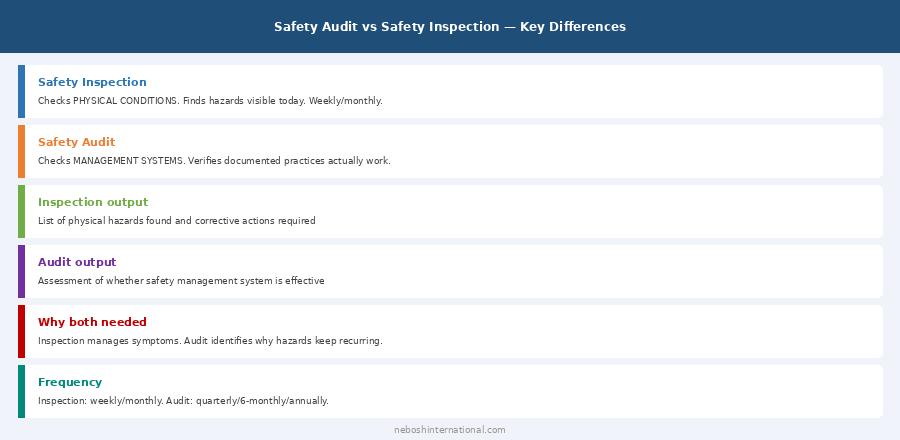
Safety audits and inspections support the same overall goal, but they focus on different aspects of workplace safety.
| Comparison | Safety Inspection | Safety Audit |
|---|---|---|
| Main purpose | Identify unsafe conditions and practices | Evaluate safety management arrangements |
| Focus | Equipment, workplace conditions, and activities | Policies, procedures, records, and system effectiveness |
| Evidence | Site observations and physical checks | Documents, interviews, observations, and records |
| Typical outcome | Hazard report and immediate corrective action | Audit findings and a corrective action plan |
| Frequency | Based on workplace risk and inspection schedules | At planned intervals based on risk and audit programme |
| Example | Finding an unguarded machine | Checking whether machine guarding procedures are implemented and monitored |
Both activities are necessary. Inspections help organisations identify immediate hazards, while audits help management determine whether its safety systems consistently control risks.
Types of Safety Audit in Pakistani Workplaces
1. Internal Safety Audit
An internal safety audit is conducted by competent personnel within an organisation or by an appropriately independent internal audit team. It evaluates whether workplace safety arrangements meet company policies, legal obligations, and applicable standards.
An internal audit may examine:
- Risk assessments and safe systems of work.
- Employee induction and training records.
- Personal protective equipment requirements.
- Equipment maintenance and inspection records.
- Incident investigations and corrective actions.
- Emergency response procedures and drills.
- Management responsibilities and worker consultation.
For example, a textile factory in Faisalabad may conduct an internal audit to determine whether machine guarding, chemical storage, fire precautions, and worker training arrangements meet its established requirements.
2. External Safety Audit
An external safety audit is conducted by an independent organisation or suitably qualified auditor outside the company being assessed.
Depending on the purpose, it may involve a client HSE audit, an independent compliance review, an insurance assessment, or an ISO 45001 certification audit.
External audits can help organisations demonstrate that their safety arrangements have been evaluated against specified criteria. However, an independent audit does not automatically guarantee that every workplace risk has been eliminated.
3. Contractor Safety Audit
Contractor audits assess whether a contractor has appropriate arrangements for managing health and safety risks before or during a project.
They are particularly relevant to construction, infrastructure, manufacturing, and oil and gas operations.
A contractor safety audit may review:
- HSE policies and assigned responsibilities.
- Worker competency and training records.
- Job safety analysis and risk assessments.
- Permit-to-work procedures.
- Emergency preparedness.
- Incident history and reporting arrangements.
- Subcontractor management.
- Previous audit findings and corrective actions.
For Pakistani contractors seeking projects with large industrial clients, maintaining accurate records and demonstrating effective risk controls can support the contractor evaluation process. Requirements vary by client, contract, and project.
4. ISO 45001 Safety Management System Audit
ISO 45001 is an international standard for occupational health and safety management systems. An audit against this standard evaluates whether the organisation’s arrangements meet the applicable requirements and are implemented effectively.
The audit may cover leadership, worker participation, hazard identification, risk assessment, operational controls, performance monitoring, incident investigation, and continual improvement.
Not every workplace safety audit is an ISO 45001 audit. A general HSE audit may instead use company procedures, applicable legal requirements, contractual obligations, or another defined set of criteria.
How to Plan a Safety Audit: Step-by-Step Guide
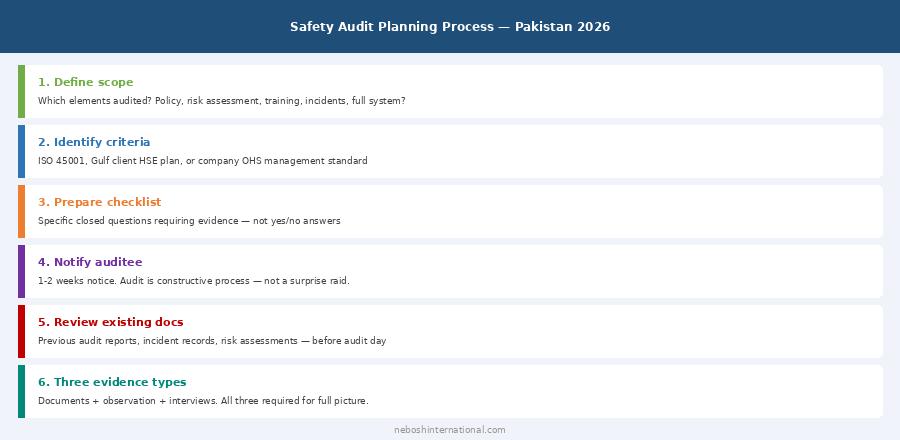
Effective auditing starts before the auditor enters the workplace. A clear plan helps the audit team gather relevant evidence and focus on significant risks.
Step 1: Define the Audit Scope
Identify the department, site, activities, or management system elements that will be assessed.
For example, an audit at a Karachi warehouse may focus on forklift operations, pedestrian routes, stacking practices, fire protection, and emergency arrangements.
Step 2: Establish the Audit Criteria
Determine which requirements the organisation must meet. These may include applicable Pakistani legislation, company HSE procedures, ISO 45001 requirements, and client-specific standards.
The auditor should understand the criteria before evaluating compliance.
Step 3: Prepare an Audit Checklist
Develop questions that help verify whether the required controls are implemented.
Examples include:
- Are workplace risk assessments current and relevant to actual activities?
- Can workers explain the hazards associated with their tasks?
- Are emergency exits accessible and clearly identified?
- Are defective tools removed from service?
- Are incidents investigated and corrective actions tracked?
- Do supervisors verify that safe work procedures are followed?
A checklist provides structure, but auditors must use professional judgement rather than relying only on tick-box answers.
Step 4: Review Existing Records
Before the site visit, examine relevant documents such as previous audit reports, incident records, training registers, risk assessments, maintenance logs, and corrective action trackers.
This review helps identify recurring problems and areas that need further investigation.
Step 5: Arrange the Audit
Inform relevant managers and departments about the scope, schedule, evidence requirements, and audit team. Audits should be planned according to their purpose and the organisation’s audit programme.
The aim is to evaluate normal working practices accurately, not simply to assess a workplace that has been temporarily prepared for an inspection.
How to Conduct a Safety Audit
A practical safety audit normally includes an opening meeting, evidence gathering, and a closing meeting.
Opening Meeting
Explain the audit’s objectives, scope, criteria, schedule, and reporting arrangements. Clarify the responsibilities of the auditors and the people being audited.
A constructive approach encourages employees to explain how work is performed in practice.
Gather and Verify Evidence
Use three main evidence sources:
Document review: Examine policies, risk assessments, permits, training records, inspection reports, maintenance records, and incident investigations.
Workplace observation: Observe actual tasks, equipment, work areas, and safety controls. For example, check whether workers follow the documented permit-to-work procedure during maintenance activities.
Employee interviews: Ask workers and supervisors to explain their responsibilities and demonstrate how procedures are applied. Compare their answers with the documents and workplace observations.
The strongest findings come from evidence that has been checked and verified. A training register alone does not prove that workers understand a procedure or consistently follow it.
Closing Meeting
Present the findings to management, explain significant gaps, and discuss appropriate corrective actions. Confirm the report’s expected delivery date and the process for tracking outstanding findings.
The meeting should focus on evidence, risk reduction, and improvement rather than personal blame.
Safety Audit Checklist for Safety Officers
Use this practical checklist as a starting point. Adapt it to the workplace, applicable requirements, and hazards being assessed.
| Audit area | What to verify |
|---|---|
| HSE policy | Is the policy current, communicated, and supported by management? |
| Risk assessment | Are hazards identified and controls suitable for the work? |
| Training | Are competency and induction records available and relevant? |
| PPE | Is required equipment suitable, available, maintained, and used correctly? |
| Machinery | Are guarding, maintenance, and isolation arrangements effective? |
| Fire safety | Are exits accessible and emergency equipment maintained? |
| Permit to work | Are permits authorised and followed for applicable high-risk tasks? |
| Incident management | Are incidents investigated and lessons communicated? |
| Emergency response | Are responsibilities, arrangements, and drills appropriate? |
| Corrective actions | Are findings assigned, completed, and verified for effectiveness? |
Record the evidence supporting each finding. If a requirement is not met, explain the gap clearly and identify the relevant risk.
How to Write an Effective HSE Audit Report
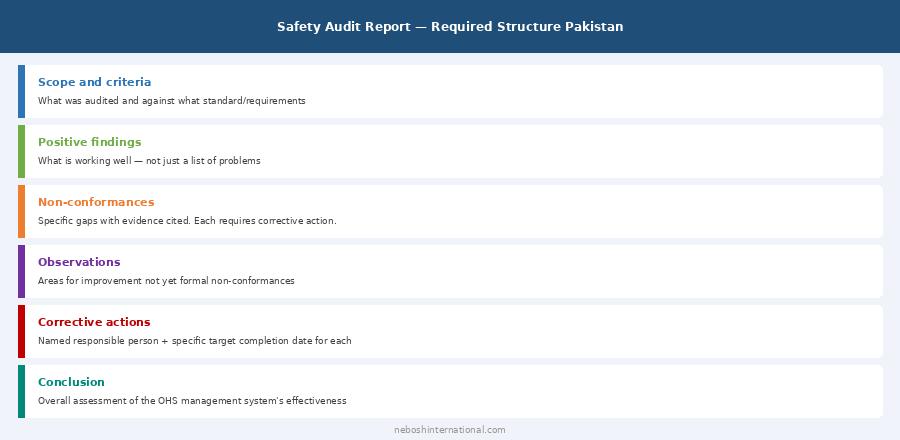
An HSE audit report should help management understand what was assessed, what the evidence showed, and what action is required.
Include these sections:
- Audit details: Site, date, auditor, department, and audit scope.
- Audit criteria: Standards, policies, procedures, and requirements used.
- Positive findings: Controls and processes that are working effectively.
- Non-conformities: Specific failures to meet an applicable requirement.
- Observations: Other issues or opportunities for improvement, clearly distinguished from formal non-conformities.
- Corrective action plan: Required actions, responsible persons, and agreed deadlines.
- Conclusion: An evidence-based assessment of the areas audited.
For example, avoid writing, “Worker training is inadequate.”
Instead, state which training requirement was not met, what records or observations support the finding, which workers or activities are affected, and what corrective action is necessary.
Corrective actions should address the underlying cause where appropriate, not merely correct the immediate problem. Follow-up verification is also important because closing a report does not necessarily mean the risk has been controlled effectively.
Safety Auditing and NEBOSH IGC in Pakistan
NEBOSH IGC can help learners develop knowledge of workplace hazards, risk assessment, control measures, and the monitoring and review of health and safety performance. These topics provide useful foundations for understanding safety management systems.
However, holding a NEBOSH IGC qualification does not automatically make someone competent to conduct every type of audit. Competence depends on the audit scope, relevant experience, knowledge of the criteria, and any additional qualifications or authorisation required.
Safety officers in Lahore, Karachi, Rawalpindi, Faisalabad, and other industrial centres can strengthen their practical skills by learning how to collect evidence, evaluate procedures, write findings, and monitor corrective actions.
These capabilities may also be relevant to HSE positions in Saudi Arabia, the UAE, Qatar, Oman, and other Gulf markets. Actual employer requirements differ by role and industry.
For related learning, explore the NEBOSH IGC exam format guide and the NEBOSH International website for course information and learner guidance.
Frequently Asked Questions
The main purpose is to evaluate whether an organisation’s health and safety management arrangements meet defined requirements and work effectively to control workplace risks,
The frequency depends on workplace risks, applicable legal and contractual requirements, previous findings, and the organisation’s audit programme. ISO 45001 requires audits at planned intervals, but it does not establish a universal annual minimum for every organisation. High-risk workplaces may need more frequent audits.
No. An ISO 45001 audit evaluates an occupational health and safety management system against that standard. A general safety audit can use other defined criteria.
A NEBOSH IGC holder may contribute to or conduct an audit when they have the necessary competence, experience, and organisational authorisation for its scope. The qualification alone does not establish competence for every audit.
It should include the scope, audit criteria, evidence, positive findings, non-conformities, improvement observations, corrective actions, responsible persons, target dates, and conclusions.
Corrective actions address identified failures and, where necessary, their underlying causes. Follow-up checks help confirm whether the action has reduced the risk and prevented the issue from recurring.
Conclusion
Safety auditing is an important part of effective workplace risk management. For Pakistani safety officers, understanding the audit process can improve the way they evaluate procedures, verify controls, report non-conformities, and support continual improvement.
The essential difference is straightforward: a safety inspection identifies unsafe conditions, while a safety audit examines whether the management system can prevent and control those problems consistently.
Whether you work in construction, manufacturing, textiles, warehousing, or oil and gas, build your auditing skills around evidence, clear reporting, suitable corrective actions, and follow-up verification.
If you are exploring NEBOSH IGC in Pakistan, use your studies to develop a broader understanding of risk management and safety performance. Combine that knowledge with practical experience and relevant audit training to prepare for the responsibilities of an HSE professional.

NEBOSH International General Certificate (IGC) certified HSE professional focused on occupational health and safety, workplace risk assessment, hazard identification, and safety management systems. The content published on NeboshInternational.com is based on current industry guidance, recognized safety best practices, and practical workplace examples to help professionals in Pakistan and the Gulf prepare for NEBOSH qualifications and build successful HSE careers.


3 Comments
Comments are closed.