Scaffold Safety in Pakistan 2026: Complete Guide for Safety Officers

A construction site in Lahore may have workers laying bricks several metres above ground while another team installs electrical services on a nearby scaffold. If the working platform has missing guardrails, loose boards or an unsafe access ladder, a routine task can quickly become a serious accident.
Scaffold safety in Pakistan is essential for protecting construction workers, contractors and visitors from falls, falling materials and scaffold collapse. These risks affect projects in Lahore, Karachi, Rawalpindi, Islamabad, Faisalabad and other growing construction centres.
Scaffolding provides temporary access to elevated work areas. However, it must be properly designed, erected, inspected, maintained and dismantled by competent personnel.
This guide explains common scaffold types, essential safety precautions, inspection procedures, loading controls and the responsibilities of safety officers. It also provides practical guidance for NEBOSH IGC students and HSE professionals preparing for construction safety roles in Pakistan and the Gulf.
1. Common Types of Scaffolding Used in Pakistan
Different construction activities require different scaffolding systems. Therefore, safety officers should understand how each system works and which hazards require attention.
Independent Tied Scaffold
An independent tied scaffold uses two rows of standards connected by ledgers and transoms. Ties secure the scaffold to the building and help maintain stability.
Contractors commonly use this system for brickwork, plastering, painting, cladding and external maintenance. Safety officers should check the ties, bracing, foundations and working platforms before authorising access.
Putlog Scaffold
A putlog scaffold uses the supporting building structure as one side of the arrangement. Putlogs connect the scaffold platform to suitable support within the structure.
During brickwork, incorrectly positioned or unsupported putlogs can create unstable platforms. Consequently, competent scaffolders must verify the design and support arrangements before workers begin.
Tube and Coupler Scaffold
This system uses metal tubes connected by couplers. Its flexibility makes it useful for irregular buildings, industrial facilities and complicated construction layouts.
However, incorrect connections, missing braces and unsuitable foundations can compromise stability. Erectors must follow the approved design and manufacturer instructions.
2. Essential Scaffold Safety Requirements
Before allowing workers to use a scaffold, the site team should verify that it is suitable for the task and complies with applicable project requirements.
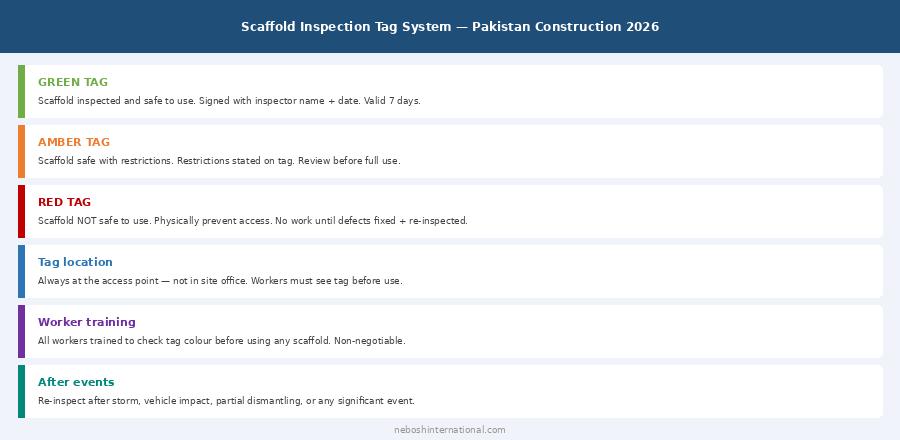
Guardrails and Toe Boards
Provide suitable edge protection wherever workers or materials could fall from an exposed platform.
- Install secure top guardrails and intermediate protection.
- Fit toe boards or equivalent protection to help prevent tools and materials from falling.
- Protect open ends and other exposed edges.
- Check that guardrails are firmly secured and capable of withstanding foreseeable loads.
As an international reference, the UK Health and Safety Executive describes a top guardrail height of at least 950 mm and intermediate protection that limits unprotected gaps. Apply the requirements of the governing local rules and approved project standard.
Safe Working Platforms
A scaffold platform must provide stable, suitable support for workers, tools and materials.
Check that:
- Platforms are fully boarded or decked as required by the scaffold design.
- Boards are secured against movement.
- Damaged, cracked or unsuitable components are removed from service.
- Walking surfaces are free from unnecessary obstructions.
- Platform width and access arrangements suit the work.
- Materials cannot fall through openings or from exposed edges.
Never assume that a platform is safe simply because it appears complete from ground level.
Foundations, Bracing and Ties
Scaffold stability starts at ground level. Soft soil, uneven surfaces, damaged base plates and missing ties can cause settlement or collapse.
Safety officers should verify that base plates and suitable sole boards are installed where required. They should also check the scaffold’s alignment, bracing, connections and ties against the approved design.
Never allow workers to remove structural components without authorisation from a competent person.
Safe Access
Workers must use designated access systems rather than climbing scaffold tubes or cross-bracing.
Provide suitable ladders, stair towers or other approved access arrangements. Secure ladders where required and ensure that entry and exit points remain unobstructed.
For more guidance, read our Working at Height Safety in Pakistan: Complete Guide for Safety Officers.
3. Scaffold Inspection Procedure for Safety Officers
Regular inspection is a fundamental part of scaffold safety management. However, the inspection schedule must follow applicable regulations, project requirements and the scaffold’s risk assessment.
The UK HSE recommends inspecting construction scaffolds before first use, at intervals not exceeding seven days and after circumstances that could affect their safety, such as adverse weather or substantial alterations. This is useful international guidance, but it should not automatically be treated as the applicable legal requirement for every Pakistani project.
What Should a Scaffold Inspection Cover?
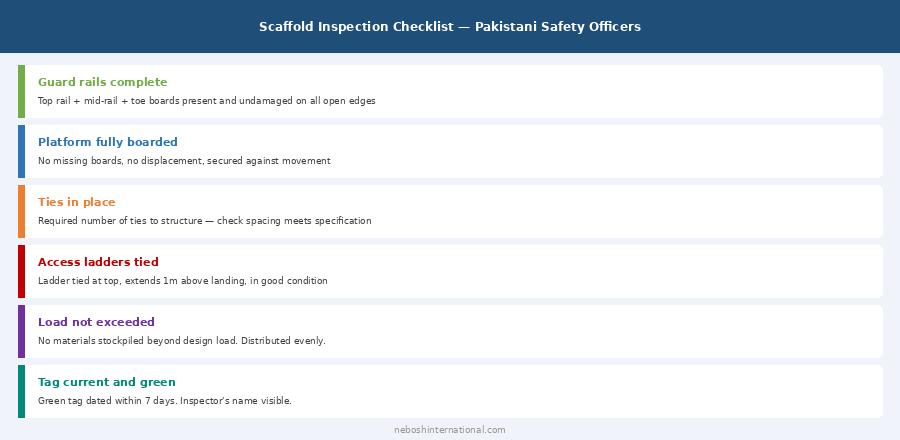
Use the following checklist as a starting point:
- Foundations: Check ground conditions, settlement, base plates and sole boards.
- Structure: Examine standards, ledgers, transoms, braces, couplers and ties.
- Platforms: Identify missing boards, unsecured decking, excessive gaps and trip hazards.
- Edge protection: Check guardrails, intermediate rails and toe boards.
- Access: Verify that designated ladders or stairways are secure and usable.
- Loading: Confirm that the intended load remains within the scaffold’s rated capacity.
- Surroundings: Look for overhead electrical hazards, vehicle impact risks and falling-object hazards.
- Records: Confirm that inspection findings, defects and corrective actions are documented.
A competent person with appropriate training and experience should carry out formal scaffold inspections.
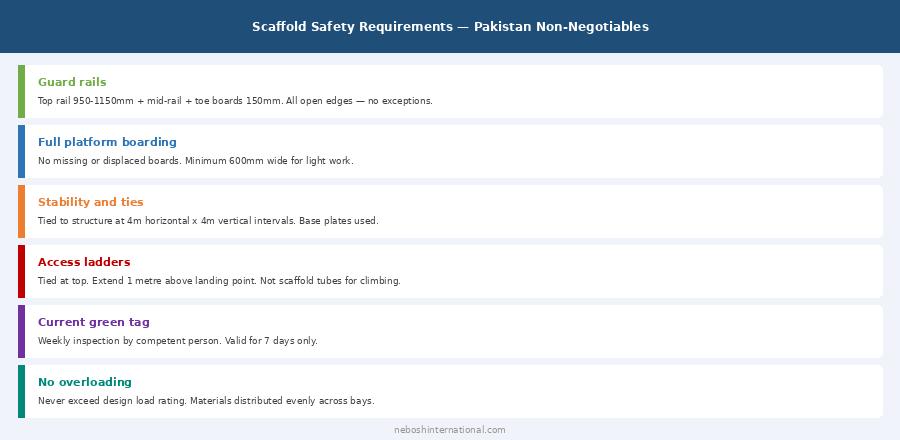
Scaffold Tag Systems: Green, Amber and Red
Many construction projects use colour-coded tags to communicate scaffold status.
- Green: Indicates that the scaffold has been inspected and is authorised for the stated use, subject to its inspection status and site procedure.
- Amber: Indicates restricted use or outstanding conditions that must be clearly defined and controlled under the site system.
- Red: Indicates that the scaffold must not be used.
Colour meanings can vary between projects. Therefore, workers must follow the site’s written tagging procedure and inspection records.
A tag does not replace a proper physical inspection. Likewise, a scaffold that looks safe must not be used if its inspection status cannot be verified.
Read the official HSE scaffolding inspection guidance for additional information.
4. Scaffold Loading: Preventing Overloading and Collapse
Every scaffold must be suitable for its intended duty. Workers may need to carry bricks, cement, tiles, tools or equipment onto elevated platforms. If the combined load exceeds the scaffold’s design capacity, structural failure may occur.
Safety officers should:
- Confirm the scaffold’s rated capacity and intended use.
- Prevent the accumulation of unnecessary materials.
- Distribute permitted loads as specified by the design.
- Keep access routes clear.
- Stop work if the scaffold shows signs of movement, deformation or instability.
- Ensure that changes in loading are assessed by a competent person.
Do not apply generic light-, medium- or heavy-duty load figures to every scaffold. Actual capacity depends on the design, components, configuration and loading arrangement.
The US Occupational Safety and Health Administration provides further technical information in its scaffold construction requirements. Use this as a technical reference rather than a substitute for applicable Pakistani requirements.
5. Common Scaffolding Hazards and Control Measures
Construction sites in Pakistan can face additional challenges involving housekeeping, weather, supervision and changing work conditions.
| Hazard | Recommended control |
|---|---|
| Falls from platforms | Provide suitable edge protection and safe access |
| Scaffold collapse | Use competent erectors and follow the approved design |
| Falling tools or materials | Install appropriate toe boards, barriers and exclusion zones |
| Overloading | Display and enforce the scaffold’s rated capacity |
| Electrical contact | Assess overhead lines and maintain required clearances |
| Slippery platforms | Control spills and suspend work when conditions are unsafe |
| Unauthorised alterations | Restrict modifications to authorised, competent personnel |
| Vehicle impact | Provide suitable barriers and traffic management where needed |
For example, a scaffold beside a busy construction entrance in Karachi may require impact protection as well as routine inspections. Similarly, a project in Rawalpindi exposed to strong winds or heavy rain should reassess scaffold stability when conditions could have affected its safety.
These controls should form part of the site’s risk assessment and safe system of work.
6. Responsibilities of a Construction Safety Officer
Scaffold safety requires cooperation between management, scaffold contractors, supervisors and workers.
- The scaffolding contractor should ensure that erection, alteration and dismantling are undertaken by competent personnel in accordance with the approved design and relevant instructions.
- The safety officer should verify inspection arrangements, identify hazards, review records, communicate unsafe conditions and follow up corrective actions.
- Site supervisors should ensure that workers use authorised scaffolds and follow access, loading and work restrictions.
- Workers should check the scaffold’s status before use, avoid unauthorised modifications and immediately report damaged components or unsafe conditions.
- If a scaffold is unsafe, the safety officer should stop the affected work, prevent access, arrange a competent assessment and ensure that defects are corrected before use resumes.
NEBOSH IGC can help HSE professionals develop broader knowledge of risk assessment, hazard identification and workplace control measures. For further information, read our guide to NEBOSH IGC for Engineers in Pakistan 2026.
Frequently Asked Questions
Inspection frequency depends on applicable requirements and site conditions. As a recognised international example, the UK HSE recommends inspection before first use, at least every seven days during use, and after events that could affect safety. Follow the requirements governing your project.
Workers should not use a scaffold when its inspection status or authorisation cannot be verified. Follow the site’s tagging procedure and arrange an inspection by a competent person before permitting access.
Responsibility is shared. The scaffolding contractor manages competent erection, alteration and dismantling; the site management team oversees safe work arrangements; and safety officers monitor hazards, inspection records and corrective actions.
Stop the affected work, arrange for workers to leave the scaffold safely, prevent further access and notify the responsible supervisor. The scaffold must remain out of service until a competent person verifies that the defects have been corrected and authorises its use.
Yes. Scaffold safety is a practical application of working-at-height risk assessment, hazard identification, control measures and safe systems of work. Students should also consult the current official syllabus and assessment guidance for their qualification.
Conclusion:
Scaffold safety in Pakistan requires more than checking a few guardrails or attaching a coloured tag. Effective management combines competent erection, stable foundations, suitable platforms, safe access, controlled loading and documented inspections.
Whether you work on a construction project in Lahore, Karachi, Islamabad, Faisalabad or Rawalpindi, make scaffold safety part of daily site supervision. Stop unsafe work, report defects promptly and verify that corrective actions are complete before workers return to an affected scaffold.
For HSE professionals developing their careers, practical knowledge of scaffolding and working-at-height hazards is an important complement to broader occupational safety training.
Explore NEBOSH course information and HSE career guidance at NEBOSH International.

NEBOSH International General Certificate (IGC) certified HSE professional focused on occupational health and safety, workplace risk assessment, hazard identification, and safety management systems. The content published on NeboshInternational.com is based on current industry guidance, recognized safety best practices, and practical workplace examples to help professionals in Pakistan and the Gulf prepare for NEBOSH qualifications and build successful HSE careers.