Working at Height Safety in Pakistan 2026: 10 Essential Rules for Safety Officers
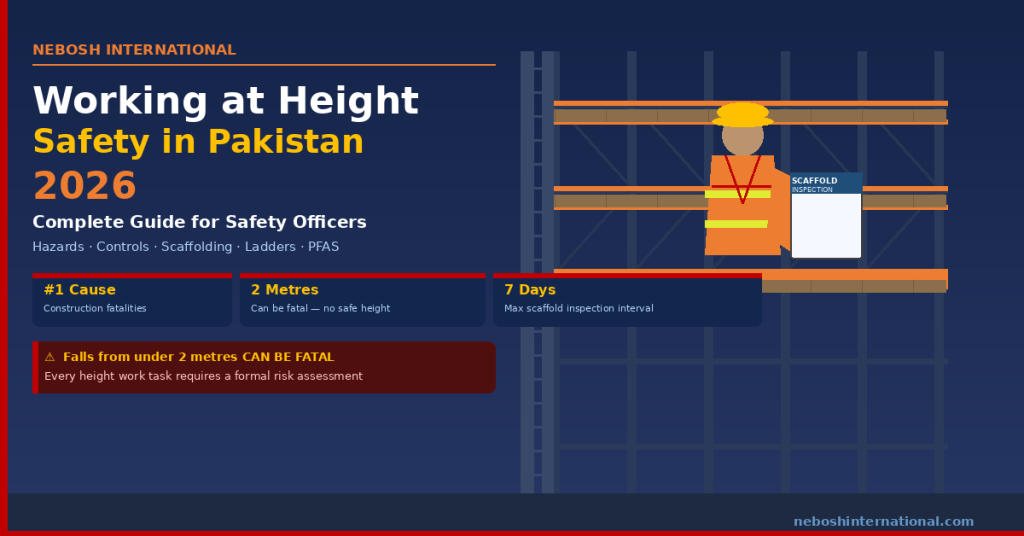
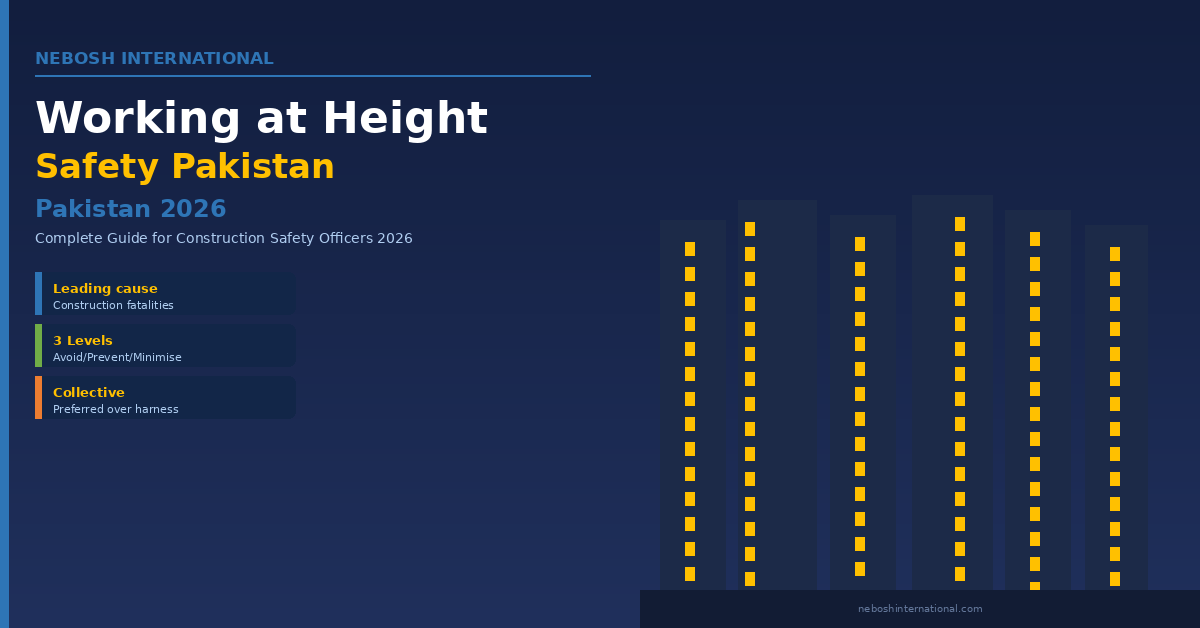
Working at Height Safety in Pakistan is one of the most important responsibilities for Safety Officers working in construction, manufacturing, oil and gas, maintenance, telecommunications and other high-risk industries.
For example, imagine a Safety Officer inspecting a construction project in Rawalpindi. Workers are installing formwork several metres above ground, but one scaffold section has incomplete edge protection. In addition, a worker is wearing a harness without a clear rescue plan. Although the task may appear routine, a single fall could result in permanent disability or death.
Therefore, effective working at height safety requires more than wearing a safety helmet or harness. Instead, it involves proper risk assessment, competent workers, suitable access equipment, collective protection, regular inspections, effective supervision and emergency planning.
Furthermore, Safety Officers must ensure that these controls remain effective throughout the task. As site conditions change, they should reassess hazards and introduce additional precautions where necessary.
This guide explains the main work-at-height hazards, essential safety rules, scaffold and ladder requirements, fall-protection systems, permit-to-work considerations and the relevance of working at height to the NEBOSH International General Certificate in 2026.
Quick answer: Working at height means performing work where a person could fall far enough to suffer injury. Therefore, the safest approach is to avoid unnecessary height work, prevent falls through collective protection and use suitable personal fall-protection systems when residual risks remain.
What Is Working at Height?
Working at height refers to work where a person could fall a distance that could cause personal injury.
It can include:
For example, even work at a relatively low level can cause serious injury if a worker falls onto a hard surface or into an opening.
- Working on scaffolding or temporary platforms
- Working on roofs
- Working near fragile surfaces
- Working beside unprotected edges
- Working around floor openings or stairwells
- Using ladders or stepladders
- Operating mobile elevated work platforms (MEWPs)
- Maintenance work on elevated structures
- Accessing tanks, structures or equipment at height
Importantly, there is no universal rule that makes only high-level work dangerous. Therefore, Safety Officers should assess the potential consequences of a fall rather than relying only on a particular height threshold. A fall from a relatively low level can still cause serious injury.
For construction projects in Lahore, Rawalpindi, Karachi, Islamabad, Faisalabad and Peshawar, this approach is particularly important because temporary structures, access equipment and changing work conditions can introduce additional risks.
10 Essential Working at Height Safety Rules
1. Avoid Work at Height Where Possible
First, consider whether the task can be completed safely from ground level. For example, workers may be able to assemble equipment on the ground before lifting it into position. Similarly, remote inspection tools may eliminate the need to access an elevated location.
As a result, avoiding work at height removes the associated exposure to falls. Therefore, consider this option before selecting ladders, scaffolds or personal protective equipment.
2. Complete a Suitable Risk Assessment
Before work begins, Safety Officers should conduct a suitable risk assessment. First, identify who could fall and determine the locations where falls might occur. Next, consider the possible consequences and decide which controls are necessary.
The assessment should address the following questions:
- Who could fall, and from where?
- What could workers fall onto?
- Could tools or materials fall onto people below?
- Is the structure stable and suitable for the task?
- Is the access equipment appropriate?
- Could wind, rain or poor visibility increase the risk?
- Are the workers trained and competent?
- What rescue arrangements are available?
In addition, assess other hazards that could affect the activity. For example, a worker installing equipment on a roof may face an unprotected edge, fragile roofing material, strong winds and electrical hazards simultaneously.
Consequently, controlling only one hazard may not make the task safe. Instead, the risk assessment should consider the entire activity, including access, equipment, nearby workers and emergency arrangements.
Finally, record the necessary controls and communicate them to the workers and supervisors before work starts.
Common Work at Height Hazards in Pakistan
| Hazard | Potential consequence | Typical control |
|---|---|---|
| Unprotected edges | Fall from height | Guardrails or suitable fall protection |
| Unsafe scaffolding | Fall or collapse | Competent erection and inspection |
| Fragile roofs | Fall through surface | Avoidance, barriers and suitable access |
| Unsafe ladders | Fall during climbing | Correct selection, positioning and inspection |
| Dropped tools | Injury to people below | Tool securing and exclusion zones |
| Strong wind/rain | Loss of balance | Weather monitoring and work restrictions |
| Overhead electrical lines | Electric shock | Isolation, clearance and planning |
| Defective MEWPs | Fall or equipment incident | Inspection and competent operation |
| Poor access | Slips and falls | Safe access and egress |
| No rescue plan | Prolonged suspension after fall | Pre-planned rescue arrangements |
Overall, these hazards show why work-at-height planning must address both people and equipment.
The International Labour Organization’s Construction Convention also specifically addresses work at height, including measures to protect workers from falling and precautions around fragile roof materials.
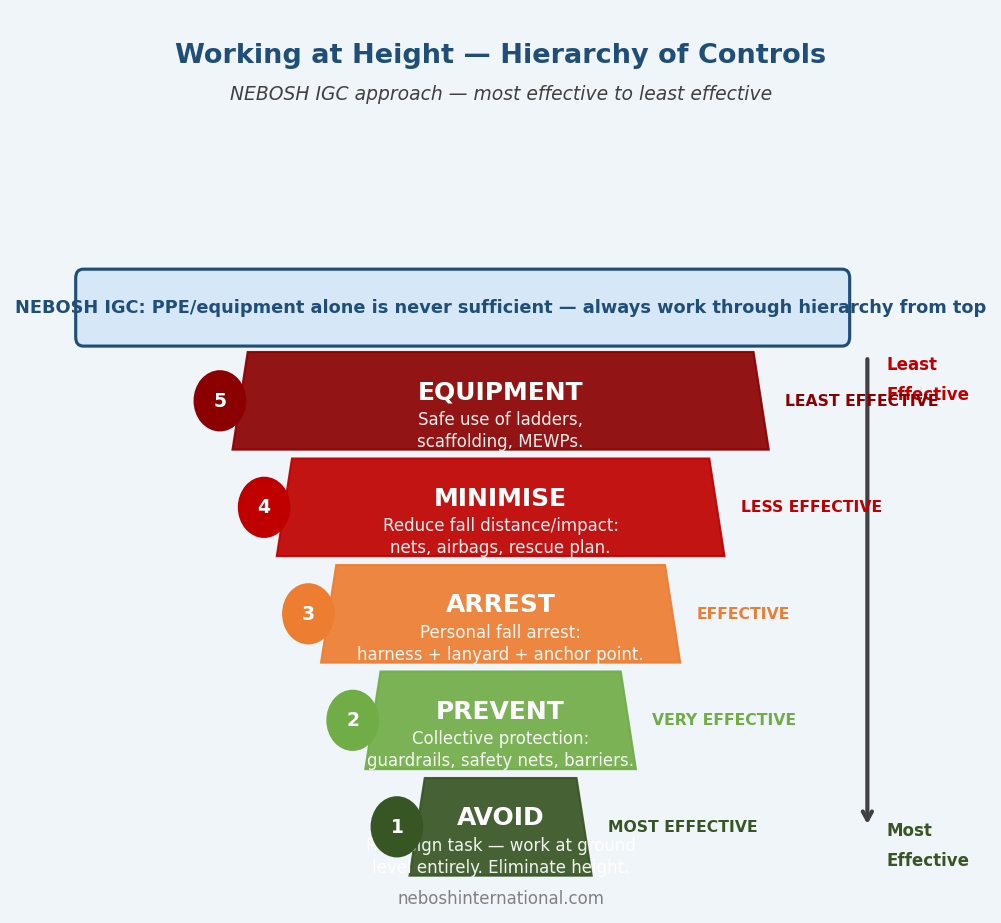
3. Follow the Hierarchy of Controls
A strong working at height safety plan should not begin with PPE. Instead, apply controls in the following order:
- Avoid work at height where reasonably possible.
- Prevent falls using collective protection such as guardrails.
- Minimise the consequences of a fall using suitable safety systems.
- Use personal fall protection where residual risk remains.
- Provide safe access equipment and ensure it is correctly selected and used.
Collective protection is generally preferable because it can protect several workers at the same time.
For example, a properly installed guardrail can prevent a worker from reaching an edge. By contrast, a harness system normally depends on correct selection, connection, inspection, anchorage and user behaviour.
For this reason, Safety Officers should prioritise collective protection whenever reasonably practicable.
4. Make Scaffold Safety a Priority
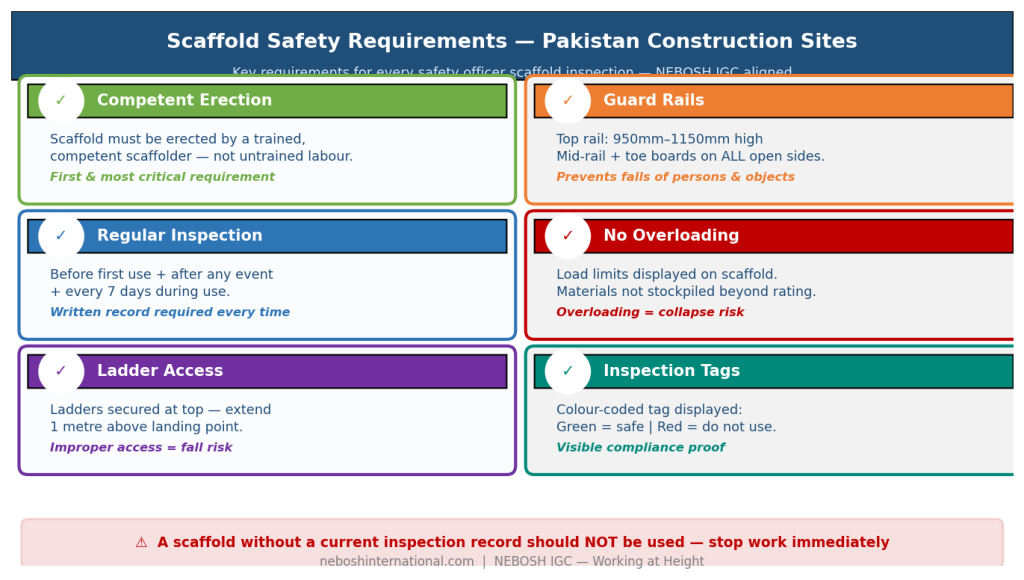
Pakistani construction projects widely use scaffolding. However, unsafe scaffolding can create several risks at once, including falls, collapse, falling objects and unsafe access.
A Safety Officer should check that:
- Competent personnel erect the scaffolding.
- The structure can safely carry its intended load.
- Workers use properly arranged working platforms.
- Guardrails and toe boards provide suitable edge protection where required.
- Workers have safe access and egress.
- A competent person inspects the scaffold before use and after events that could affect its integrity.
- Supervisors record inspection findings.
- Workers keep damaged scaffolding out of service until a competent person assesses it.
As a result, regular scaffold checks can identify defects before workers use the structure.
According to the ILO construction standard, employers should provide and maintain a suitable scaffold or equally safe arrangement when workers cannot safely perform the task from the ground or a permanent structure.
Scaffold Inspection Checklist
Before allowing access, ask:
Is it stable? Is it complete? Is access safe? Is edge protection adequate? Is it overloaded? Has it been inspected?
Therefore, supervisors can use a simple checklist to identify defects before workers access the scaffold.
5. Use Ladders Correctly
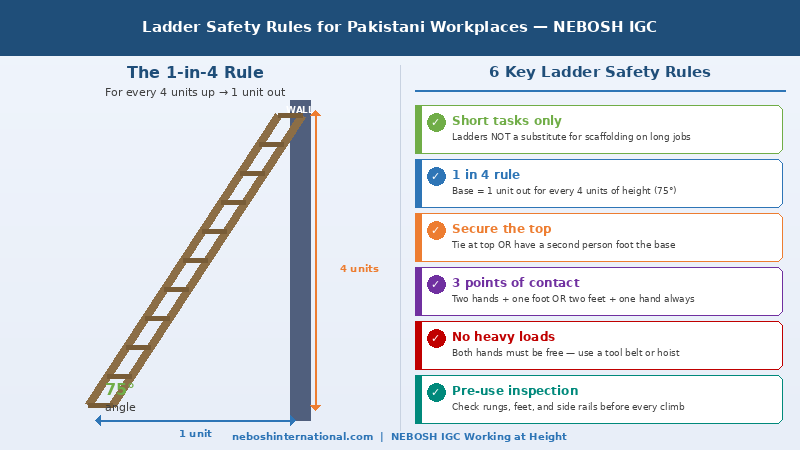
Ladders are useful for certain short-duration tasks. However, workers should not automatically treat them as the safest option.
Before using a ladder:
- Select the correct type and length.
- Inspect it for damage.
- Place it on a stable surface.
- Secure it against movement.
- Maintain three points of contact while climbing.
- Keep both hands available where practical.
- Do not overreach.
- Do not use damaged ladders.
- Avoid carrying awkward or heavy loads while climbing.
For leaning ladders, the commonly used 1:4 positioning principle means approximately one unit out for every four units of vertical height.
However, workers must follow the manufacturer’s instructions and applicable site procedures. In addition, supervisors should check that workers position and secure each ladder correctly.
As a result, supervisors should verify that each ladder provides safe access and suits the task.
6. Inspect Fall Protection Equipment
When other controls cannot adequately prevent a fall, Safety Officers should select a suitable personal fall-protection system.
Depending on the task, this may include:
- Full-body harness
- Energy-absorbing lanyard
- Suitable connectors
- Lifelines
- Approved anchor systems
- Fall-arrest or restraint equipment
Therefore, Safety Officers must check that the equipment fits correctly, suits the task and connects to an appropriate anchorage.
Furthermore, workers need training in correct use and inspection.
In addition, workers should understand how to inspect and correctly use the equipment before starting the task.
As a result, proper training can reduce incorrect equipment use and improve worker confidence.
7. Plan for Rescue Before Work Starts
One of the most important points in working at height safety in Pakistan is often overlooked:
What happens after a fall is arrested?
A fall-arrest system may stop a worker from reaching the ground. However, the worker can still remain suspended in the harness. Therefore, every fall-arrest activity needs a realistic rescue plan covering:
- Rescue equipment
- Rescue personnel
- Communication
- Access to the casualty
- Emergency contact arrangements
- First-aid arrangements
- Safe recovery of the worker
- Post-incident reporting
Safety Officers should make the rescue plan practical rather than treating it as paperwork.
Most importantly, rescue arrangements should match the actual location, equipment and number of workers involved.
8. Control Falling Objects
Height work creates a second major hazard: objects falling onto people below.
Consequently, employers should establish exclusion zones and secure loose items to protect people below.
Tools, bolts, materials and equipment can fall from platforms or structures.
Before starting any task, Safety Officers can use the following checklist to verify the main controls.
- Tool lanyards where appropriate
- Toe boards
- Secure storage
- Material restraints
- Exclusion zones
- Barricades
- Warning signs
- Controlled lifting arrangements
- Head protection
- Good housekeeping
For example, if workers are installing steel components above a pedestrian route, simply asking people below to “be careful” is not an adequate control.
Instead, the area should be controlled so that people are not unnecessarily exposed to falling-object risks.
9. Use Permit-to-Work Controls for High-Risk Tasks
A Permit to Work (PTW) system may be appropriate for specific high-risk activities, depending on the organization’s risk assessment and procedures.
For example, additional authorization may be required for:
- High-risk roof work
- Work near fragile surfaces
- Work near significant unprotected edges
- Certain MEWP activities
- Work near electrical hazards
- Complex maintenance activities
A working-at-height permit can identify:
- Exact work location
- Scope of work
- Hazards
- Required controls
- Worker competency
- Equipment requirements
- Isolation requirements
- Rescue arrangements
- Permit duration
- Authorizing person
Importantly, a permit does not make unsafe work safe. It is a control and communication mechanism that supports a broader risk-management system.
10. Train, Supervise and Review
Even the best equipment can fail as a control if workers do not understand how to use it.
Therefore, training should cover the specific task and equipment, including:
- Work-at-height hazards
- Safe access
- Scaffold awareness
- Ladder selection
- Fall protection
- Equipment inspection
- Dropped-object prevention
- Emergency procedures
- Rescue arrangements
In addition, supervisors should observe the work and correct unsafe practices immediately.
Therefore, Safety Officers should verify that workers actually use the controls identified in the risk assessment on site.
Working at Height and NEBOSH IGC in 2026
Working at height is highly relevant to learners studying the NEBOSH International General Certificate because the qualification focuses on applying health and safety knowledge to workplace situations.
For 2026, NEBOSH updated the qualification, with teaching of the revised syllabus beginning on 2 February 2026 and the first revised assessments taking place from March 2026.
The current qualification includes:
- GIC1 — Management of Health and Safety: open-book examination, including scenario-based assessment and a closing interview.
- GIC2 — Risk Assessment: practical assessment involving a workplace risk assessment and action plan.
As a result, work-at-height knowledge has practical value beyond the classroom. A Safety Officer should be able to identify the hazard, explain why the existing controls are inadequate and recommend stronger measures.
If you are preparing for NEBOSH, you can also read our NEBOSH IGC Course and Fees in Pakistan guide.
Working at Height Safety Checklist for Pakistan
Before work starts, a Safety Officer can use this quick checklist:
- Can the work be avoided at height?
- Has a suitable risk assessment been completed?
- Are workers competent?
- Is the access equipment suitable?
- Is scaffolding inspected?
- Are guardrails and toe boards adequate?
- Are ladders correctly positioned and secured?
- Are fragile surfaces identified?
- Are tools and materials secured?
- Are electrical hazards controlled?
- Are weather conditions suitable?
- Is fall protection compatible and inspected?
- Is an appropriate anchorage available?
- Is a rescue plan available?
- Are people below protected?
- Is a PTW required under site procedures?
- Are supervisors checking the controls?
This checklist can also be adapted into a daily site inspection form.
Pakistan Legal and International Safety Context
Employers and Safety Officers should identify the laws, regulations, contractual requirements and client standards applicable to their particular workplace.
Pakistan’s occupational safety requirements can vary according to the workplace and applicable provincial or sector-specific legislation. Therefore, a Safety Officer should not rely on a single generic “height limit” as the basis for deciding whether controls are required.
In addition, international standards can help employers strengthen their work-at-height procedures. For example, ILO Convention C167 addresses construction safety, including scaffolds, access and protection against falls.
Similarly, ISO 45001 provides an internationally recognized framework for occupational health and safety management systems, including hazard identification, risk assessment, legal requirements, emergency planning and continual improvement.
For Pakistan projects, always check the requirements that actually apply to the employer, site, client and contract.
Frequently Asked Questions
Working at height is work where a person could fall far enough to suffer injury. It can include scaffolding, roofs, ladders, MEWPs, platforms, floor openings and other elevated or exposed locations.
Do not rely on a single height threshold. The key question is whether a fall could cause injury. Therefore, even relatively low-level work should be assessed where a fall could cause harm.
The first control is to determine whether the work can be avoided at height. If it cannot, prevent falls using suitable collective protection wherever reasonably practicable.
No. A harness is only one part of a fall-protection system. Correct equipment selection, anchorage, compatibility, inspection, training and rescue planning are also important.
Inspection frequency depends on applicable requirements, site procedures and conditions. Scaffolding should be checked before use and after events that could affect its stability or integrity, with inspections documented according to the applicable system.
It develops practical risk-management skills that Safety Officers can apply to construction, manufacturing, maintenance and other workplaces. It also supports the type of hazard identification and control thinking required in NEBOSH assessments.
Depending on the task, PPE may include a full-body harness, suitable lanyard or connectors, safety helmet and other task-specific equipment. However, PPE should support—not replace—higher-level controls.
Conclusion:
Ultimately, working at height safety in Pakistan is not simply about wearing a harness or putting up a warning sign. Instead, effective prevention starts with avoiding unnecessary height work, followed by risk assessment, collective protection, safe access, competent workers, equipment inspection, supervision and emergency planning.
Whether you are working on a construction project in Rawalpindi, Lahore, Karachi, Islamabad, Peshawar or Faisalabad, the same principle applies: identify the fall hazard before someone is exposed to it.
Furthermore, understanding these controls can strengthen workplace performance and professional development for aspiring and practicing Safety Officers. For NEBOSH learners, this knowledge also supports the practical risk-management approach required in modern health and safety assessments.
For further qualification guidance, explore our NEBOSH International course information and related HSE resources.

NEBOSH International General Certificate (IGC) certified HSE professional focused on occupational health and safety, workplace risk assessment, hazard identification, and safety management systems. The content published on NeboshInternational.com is based on current industry guidance, recognized safety best practices, and practical workplace examples to help professionals in Pakistan and the Gulf prepare for NEBOSH qualifications and build successful HSE careers.