How to Deliver a Toolbox Talk in Pakistan: Complete Safety Officer Guide (2026)

Imagine you are a Safety Officer on a construction project in Bahria Town Rawalpindi. Before the morning shift begins, workers prepare to use scaffolding, move construction materials and operate equipment. However, a recent near-miss has highlighted a serious risk. A short, practical safety briefing can help workers understand the hazard and the precautions required before starting work.
A toolbox talk is a short, task-specific safety discussion that helps workers identify hazards, understand risks and follow appropriate control measures before beginning work. In most workplaces, an effective session lasts around 5–15 minutes, depending on the complexity of the task.
For Safety Officers in Pakistan, toolbox talks are useful across construction projects, factories, warehouses and oil and gas facilities. They also help professionals develop practical communication skills valued by employers in Pakistan and the Gulf.
This guide explains how to deliver a toolbox talk, select relevant topics, involve workers, maintain records and apply safety communication principles in everyday work.
What Is a Toolbox Talk?
A toolbox talk is a brief safety meeting conducted before work begins or when a particular hazard needs attention. It focuses on a specific activity rather than attempting to cover every workplace safety requirement in one session.
For example, a construction team preparing to work at height may receive a briefing on scaffold inspections, fall prevention, access arrangements and dropped-object hazards.
An effective toolbox talk should be:
- Relevant: Connected to the work planned for the shift.
- Practical: Based on actual workplace hazards and control measures.
- Interactive: Encouraging workers to ask questions and report concerns.
- Understandable: Delivered in a language workers can follow.
- Documented: Recorded according to company procedures and client requirements.
Unlike a safety induction, which introduces workers to general site rules and emergency arrangements, a toolbox talk addresses a specific risk or task. Both serve different purposes and should be used appropriately.
Why Are Toolbox Talks Important in Pakistan?
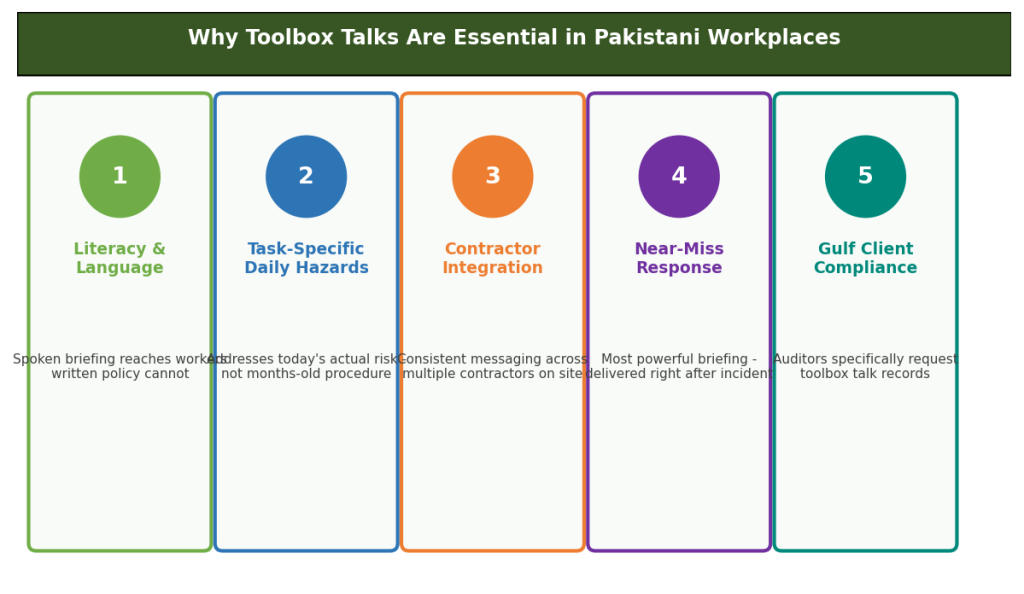
Construction and industrial workplaces often involve changing work conditions, multiple contractors and workers with different levels of experience. Consequently, safety instructions must be clear, timely and relevant.
Toolbox talks can help Safety Officers address several common challenges.
1. Preventing workplace incidents: Discussing hazards before work starts helps workers recognise unsafe conditions and understand required precautions.
2. Improving communication: On projects in Lahore, Rawalpindi, Karachi and other industrial centres, workers may prefer Urdu or regional languages. Explaining safety information in a familiar language improves understanding.
3. Coordinating contractors: A shared briefing helps contractors and subcontractors understand the hazards associated with nearby activities, equipment movements and simultaneous operations.
4. Encouraging hazard reporting: Workers can raise concerns about damaged tools, missing guardrails, unsafe access or inadequate personal protective equipment.
5. Supporting safety management systems: Recorded briefings can provide evidence of safety communication when required by company procedures, contractual arrangements or client audits.
The International Labour Organization provides guidance on occupational safety and health in construction. Review its Code of Practice on Safety and Health in Construction for broader guidance on workplace prevention and worker protection.
How to Deliver a Toolbox Talk: Step-by-Step Guide
Step 1: Choose a Relevant Safety Topic
First, identify the work activities planned for the shift. Then select a topic that addresses the actual hazards workers may encounter.
Useful sources include:
- The day’s work schedule and risk assessment.
- Recent incidents, near-misses and unsafe-condition reports.
- Permit-to-work requirements and method statements.
- Inspection findings and corrective actions.
- Weather conditions, including extreme heat and rain.
- Client requirements and the site safety plan.
For example, if workers will erect scaffolding, discuss safe assembly, inspection, access and fall protection. A generic presentation about office safety would not address their immediate needs.
Step 2: Prepare Three Key Points
Organise the discussion around three elements:
Hazard: What could cause injury or ill health? For example, an unprotected platform edge.
Risk: What could happen, and who could be affected? A worker could fall from height, potentially suffering serious injury or death.
Control measures: What precautions are required? These may include suitable edge protection, safe access, competent inspection and compliance with the approved work method.
Explain the controls that apply to the actual task. A toolbox talk does not replace a risk assessment, permit, formal training or necessary engineering controls.
Step 3: Select the Right Time and Location
Deliver the briefing before the relevant work begins. Choose a safe location close enough to the work area for workers to understand the hazards without exposing them to moving machinery, traffic, falling objects or other dangers.
A group of approximately 8–15 workers is often manageable because everyone has an opportunity to participate. However, the appropriate size depends on noise levels, visibility, language needs and the complexity of the topic.
Step 4: Start With a Clear Example
Explain the topic and why it matters today.
For instance:
“Today’s toolbox talk covers scaffold safety. Before using any scaffold, check that access is safe, required edge protection is in place and the inspection status is acceptable under our site procedure. Report any defect before starting work.”
Whenever possible, use a real site observation or a relevant near-miss to make the message meaningful.
Step 5: Demonstrate and Involve Workers
Do not simply read from a printed sheet. Instead, demonstrate the correct procedure using suitable equipment, photographs or a practical example.
Ask questions such as:
- What hazards can you identify in this work area?
- What should you do if required guardrails are missing?
- Which PPE is necessary for this task?
- Who must be informed if an unsafe condition is discovered?
Give workers time to respond. If someone identifies a serious hazard, make sure it is reported and addressed through the appropriate site process.
Step 6: Summarise Actions and Check Understanding
At the end, repeat the most important control measures and explain what workers must do before starting work.
For example, instruct workers not to use defective equipment and to report it to the responsible supervisor. Ask a worker to explain the key precautions in their own words.
Finally, record attendance and any follow-up actions. If the discussion identifies an uncontrolled serious hazard, escalate it immediately rather than relying on the briefing alone.
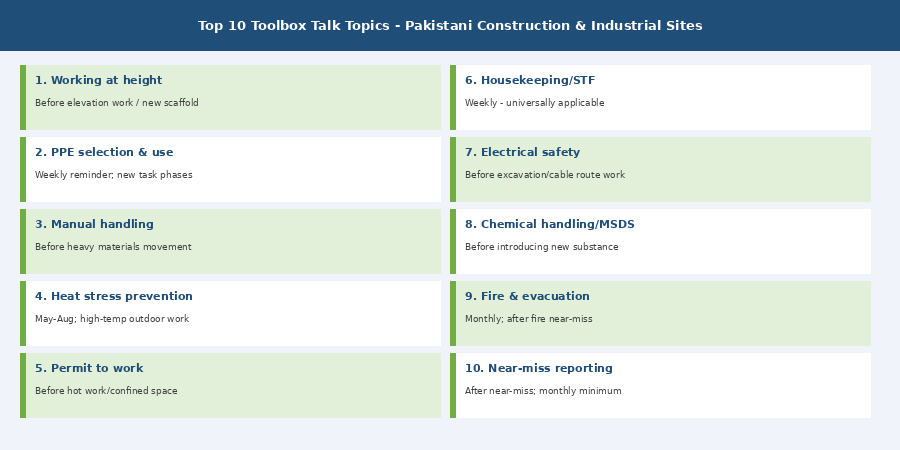
Top 10 Toolbox Talk Topics for Pakistani Workplaces
| Toolbox talk topic | When to deliver it |
|---|---|
| Working at height | Before scaffold, ladder or elevated work |
| Personal protective equipment (PPE) | Before new tasks and when deficiencies are identified |
| Manual handling | Before moving heavy or awkward loads |
| Heat stress prevention | During hot weather and strenuous outdoor work |
| Permit-to-work systems | Before applicable high-risk permitted activities |
| Housekeeping | During routine inspections and when access routes are obstructed |
| Electrical safety | Before electrical work or activities near cables |
| Chemical safety | Before handling hazardous substances |
| Fire prevention and evacuation | Before relevant operations and emergency drills |
| Near-miss reporting | Following near-misses and during routine safety discussions |
For Pakistani construction sites, additional topics may include excavation collapse, lifting operations, vehicle reversing, falling objects and concrete pouring. In factories, machine guarding, lockout/tagout procedures and chemical exposure may deserve greater attention.
Select topics according to workplace risks instead of following a calendar without considering actual conditions.
Toolbox Talk Attendance Sheet: What Should It Include?
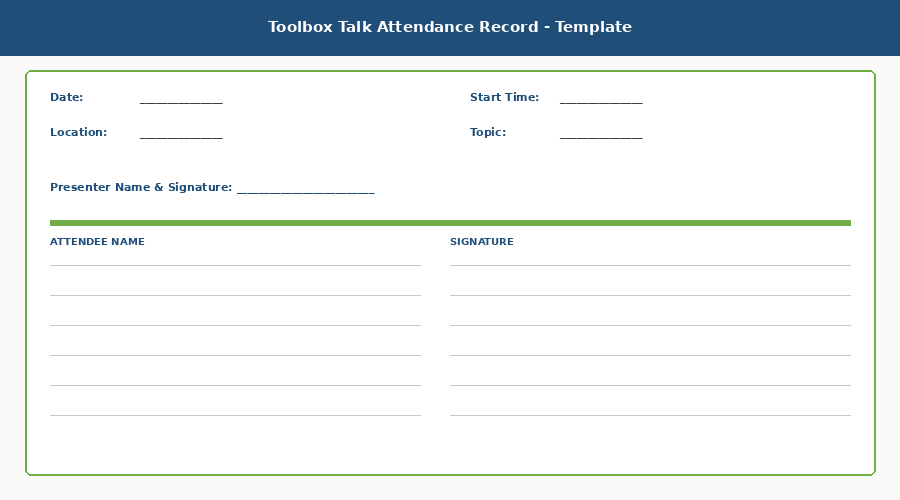
A toolbox talk attendance record helps demonstrate that a briefing took place and identifies the workers who attended.
Use the following template as a starting point:
| Record field | Information required |
|---|---|
| Project or workplace | Site or department name |
| Date and time | Start time and session date |
| Location | Area where the briefing took place |
| Topic | Specific hazard or activity |
| Presenter | Name and designation |
| Attendance | Worker names and signatures |
| Key points | Hazards and controls discussed |
| Questions | Important worker concerns |
| Follow-up actions | Action, responsible person and due date |
Keep completed records according to your organisation’s document-control and retention procedures. Signatures alone do not prove that workers understood the briefing, so encourage questions and verify understanding.
Are Toolbox Talks Mandatory in Pakistan?
There is no single blanket rule that makes every toolbox talk, by that name and at a fixed frequency, mandatory for every workplace in Pakistan. Applicable legal duties, provincial requirements, sector-specific rules, contracts and client procedures must be checked for the particular project.
Nevertheless, toolbox talks may be required by a company’s safety management system or a client’s contractual HSE plan. ISO 45001 also emphasises worker consultation, participation, competence and communication, although it does not prescribe a universal daily toolbox talk schedule.
Therefore, Safety Officers should check the applicable requirements rather than assume that one frequency applies to every site.
For broader guidance, consult the ILO’s occupational safety and health resources and your organisation’s current HSE procedures.
How Toolbox Talks Relate to NEBOSH IGC
The NEBOSH International General Certificate develops knowledge and practical skills for identifying workplace hazards, assessing risks and supporting effective health and safety management. Toolbox talks are a useful workplace example of safety communication and worker involvement.
When answering a NEBOSH scenario question, avoid writing only “conduct a toolbox talk.” Explain the specific hazard, the workers who need the briefing, the relevant control measures and how understanding or completion will be checked.
You can review the official NEBOSH International General Certificate information for current qualification details. For further preparation, read our guides on how to pass the NEBOSH IGC open-book assessment and NEBOSH IGC risk assessment terminology.
Frequently Asked Questions
A typical toolbox talk lasts 5–15 minutes. The duration should reflect the task, hazard complexity and workers’ questions. More complex or high-risk activities may require additional training or a separate formal briefing.
A competent Safety Officer, supervisor, foreman or other appropriately knowledgeable person can deliver it, depending on company procedures and the topic. Specialist hazards may require a suitably qualified person.
Yes, where Urdu or another language helps workers understand the safety message. Use language appropriate to the workforce and verify understanding instead of relying on attendance signatures alone.
Frequency depends on the risk, work schedule, company procedures and client requirements. Some sites use daily briefings, while others use weekly sessions supplemented by task-specific discussions whenever conditions change.
A safety induction introduces general workplace rules, emergency procedures and site requirements, usually when a person joins a workplace or project. A toolbox talk focuses on a particular hazard or activity and is repeated as needed.
Practical toolbox talk delivery, worker communication and accurate safety documentation can strengthen a Safety Officer’s professional skills. However, employment also depends on experience, qualifications, employer requirements and the relevant country’s rules.
Conclusion
Learning how to deliver a toolbox talk is an important practical skill for Safety Officers working in Pakistan’s construction, manufacturing and oil and gas sectors. An effective briefing identifies the day’s hazards, explains suitable control measures, encourages workers to participate and records necessary follow-up actions.
Whether you work in Rawalpindi, Lahore, Karachi, Faisalabad or a Gulf construction project, focus on making every discussion relevant to the work being performed. Above all, remember that the purpose of a toolbox talk is not simply to complete paperwork; it is to help people recognise hazards and work safely.
At NEBOSH International, we provide independent NEBOSH guidance for learners in Pakistan. Explore our website to learn more about the NEBOSH IGC course in Pakistan and develop the knowledge needed to progress in health and safety.

NEBOSH International General Certificate (IGC) certified HSE professional focused on occupational health and safety, workplace risk assessment, hazard identification, and safety management systems. The content published on NeboshInternational.com is based on current industry guidance, recognized safety best practices, and practical workplace examples to help professionals in Pakistan and the Gulf prepare for NEBOSH qualifications and build successful HSE careers.


One Comment
Comments are closed.