How to Pass NEBOSH IGC Open Book Exam 2026: GIC1 Tips
Preparing for the NEBOSH IGC open book exam can feel confusing, particularly if this is your first scenario-based assessment. Many learners in Pakistan assume that an open-book exam will be easy because they can access their study materials. In reality, GIC1 tests something more practical: whether you can apply health and safety knowledge to a workplace scenario.
For example, a safety officer working on a construction project in Rawalpindi may know the definition of a risk assessment. However, the GIC1 assessment expects the learner to identify relevant issues in the scenario, explain why they matter and recommend appropriate controls.
Fortunately, the right preparation makes the assessment much more manageable.
This guide explains how to pass the NEBOSH IGC open book exam in 2026, including the current GIC1 format, answer-writing techniques, command words, time management, scenario application, closing interview preparation and common mistakes.
What Is the NEBOSH IGC GIC1 Open Book Exam?
Under the current 2025 specification, the International General Certificate uses two units:
- GIC1 – Management of health and safety
- GIC2 – Risk assessment
NEBOSH describes GIC1 as a scenario-based open-book examination that includes a closing interview. Furthermore, GIC2 is a practical risk assessment designed to assess how effectively you can apply what you have learned in a workplace.
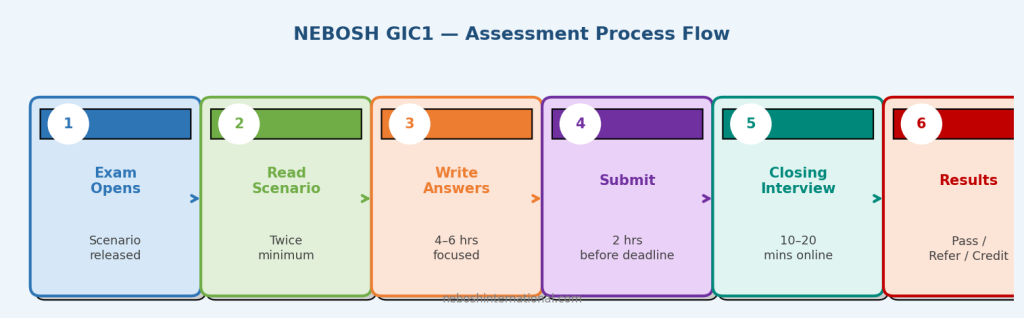
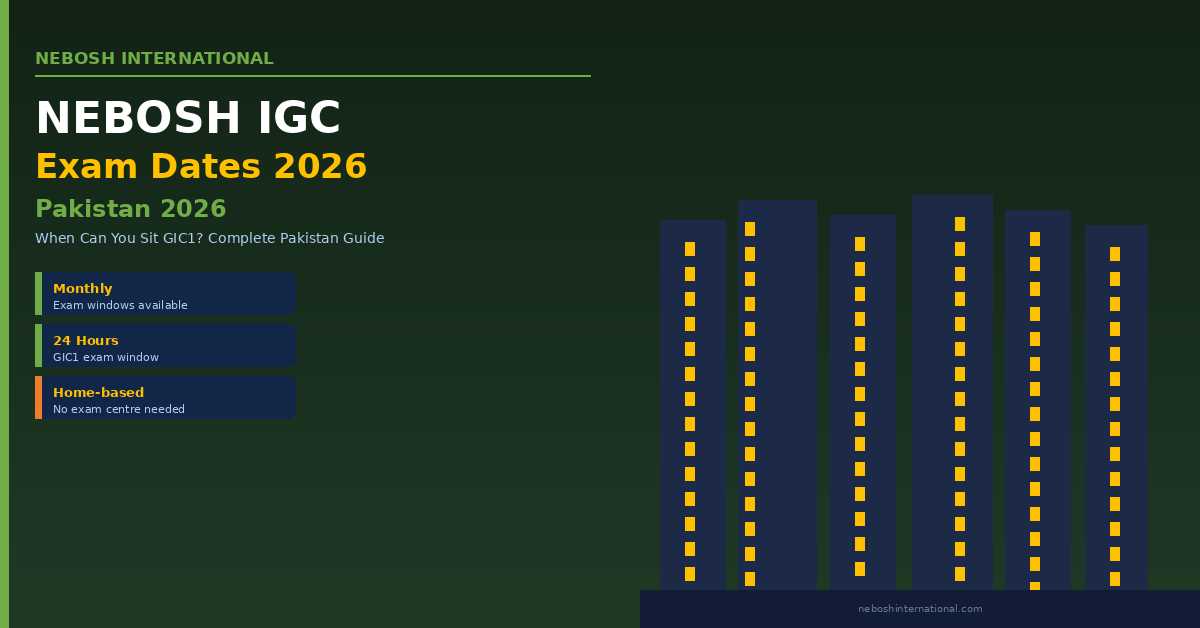
For GIC1, NEBOSH currently provides a 24-hour access window, beginning at 11am UK time on the assessment date. However, the published assessment time for GIC1 is 5 hours. Therefore, candidates should not interpret the 24-hour window as five, ten or twenty-four hours of continuous writing.
Is the NEBOSH IGC open book exam easy?
No. Open book does not mean easy.
The assessment gives you access to information, but you still need to:
- Understand the scenario.
- Identify relevant hazards and management issues.
- Apply appropriate health and safety principles.
- Explain your reasoning.
- Provide scenario-specific answers.
- Manage your available assessment time.
However, simply searching your course book for definitions is not enough.
NEBOSH GIC1 Assessment Format 2026
Instead, the current GIC1 assessment is based on workplace scenarios rather than traditional memory-based examination questions.
In addition, NEBOSH’s current qualification information confirms that GIC1 is an open-book examination and includes a closing interview about the submitted work.
| GIC1 feature | 2026 information |
|---|---|
| Unit | GIC1 |
| Subject | Management of health and safety |
| Assessment | Open-book examination |
| Assessment time | 5 hours |
| Access window | 24 hours |
| Format | Scenario-based digital assessment |
| Closing interview | Yes |
| Provisional pass standard | 45% |
| Qualification grade | Based on GIC1 result |
Furthermore, NEBOSH’s current syllabus guidance states that the provisional GIC1 pass mark is 45%. It also lists 65–74 marks as Credit and 75 marks or higher as Distinction.
Therefore, because NEBOSH can adjust raw marks following marking, candidates should focus on producing strong, relevant answers rather than trying to predict a specific raw-score adjustment.
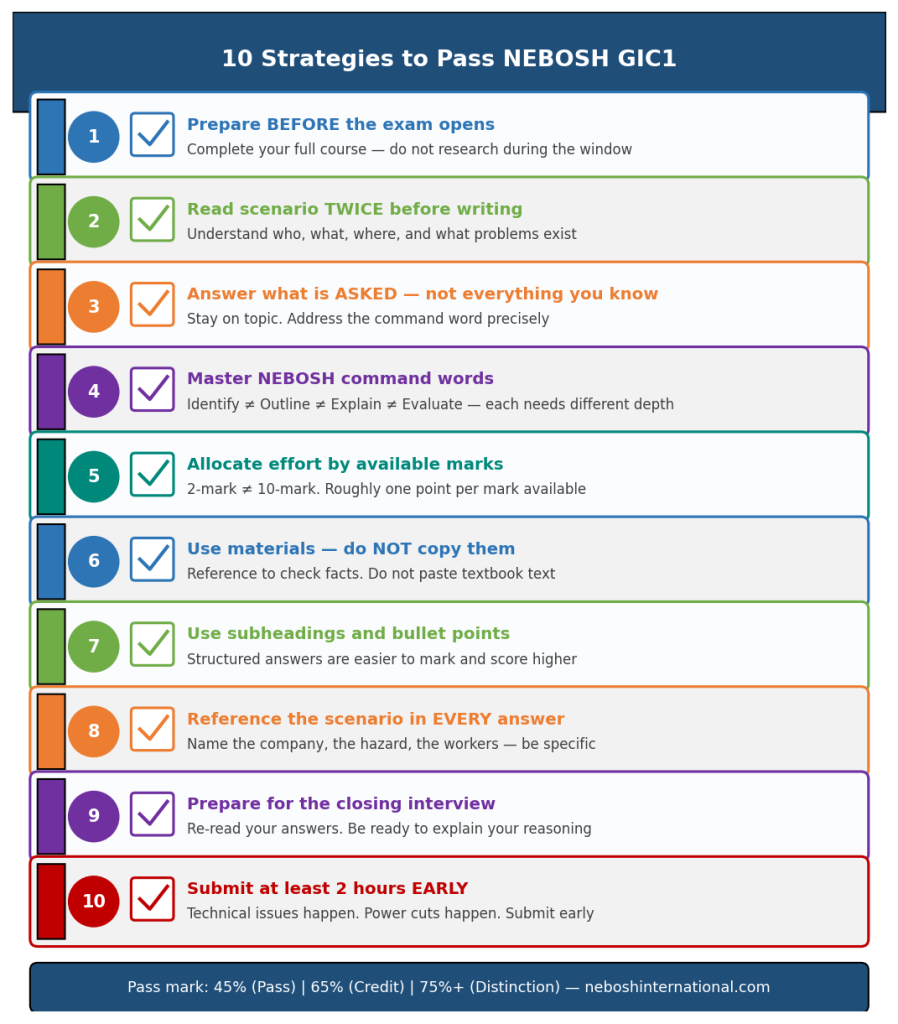
10 Tips to Pass the NEBOSH IGC Open Book Exam
1. Finish Your Learning Before the Assessment
Do not use the GIC1 assessment itself as your study period.
Before assessment day, make sure you understand the major topics covered by the syllabus. Review your notes, course book, tutor explanations and practice questions before the assessment opens.
Your goal should be to apply knowledge quickly, rather than spending large amounts of time searching for basic information.
2. Read the Entire Scenario Carefully
In particular, the scenario is one of the most important sources of information in GIC1.
Before answering a question, identify:
- The type of organisation.
- Main activities.
- Employees and contractors.
- Existing health and safety arrangements.
- Hazards and unsafe conditions.
- Previous incidents.
- Management weaknesses.
- Existing controls.
- Any changes taking place in the workplace.
For instance, a construction scenario in Lahore should lead you to think about issues relevant to that environment rather than producing a generic list of hazards that could apply anywhere.
3. Identify the Command Word
Understanding the question is just as important as knowing the subject.
| Command word | What you should do |
|---|---|
| Identify | Name the relevant item. |
| State | Give a concise answer. |
| Outline | Give the main features or points. |
| Describe | Explain what something is or what happened with relevant detail. |
| Explain | Give reasons and show why something happens or matters. |
| Assess | Consider the issue using evidence and reach a reasoned conclusion. |
| Evaluate | Consider strengths, weaknesses and overall effectiveness. |
Do not answer an identify question with several paragraphs of theory. Likewise, do not give a one-line response when the question asks you to explain something.
4. Match Your Answer to the Marks
Marks provide a useful indication of how much depth is expected.
Generally, a higher-mark question requires more developed and distinct points than a low-mark question.
For example, if the question requires you to explain several management failures, do not repeat the same idea using different wording. Instead, identify separate failures and explain their relevance to the scenario.
A useful structure is:
Point → Scenario evidence → Explanation → Consequence
As a result, this makes your reasoning easier to follow and helps prevent vague answers.
5. Apply the Scenario to Every Major Answer
Most importantly, this is one of the most important NEBOSH GIC1 techniques.
A generic statement such as:
“The company should provide training.”
is usually weaker than an answer explaining who needs training, what training is required, why it is necessary and how the scenario demonstrates the need.
For instance, if workers are using unfamiliar equipment without adequate instruction, explain how appropriate training could reduce the identified risk.
Think:
What happened in the scenario? → Why is it a problem? → What should be done? → Why would that control help?
6. Do Not Copy Your Course Book
An open-book assessment allows you to consult relevant learning materials, but your answer should demonstrate your own understanding.
Use your notes to:
- Check terminology.
- Confirm principles.
- Review concepts.
- Refresh your memory.
Afterward, writethe answer in your own words and apply the concept to the scenario.
This approach also helps you prepare for the closing interview because you should be able to explain the reasoning behind your submission.
7. Use Headings and Clear Answer Structures
Good presentation does not replace good content, but clear organisation makes your reasoning easier to follow.
For longer questions, consider using:
Issue 1: Inadequate supervision
Explain the problem, connect it to the scenario and discuss its possible consequences.
Issue 2: Insufficient training
Explain which workers are affected and why additional training is appropriate.
Avoid turning every answer into a huge block of text.
8. Practise Scenario Questions Before GIC1
Do not wait until assessment day to discover that you struggle with scenario-based questions.
Complete practice questions and mock assessments before your real GIC1 assessment.
After each practice answer, ask:
- Did I answer the exact question?
- Did I use the command word correctly?
- Did I refer to the scenario?
- Did I explain my points?
- Did I repeat myself?
- Did I manage my time?
- Could I explain this answer verbally?
The final question is particularly useful because of the closing interview.
9. Prepare for the Closing Interview
Furthermore, the closing interview is part of the GIC1 process. NEBOSH explains that candidates will be asked questions about their submission.
Before the interview:
- Read your submitted assessment again.
- Review your main recommendations.
- Understand why you selected particular controls.
- Remember the scenario evidence you used.
- Be prepared to explain your reasoning in your own words.
Consequently, if you genuinely completed the assessment yourself and understand your answers, preparation becomes much easier.
For additional preparation, see our internal guide to NEBOSH safety officer interview questions.
10. Submit Before the Final Deadline
Finally, do not plan to submit at the last possible moment.
Candidates in Pakistan should consider practical issues such as:
- Internet interruptions.
- Electricity problems.
- Computer or browser issues.
- Upload problems.
- Unexpected personal commitments.
As a result, complete your work with sufficient time remaining to review the answers and submit successfully.
A Simple NEBOSH GIC1 Answer Formula
When you are unsure how to structure an answer, use this four-step method:
1. Make the point
Identify the safety issue or recommendation.
2. Use scenario evidence
Show where the issue appears in the scenario.
3. Explain why it matters
Discuss the potential consequence or reason.
4. Recommend the practical response
Where appropriate, explain what the organisation should do.
Example
Weak answer:
The company should provide training and PPE.
Stronger approach:
Workers should receive task-specific training because the scenario indicates that employees are carrying out the activity without adequate instruction. Training should cover the correct working method, associated hazards and required controls. The organisation should also provide suitable PPE where residual risk remains after higher-level controls have been considered.
As a result, the second approach demonstrates application and reasoning rather than simply listing safety measures.
What Should You Use During an Open Book Assessment?
Beforehand, your preparation materials should be organised before GIC1 begins.
Consider preparing:
- NEBOSH course book.
- Your own study notes.
- Key definitions.
- Topic summaries.
- Relevant legislation or guidance studied during your course.
- Practice questions.
- A command-word reference.
- A simple time-management plan.
However, avoid building a giant collection of documents that slows you down.
Instead, the objective is fast access to knowledge, not unlimited research.
You can also review NEBOSH’s official digital assessment information and qualification guidance before your assessment.
Common NEBOSH GIC1 Mistakes
Information dumping
However, writing everything you know about a topic does not automatically produce a high-scoring answer.
Generic answers
Similarly, a correct health and safety statement can still be weak if it does not address the scenario.
Ignoring command words
An answer can contain good knowledge but fail to meet the question’s requirement.
Repeating the same point
Moreover, ten sentences describing one idea are not necessarily ten different marks.
Excessive research
Searching the internet throughout the assessment wastes valuable time.
Copying textbook wording
Your submission should demonstrate understanding and application.
Leaving submission until the last minute
Consequently, technical problems become much more stressful when there is no time remaining.
What About GIC2?
Passing GIC1 is only one part of completing the current NEBOSH International General Certificate.
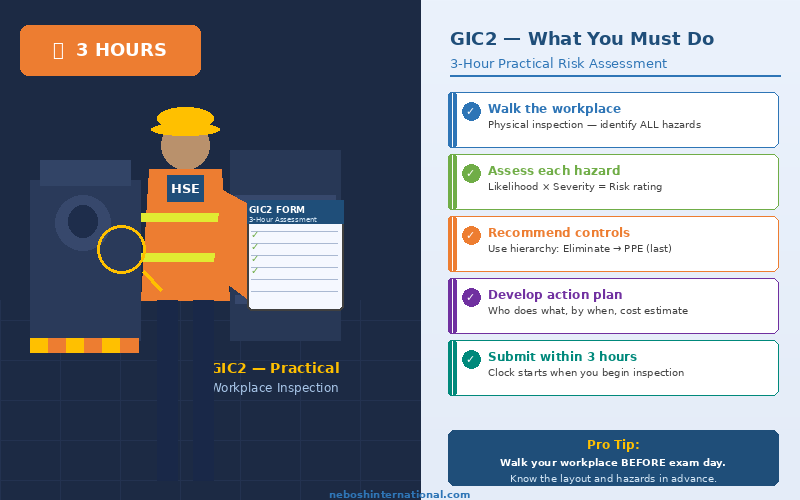
Meanwhile, GIC2 is the practical risk assessment unit. NEBOSH describes it as an assessment in which learners complete a workplace risk assessment and develop an action plan.
The current 2025 specification guidance lists GIC2 as a 4-hour practical assessment, rather than the older format described in many online articles.
The GIC2 submission process has also changed under the current specification. NEBOSH states that GIC2 is submitted through the online assessment platform, with the deadline 10 working days after the GIC1 assessment.
Therefore, do not rely on old IG2 guides when preparing for the current GIC2 assessment.
NEBOSH IGC GIC1 Pass Mark and Grades
For the current GIC1 specification, the provisional pass standard is 45%.
The qualification grade is based on the GIC1 result:
- Pass: 45–64
- Credit: 65–74
- Distinction: 75 or higher
GIC2 has its own pass standard rather than contributing a numerical mark to the qualification grade in the same way.
For this reason, always check the official NEBOSH guidance because assessment arrangements and examination information can change.
NEBOSH IGC Open Book Exam Checklist
Before GIC1:
- Complete your course learning.
- Review GIC1 topics.
- Practise scenario-based questions.
- Understand command words.
- Organise your notes.
- Complete at least one realistic mock assessment.
- Check your computer and internet connection.
- Understand your assessment instructions.
During GIC1:
- Read the complete scenario.
- Read each question carefully.
- Identify the command word.
- Check the available marks.
- Use scenario evidence.
- Explain your reasoning.
- Avoid unnecessary information.
- Review your answers before submission.
After submission:
- Review what you submitted.
- Prepare to discuss your answers.
- Understand your recommendations.
- Be ready to explain your reasoning during the closing interview.
Frequently Asked Questions
Currently, the GIC1 assessment time is 5 hours, while NEBOSH provides a 24-hour access window beginning at 11am UK time on the assessment date
However, it can be challenging because the assessment requires you to apply knowledge to a workplace scenario. Open-book access does not remove the need for preparation, analysis and time management.
The provisional pass standard for GIC1 is 45%. A score of 65–74 is a Credit and 75 or higher is a Distinction.
GIC1 is an open-book assessment, so relevant learning materials can be used. However, candidates should use materials to support their understanding rather than simply copying content.
Yes. NEBOSH states that GIC1 includes a closing interview in which learners are asked questions about their submission.
Under the current 2025 specification, NEBOSH’s syllabus guidance lists GIC2 as a 4-hour practical assessment.
Yes. The International General Certificate is designed for an international audience, and Pakistani learners can study through an appropriate NEBOSH Learning Partner. Therefore, before enrolling, verify the provider’s current accreditation and registration arrangements.
Conclusion:
Ultimately, the most effective way to prepare for the NEBOSH IGC open book exam 2026 is not to memorise hundreds of textbook paragraphs. Instead, learn how to recognise workplace problems, apply health and safety principles and explain your recommendations clearly.
Whether you are preparing in Rawalpindi, Islamabad, Lahore, Karachi, Faisalabad, Peshawar or another Pakistani city, the core GIC1 strategy remains the same:
Understand the syllabus → practise scenarios → identify the command word → use scenario evidence → explain your reasoning → manage your time → prepare for the closing interview.
If you are still looking for an appropriate provider, use our guide to finding a NEBOSH Learning Partner in Pakistan before registering.
You can also review the official NEBOSH International General Certificate information for the latest qualification and assessment requirements.
For learners who want to continue improving their exam technique, our NEBOSH IGC exam format guide provides additional preparation information.
Remember: GIC1 is open book, but it is not open strategy. The candidates who prepare their knowledge, practise application and understand the scenario are in a much stronger position when the assessment begins.

NEBOSH International General Certificate (IGC) certified HSE professional focused on occupational health and safety, workplace risk assessment, hazard identification, and safety management systems. The content published on NeboshInternational.com is based on current industry guidance, recognized safety best practices, and practical workplace examples to help professionals in Pakistan and the Gulf prepare for NEBOSH qualifications and build successful HSE careers.


8 Comments
Comments are closed.