COSHH Assessment in Pakistan: Complete Workplace Safety Guide (2026)
Imagine a construction project in Lahore where workers are applying solvent-based paints, mixing adhesives and using cleaning chemicals in poorly ventilated areas. The products are available, but the Safety Data Sheets (SDS) have not been checked, and nobody has assessed how workers could be exposed during their shifts.
This situation highlights why chemical safety needs more than personal protective equipment (PPE). Employers and safety officers must understand the substances being used, identify potential exposure routes and select effective controls before work begins.
A COSHH assessment in Pakistan is a systematic way to identify hazardous substances, evaluate the risks they create and determine how to protect workers. Although COSHH is a UK regulatory framework, its risk-assessment principles can help Pakistani organisations improve chemical safety in construction, manufacturing, textiles, laboratories and other industries.
This guide explains the eight practical steps of a COSHH-equivalent assessment, how to interpret an SDS, which controls to prioritise and how safety officers can apply these principles in Pakistani workplaces.
What Is a COSHH Assessment?
COSHH stands for Control of Substances Hazardous to Health. It refers to the UK framework for controlling exposure to hazardous substances at work.
A COSHH assessment identifies substances that could harm workers, considers how exposure might occur and establishes appropriate preventive measures. These substances may include chemicals, fumes, vapours, dusts, mists and certain biological agents.
In Pakistan, organisations can apply similar assessment principles within their workplace risk-management systems. However, COSHH should not be described as Pakistani legislation. Employers must check the applicable Pakistani laws, provincial requirements, industry rules and client standards for their particular operations.
For example, a safety officer in Karachi may assess solvent exposure in a manufacturing facility, while a construction HSE officer in Lahore may focus on cement dust, silica-containing materials and paint fumes.
These assessments help organisations make informed decisions about safer products, ventilation, handling procedures, worker training and respiratory protection.
Professionals studying NEBOSH IGC in Pakistan can also use these principles to connect occupational health theory with practical workplace risk management.
Which Substances Require Assessment?
Hazardous substances can cause harm through inhalation, skin contact, ingestion or accidental injection. The risk depends on the substance, its concentration, the task, exposure duration and the effectiveness of existing controls.
Common examples in Pakistani workplaces include:
- Construction: cement, silica dust, paints, adhesives and waterproofing chemicals.
- Textile manufacturing: dyes, cleaning solvents, finishing agents and process chemicals.
- Welding and fabrication: welding fumes, metal dust and gases.
- Agriculture: pesticides, herbicides and other chemical treatments.
- Laboratories: acids, alkalis, solvents and reactive chemicals.
- Maintenance and cleaning: bleach, degreasers, drain cleaners and disinfectants.
- Oil and gas: fuels, process chemicals, cleaning agents and hazardous vapours.
A product should not be considered safe simply because it is commonly used or available without specialist supervision. Likewise, a chemical’s presence does not automatically mean that exposure is dangerous at every level. The assessment must consider the actual working conditions and the manufacturer’s safety information.
How to Conduct a COSHH Assessment in Pakistan: 8 Steps
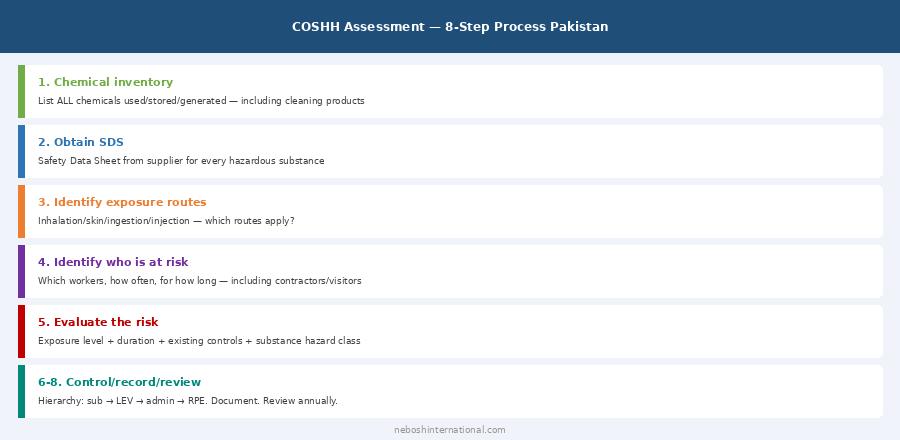
Step 1: Identify Hazardous Substances
Begin by inspecting the workplace and preparing an inventory of substances that are used, stored, handled or generated during work.
Include purchased chemicals as well as substances produced by workplace activities. For instance, welding creates fumes, while cutting certain construction materials can release respirable crystalline silica.
Record the product name, work activity, location, quantity used and the workers who may be exposed. Consult supervisors and workers because they often understand how tasks are actually performed.
Step 2: Obtain and Review Safety Data Sheets
Request the current Safety Data Sheet from the manufacturer or supplier for each relevant chemical product.
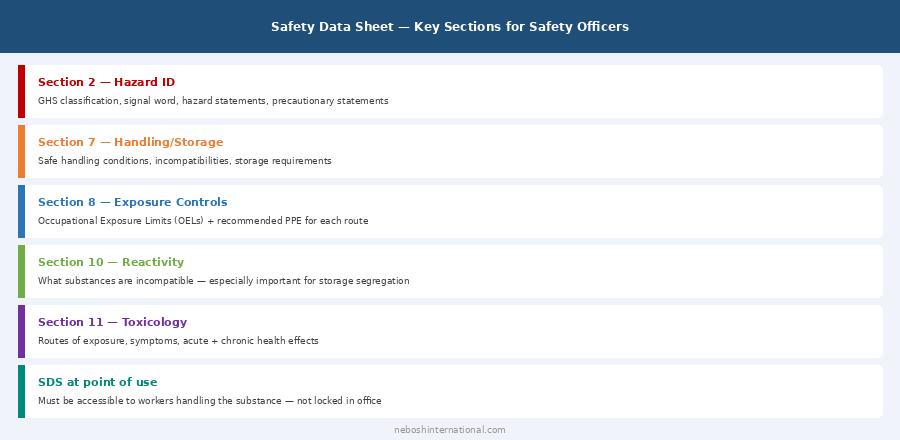
An SDS provides information about hazards, ingredients, safe handling, storage, exposure controls and emergency measures. Under the internationally harmonised format, it contains 16 sections.
Pay particular attention to:
- Section 2: Hazard identification.
- Section 4: First-aid measures.
- Section 7: Handling and storage.
- Section 8: Exposure controls and personal protection.
- Section 10: Stability and reactivity.
- Section 11: Toxicological information.
Keep SDS documents accessible to workers and supervisors where they can consult them when needed. If an SDS is missing, outdated or unclear, contact the supplier before relying on assumptions about the product’s safety.
Step 3: Identify Exposure Routes
Determine how workers could come into contact with the substance.
The four main exposure routes are inhalation, skin or eye contact, ingestion and injection through punctures or cuts.
For example, spraying paint may create airborne droplets and vapours, while handling wet cement can cause skin irritation and chemical burns. Cutting silica-containing materials can release fine dust that reaches deep into the lungs.
Consider routine work, cleaning, maintenance, equipment failure and emergency situations. An assessment should reflect realistic working conditions rather than only the intended procedure.
Step 4: Identify Who Could Be Harmed
List everyone who may be exposed, including employees, contractors, cleaners, maintenance staff and nearby workers.
Assess how often the activity occurs, how long exposure lasts and whether workers perform the task in enclosed or poorly ventilated spaces.
Also consider workers who may need additional precautions, including new employees and those who have not received appropriate chemical-handling training.
Step 5: Evaluate the Risk
Evaluate the substance’s hazardous properties alongside the likelihood and potential severity of exposure.
Consider the quantity used, concentration, method of application, ventilation, work duration and existing controls. Review any relevant occupational exposure limits and determine whether further monitoring or specialist advice is needed.
Do not assume that an SDS alone provides a complete risk assessment. It describes the product’s hazards and recommended precautions, but the employer must assess the specific workplace activity.
Where exposure cannot be adequately evaluated through available information, seek competent occupational hygiene advice or appropriate exposure monitoring.
Step 6: Select and Implement Effective Controls
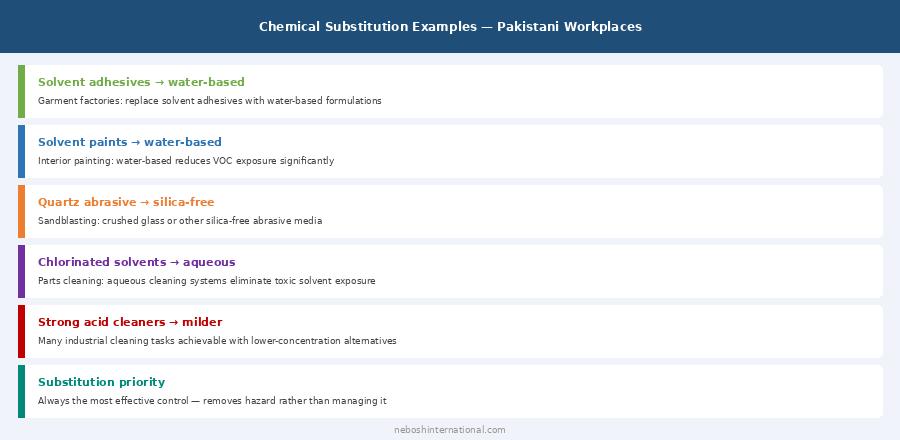
Use the hierarchy of controls to reduce exposure. Start by eliminating the hazardous activity or substituting a safer substance where reasonably practicable.
If the hazard cannot be eliminated, consider the following measures:
- Substitution: replace a hazardous product with a suitable, less hazardous alternative.
- Engineering controls: use effective local exhaust ventilation, enclosed systems or suitable dust suppression.
- Administrative controls: establish safe procedures, restrict access, train workers and minimise exposure time where appropriate.
- PPE and respiratory protection: select suitable gloves, eye protection, protective clothing and respiratory protective equipment based on the assessed risks.
PPE should not automatically be the first or only solution. Respiratory protective equipment must be suitable for the contaminant and conditions, properly fitted where a tight-fitting facepiece is used, and maintained correctly.
Step 7: Record the Assessment and Communicate Findings
Document the substances assessed, hazards identified, people at risk, exposure routes, existing precautions, additional actions and responsible persons.
For larger projects, maintain a chemical register linked to SDS documents and relevant work procedures.
Explain the findings to affected workers in language they understand. Training should cover safe handling, required controls, correct PPE use, spill response and emergency arrangements.
A completed assessment is useful only when the required precautions are implemented and followed.
Step 8: Review and Update the Assessment
Review the assessment when a new substance is introduced, work methods change, control equipment fails, an incident occurs or new information becomes available.
Also establish a suitable periodic review schedule based on the level of risk, applicable requirements and workplace conditions. An annual review may be a useful internal practice, but it should not be presented as a universal legal requirement for every COSHH-equivalent assessment in Pakistan.
How to Choose the Right Chemical Controls
Substitution can reduce risk at its source. For example, a construction contractor may investigate whether a suitable water-based paint can replace a more hazardous solvent-based product.
However, the alternative must be assessed before use. A replacement chemical may introduce different hazards, affect product performance or require different handling precautions.
Where substitution is unsuitable, engineering controls become particularly important. Local exhaust ventilation can capture contaminants near the point where they are generated, while properly designed enclosures can reduce the release of hazardous substances.
General ventilation may help in suitable circumstances, but it is not a universal solution for controlling concentrated or highly hazardous airborne contaminants. Similarly, wet methods can reduce dust during appropriate cutting or grinding activities, provided the equipment and method are suitable for the task.
Safety officers should inspect controls during actual operations. A ventilation system that is poorly positioned, damaged or inadequately maintained may fail to provide the expected protection.
COSHH Assessment Checklist for Pakistani Safety Officers
Before authorising work involving hazardous substances, check the following:
- The chemical inventory is complete and current.
- Relevant, current SDS documents are available.
- Hazards and exposure routes have been identified.
- Employees and contractors who may be exposed are listed.
- Existing controls have been checked for effectiveness.
- Safer alternatives have been considered.
- Ventilation and other engineering controls are suitable.
- Required PPE and respiratory protection are appropriate.
- Workers understand handling and emergency procedures.
- The assessment is documented and review arrangements are established.
This checklist supports workplace planning but does not replace a site-specific assessment or applicable legal requirements.
COSHH Assessment in Construction, Manufacturing and Textiles
Construction Projects in Lahore and Rawalpindi
Construction safety officers should pay attention to silica dust, cement, coatings, adhesives and cleaning products. Before work starts, review the materials, the task, ventilation arrangements and any potential exposure to nearby workers.
For dusty activities, use suitable dust-suppression or extraction methods and prevent unnecessary access to affected areas.
Textile Factories in Faisalabad and Karachi
Textile operations may involve dyes, finishing chemicals, cleaning products and maintenance solvents. Safety officers should review supplier information, chemical compatibility, storage arrangements and exposure controls.
Clearly labelled containers and controlled chemical-transfer procedures can help reduce spills, accidental mixing and unnecessary contact.
Laboratories and Industrial Facilities
Laboratories and industrial plants may handle corrosive, flammable, toxic or reactive substances. Assess storage compatibility, ventilation, emergency equipment and the specific procedures used for each task.
For every sector, the appropriate controls depend on the chemical, exposure potential and working conditions. A generic assessment should never be copied without checking whether it reflects the actual process.
Why COSHH Knowledge Matters for NEBOSH IGC Professionals
Chemical hazard management is an important part of occupational health and risk-control knowledge. Understanding how to identify hazards, evaluate exposure and select effective controls can help safety professionals apply their learning in practical situations.
For candidates preparing for assessments, focus on explaining the connection between the hazard, the people exposed, the possible harm and the controls required. Avoid simply listing PPE without explaining why additional measures may be necessary.
You can also review the NEBOSH IGC open-book exam preparation guide for guidance on applying health and safety principles to scenario-based questions.
For professionals exploring career opportunities, NEBOSH IGC for fresh graduates in Pakistan provides further information about building a foundation in health and safety.
Frequently Asked Questions
A COSHH assessment in Pakistan is a practical assessment of hazardous substances, potential worker exposure and the controls needed to protect health. COSHH itself is a UK framework, so Pakistani organisations should also check applicable local legislation and workplace requirements.
COSHH is UK legislation, not a standalone Pakistani regulation. However, employers in Pakistan must consider applicable occupational safety and health laws, provincial requirements and relevant industry obligations. COSHH principles can support chemical risk management without replacing local compliance duties.
The four main routes are inhalation, skin or eye contact, ingestion and injection. The relevant routes depend on the substance and work activity.
Sections 2, 4, 7, 8, 10 and 11 are particularly useful for understanding hazards, first aid, handling, exposure controls, reactivity and toxicological effects. Other sections may also be necessary depending on the assessment.
Review it when substances, processes or working conditions change, when an incident occurs, when new hazard information becomes available or when existing controls are no longer effective. Set periodic reviews according to risk and applicable requirements.
They are closely related. A COSHH assessment follows the UK framework for controlling exposure to hazardous substances, while a chemical risk assessment is a broader term used in different regulatory and organisational systems.
NEBOSH IGC learning can help candidates understand workplace hazards, risk assessment and control measures. Practical competence, relevant experience and knowledge of local requirements are also important for HSE roles.
Conclusion
A COSHH assessment helps safety officers move beyond simply identifying chemicals or issuing PPE. It provides a structured way to understand hazardous substances, evaluate exposure, select suitable controls and review whether those controls work in practice.
For Pakistani workplaces, the most useful approach is to combine these principles with applicable local requirements, current SDS information and the actual conditions in which employees work.
Whether you work in construction in Lahore, manufacturing in Karachi or textiles in Faisalabad, effective chemical risk management can help protect workers and strengthen workplace safety procedures.
Explore NEBOSH International for information about NEBOSH qualifications and HSE learning opportunities in Pakistan.
Further Reading and Official Guidance
- UK Health and Safety Executive: COSHH — Control of Substances Hazardous to Health
- US Occupational Safety and Health Administration: Hazard Communication
- NEBOSH International: NEBOSH IGC for Fresh Graduates in Pakistan

NEBOSH International General Certificate (IGC) certified HSE professional focused on occupational health and safety, workplace risk assessment, hazard identification, and safety management systems. The content published on NeboshInternational.com is based on current industry guidance, recognized safety best practices, and practical workplace examples to help professionals in Pakistan and the Gulf prepare for NEBOSH qualifications and build successful HSE careers.