NEBOSH IGC 8-Week Study Plan Pakistan 2026: Complete Weekly Guide
Preparing for the NEBOSH International General Certificate while working full-time can be challenging. Pakistani professionals often balance long working hours, family responsibilities and demanding site duties. However, a realistic study timetable can help you organise the syllabus, practise exam questions and prepare your workplace risk assessment without relying on last-minute cramming.
This NEBOSH IGC 8-week study plan for Pakistan is designed for learners in Lahore, Karachi, Islamabad, Rawalpindi, Faisalabad, Peshawar and other cities. It explains what to study each week, how to revise effectively and when to begin practical assessment preparation.
The plan is a suggested routine, not an official NEBOSH timetable. Your training provider’s syllabus, assessment instructions and deadlines should always take priority.
Is Eight Weeks Enough to Prepare for NEBOSH IGC?
Yes, eight weeks can be a reasonable preparation period for some learners, particularly those who can study consistently and receive appropriate tutor support. However, the time required depends on your previous knowledge, English writing ability, work schedule and familiarity with health and safety concepts.
NEBOSH’s revised International General Certificate has two units: GIC1, Management of Health and Safety, and GIC2, Risk Assessment. The official qualification guide gives 49 notional learning hours for GIC1 and 63 for GIC2, totalling 112 hours. These figures include taught learning, self-study and assessment time.
For the 2025 specification, GIC1 uses a scenario-based digital open-book assessment, while GIC2 requires a practical workplace risk assessment and action plan. Confirm the assessment arrangements for your own sitting through the official NEBOSH qualification page.
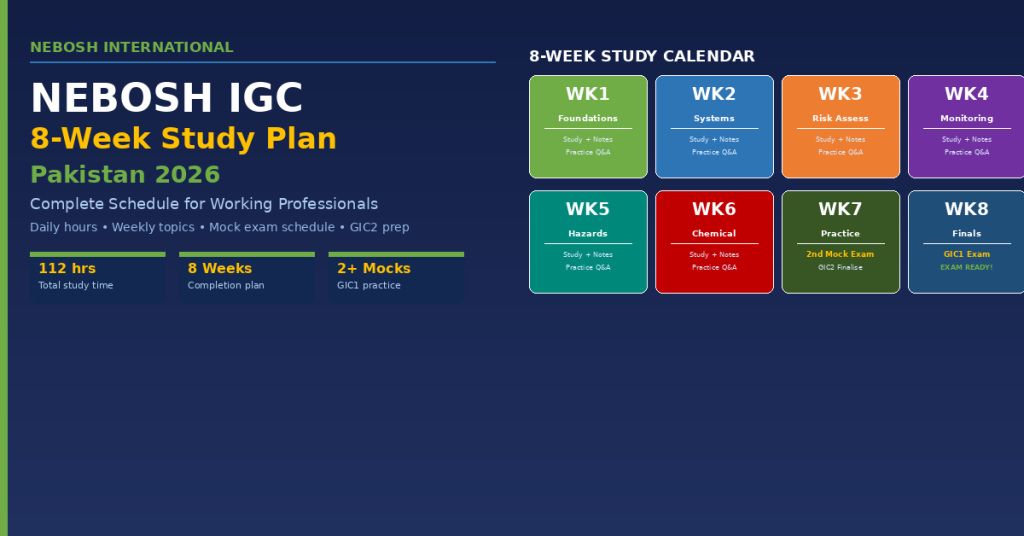
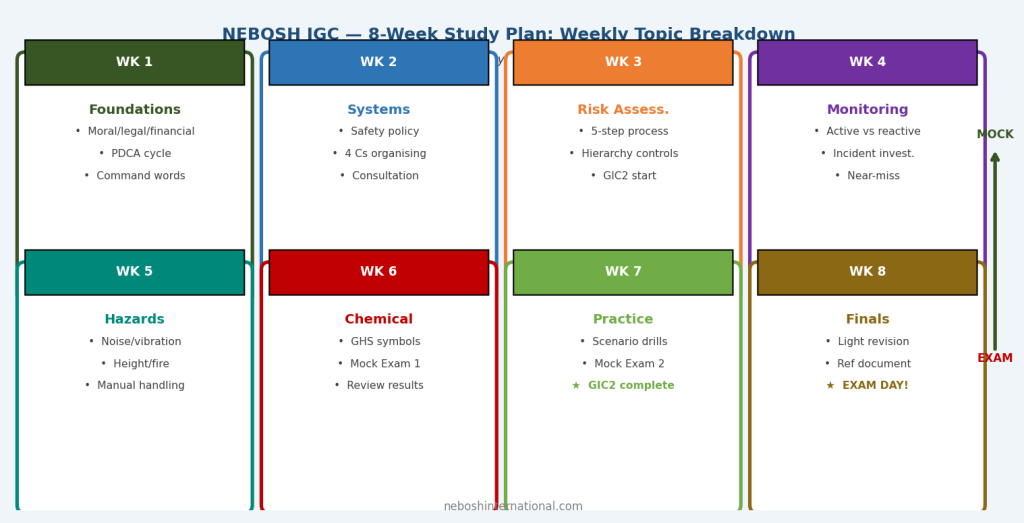
Your Eight-Week NEBOSH IGC Study Timetable
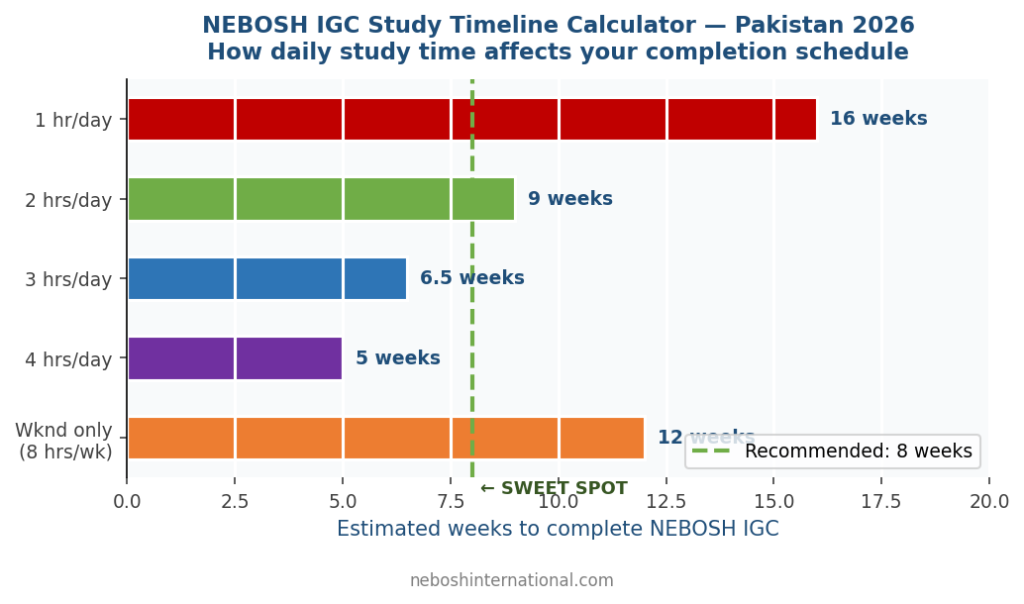
A practical starting point is approximately 12–14 hours per week, adjusted to your personal circumstances.
| Study period | Main objective | Weekly target |
|---|---|---|
| Week 1 | Understand health and safety management | Learn the foundations |
| Week 2 | Build management-system knowledge | Revise policies and responsibilities |
| Week 3 | Learn risk assessment principles | Practise hazard identification |
| Week 4 | Study monitoring and investigation | Apply concepts to incidents |
| Week 5 | Revise physical and workplace hazards | Develop scenario-based answers |
| Week 6 | Review remaining syllabus topics | Complete a mock assessment |
| Week 7 | Improve exam technique | Practise and review weak areas |
| Week 8 | Consolidate learning and finalise GIC2 | Check assessment readiness |
Week 1: Understand Health and Safety Management
Start by understanding why organisations need to manage health and safety. Study the moral, legal and financial reasons for preventing workplace injuries and ill health.
Next, learn the role of a safety officer, supervisor, employer and worker. Connect these responsibilities to workplaces you understand, such as construction projects in Rawalpindi, manufacturing facilities in Faisalabad or maintenance operations in Karachi.
Your weekly tasks:
- Study your provider’s introductory syllabus material.
- Write short notes using your own words.
- Explain the reasons for managing health and safety without looking at your textbook.
- Complete a short knowledge test at the weekend.
By the end of Week 1, you should be able to explain why effective safety management matters to workers, employers and the wider organisation.
Week 2: Learn Safety Management Systems
This week, focus on health and safety policies, organisational responsibilities, communication, consultation and management-system principles.
Study the Plan-Do-Check-Act approach where relevant to your syllabus. Understand how an organisation plans safety activities, implements controls, monitors performance and improves its arrangements.
For example, a Lahore construction contractor may establish a work-at-height procedure, train workers, inspect scaffolding and review incidents to improve future performance.
Your weekly tasks:
- Prepare a summary of safety policy components.
- Practise explaining management responsibilities.
- Write one timed answer using an appropriate command word.
- Review your mistakes before moving to the next topic.
Rather than memorising definitions alone, practise explaining how each concept would work in a real workplace.
Week 3: Master Risk Assessment and Hazard Identification
Risk assessment is essential for practical health and safety work. Therefore, devote this week to understanding hazards, risks, existing controls and additional control measures.
Learn how to identify hazards, consider who might be harmed, evaluate risks, select suitable controls and review the assessment. Follow the method and terminology in your official learner guidance.
A construction-site example might include workers using ladders near an unprotected edge. Your assessment should consider who could fall, the likelihood and severity of harm, existing precautions and stronger controls that could reduce the risk.
Your weekly tasks:
- Practise identifying hazards in a familiar workplace.
- Record who could be harmed and how.
- Compare existing controls with additional measures.
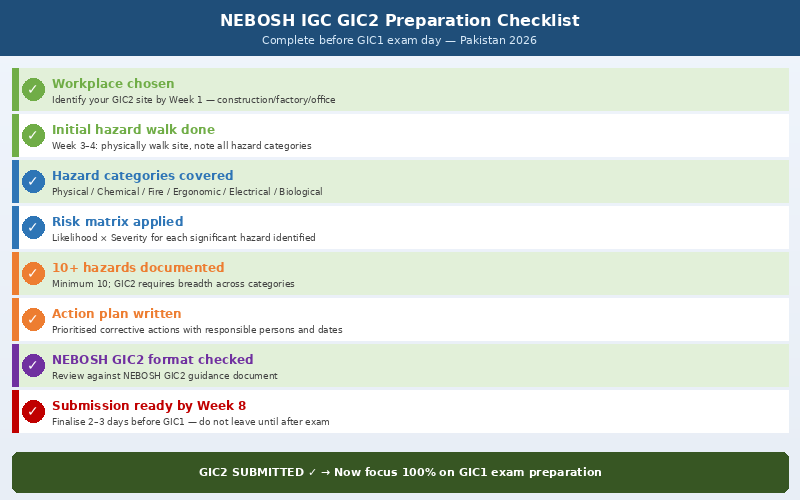
- Start identifying a suitable workplace for GIC2, with permission where required.
Use the official NEBOSH assessment resources to understand the required GIC2 format.
Week 4: Study Monitoring, Auditing and Incident Investigation
Now develop your understanding of workplace monitoring and incident prevention. Review proactive monitoring, reactive monitoring, inspections, audits and incident investigation according to your course materials.
For example, a textile factory in Faisalabad might use routine machinery inspections to identify unsafe conditions. After an injury, investigators would examine the circumstances, immediate causes, underlying factors and opportunities to prevent recurrence.
Your weekly tasks:
- Compare inspections with audits.
- Explain the difference between proactive and reactive monitoring.
- Practise analysing a short workplace incident.
- Recommend corrective actions linked to the causes identified.
Remember that an effective investigation looks beyond blaming an individual. It considers relevant procedures, training, supervision, equipment and management arrangements.
Week 5: Revise Physical and Workplace Hazards
This week, concentrate on the hazards included in your assigned syllabus. These may include noise, vibration, manual handling, working at height, electricity, fire, temperature extremes and other workplace risks.
Connect your learning to Pakistani industries. Construction workers may face fall hazards, while textile employees may encounter noise and machinery risks. Oil and gas operations may involve hazardous substances, ignition sources and complex work activities.
For each hazard, ask four questions:
- What is the hazard?
- Who could be harmed, and how?
- What controls are already in place?
- What further action would reduce the risk?
Your weekly tasks:
- Prepare concise hazard-and-control notes.
- Practise applying the hierarchy of controls.
- Write scenario-based answers rather than generic textbook statements.
- Review any topics you find difficult.
Prioritise understanding and practical application over memorising long lists of control measures.
Week 6: Cover Remaining Topics and Complete a Mock Assessment
Use Week 6 to study the remaining topics in your course materials. Depending on your assigned syllabus, these may include chemical and biological hazards, work equipment, machinery, personal protective equipment and other workplace health risks.
Next, attempt an appropriate GIC1 sample assessment supplied by NEBOSH or your Learning Partner. Follow the applicable instructions and simulate the assessment conditions as closely as possible.
Your weekly tasks:
- Complete your outstanding syllabus notes.
- Attempt a timed practice assessment.
- Review each answer against the command word and marking expectations.
- List your three weakest subject areas.
The NEBOSH digital assessment preparation resources provide official guidance and sample papers. Use them instead of relying exclusively on unofficial online questions.
Week 7: Improve Exam Technique and Progress GIC2
During Week 7, shift your attention from learning new material to applying what you know. Complete additional practice questions and focus on the weaknesses identified during your first mock assessment.
A key skill is using evidence from the scenario. For instance, if a question describes workers handling materials manually without suitable assistance, relate your answer to those workers and their actual working conditions. Generic statements may fail to demonstrate sufficient application.
At the same time, continue preparing your GIC2 risk assessment.
Your weekly tasks:
- Attempt another practice assessment if time allows.
- Review the relevance and depth of your answers.
- Inspect your selected workplace with appropriate permission.
- Identify a range of hazards and record existing controls.
- Begin drafting the risk assessment and action plan.
Do not copy another learner’s risk assessment. Your submission should reflect your own workplace observations and comply with NEBOSH’s current requirements.
Week 8: Final Revision and Assessment Readiness
The final week should focus on consolidation rather than trying to learn the entire syllabus again.
Review your own notes, revisit difficult concepts and practise interpreting command words. Check that your GIC2 work follows the current submission guidance and that you understand your Learning Partner’s deadlines.
Your final checklist:
- Review the major syllabus topics.
- Revisit mistakes from your practice assessments.
- Check your digital assessment login and technical arrangements.
- Confirm the correct date, time and submission requirements.
- Review the GIC2 guidance and required template.
- Plan your assessment time and leave an opportunity to check your work.
For GIC1, the official assessment arrangements provide a 24-hour window to access, complete and submit the digital assessment, with approximately five hours of assessment working time. This does not mean you must work continuously for 24 hours. Follow the instructions issued for your assessment sitting.
Daily Study Routine for Pakistani Working Professionals
If you work on a construction site or in a factory, a short, repeatable routine may be easier to maintain than occasional long study sessions.
| Day | Suggested activity |
|---|---|
| Monday | Learn a new topic |
| Tuesday | Make notes and review definitions |
| Wednesday | Apply concepts to a workplace scenario |
| Thursday | Practise exam-style questions |
| Friday | Review difficult areas |
| Saturday | Complete a longer revision session |
| Sunday | Rest or undertake light revision |
Aim for focused study sessions that fit your working hours. If you miss a day because of overtime or family responsibilities, adjust the timetable instead of attempting to cover several topics in one exhausting session.
Five NEBOSH IGC Study Mistakes to Avoid
- Memorising without understanding. Learn why a control works and when it is appropriate.
- Ignoring scenario details. Support your answers with relevant facts from the question.
- Leaving GIC2 until the last moment. Begin workplace selection and hazard identification early.
- Revising only familiar topics. Use mock assessment feedback to prioritise weaker areas.
- Relying on outdated guidance. Check whether your course follows the 2025 specification or an earlier assessment arrangement. Requirements and assessment dates can differ.
Frequently Asked Questions
Eight weeks may be sufficient for some candidates if they follow a consistent schedule, receive suitable teaching and practise regularly. However, learners with limited prior knowledge or less study time may need longer.
Start with one to two focused hours on available weekdays and a longer weekend session if your schedule permits. Adjust your hours according to your progress and the learning time recommended by your provider.
Start understanding the risk assessment process early, ideally during Week 3. Identify an appropriate workplace, learn the official requirements and develop your assessment progressively rather than leaving everything until the final week.
Use the language in which your assessment will be completed for most of your written practice. If you will be assessed in English, regularly practise writing clear English answers. You can use Urdu initially to understand difficult concepts, then explain them accurately in English.
Start with the official NEBOSH International General Certificate page and its learner guidance, sample assessments and GIC2 resources. Your accredited Learning Partner can also explain course arrangements and assessment requirements.
Conclusion:
An effective NEBOSH IGC 8-week study plan in Pakistan should balance syllabus learning, scenario practice, revision and practical risk assessment preparation. Whether you are working in Lahore, Karachi, Islamabad, Rawalpindi or another city, consistency and active learning can help you make better use of your available time.
Start with a realistic timetable, measure your progress each week and give additional attention to topics you find difficult. Most importantly, follow the official assessment guidance for your specification instead of relying on outdated notes or unsupported exam tips.
Need guidance for your NEBOSH IGC preparation? Visit NEBOSH International to explore course information and learner guidance. NEBOSH International is an independent information and learner-referral platform, not NEBOSH itself; check the relevant Learning Partner’s accreditation and course arrangements before enrolling.

NEBOSH International General Certificate (IGC) certified HSE professional focused on occupational health and safety, workplace risk assessment, hazard identification, and safety management systems. The content published on NeboshInternational.com is based on current industry guidance, recognized safety best practices, and practical workplace examples to help professionals in Pakistan and the Gulf prepare for NEBOSH qualifications and build successful HSE careers.