ISO 45001 vs NEBOSH IGC: What’s the Difference and Which Do You Need? (2026)
A safety officer working for an oil & gas contractor in Rawalpindi has just seen a Gulf job advertisement asking for both NEBOSH IGC and ISO 45001 experience. He already understands workplace safety, but one question keeps coming up: are these two qualifications the same, or do employers expect different skills?
Pakistani professionals often ask us whether they should study NEBOSH IGC first and later pursue ISO 45001 Lead Auditor training. In our experience reviewing Gulf job postings in 2026, employers frequently mention both NEBOSH IGC and ISO 45001, leading many candidates to believe they are the same. However, they serve very different purposes.
This guide explains the difference between NEBOSH IGC vs ISO 45001, who needs each one, how they work together, and which option makes the most sense for HSE professionals in Pakistan and the Gulf.
What Is NEBOSH IGC?
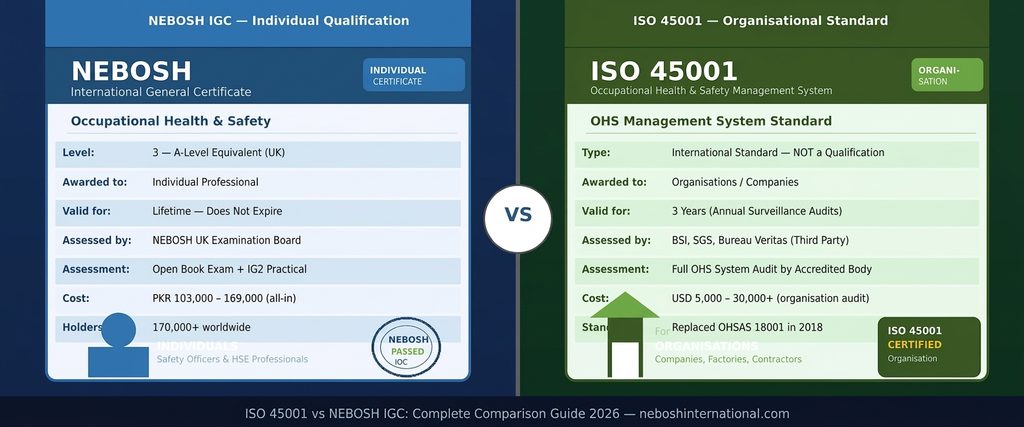
The NEBOSH International General Certificate in Occupational Health and Safety is a Level 3 professional qualification. The UK-based National Examination Board in Occupational Safety and Health (NEBOSH) awards this qualification. It demonstrates competence in health and safety management, hazard identification, risk assessment, and workplace safety controls.
NEBOSH IGC is held by individuals, including safety officers, HSE engineers, and site safety professionals. It demonstrates their professional competence. NEBOSH assesses candidates through an open-book examination and a practical risk assessment, and it is awarded to the individual, not the organisation.
Over 170,000 professionals hold the NEBOSH IGC globally, making it the world’s most widely held health and safety qualification.
What we consistently see in Pakistan’s HSE market is that NEBOSH IGC remains the qualification most employers expect from safety officers before considering more specialised certifications.
If you’re new to the qualification, read our NEBOSH IGC for Engineers in Pakistan 2026 guide to understand who should take the course, career opportunities, and expected salaries.
What Is ISO 45001?
ISO 45001 is an international standard, not a qualification.It is published by the International Organization for Standardization (ISO) and sets out the requirements for an Occupational Health and Safety Management System (OHSMS) at an organisational level.
ISO 45001 is held by organisations—companies, factories, government bodies, and contractors—not by individuals.When an organisation achieves ISO 45001 certification, its health and safety management system has been independently audited. The audit confirms that it meets the requirements of the standard.
ISO 45001 replaced OHSAS 18001 in 2018. Today, it is the globally recognised benchmark for occupational health and safety management systems. It follows the Plan-Do-Check-Act (PDCA) cycle. It also emphasises hazard identification, risk assessment, worker participation, and continual improvement.
NEBOSH IGC vs ISO 45001: Key Differences
Understanding the differences between NEBOSH IGC vs ISO 45001 helps Pakistani HSE professionals choose the right path. It also helps them meet employer requirements.
| Factor | NEBOSH IGC | ISO 45001 |
|---|---|---|
| Type | Professional qualification (individual) | Management system standard (organisation) |
| Awarded to | Individual professionals | Organisations / companies |
| Purpose | Certify personal HSE competence | Certify organisational OHS management systems |
| Assessed by | NEBOSH examination board | Accredited third-party certification bodies (BSI, SGS, Bureau Veritas etc.) |
| Assessment method | Open book exam + practical risk assessment | Third-party audit of organisational systems and processes |
| Validity | Lifetime (individual certificate) | Three years (organisational certificate, with annual surveillance audits) |
| Applicable to | Individuals at any career stage | Organisations of any size, industry, or sector |
| Level | Level 3 (A-Level equivalent) | Not a qualification level — a management system standard |
| Cost | PKR 103,000 – 169,000 (all-in) | Varies by organisation size; typically USD 5,000–30,000+ for certification audit |
| Link to employment | Required or preferred by employers for HSE roles | Required or preferred from supplier organisations by clients and buyers |
How ISO 45001 Works in Practice
One of the biggest differences between NEBOSH IGC vs ISO 45001 is that NEBOSH focuses on individual competence, while ISO 45001 focuses on an organisation’s health and safety management system.
When an organisation decides to pursue ISO 45001 certification, it undertakes the following process:
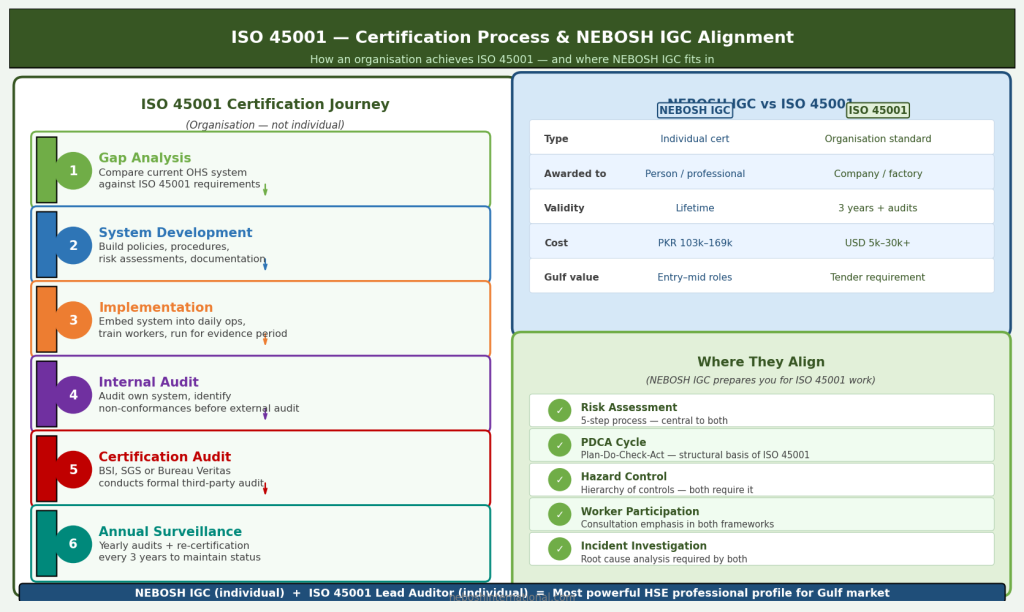
- Gap analysis — reviewing the current OHS management system against ISO 45001 requirements. This identifies areas that need improvement.
- System development — building the policies, procedures, risk assessments, objectives, and documentation required by the standard.
- Implementation — integrating the system into daily operations and training workers. The organisation then operates the system long enough to demonstrate that it works effectively.
For example, OGDC, PPL, major construction contractors, and large manufacturers often implement formal health and safety management systems. Their clients expect consistent compliance across multiple sites.
- Internal audit — conducting an internal audit against the standard to identify any non-conformances before the external audit.
- Certification audit — an accredited third-party auditor (such as BSI, SGS, or Bureau Veritas) audits the organisation’s system and, if satisfied, awards ISO 45001 certification.
- Surveillance audits — annual audits confirm the organisation continues to meet the standard. Re-certification occurs every three years.
This is an organisational journey it requires commitment from leadership, worker involvement, documented systems, and evidence of continual improvement. It is not a course a person can attend and receive a certificate at the end.
How ISO 45001 Relates to NEBOSH IGC Content
Although NEBOSH IGC and ISO 45001 are different, they complement each other by sharing many of the same occupational health and safety principles. This is intentional. NEBOSH designed the IGC to align with internationally recognised OHS management frameworks, especially ISO 45001.
Key areas of alignment include:
- Risk assessment methodology — both ISO 45001 and NEBOSH IGC place risk assessment at the centre of OHS management. The five-step risk assessment process is referenced in NEBOSH IGC content and is a core requirement of ISO 45001.
For example, a safety officer on a Bahria Town construction project in Rawalpindi uses the same risk assessment principles taught in NEBOSH IGC. The same applies to someone working in a textile factory in Faisalabad that follows an ISO 45001 management system.
- The Plan-Do-Check-Act cycle — NEBOSH IGC covers the PDCA management cycle as the framework for systematic OHS management, which is also the structural basis of ISO 45001.
- Hazard identification and control — both frameworks require systematic identification of hazards, evaluation of risks, and implementation of a hierarchy of controls.
- Worker participation — ISO 45001 has a strong emphasis on worker consultation and involvement in OHS management, a theme that also runs through NEBOSH IGC’s management elements.
- Incident investigation and corrective action — both require systematic incident investigation to identify root causes and prevent recurrence.
In practice, a NEBOSH IGC-qualified professional has a strong conceptual understanding of the principles that ISO 45001 is built upon, making them well-equipped to contribute to ISO 45001 implementation projects within their organisation.
This is not straightforward. Many Pakistani candidates struggle with understanding the difference between a qualification for individuals and a certification for organisations. Once that distinction becomes clear, choosing the right learning path becomes much easier.
ISO 45001 Lead Auditor Training
Many professionals who already hold NEBOSH IGC later choose ISO 45001 Lead Auditor training because NEBOSH IGC vs ISO 45001 complement each other in career development.
ISO 45001 Lead Auditor is a separate training course (typically five days) delivered by accredited training providers. It is not the same as ISO 45001 organisational certification. It certifies that the individual has the skills to plan, conduct, report on, and follow up an OHS management system audit.
Gulf employers increasingly value ISO 45001 Lead Auditor certification alongside NEBOSH IGC. This is especially true in oil and gas and large construction organisations. It demonstrates the ability to assess compliance at an organisational level.
From our discussions with HSE professionals in Rawalpindi and Lahore, many pursue Lead Auditor training after gaining site experience. It helps them qualify for more senior HSE positions.
Pakistani professionals often ask us whether they should skip NEBOSH and go directly to ISO 45001. In most cases, employers expect NEBOSH IGC first because it demonstrates practical health and safety competence.
Which Do You Need and When?
If you’re still comparing health and safety qualifications, our NEBOSH vs IOSH comparison explains which certification best matches your career goals and experience level.
You Need NEBOSH IGC If:
- You are an individual seeking to enter or advance in an HSE career.
- You are applying for safety officer, HSE officer, or site safety roles in Pakistan, the Gulf, or internationally.
- You want a globally recognised professional qualification that validates your personal HSE competence.
- You are required by an employer or contract to hold a recognised HSE qualification.
Your Organisation Needs ISO 45001 If:
This is especially common in Pakistan’s construction, oil & gas, manufacturing, and textile industries, where clients increasingly expect contractors to demonstrate internationally recognised health and safety management systems.
- Your clients, buyers, or main contractors require proof of a certified OHS management system.
- You are tendering for contracts particularly with large multinationals, government bodies, or Gulf-based operators that specify ISO 45001 as a requirement.
- You want to demonstrate a systematic, auditable approach to health and safety across your operations.
- You are seeking to reduce insurance premiums, improve safety performance, or build organisational credibility in your sector.
You Would Benefit From Both If:
Many experienced HSE professionals choose both qualifications. They hold NEBOSH IGC and later add ISO 45001 Lead Auditor certification.This combination is particularly powerful for professionals targeting senior HSE management, consultancy, or systems implementation roles in large organisations or in the Gulf market.
Frequently Asked Questions
They are not directly comparable because they certify different things. ISO 45001 Lead Auditor training (for individuals) is typically a five-day course assessed by examination and is generally considered less demanding than the NEBOSH IGC. However, implementing ISO 45001 within an organisation is a complex, multi-month process requiring leadership commitment, system development, and sustained effort.
NEBOSH IGC content is closely aligned with ISO 45001 principles , particularly risk assessment, hazard identification, the PDCA management cycle, and incident investigation. NEBOSH itself holds ISO 45001 certification, reflecting this alignment. However, the IGC does not provide ISO 45001 Lead Auditor certification that requires a separate training programme.
Yes ,in fact, having a NEBOSH IGC-qualified HSE officer is an advantage when implementing ISO 45001 within an organisation, as the professional has a strong grounding in the management principles the standard requires. However, ISO 45001 certification is awarded to the organisation, not the individual, and requires a formal third-party audit regardless of the qualifications held by the HSE team.
For entry to mid-level HSE roles, NEBOSH IGC remains the primary expectation. For senior roles, consultancy positions, and roles specifically involving management system implementation or auditing, ISO 45001 Lead Auditor adds significant value alongside NEBOSH IGC. The strongest candidate profiles in the Gulf market combine both.
ISO 45001 Lead Auditor training usually takes five days. It is available in classrooms or online and ends with a written or oral examination. Upon passing,The training body awards an ISO 45001 Lead Auditor certificate to successful candidates. (such as CQI/IRCA, Exemplar Global, or PECB). Continuing professional development is required to maintain the certification.
Conclusion
NEBOSH IGC vs ISO 45001 are not competitors. They are complementary. NEBOSH IGC demonstrates your personal health and safety competence, while ISO 45001 demonstrates that an organisation has an effective occupational health and safety management system.
If you’re in Rawalpindi, Lahore, Karachi, Peshawar, Faisalabad, or anywhere else in Pakistan, you may be wondering whether NEBOSH IGC is worth it in 2026. Our answer is yes. It remains the strongest starting point for most HSE careers. You can also explore our guide to the Top 10 Safety Officer Jobs in Pakistan to see where employers most frequently request NEBOSH-qualified professionals.After gaining practical experience, adding ISO 45001 Lead Auditor training can strengthen your profile even further, especially if you plan to work in the Gulf or move into senior HSE management.
Ready to advance your HSE career? Visit our NEBOSH International homepage to explore comprehensive guides on NEBOSH IGC, ISO 45001, career pathways, exam preparation, and accredited training providers in Pakistan. Whether you’re starting your first HSE role or planning a move to the Gulf, you’ll find practical resources to support every stage of your professional journey.

NEBOSH International General Certificate (IGC) certified HSE professional focused on occupational health and safety, workplace risk assessment, hazard identification, and safety management systems. The content published on NeboshInternational.com is based on current industry guidance, recognized safety best practices, and practical workplace examples to help professionals in Pakistan and the Gulf prepare for NEBOSH qualifications and build successful HSE careers.