Permit to Work System in Pakistan: 6 Essential Steps for Safety Officers (2026)
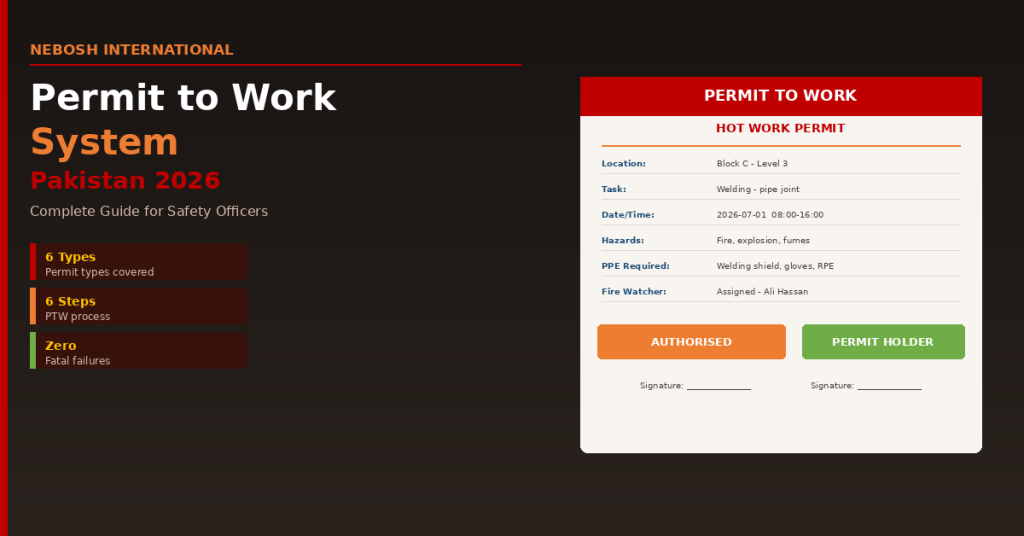
A permit to work system in Pakistan helps safety officers control high-risk activities such as welding, confined space entry, electrical maintenance, excavation and work at height. It ensures that hazards are assessed, essential precautions are verified, and authorised personnel understand the conditions before work begins.
For example, imagine a construction project in Rawalpindi where workers begin welding near combustible materials. Without proper isolation, fire prevention measures and authorisation, a single spark could cause a serious incident. However, an effective permit to work (PTW) system helps identify these risks and establish appropriate controls before the task starts.
Across Pakistan, PTW systems are particularly important in construction, oil and gas, manufacturing, power generation and industrial maintenance. Furthermore, international contractors and Gulf employers often expect HSE professionals to understand permit procedures and their practical application.
This guide explains the six essential steps of a permit to work system, common permit types, implementation challenges and the responsibilities of safety officers in Pakistan.
What Is a Permit to Work System?
A permit to work system is a formal procedure used to authorise and control specified hazardous activities. It documents the work scope, identifies relevant hazards, records required precautions and establishes who can authorise, supervise and perform the task.
Importantly, a permit is not a substitute for risk assessment, competent supervision or safe working practices. Instead, it provides a structured way to verify and communicate the controls needed for particular high-risk jobs.
An effective PTW system should:
- Identify hazards associated with the planned task.
- Confirm required isolations and other safety precautions.
- Define the work location, scope and validity period.
- Identify the authorised personnel and responsible supervisors.
- Communicate emergency arrangements and stop-work conditions.
- Ensure work is completed, the permit is closed and the workplace is safely restored.
For additional guidance on safety management, read our article on NEBOSH IGC and ISO 45001: key differences.
Which Activities Require a Permit to Work?
Not every workplace task needs a formal permit. Instead, employers should identify permit-controlled activities through risk assessment, legal obligations, site procedures and contractual requirements.
Common examples include:
| Work activity | Main hazards | Typical permit or control |
|---|---|---|
| Welding, cutting and grinding | Fire, burns and explosions | Hot work permit |
| Confined space entry | Oxygen deficiency, toxic gases and engulfment | Confined space entry permit |
| Electrical maintenance | Electric shock, arc flash and unexpected energisation | Electrical work and isolation permit |
| Work at height | Falls and falling objects | Work-at-height permit where required by site rules |
| Excavation | Collapse and underground service damage | Excavation permit |
| Pipeline opening | Chemical release, pressure and flammable substances | Line-breaking permit |
| Radiographic testing | Ionising radiation exposure | Radiation work authorisation |
The exact permit requirements vary by industry and workplace. For example, excavation may require a permit even for relatively shallow work if underground services or unstable ground create significant risks.
In Lahore and Rawalpindi construction projects, several contractors may work simultaneously in the same area. Therefore, permit coordination is essential to prevent one activity from creating hazards for another team.
The Permit to Work Process: 6 Essential Steps
A practical PTW system follows six connected stages. Although the precise workflow depends on the employer’s procedure, each stage helps maintain control from initial planning to final closure.
Step 1: Identify the Task and Plan the Work
First, the supervisor identifies the proposed activity, work location, equipment involved and expected duration. The team then determines whether a permit is required under the site procedure.
For instance, a maintenance team planning to repair a pipeline must identify the substance inside it, operating pressure, nearby activities and possible release points.
Before proceeding, the responsible personnel should review the risk assessment, method statement, equipment requirements and competence of the workers. Additionally, they should identify simultaneous operations that could affect the job.
Safety officer checklist:
- Confirm the work scope and location.
- Review the risk assessment and method statement.
- Identify relevant permits and approvals.
- Check contractor coordination and scheduling.
Step 2: Identify Hazards and Prepare the Permit
Next, the permit issuer and relevant supervisors identify task-specific hazards and document the required precautions.
Depending on the work, these may include electrical isolation, depressurisation, gas testing, ventilation, barricades, fall protection, fire prevention or emergency rescue arrangements.
For confined space entry, for example, atmospheric testing and a suitable rescue plan may be essential. A generic checklist alone is not sufficient because the controls must reflect actual site conditions.
The permit should clearly state the work scope, equipment, location, precautions, responsible persons and validity period.
Safety officer checklist:
- Verify the hazards and risk controls.
- Specify isolation and testing requirements.
- Confirm PPE and emergency arrangements.
- Ensure the permit matches the approved work scope.
Step 3: Prepare and Make the Worksite Safe
Before authorisation, the responsible team must implement the required precautions.
For electrical maintenance, this may involve isolating energy sources, applying locks and tags, and verifying that equipment is de-energised using an appropriate testing procedure. For hot work, combustible materials may need removal or protection, and suitable fire extinguishers must be available.
Similarly, confined space entry may require isolation, atmospheric monitoring, ventilation and standby personnel.
Never assume that equipment is safe simply because a switch has been turned off. Isolation must follow the approved procedure and be verified by competent personnel.
Safety officer checklist:
- Verify required energy isolation and lockout/tagout (LOTO).
- Confirm gas testing or other required examinations.
- Check barriers, equipment and protective measures.
- Verify that emergency and rescue arrangements are ready.
Step 4: Authorise the Permit and Brief Workers
Once the required precautions have been verified, the authorised permit issuer reviews the conditions and approves the work. The permit holder or task supervisor must then understand the requirements and communicate them to the workers.
A toolbox talk should explain the job scope, hazards, precautions, emergency response and conditions requiring work to stop.
Workers must also know that they cannot expand the task beyond the authorised scope without reassessment and the required permit amendment or reissue.
Safety officer checklist:
- Confirm the correct authorised signatories.
- Verify that required precautions are in place.
- Brief all affected workers and contractors.
- Display or retain the permit according to site procedure.
Step 5: Monitor the Work and Control Changes
After work begins, supervisors must ensure that the specified precautions remain effective. A permit is not permission to ignore changing site conditions.
For example, a hot work task must stop if flammable vapours are detected, the fire protection arrangements fail or nearby conditions change. Likewise, confined space work must stop when required atmospheric conditions cannot be maintained.
If the permit expires, the work scope changes or an emergency occurs, personnel should stop work and follow the site procedure for reassessment, suspension or reauthorisation.
Safety officer checklist:
- Monitor compliance with permit conditions.
- Coordinate simultaneous operations.
- Repeat gas testing or inspections as required.
- Stop work if controls fail or conditions change.
Step 6: Complete the Job, Close the Permit and Restore the Site
Finally, the task supervisor informs the permit issuer when the work is complete or suspended. The responsible personnel inspect the worksite, confirm the status of equipment and verify that tools, waste and temporary materials have been managed safely.
Before equipment returns to service, authorised personnel must follow the applicable handover and isolation-removal procedures. Locks must never be removed casually or by unauthorised persons.
The permit issuer then closes the permit and records the outcome. If work remains incomplete, the job must be left in a safe condition and any further work authorised under the applicable procedure.
Safety officer checklist:
- Inspect the completed work and surrounding area.
- Confirm personnel and equipment are accounted for.
- Complete handover and approved isolation removal.
- Record permit closure and outstanding actions
Hot Work Permit Requirements in Pakistan
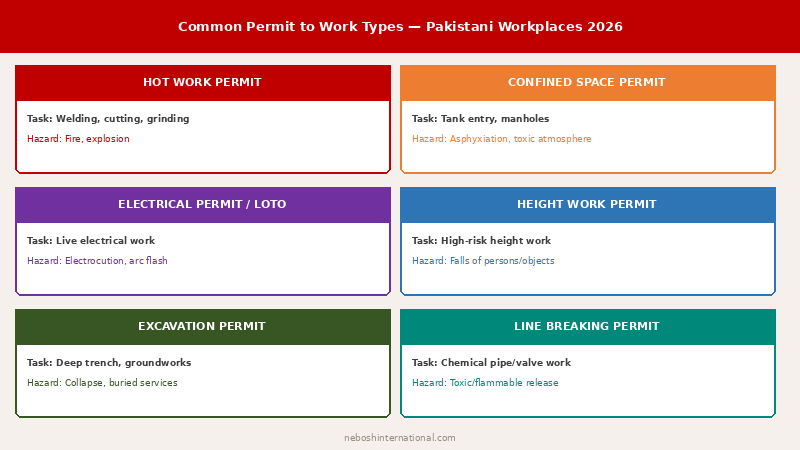
Hot work includes welding, flame cutting, grinding and other activities capable of generating sparks or heat. These activities can ignite combustible materials or flammable atmospheres.
Before issuing a hot work permit, the responsible team should:
- Remove combustible materials or protect them with suitable fire-resistant barriers.
- Provide suitable firefighting equipment and a competent fire watcher where required.
- Inspect nearby spaces, openings and areas where sparks could travel.
- Test the atmosphere where flammable gases or vapours may be present.
- Verify that required isolations and fire protection measures are effective.
- Establish an appropriate post-work fire watch based on the risk and site procedure.
A clearance distance of around 10 metres and a post-work monitoring period of 30–60 minutes may be specified in particular procedures. However, these are not universal rules for every task. The actual requirements should reflect the hazards, applicable standards and site-specific risk assessment.
In Pakistan’s oil and gas industry, pipeline maintenance and work near process equipment require particular attention to ignition sources, pressure and hazardous substances.
How to Implement an Effective PTW System
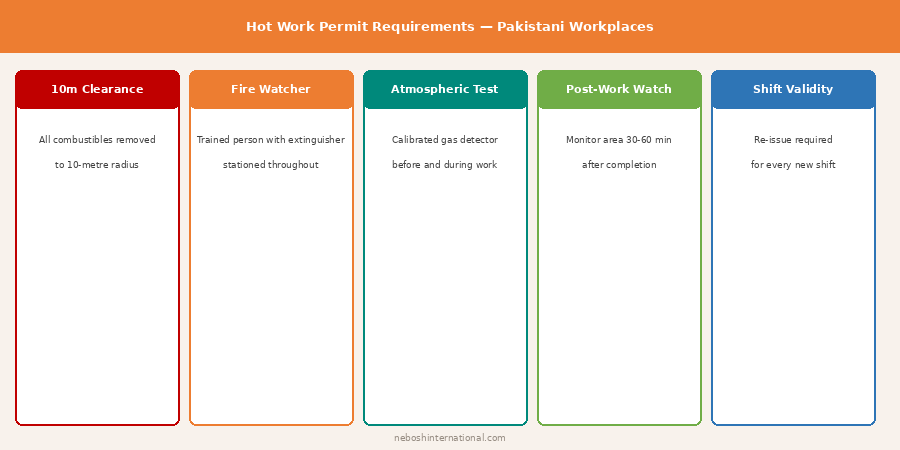
Employers should establish a written procedure that defines permit categories, responsibilities, authorisation limits, validity, suspension, handover and closure. Furthermore, each permit type should have a suitable form and task-specific checklist.
Permit issuers, supervisors and permit holders need appropriate training. Workers should understand their responsibilities, while managers must provide sufficient time and resources to implement the controls.
Regular field inspections and audits should compare the paperwork with actual working conditions. For example, an auditor can check whether an electrical isolation recorded on the permit has been physically applied and verified.
A permit register should track active, suspended and closed permits. In addition, a coordination process should identify conflicting activities, especially where multiple contractors operate in a shared work area.
Common Permit to Work Mistakes
The following failures can undermine even a well-designed system:
- Signing before verification: Required precautions are recorded but have not been implemented.
- Changing the work scope: Workers perform additional tasks without reassessment or proper authorisation.
- Ignoring permit expiry: Work continues beyond the approved period without the required review.
- Poor contractor coordination: One team’s activity creates a hazard for another team.
- Treating the permit as paperwork: Workers sign without understanding the conditions.
- Weak monitoring and closure: Conditions change unnoticed, or equipment is returned to service before proper handover.
To prevent these failures, managers should encourage workers to report unsafe conditions and support stop-work decisions without production pressure overriding safety.
Why PTW Knowledge Matters for NEBOSH IGC Candidates
Permit to work is an important practical example of administrative risk control and a safe system of work. Understanding it can help NEBOSH IGC candidates explain how hazards should be controlled in workplace scenarios.
Instead of writing only “issue a permit,” candidates should explain the relevant controls. For example, for hot work near flammable materials, an answer might identify combustible material removal, suitable isolation, atmospheric testing where necessary, fire protection and competent authorisation.
Explore our NEBOSH IGC open-book exam guide for further study guidance.
For learners in Pakistan considering an HSE career, practical knowledge of PTW procedures can also support workplace readiness for construction, manufacturing and oil and gas roles. However, employment depends on experience, competence, employer requirements and other relevant qualifications.
NEBOSH International is an independent guidance and learner referral platform. It helps learners explore NEBOSH information and training options; it is not NEBOSH itself and does not issue NEBOSH qualifications.
Frequently Asked Questions:
A permit to work system is a formal process for authorising specified hazardous activities after required precautions have been identified, implemented and verified. Employers use it to coordinate work and communicate safety responsibilities.
The six steps are task identification and planning, hazard assessment and permit preparation, worksite preparation, permit authorisation and worker briefing, work monitoring, and job completion with permit closure.
Common examples include hot work, confined space entry, electrical maintenance, hazardous excavation, pipeline opening and certain work-at-height activities. The exact requirements depend on risk assessments, site procedures, legal obligations and contract conditions.
A safety officer should follow the site’s stop-work and escalation procedures when required precautions are missing or conditions become unsafe. Work should not continue until the hazard has been addressed and the necessary authorisation restored.
A method statement explains how a task will be performed safely. A permit to work formally authorises specified work under defined conditions after the required precautions have been verified. Both documents may be required for the same activity.
No. A formal permit is not necessary for every routine, low-risk activity. However, specific legal requirements, client contracts, site rules and risk assessments may require permits for particular activities. Employers should confirm the requirements applicable to their workplace.
Conclusion
A reliable permit to work system in Pakistan depends on more than signatures and forms. It requires proper planning, effective hazard controls, competent authorisation, active supervision and formal closure.
By applying these six steps, safety officers can help control high-risk work on construction sites, in industrial facilities and across oil and gas operations. Moreover, understanding PTW procedures strengthens practical HSE knowledge for NEBOSH IGC candidates and professionals pursuing safety careers in Pakistan and the Gulf.
For further learning, explore our NEBOSH International website and compare available learning options with accredited NEBOSH Learning Partners.

NEBOSH International General Certificate (IGC) certified HSE professional focused on occupational health and safety, workplace risk assessment, hazard identification, and safety management systems. The content published on NeboshInternational.com is based on current industry guidance, recognized safety best practices, and practical workplace examples to help professionals in Pakistan and the Gulf prepare for NEBOSH qualifications and build successful HSE careers.





3 Comments
Comments are closed.