Noise at Work Risk Assessment in Pakistan 2026: A Complete Guide for Safety Officers
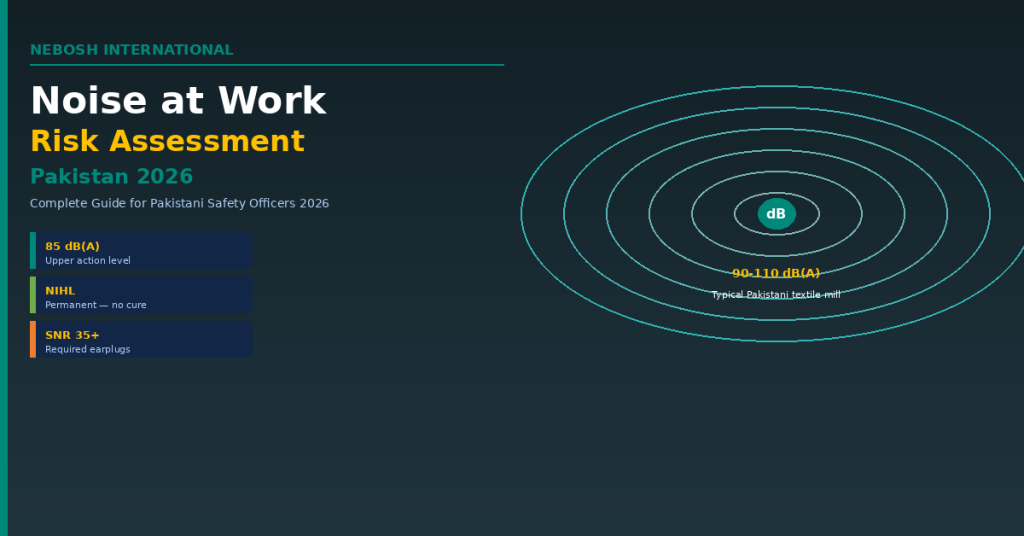
Noise at work risk assessment in Pakistan is an essential part of occupational health and safety, particularly in textile mills, manufacturing plants, construction projects and oil and gas facilities. In 2026, safety officers need to understand how to identify noisy activities, assess worker exposure, select appropriate controls and prevent permanent hearing damage.
For example, a safety officer inspecting a textile factory in Faisalabad may find workers shouting to communicate near spinning and weaving machines. Although employees might have worked in the same environment for years, the workplace may lack recent noise measurements, suitable hearing protection or hearing checks.
This situation highlights an important principle: workplace noise must be assessed and controlled before it causes irreversible hearing damage.
This guide explains seven practical steps for conducting a workplace noise risk assessment, with examples relevant to Pakistani industries and NEBOSH IGC learners.
What Is a Noise at Work Risk Assessment?
A noise at work risk assessment is a systematic process for identifying noise hazards, estimating workers’ exposure, evaluating the risk of hearing damage and implementing suitable control measures.
A competent safety professional considers the noise level, exposure duration, number of affected workers, existing controls and potential health consequences.
The assessment is particularly relevant to:
- Textile mills in Faisalabad and Lahore.
- Manufacturing facilities in Karachi and Sialkot.
- Construction projects in Rawalpindi and Islamabad.
- Oil and gas installations and processing plants.
- Workshops using grinders, compressors and cutting equipment.
Noise-induced hearing loss (NIHL) can develop gradually. Workers may also experience tinnitus, temporary hearing difficulties and problems understanding verbal instructions. Because permanent noise-induced hearing loss cannot generally be reversed, prevention is essential.
Why Is Workplace Noise Assessment Important in Pakistan?
Industrial noise can affect both workers’ long-term health and day-to-day operational safety. Excessive noise can make alarms harder to hear, interfere with communication and increase the possibility of misunderstandings during hazardous activities.
For instance, a construction worker operating a concrete-cutting machine may struggle to hear a warning from a nearby colleague. Similarly, workers in a textile production area may experience prolonged exposure throughout an eight-hour shift.
A structured noise assessment helps employers identify these problems and prioritise practical improvements.
It also supports a wider HSE management system by providing documented evidence of hazards, control measures, responsible persons and follow-up actions.
Noise Exposure Levels: What Should Safety Officers Know?
Noise is measured in decibels (dB). Workplace exposure is commonly expressed in A-weighted decibels, written as dB(A), which accounts for the sensitivity of human hearing to different sound frequencies.
The following values are widely used under the UK’s Control of Noise at Work Regulations 2005. They are useful international reference points, but they should not automatically be treated as the legally binding exposure limits in Pakistan.
| Exposure value | Daily or weekly exposure | General action under UK guidance |
|---|---|---|
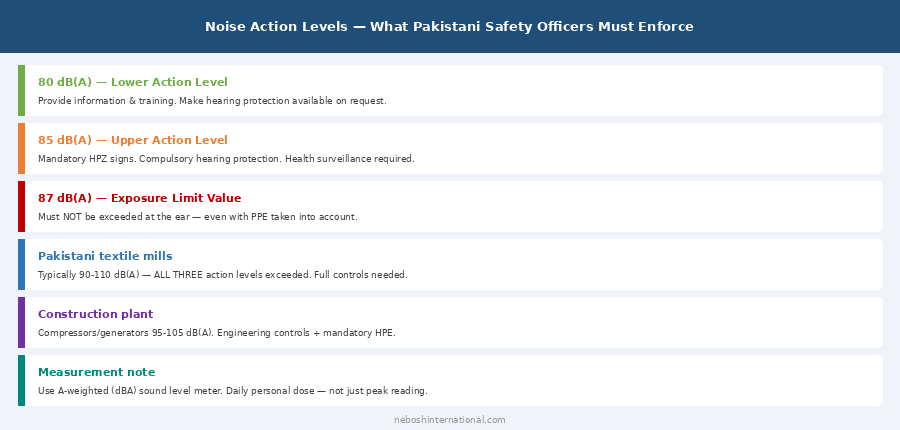
| Lower exposure action value | 80 dB(A) | Assess risks and provide relevant information and training. |
| Upper exposure action value | 85 dB(A) | Introduce stronger controls and hearing protection measures. |
| Exposure limit value | 87 dB(A) | Maximum permitted exposure after accounting for hearing protection under the UK regulations. |
Source: UK Health and Safety Executive — Employers’ responsibilities for noise.
Safety officers working in Pakistan should check the applicable provincial occupational safety and factory legislation, contractual requirements and client standards before determining legal compliance.
Remember that exposure depends on both sound intensity and duration. A brief reading from a sound level meter does not necessarily establish a worker’s total daily exposure.
Seven Steps to Conduct a Noise at Work Risk Assessment
Step 1: Identify Noise Sources
Begin with a workplace inspection. Observe machinery, production processes and tasks that may expose employees to excessive noise.
Common sources include:
- Spinning and weaving machines.
- Industrial compressors and generators.
- Metal presses and cutting equipment.
- Concrete breakers and drilling machines.
- Grinding, fabrication and pneumatic tools.
- Pumps, compressors and processing equipment.
Record the location of each source, the workers potentially affected and the activities performed during a normal shift.
For example, a factory in Lahore may have several noisy machines operating simultaneously. Assessing each work area helps identify where more detailed measurements are required.
Step 2: Measure Noise Levels
Use a suitable, properly calibrated sound level meter to assess noise at representative work positions. A personal noise dosimeter may be appropriate when workers move between different areas or perform changing tasks throughout their shifts.
A competent person should select the measurement method, account for background noise and ensure the instrument is used correctly.
Record:
- Measurement location and date.
- Noise level in dB(A).
- Machinery and activities operating during the assessment.
- Relevant operating conditions.
- Workers and tasks represented by the measurements.
Do not rely solely on a mobile phone application for formal exposure assessment. Such applications may help identify potentially noisy areas, but their accuracy depends on the device, microphone and calibration.
Where exposure is uncertain or potentially excessive, arrange a competent occupational noise survey.
Step 3: Evaluate Worker Exposure
The next step is to determine how long each worker spends in noisy areas and how exposure varies throughout the shift.
Consider machine operators, maintenance technicians, contractors and employees working near the noise source.
For example, a maintenance technician may spend two hours near noisy equipment and the remainder of the shift in a quieter workshop. Another employee may operate a loom for most of the day. Their daily exposure may therefore differ substantially.
A professional assessment should account for changing noise levels and exposure duration rather than relying on a single reading.
The HSE noise assessment guidance explains how to assess exposure in construction and other dynamic workplaces.
Step 4: Apply the Hierarchy of Controls
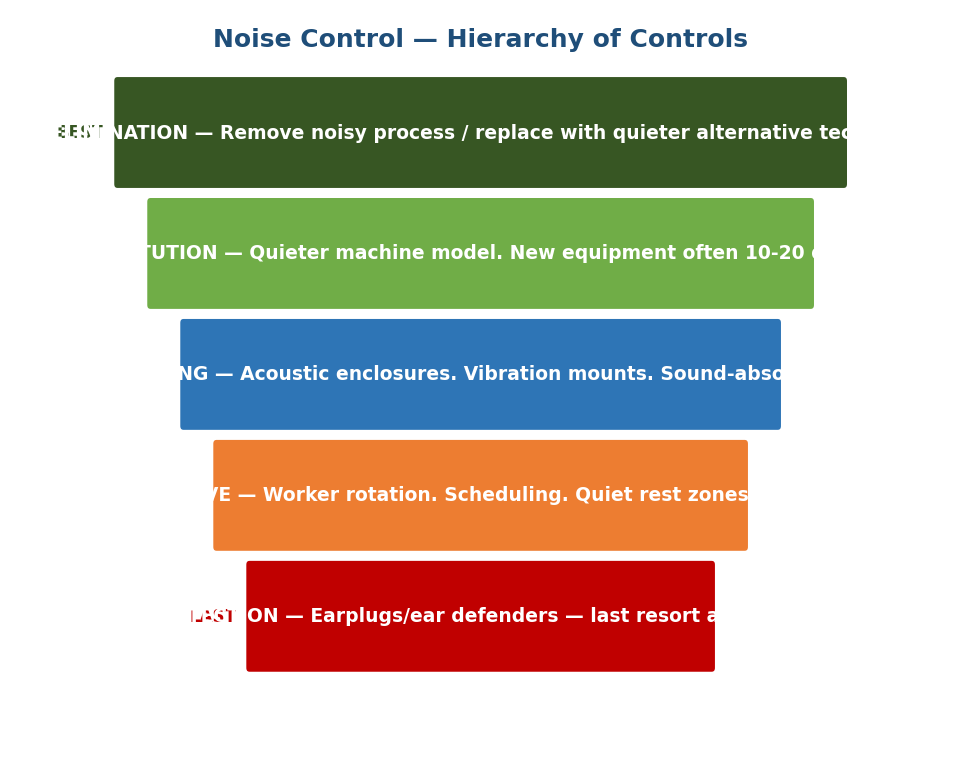
The most effective noise management strategy reduces noise at its source. Hearing protection should not be the automatic first response when engineering or process improvements are possible.
- Elimination: Remove an unnecessary noisy process where practicable.
- Substitution: Replace noisy machinery or tools with quieter alternatives.
- Engineering controls: Install acoustic enclosures, vibration-damping mounts, silencers or sound-absorbing barriers. Maintain equipment to prevent excessive vibration and mechanical noise.
- Administrative controls: Limit exposure duration, schedule noisy work appropriately, restrict access to high-noise areas and provide suitable quiet rest areas.
- Personal protective equipment: Provide correctly selected earplugs or ear defenders when additional protection is necessary.
For example, a textile factory might combine machinery maintenance, acoustic barriers, worker training and hearing protection to reduce the overall risk.
For related guidance, read our NEBOSH IGC open-book exam preparation guide.
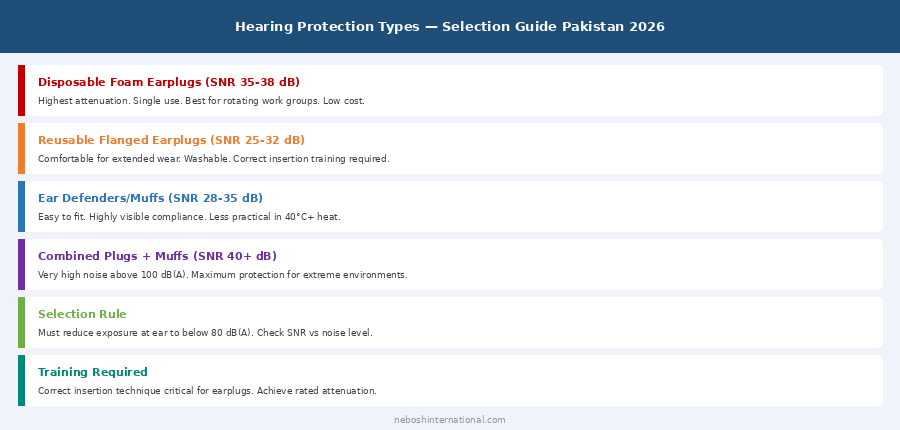
Step 5: Select Suitable Hearing Protection
Hearing protection must match the measured exposure, task requirements and working environment.
| Protection type | Typical application | Important consideration |
|---|---|---|
| Disposable foam earplugs | Routine use in noisy workplaces | Correct insertion is essential. |
| Reusable earplugs | Repeated use where hygiene can be maintained | Inspect and clean according to the manufacturer’s instructions. |
| Ear defenders | Factory floors and maintenance activities | Check the seal, condition and compatibility with other PPE. |
| Combined earplugs and ear defenders | Selected very-high-noise tasks | Use following a competent assessment of the actual exposure. |
Choose protection using the manufacturer’s attenuation data and a suitable exposure calculation. Do not assume that the advertised rating represents the exact reduction every worker will achieve.
Workers need training in fitting, cleaning, storage, inspection and replacement. Protection should remain in place throughout exposure, and it must not prevent workers from detecting essential alarms or communicating safely.
Step 6: Arrange Hearing Health Surveillance
Where the assessment identifies a risk of hearing damage, arrange appropriate occupational health surveillance. Audiometric testing can establish a baseline and help identify changes in hearing over time.
The programme should be determined by a competent occupational health professional, taking account of exposure, individual risk factors and applicable requirements.
Employers should maintain appropriate records, protect medical confidentiality and investigate any evidence of hearing deterioration.
Importantly, hearing tests do not replace noise control. They help identify potential harm and evaluate whether preventive measures are working.
Step 7: Document Findings and Review Controls
A useful noise risk assessment should include:
- Noise sources and measurement results.
- Workers and tasks exposed.
- Exposure duration and assessment method.
- Existing and additional control measures.
- Required hearing protection.
- Health surveillance arrangements, where appropriate.
- Responsible persons and completion dates.
- Follow-up measurements and review dates.
Review the assessment when machinery changes, production increases, new equipment is installed, workers report hearing problems or existing controls become ineffective.
Noise Risk Assessment Example: Faisalabad Textile Factory
Consider a hypothetical textile mill where workers operate several weaving machines during an eight-hour shift.
The safety officer identifies continuous machinery noise, limited separation between workstations and inconsistent use of earplugs.
The officer arranges a competent noise survey, evaluates individual exposure and recommends maintaining machinery, installing suitable acoustic enclosures, improving work-area separation and providing appropriate hearing protection.
The employer then arranges worker training and risk-based hearing surveillance. Follow-up measurements help establish whether the controls have reduced exposure adequately.
This example demonstrates how a documented assessment converts hazard identification into practical preventive action.
Common Noise Assessment Mistakes
Safety officers should avoid these common errors:
- Providing earplugs without assessing actual exposure.
- Using a single spot measurement to represent an entire shift.
- Ignoring contractors and employees working nearby.
- Failing to check whether hearing protection fits correctly.
- Treating UK exposure values as automatically binding Pakistani law.
- Neglecting maintenance, training and health surveillance.
- Failing to review the assessment after workplace changes.
Avoiding these mistakes makes workplace noise management more reliable and easier to verify.
How Does Noise Assessment Relate to NEBOSH IGC?
Noise is a useful example of a physical workplace hazard for NEBOSH IGC learners. Candidates should understand how to identify hazards, evaluate risks, justify control measures and apply the hierarchy of controls to realistic workplace scenarios.
For example, a scenario involving a noisy manufacturing plant may require candidates to explain why hearing protection alone is insufficient and recommend additional engineering and administrative measures.
Pakistani candidates can strengthen their practical understanding by studying the NEBOSH IGC exam format guide and practising scenario-based risk assessment questions.
Employers also value practical HSE skills, so learning to conduct workplace inspections and document effective controls can complement formal qualifications.
Frequently Asked Questions
It is a structured process for identifying workplace noise hazards, assessing worker exposure and implementing measures to prevent hearing damage.
The 80, 85 and 87 dB(A) values are commonly referenced in UK noise regulations. Safety officers in Pakistan should verify applicable provincial legislation, industry requirements and client standards before using any values for legal compliance.
Factories can maintain machinery, install acoustic enclosures, reduce vibration, separate noisy processes, measure worker exposure and provide suitable hearing protection.
Not always. A sound level meter provides measurements at particular locations and times. A personal dosimeter or further exposure calculations may be needed to evaluate a worker’s exposure across a full shift.
NEBOSH IGC develops knowledge of workplace hazards and risk control. Understanding noise assessment helps candidates apply these principles to manufacturing, construction and other industrial scenarios.
Conclusion
A noise at work risk assessment in Pakistan helps safety officers identify excessive exposure, prevent occupational hearing damage and improve workplace safety in textile mills, construction projects, manufacturing facilities and oil and gas operations.
The most effective approach combines competent noise measurement, exposure assessment, engineering improvements, appropriate hearing protection, health surveillance and regular review.
For Pakistani HSE professionals, these skills provide a practical foundation for managing physical hazards and applying risk assessment principles in real workplaces.
At NEBOSH International, learners can explore independent NEBOSH guidance and build their understanding of occupational health and safety. Explore our About Us page to learn more about our information and learner referral platform.

NEBOSH International General Certificate (IGC) certified HSE professional focused on occupational health and safety, workplace risk assessment, hazard identification, and safety management systems. The content published on NeboshInternational.com is based on current industry guidance, recognized safety best practices, and practical workplace examples to help professionals in Pakistan and the Gulf prepare for NEBOSH qualifications and build successful HSE careers.