ISO 45001 Certification in Pakistan 2026: Requirements, Costs and Career Benefits
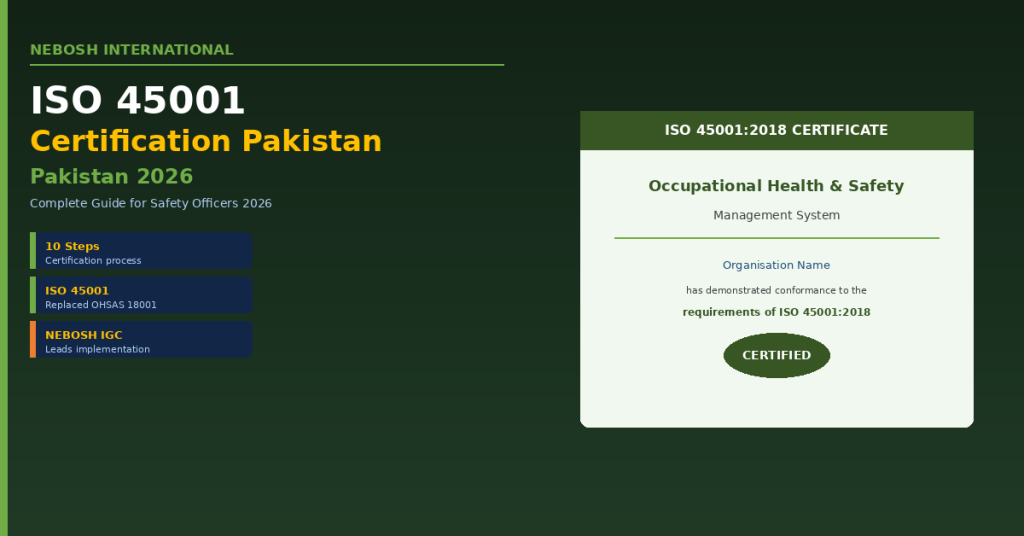
ISO 45001 certification in Pakistan helps organisations build a structured occupational health and safety management system (OHSMS) to identify workplace hazards, control risks, prevent work-related injuries and improve safety performance. It is particularly relevant to construction companies, textile manufacturers, engineering firms, oil and gas contractors, and businesses supplying international clients.
For safety officers in Lahore, Karachi, Faisalabad, Rawalpindi, Islamabad and other industrial centres, understanding ISO 45001 can strengthen practical HSE knowledge and support career development. However, ISO 45001 is an organisational certification, not an individual qualification. Safety professionals can support its implementation by developing risk assessments, monitoring compliance, investigating incidents and helping management improve workplace safety.
This guide explains ISO 45001 requirements, the certification process in Pakistan, estimated costs, the difference between ISO 45001 and NEBOSH IGC, and the skills employers may value in Pakistan and Gulf countries.
What Is ISO 45001 Certification?
ISO 45001 is an international standard for occupational health and safety management systems. It provides a framework for organisations to identify hazards, assess occupational risks, meet applicable legal requirements and continually improve working conditions.
Unlike a standalone safety training course, ISO 45001 focuses on how an organisation manages safety through its policies, responsibilities, operational controls, monitoring activities and management reviews.
For example, a construction contractor in Lahore may identify fall hazards during a site inspection. The organisation can assess the risks, establish suitable fall-prevention measures, train workers, supervise subcontractors and investigate any incidents. ISO 45001 helps integrate these activities into a consistent management system.
The standard can be useful for organisations of different sizes and across different industries. Certification may also help businesses demonstrate their approach to occupational health and safety when clients request evidence of a recognised management system.
Read the official overview from the International Organization for Standardization (ISO).
How Does ISO 45001 Work? Understanding the PDCA Cycle
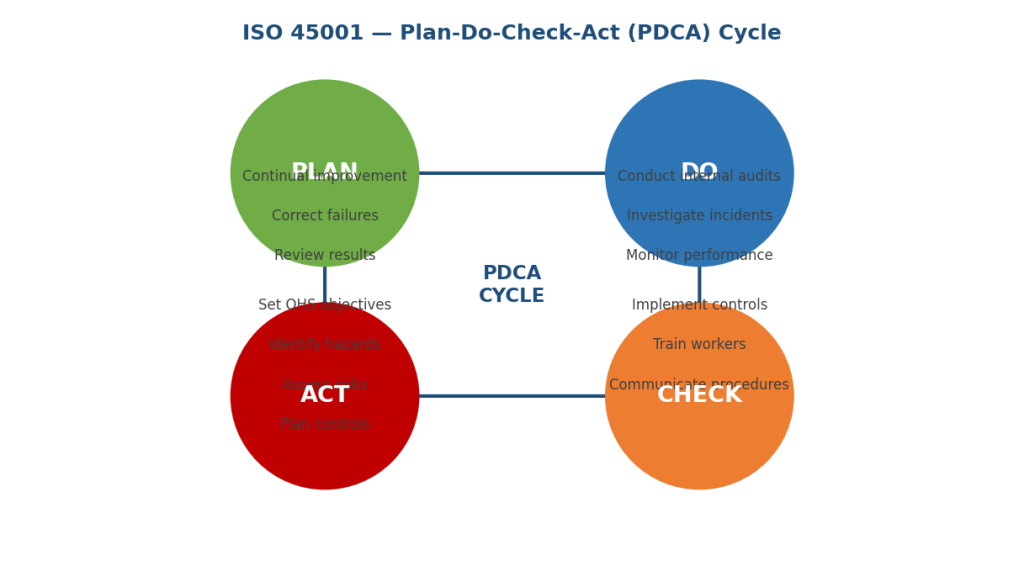
ISO 45001 uses the Plan-Do-Check-Act (PDCA) approach to support continual improvement. This cycle helps organisations move beyond reactive safety practices and establish a systematic process for managing risks.
1. Plan
Identify workplace hazards, assess risks, understand applicable legal requirements and establish measurable occupational health and safety objectives.
2. Do
Implement risk controls, communicate procedures, provide suitable training and assign responsibilities to workers, supervisors and management.
3. Check
Monitor safety performance, inspect workplaces, review compliance, investigate incidents and conduct internal audits.
4. Act
Correct identified problems, investigate recurring failures, review performance with senior management and improve the management system.
For example, a textile factory in Faisalabad might identify unsafe machine guarding during an inspection. Management can arrange corrective action, verify that the machinery is safe to operate and review whether similar machines have the same problem.
Safety officers can support every stage by conducting inspections, maintaining records, monitoring corrective actions and communicating findings to management.
Before implementing workplace controls, professionals should also understand PPE selection and requirements in Pakistan.
ISO 45001 vs OHSAS 18001: What Has Changed?
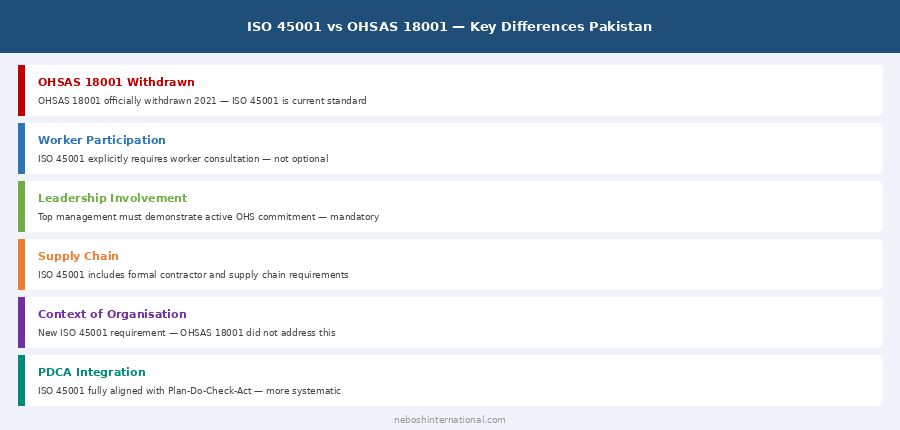
ISO 45001 replaced OHSAS 18001 as the international occupational health and safety management system standard. The transition deadline for organisations certified to OHSAS 18001 ended in September 2021.
Although both frameworks addressed occupational health and safety, ISO 45001 places greater emphasis on leadership, organisational context, worker participation and the integration of safety management into business processes.
| Area | OHSAS 18001 | ISO 45001 |
|---|---|---|
| Status | Withdrawn | Successor standard |
| Management responsibility | Management involvement required | Stronger emphasis on leadership accountability |
| Worker participation | Less explicit | Specific participation and consultation requirements |
| Organisational context | Less developed | Internal and external issues must be considered |
| Risk management | Focused on occupational hazards and risks | Addresses risks and opportunities affecting the OHSMS |
| Contractors and procurement | Covered through operational controls | Integrated into the management system requirements |
| Improvement | Continual improvement | Continual improvement supported by a structured management system |
For Pakistani organisations working with international buyers or multinational contractors, understanding ISO 45001 is more relevant than relying on the withdrawn OHSAS 18001 framework.
ISO 45001 Certification Process in Pakistan
The certification process depends on the organisation’s size, activities, risk profile and existing safety arrangements. A typical implementation follows these steps.
Step 1: Conduct a gap analysis
Compare current safety practices with the requirements of ISO 45001. Identify missing procedures, incomplete records, weak risk controls and gaps in management responsibilities.
Step 2: Obtain management commitment
Senior management must provide appropriate resources, establish responsibilities and support the occupational health and safety policy. Certification is difficult to maintain when safety remains solely the responsibility of the HSE department.
Step 3: Identify hazards and assess risks
Review routine and non-routine activities, machinery, chemicals, manual handling, working at height, emergency arrangements and contractor activities. Consult workers who understand the hazards associated with their jobs.
Step 4: Develop the management system
Establish suitable procedures, risk assessments, training arrangements, emergency plans, inspection records and processes for managing incidents and corrective actions.
Step 5: Train employees
Ensure that workers understand relevant hazards, control measures, emergency procedures and their responsibilities. Supervisors should know how to monitor compliance and report unsafe conditions.
Step 6: Conduct internal audits
Evaluate whether the management system meets ISO 45001 requirements and whether the organisation implements its procedures effectively. Record findings and follow up on corrective actions.
Step 7: Complete a management review
Senior management reviews performance, audit findings, incident trends, compliance issues, objectives and opportunities for improvement.
Step 8: Arrange the certification audit
Select an appropriate certification body and agree on the audit arrangements. Initial certification generally involves Stage 1, which reviews readiness and system documentation, and Stage 2, which evaluates implementation and effectiveness.
Step 9: Maintain certification
Address audit findings and continue monitoring performance. Certification typically operates on a three-year cycle, with periodic surveillance audits and a recertification audit. Confirm the applicable schedule with the certification body.
ISO 45001 Certification Cost in Pakistan 2026
The cost of ISO 45001 certification in Pakistan varies according to the number of employees, number of sites, industry risks, audit duration, consultant involvement and existing management systems.
The following figures are indicative budgeting estimates, not verified market quotations.
| Cost component | Illustrative estimate |
|---|---|
| Certification audit fees for a small organisation | PKR 150,000–400,000 |
| Implementation consultancy | Depends on scope and provider |
| Staff and management training | Depends on participants and course |
| Internal audit and corrective actions | Depends on available resources |
| Multi-site or higher-risk certification | May cost considerably more |
The certification audit fee is not necessarily the total cost of achieving certification. Organisations may also need to invest in equipment, training, documentation, workplace improvements and ongoing monitoring.
Before choosing a provider, request a written quotation that explains the audit scope, number of sites, audit days, accreditation arrangements, surveillance fees and any additional charges.
To verify relevant accreditation information, consult the Pakistan National Accreditation Council (PNAC) and confirm that the certification body’s accreditation covers the applicable standard and scope. Do not assume that every consultancy or training provider can issue accredited certification.
Which Organisations in Pakistan Benefit From ISO 45001?
ISO 45001 can support organisations across Pakistan, particularly where workplace hazards, contractor management or customer requirements make a structured safety system valuable.
- Construction: Contractors working on commercial buildings, infrastructure, industrial facilities and housing developments can use the framework to manage working-at-height risks, excavation, lifting operations and subcontractor safety.
- Textile and manufacturing: Factories in Faisalabad, Karachi and Lahore can apply it to machinery safety, chemical handling, fire prevention, maintenance and worker training.
- Oil and gas: Operators and contractors can use the management system to coordinate risk assessments, permit-to-work arrangements, emergency preparedness and contractor controls.
- Engineering and logistics: Businesses can manage vehicle movements, equipment maintenance, manual handling and workplace hazards more systematically.
- International supply chains: Companies serving overseas customers may need to demonstrate that their health and safety management arrangements meet contractual expectations.
ISO 45001 is not automatically a legal requirement for every Pakistani business. Whether certification is required depends on applicable law, client specifications, tender conditions and contractual obligations.
NEBOSH IGC vs ISO 45001: Which Should a Safety Officer Choose?
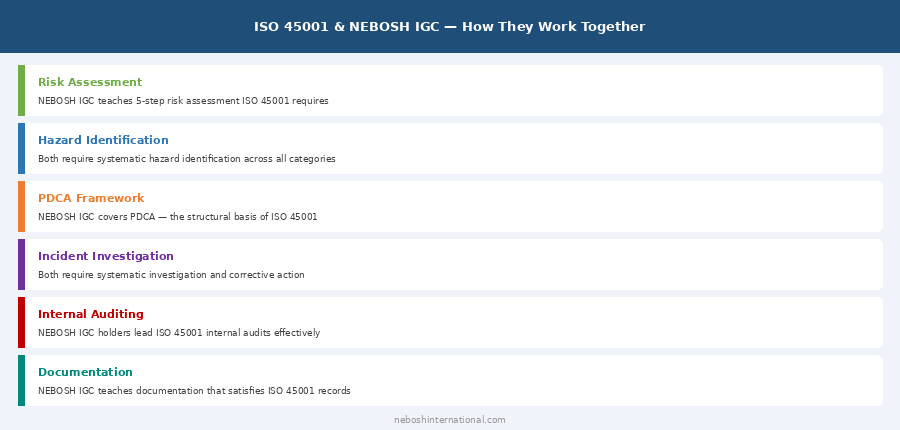
NEBOSH IGC and ISO 45001 serve different purposes, so they should not be treated as interchangeable qualifications.
| Feature | NEBOSH IGC | ISO 45001 |
|---|---|---|
| Type | Individual occupational health and safety qualification | Organisational management system standard |
| Main purpose | Develop workplace health and safety knowledge | Establish and improve an OHS management system |
| Main users | HSE professionals and learners | Organisations and personnel supporting their OHSMS |
| Typical application | Hazard control, risk assessment and safety practice | Implementation, monitoring, auditing and continual improvement |
| Career development | Supports entry and progression in HSE roles | Can support implementation and auditing responsibilities when combined with relevant training and experience |
For someone starting an HSE career in Pakistan, NEBOSH IGC can provide a useful foundation in hazard identification, risk assessment and control measures. ISO 45001 training can then help develop knowledge of management system implementation and auditing.
Explore the NEBOSH IGC guide for engineers in Pakistan and our comparison of NEBOSH and IOSH courses.
An ISO 45001 Internal Auditor or Lead Auditor course is a separate training option. Completing a short course alone does not guarantee employment or automatically establish professional competence; employers may also consider relevant experience, practical auditing ability and industry knowledge.
Career Opportunities in Pakistan and the Gulf
Knowledge of ISO 45001 may be relevant to HSE officers, safety supervisors, HSE engineers, internal auditors and professionals involved in compliance or management systems.
In Pakistan, opportunities may arise in construction, manufacturing, textiles, engineering and oil and gas. In Saudi Arabia, the UAE, Qatar and other Gulf markets, some employers or project clients may value ISO 45001 knowledge alongside relevant qualifications and experience.
However, certification knowledge does not guarantee a job, promotion or a particular salary. Recruitment requirements vary by employer, project, industry and location.
To strengthen your career preparation, explore safety officer job opportunities in Pakistan and develop practical skills in risk assessment, incident investigation, auditing, reporting and contractor safety.
Frequently Asked Questions
It is not a universal legal requirement for every organisation. However, particular contracts, tenders, customers or supply-chain arrangements may require or prefer certification. Businesses should check the legal and contractual requirements that apply to their activities.
Yes. NEBOSH IGC can provide relevant occupational health and safety knowledge for supporting implementation. You will also need to understand ISO 45001 requirements, organisational processes, documentation, consultation and audit practices. Additional training or experienced support may be beneficial.
Costs depend on the organisation’s size, risk profile, number of locations and certification arrangements. A small organisation might use PKR 150,000–400,000 as an initial illustrative estimate for certification audit fees, but it should obtain current written quotations and budget separately for implementation.
The timeline depends on the organisation’s readiness, operational complexity, resources and corrective actions. Several months may be required; complex organisations may take longer. Obtain a realistic implementation schedule following a gap analysis.
An internal auditor evaluates the organisation’s management system as part of its internal audit programme. A lead auditor typically develops the skills to lead audit teams and manage more complex audit activities. The course, practical experience and qualification requirements depend on the training and certification scheme.
It can be useful where employers value occupational health and safety management systems, particularly in construction, manufacturing and oil and gas. Job eligibility still depends on the vacancy’s requirements, professional experience and other qualifications.
Conclusion:
ISO 45001 certification can help Pakistani organisations strengthen their occupational health and safety management systems, improve risk control and demonstrate their approach to workplace safety. For safety officers, understanding the standard can provide practical skills in implementation, auditing, compliance and continual improvement.
If you are working in Lahore, Karachi, Faisalabad, Rawalpindi, Islamabad or another industrial centre, consider building a combination of workplace safety knowledge, NEBOSH IGC, ISO 45001 training and relevant practical experience.
Start by reviewing the official ISO standard, understanding your employer’s requirements and identifying the skills needed for your preferred HSE role. If you are exploring NEBOSH qualifications, NEBOSH International provides independent guidance and can help learners in Pakistan explore suitable accredited learning partners.
The strongest career strategy is to combine recognised learning with practical safety skills and the ability to improve real workplace conditions.

NEBOSH International General Certificate (IGC) certified HSE professional focused on occupational health and safety, workplace risk assessment, hazard identification, and safety management systems. The content published on NeboshInternational.com is based on current industry guidance, recognized safety best practices, and practical workplace examples to help professionals in Pakistan and the Gulf prepare for NEBOSH qualifications and build successful HSE careers.