Manual Handling Risk Assessment in Pakistan: 7 Practical Steps for 2026
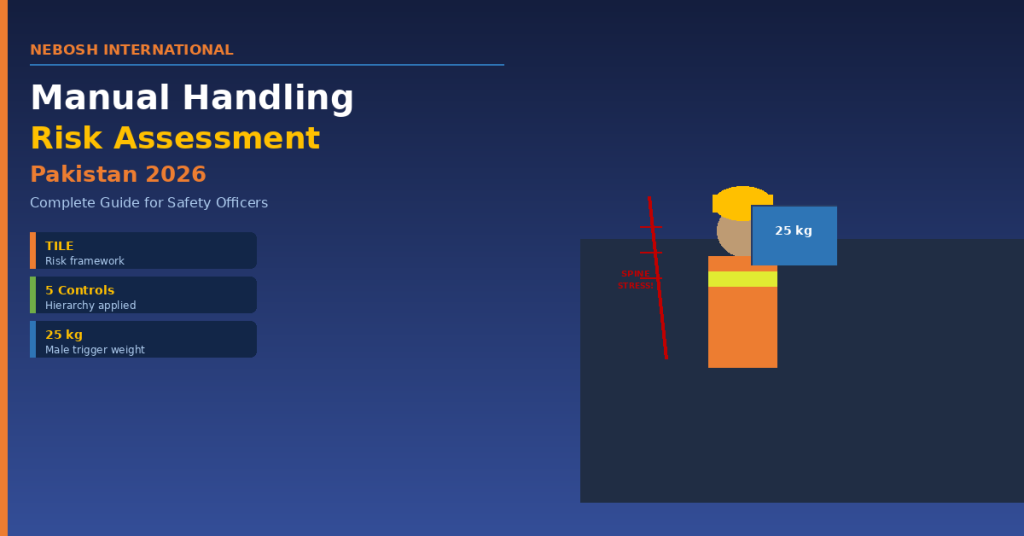
Manual handling risk assessment in Pakistan helps employers identify lifting, carrying, pushing and pulling hazards before they cause workplace injuries. By examining the task, individual, load and working environment, safety officers can select suitable controls to reduce the risk of back pain, muscle strains and other musculoskeletal disorders.
From construction projects in Lahore to textile factories in Faisalabad and warehouses in Karachi, manual handling is a routine part of many jobs. Workers may carry cement bags, move fabric rolls, load deliveries or repeatedly handle materials during production. Without suitable equipment and safe working arrangements, these activities can place excessive strain on the body.
For Pakistani safety officers, supervisors and NEBOSH IGC candidates, understanding manual handling risk assessment is an important practical skill. This guide explains seven steps for assessing manual handling hazards, applying the TILE framework and selecting realistic workplace controls.
What Is Manual Handling?
Manual handling refers to moving or supporting a load using bodily force. It includes lifting, lowering, carrying, pushing, pulling and repositioning objects. Some tasks involve handling people or animals, while repetitive movements and awkward postures can also create significant ergonomic risks.
Common workplace examples include:
- Carrying cement bags on construction sites.
- Moving cartons and pallets in warehouses.
- Handling fabric rolls in textile factories.
- Loading agricultural produce onto vehicles.
- Repeatedly packing products on manufacturing lines.
- Pushing trolleys or pulling heavy equipment.
The main concern is not simply the weight of an object. The handling method, frequency, distance, grip, posture and working conditions can all affect the likelihood of injury.
Why Is Manual Handling Risk Assessment Important in Pakistan?
Manual handling hazards occur across Pakistan’s construction, manufacturing, agriculture, logistics and oil and gas sectors. Workers may face additional challenges where mechanical equipment is unavailable, access routes are uneven or production targets encourage repetitive work.
For example, a construction worker in Rawalpindi might carry materials up a sloping access route. A warehouse employee in Karachi may repeatedly move heavy cartons between storage areas. In Faisalabad, production workers might handle fabric rolls throughout a shift.
These tasks can cause immediate injuries or contribute to longer-term musculoskeletal problems. Effective assessment helps employers identify hazards early, improve work methods and reduce avoidable physical strain.
A risk assessment should also consider workers’ experience, training, individual capabilities and any relevant health restrictions. Employers should provide a safe system of work rather than relying entirely on workers to lift correctly.
Seven Steps for Manual Handling Risk Assessment
Step 1: Identify the Manual Handling Task
Begin by describing the task clearly. Observe workers performing their normal duties instead of relying exclusively on written procedures or supervisors’ descriptions.
Record what the worker moves, where the load starts and finishes, how often the task occurs and how far the load travels.
For example, a Lahore construction site may require workers to move cement bags from a delivery point to a storage area. The assessment should examine the entire route, including steps, ramps, narrow passages and changes in floor level.
Identify whether the task involves lifting, lowering, carrying, pushing, pulling or repetitive handling.
Step 2: Assess the Task Using TILE
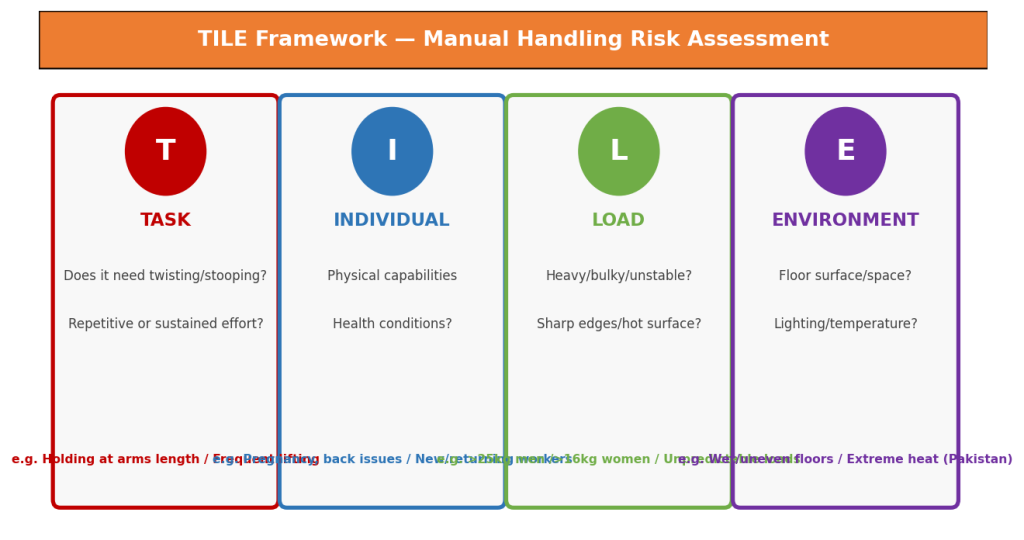
The TILE framework helps safety officers organise the main risk factors into four categories.
T — Task
Consider how the work must be performed.
- Does the worker bend, twist or reach excessively?
- Is the load held away from the body?
- Are movements repetitive or physically demanding?
- Does the task involve long carrying distances?
- Are there sufficient breaks between handling activities?
I — Individual
Consider the person performing the work.
- Has the worker received appropriate instruction?
- Does the task match the worker’s physical capabilities?
- Is the person new to the job or returning after an absence?
- Are individual health restrictions or pregnancy-related needs relevant?
- Does the worker know when to request assistance?
L — Load
Examine the load’s physical characteristics.
- Is it heavy, bulky or difficult to grip?
- Can its contents move unexpectedly?
- Does it obstruct the worker’s view?
- Does it have sharp edges, hot surfaces or slippery packaging?
- Can the load be divided into smaller units?
E — Environment
Inspect the surrounding workplace.
- Is the floor uneven, slippery or obstructed?
- Is there sufficient space to move safely?
- Are lighting and visibility adequate?
- Are ramps, stairs or changes in level present?
- Could heat, cold or poor access affect safe handling?
The TILE framework is a useful assessment aid, but it should not replace a complete evaluation of the task. Consider the interaction between factors and use an appropriate assessment method where more detailed analysis is necessary.
Step 3: Determine Who Could Be Harmed and How
Identify everyone exposed to the handling task. This may include employees, temporary workers, contractors and nearby people who could be struck by a dropped load.
Potential injuries include:
- Lower-back pain and muscle strains.
- Shoulder and upper-limb injuries.
- Wrist and hand problems associated with repetitive work.
- Knee strain caused by repeated kneeling or squatting.
- Slips, trips and falls while carrying materials.
- Crushing injuries caused by dropped or unstable loads.
For instance, a worker carrying a large carton through a crowded warehouse may have limited visibility. The resulting risk includes both physical strain and collision with other people or obstacles.
Record the hazards and explain how the task could cause harm.
Step 4: Evaluate Existing Controls and Remaining Risks
Check what the workplace already does to manage manual handling. Existing controls might include trolleys, lifting tables, team handling arrangements, suitable storage heights and restricted access routes.
Ask whether these measures are available, maintained and used correctly.
A trolley may reduce carrying effort, for example, but it may not solve the problem if workers must push it over damaged flooring or steep ramps.
Consider the likelihood of an incident, the potential severity of injury and the effectiveness of existing controls. Use the organisation’s risk-rating method to determine whether further action is necessary.
Do not assume that a task is safe simply because workers have performed it for years without reporting an injury.
Step 5: Introduce Suitable Control Measures
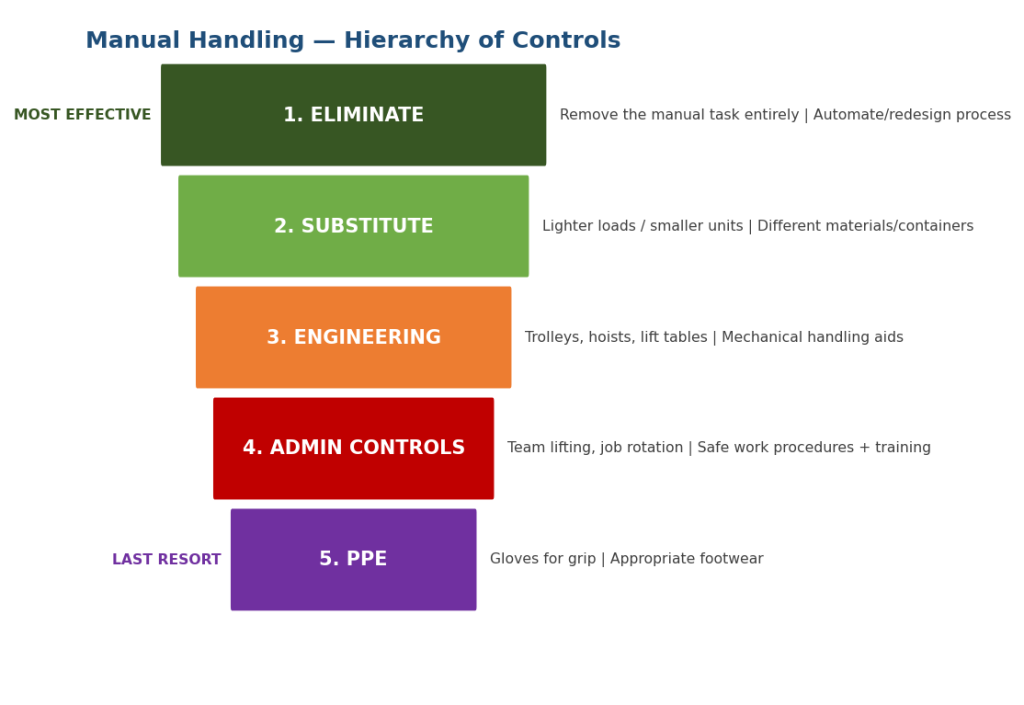
Choose controls that eliminate the hazard or reduce physical demands as far as reasonably practicable.
Eliminate unnecessary handling: Rearrange deliveries, storage and production processes to avoid moving materials repeatedly.
Use mechanical assistance: Consider conveyors, hoists, forklifts, pallet trucks, sack trucks and lifting tables where suitable for the task.
Reduce the load: Divide materials into smaller units when practical and safe. Confirm that packaging and load limits are appropriate.
Improve workplace layout: Keep frequently used items within convenient reach and reduce carrying distances.
Improve handling conditions: Repair damaged floors, remove obstructions and provide suitable access routes.
Organise the work: Reduce excessive repetition, allow recovery periods and ensure enough trained workers are available.
Provide instruction: Explain the hazards, safe working arrangements, equipment requirements and reporting procedures.
Personal protective equipment, such as suitable gloves and footwear, may help address particular hazards. However, PPE should not replace effective measures that reduce the physical demands of the task.
Step 6: Record Findings and Assign Actions
A written assessment helps managers track hazards and verify that improvements have been completed.
Include the following information:
- Task description and work location.
- Loads handled and handling frequency.
- TILE risk factors identified.
- People who could be harmed and possible injuries.
- Existing controls and their effectiveness.
- Additional measures required.
- The person responsible for each action.
- Target completion dates and review arrangements.
For example, a warehouse assessment may identify repeated manual movement of heavy cartons. The action plan could require a pallet truck, a revised storage layout and worker instruction, with a named manager responsible for completion.
The assessment should reflect the actual task rather than use generic statements that do not explain the workplace risk.
Step 7: Review the Assessment
Manual handling risks can change when production volumes increase, equipment is replaced or workers are assigned different duties.
Review the assessment after a relevant injury or near miss, a significant process change, the introduction of new loads or equipment, or evidence that existing controls are ineffective.
Also follow your organisation’s review schedule and any applicable legal requirements. Check whether agreed actions have been completed and whether the revised arrangements are working in practice.
Safe Manual Handling: Practical Advice
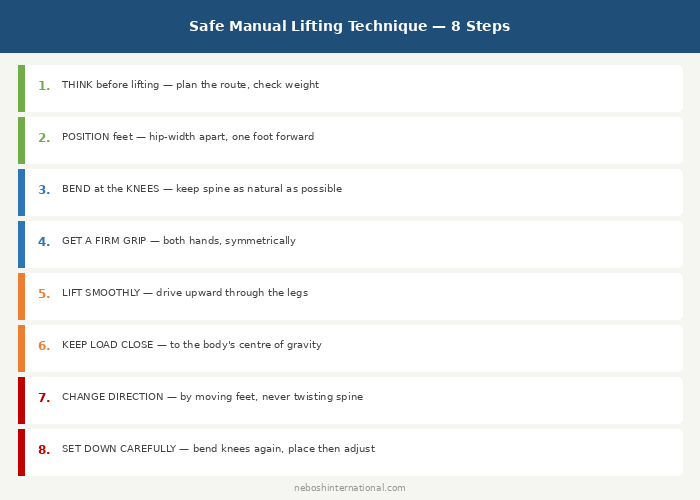
Where manual handling cannot be eliminated, workers should follow the safe system of work established for the task.
Before moving a load, check its stability, available grip points and intended route. Determine whether mechanical assistance or help from another trained worker is necessary.
Position yourself securely and keep the load close to your body where practicable. Use a stable posture, avoid sudden jerking and turn by moving your feet rather than twisting your torso under load.
Move smoothly and set the load down under control. Stop if the load is unstable, the route becomes obstructed or the task exceeds the limits of the planned safe method.
There is no single lifting technique that makes every load safe. Equipment, load shape, available space and the worker’s capabilities must all be considered.
Is There a Maximum Safe Lifting Weight?
There is no universal weight that guarantees safe manual handling for every worker and situation. A load that one person can manage under favourable conditions may present a serious risk to another person, particularly when lifting is repetitive or performed in an awkward posture.
Do not treat figures such as 25 kg or 16 kg as automatic legal limits or proof that a lift is safe. Assess the complete task and consult applicable workplace requirements and recognised guidance.
Manual Handling Risk Assessment and NEBOSH IGC
Manual handling is relevant to workplace hazard identification, ergonomic risks and practical risk assessment. NEBOSH IGC candidates should be able to identify hazards from a scenario, explain who might be harmed, describe possible consequences and recommend suitable controls.
For example, a question about workers carrying materials across a construction site may require candidates to identify excessive load weight, repetitive lifting, uneven access routes and limited mechanical assistance.
Strong answers explain the risk in the context of the scenario and recommend controls that address its causes. Merely writing “provide training” or listing the letters in TILE may not demonstrate sufficient application.
For the practical assessment, follow the current qualification instructions and assessment guidance rather than assuming that one particular framework is compulsory for every task.
Explore our NEBOSH IGC course guide for Pakistan, then review relevant workplace safety articles on the NEBOSH International website.
Frequently Asked Questions
Identify the task, assess the task, individual, load and environment, identify who could be harmed, evaluate existing controls, introduce improvements, document the findings and review the assessment when necessary.
TILE stands for Task, Individual, Load and Environment. It helps safety professionals examine the main factors that can increase the risk of injury during manual handling activities.
Not in every situation. Safety depends on factors such as posture, grip, carrying distance, frequency, the worker’s capabilities and the surrounding conditions. A weight alone cannot establish that a lift is safe.
Eliminating unnecessary handling and using suitable mechanical assistance can reduce physical demands significantly. Better layouts, smaller loads, improved work organisation and appropriate instruction can provide additional protection.
Review it when the task, load, equipment or working environment changes significantly, after relevant incidents, or when existing controls appear ineffective. Follow the organisation’s review arrangements and applicable requirements.
Yes. Understanding manual handling hazards helps candidates develop practical risk assessment skills that are relevant to construction, manufacturing, warehousing and other industrial workplaces.
Conclusion
Manual handling risk assessment in Pakistan is an important part of preventing workplace injuries and improving everyday safety. By identifying hazards, applying TILE, evaluating existing controls and introducing practical improvements, safety officers can help reduce unnecessary physical strain.
Whether you work in construction in Lahore, manufacturing in Faisalabad or logistics in Karachi, the objective remains the same: design work so that people are not exposed to avoidable manual handling risks.
For further learning, explore the official NEBOSH website and the UK Health and Safety Executive’s manual handling guidance. Apply the principles to your workplace and follow the relevant local requirements.
Disclaimer: This article provides general educational information. Employers should assess actual workplace conditions and confirm applicable legal obligations before implementing controls.

NEBOSH International General Certificate (IGC) certified HSE professional focused on occupational health and safety, workplace risk assessment, hazard identification, and safety management systems. The content published on NeboshInternational.com is based on current industry guidance, recognized safety best practices, and practical workplace examples to help professionals in Pakistan and the Gulf prepare for NEBOSH qualifications and build successful HSE careers.


2 Comments
Comments are closed.