Emergency Evacuation Plan in Pakistan: Complete Workplace Safety Guide 2026
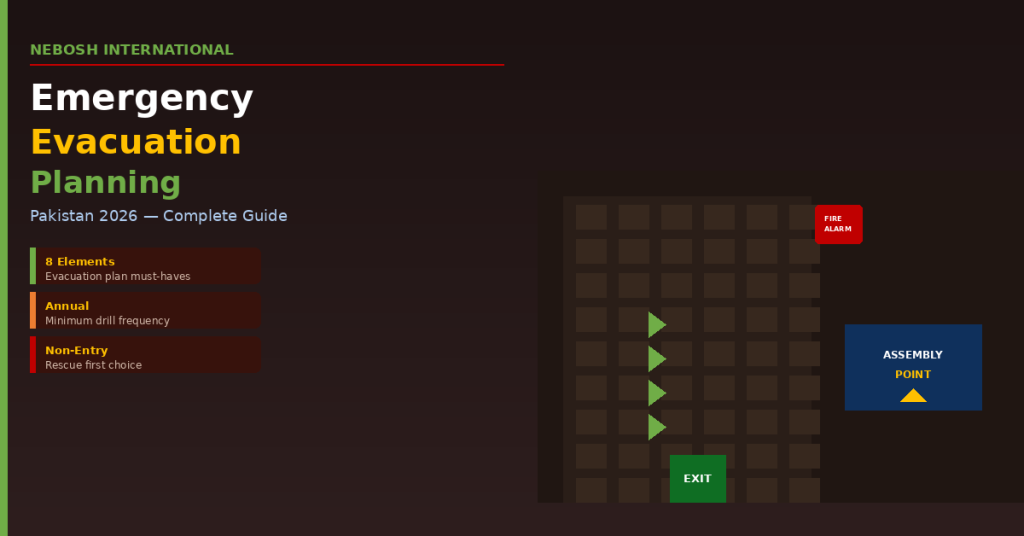
An emergency evacuation plan in Pakistan helps employers protect workers, contractors and visitors during fires, gas leaks, chemical releases and other dangerous incidents. It explains how people receive emergency warnings, which escape routes they should follow, where they must assemble and how the organisation confirms that everyone has reached safety.
For safety officers working in Lahore’s manufacturing sector, Karachi’s industrial areas, Faisalabad’s textile factories or construction projects in Rawalpindi and Islamabad, emergency preparedness is an essential workplace responsibility.
Consider a factory where an electrical fault causes smoke to spread near production machinery. If workers cannot hear the alarm, emergency exits remain blocked or supervisors do not know their responsibilities, a manageable incident can quickly become a major disaster.
The 2012 Baldia factory fire in Karachi, which killed more than 260 workers, remains a tragic reminder of the consequences of serious workplace safety failures. Read contemporary reporting on the Karachi factory fire.
A practical evacuation plan should therefore do more than satisfy an audit. It must give every person clear instructions that they can understand and follow under pressure.
This guide explains eight essential elements of an emergency evacuation plan, with practical examples for Pakistani workplaces and guidance for NEBOSH IGC candidates.
What Is an Emergency Evacuation Plan?
An emergency evacuation plan is a documented procedure that explains how occupants leave a building or worksite safely when an emergency makes evacuation necessary.
It identifies potential hazards, alarm arrangements, escape routes, assembly points, emergency responsibilities and procedures for people who need additional assistance.
The plan must reflect the workplace’s actual conditions. A textile factory in Faisalabad may face different hazards from an oil and gas facility, a high-rise office in Karachi or a construction project in Islamabad.
An effective plan should answer five questions:
- What emergencies could occur?
- How will workers recognise the warning?
- Which route should each person use?
- Where must evacuees assemble?
- Who will confirm that everyone is accounted for?
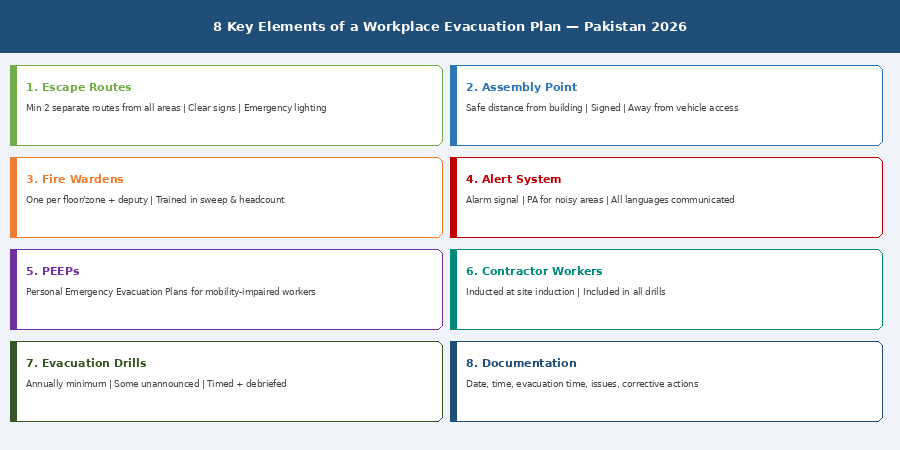
8 Essential Elements of an Emergency Evacuation Plan in Pakistan
1. Conduct a Workplace Emergency Risk Assessment
Start by identifying emergencies that could affect workers, visitors, contractors and nearby premises.
Common hazards include:
- Electrical faults and workplace fires.
- Gas leaks and explosions.
- Chemical spills or hazardous releases.
- Structural damage or building collapse.
- Flooding and severe weather.
- Security threats requiring evacuation or sheltering.
The appropriate response depends on the hazard. For example, a chemical release may require evacuation away from the affected area, while an external security threat may make sheltering safer than leaving the building.
Assess the location of hazardous materials, ignition sources, high-occupancy areas, vulnerable workers and potential escape-route obstructions. Record the findings and review the assessment whenever workplace conditions change.
For practical guidance, read our Electrical Safety at Work in Pakistan guide.
2. Keep Emergency Escape Routes Clear
Workers must be able to reach a safe location without unnecessary delay.
A workplace evacuation plan should identify primary and alternative escape routes from occupied areas. Routes must remain accessible during every shift, including night operations and periods of maintenance.
Safety officers should check that:
- Escape corridors and stairways remain free from stored materials.
- Emergency exits are not locked against escape while the premises are occupied.
- Exit signs are visible and understandable to the workforce.
- Emergency lighting is suitable for the building and its risks.
- Doors, stairways and passages remain usable.
- Workers know what to do if their usual route becomes unsafe.
Do not assume that every workplace has the same legally permitted travel distance or minimum number of exits. Requirements depend on the applicable building, fire and occupational safety rules, building characteristics and risk assessment.
In Pakistan, the Factories Act, 1934 includes provisions concerning fire escape arrangements in factories. Employers should verify the applicable provincial legislation and current building and fire safety requirements.
3. Establish a Safe Assembly Point
An assembly point is a designated location where evacuees gather after leaving the danger area. It allows the organisation to conduct headcounts and communicate with emergency responders.
Choose a location that is:
- Away from fire, smoke, hazardous releases and potential structural collapse.
- Large enough for the expected number of occupants.
- Accessible using the planned escape routes.
- Clear of emergency vehicle access and operational hazards.
- Identified through suitable signs and worker briefings.
The correct distance from a building depends on its hazards, size and emergency scenario. Do not apply a single distance to every workplace.
For large construction projects in Bahria Town, industrial estates in Lahore or manufacturing facilities in Karachi, establish clear assembly arrangements for employees, subcontractors, visitors and delivery personnel.
Keep attendance records current so supervisors can compare the headcount with the people expected to be on site.
4. Assign Fire Wardens and Emergency Responsibilities
An evacuation plan must identify who will coordinate the response and what each person should do.
Typical responsibilities include:
- Safety officer or incident coordinator: Activates or coordinates the emergency procedure, communicates with management and emergency services, and monitors the overall response where safe to do so.
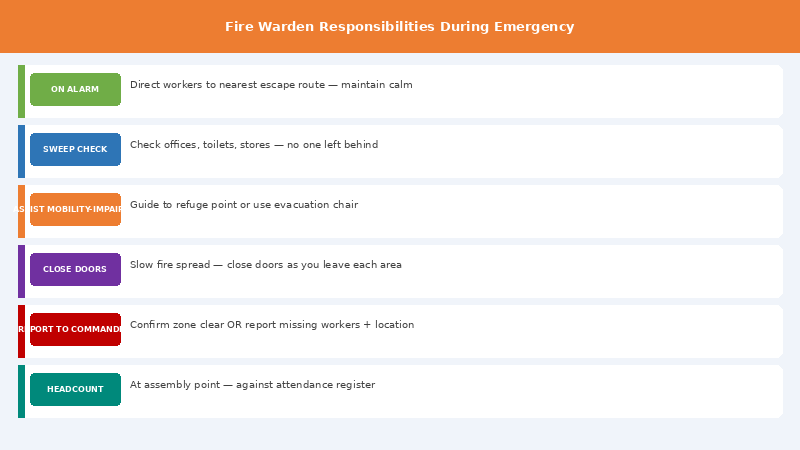
- Fire wardens: Direct people towards safe exits, check designated areas only when safe, report hazards and provide updates to the coordinator.
- First aiders: Provide appropriate first aid in a safe location and assist with casualty arrangements.
- Supervisors: Account for their teams and report missing persons or other concerns.
- All workers: Stop work, follow the alarm instructions, use a safe escape route and report to the designated assembly point.
Assign deputies to cover absences and different shifts. The number of wardens should reflect the site’s size, layout, occupancy, risk and evacuation arrangements rather than an assumed universal ratio.
Fire wardens must never enter smoke-filled rooms, fight an unsafe fire or delay their own escape to complete a building search.
5. Plan for Workers Who Need Evacuation Assistance
A safe emergency evacuation plan must account for people who cannot use standard escape routes independently.
This may include wheelchair users, people with visual or hearing impairments, injured workers, pregnant employees with relevant mobility needs and temporary visitors requiring assistance.
A Personal Emergency Evacuation Plan (PEEP), where appropriate, should identify:
- The person’s evacuation requirements.
- Suitable routes and available evacuation equipment.
- Trained people responsible for providing assistance.
- Alternative arrangements if the primary route becomes unavailable.
- Communication methods and procedures for notifying emergency responders.
Do not rely on an informal promise that a colleague will help. Agree on the arrangements, train the relevant personnel and test the procedure safely.
In multilingual workplaces across Pakistan, communicate emergency instructions in languages workers understand, including Urdu, Punjabi, Sindhi or Pashto where appropriate. Use visual signs and practical demonstrations to reinforce written instructions.
6. Provide Effective Emergency Warnings
An alarm is useful only when people recognise it and understand the required response.
Select warning arrangements that suit the workplace, its noise levels, layout and emergency hazards. These may include audible alarms, visual warning devices, public-address systems or other suitable communication methods.
Test the warning system according to the manufacturer’s guidance, maintenance schedule and applicable requirements.
The emergency procedure should explain:
- How a worker reports an emergency.
- Who activates the alarm.
- How workers recognise the evacuation signal.
- How visitors and contractors receive instructions.
- How the organisation communicates if the normal alarm system fails.
In a noisy factory in Faisalabad, an audible alarm alone may not reach every worker. Additional visual signals or other warning arrangements may be necessary following an assessment.
7. Conduct and Record Evacuation Drills
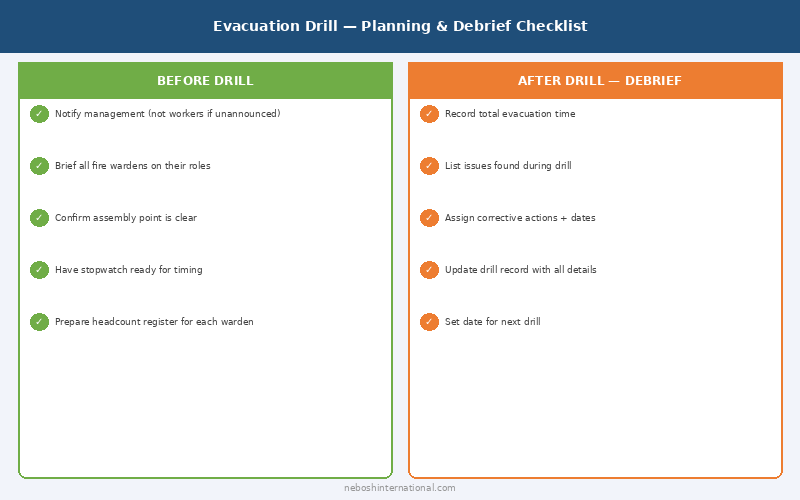
An evacuation drill tests whether workers can follow the plan under realistic conditions. It can reveal blocked routes, confusing instructions, inadequate alarms and difficulties with headcounts.
A useful drill programme should include:
- A documented scenario based on workplace hazards.
- Participation from relevant shifts and departments.
- Safe testing of evacuation routes and assembly arrangements.
- Measurement of evacuation and accountability performance.
- A debrief to collect feedback from workers and wardens.
- Corrective actions with assigned responsibilities and deadlines.
Set the drill frequency according to applicable requirements, the risk assessment, client standards and the workplace’s emergency arrangements. High-risk or complex facilities may need more frequent exercises.
Do not treat a fast evacuation time as the only measure of success. Workers must also use safe routes, follow instructions, avoid dangerous shortcuts and reach an assembly point where the organisation can account for them.
Record the date, scenario, participants, observations, identified deficiencies and corrective actions. Repeat the exercise when significant problems require further testing.
8. Review the Plan and Improve Emergency Preparedness
An evacuation plan can become outdated when a factory changes its production layout, a construction project adds new floors or a company introduces hazardous materials.
Review the plan after:
- Changes to buildings, equipment or work processes.
- Changes in workforce size or shift patterns.
- An actual emergency or significant near miss.
- An evacuation drill that identifies weaknesses.
- Changes to applicable legislation or client requirements.
Keep the latest procedures accessible to authorised personnel. Update site maps, emergency contact details, assembly-point information and staff responsibilities whenever necessary.
For companies working towards an occupational health and safety management system, the ISO 45001 standard provides a relevant framework for managing occupational health and safety risks and emergency preparedness.
Emergency Evacuation Planning for Pakistani Industries
Different workplaces require different emergency arrangements.
| Workplace | Important evacuation considerations |
|---|---|
| Textile factories in Faisalabad | Fabric storage, machinery, fire spread and noisy production areas |
| Industrial facilities in Karachi | Hazardous materials, electrical equipment, contractors and shared access routes |
| Construction sites in Lahore and Rawalpindi | Changing layouts, temporary stairways, multiple subcontractors and work at height |
| Oil and gas facilities | Gas detection, hazardous zones, process shutdown arrangements and site-specific emergency procedures |
| Offices in Islamabad | Occupant awareness, stairway access, visitor management and coordination with building management |
| Warehouses and distribution centres | High storage racks, forklift routes, loading areas and blocked exits |
These examples are starting points for risk assessment, not substitutes for a site-specific emergency plan.
Emergency Evacuation Plan and NEBOSH IGC
Emergency preparedness is a useful practical topic for NEBOSH International General Certificate candidates and working HSE professionals.
Candidates should be able to explain why an evacuation procedure is necessary, identify weaknesses in a workplace scenario and recommend controls that address the hazards described.
For example, if a scenario identifies blocked exits, workers unfamiliar with alarms and no assembly-point headcount, a strong answer should recommend maintaining escape routes, training workers, testing warning systems and introducing an effective accountability procedure.
Avoid writing generic recommendations that ignore the scenario. Explain how each proposed control reduces risk.
Read our NEBOSH IGC exam format guide and NEBOSH IGC for Engineers in Pakistan for related learning resources.
For professionals targeting HSE roles in Saudi Arabia, the UAE, Qatar and other Gulf markets, practical emergency planning knowledge can support career development. It does not guarantee employment or replace the experience and training required for a particular position. Explore our HSE Officer Salary Guide for Gulf Countries.
Frequently Asked Questions
It is a documented workplace procedure that explains how people receive warnings, leave an unsafe area, reach a safe location and are accounted for during an emergency.
The applicable legal obligations depend on the relevant federal or provincial legislation, building requirements and workplace circumstances. The Factories Act, 1934, includes fire escape provisions for factories. Employers should confirm the current rules applicable to their location and industry.
The appropriate frequency depends on applicable legal requirements, workplace risks, building arrangements and client standards. High-risk sites may require more frequent exercises than small, low-risk offices.
Management is responsible for establishing suitable arrangements and providing resources. Safety officers, wardens, supervisors, first aiders and workers carry out their assigned duties under the site procedure.
It should address foreseeable emergencies, alarm activation, escape routes, assembly points, assigned responsibilities, assistance for people with additional needs, emergency contacts, training, drills and review arrangements.
Yes. Candidates can apply emergency preparedness principles to relevant scenarios by identifying hazards, explaining the need for safe escape arrangements and recommending practical controls supported by the information provided.
Conclusion
An effective emergency evacuation plan in Pakistan protects people by turning emergency arrangements into clear, practised actions. It should identify workplace hazards, maintain safe escape routes, establish assembly points, assign responsibilities, accommodate workers who need assistance and test the procedures through suitable drills.
For safety officers in Karachi, Lahore, Faisalabad, Rawalpindi, Islamabad and other industrial centres, the priority is to ensure that every worker understands how to respond before an emergency occurs.
Review the plan whenever workplace conditions change, investigate weaknesses revealed during drills and verify that legal and site-specific requirements are met.
Build practical HSE knowledge with NEBOSH International. Explore our NEBOSH IGC resources to strengthen your understanding of workplace risk management and emergency preparedness.

NEBOSH International General Certificate (IGC) certified HSE professional focused on occupational health and safety, workplace risk assessment, hazard identification, and safety management systems. The content published on NeboshInternational.com is based on current industry guidance, recognized safety best practices, and practical workplace examples to help professionals in Pakistan and the Gulf prepare for NEBOSH qualifications and build successful HSE careers.