Behaviour-Based Safety in Pakistan 2026: A Practical Guide for HSE Professionals
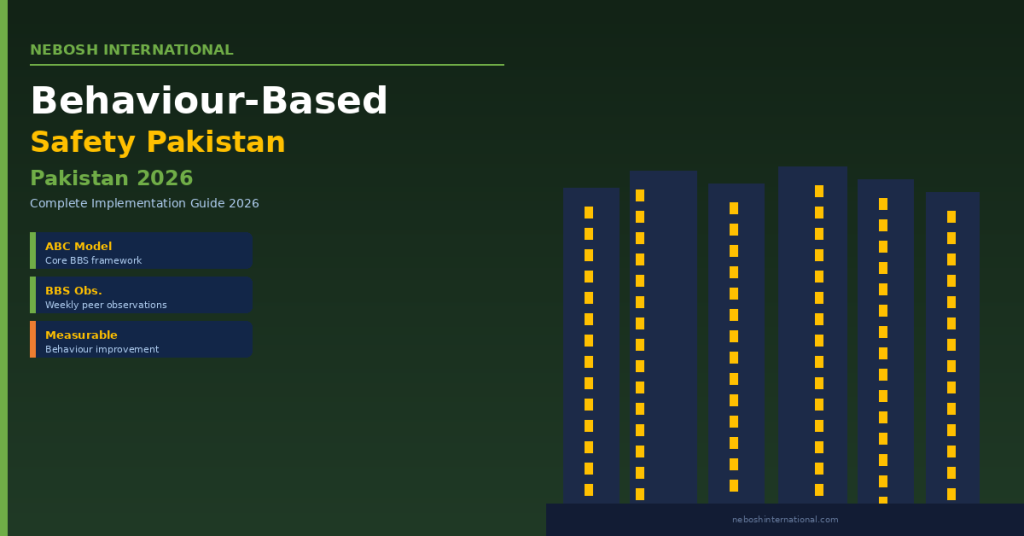
Behaviour-based safety in Pakistan helps organisations reduce workplace risks by identifying unsafe actions, understanding why they occur, and encouraging safer working practices. In construction, manufacturing, textiles, and oil and gas, a successful Behaviour-Based Safety (BBS) programme combines worker observations, positive feedback, effective supervision, and improvements to workplace conditions.
For safety officers in Lahore, Karachi, Faisalabad, Rawalpindi, and other industrial areas, BBS provides a practical way to strengthen everyday safety performance. However, it is not simply about watching workers or blaming them for mistakes. Effective behavioural safety also examines equipment, workload, training, management decisions, and the availability of suitable protective measures.
This guide explains the meaning of BBS, the ABC model, critical safety behaviours, observation methods, and six practical steps for implementing a behavioural safety programme in Pakistani workplaces in 2026.
What Is Behaviour-Based Safety?
Behaviour-Based Safety is a systematic approach to improving workplace safety by observing specific actions, providing constructive feedback, and identifying factors that influence how people work.
For example, a worker may remove hearing protection because it feels uncomfortable in a hot production area. Another employee may begin machinery maintenance without proper isolation because production targets are under pressure. Although both situations involve unsafe behaviour, the underlying causes may be different.
A good BBS programme investigates these causes rather than automatically blaming the workers.
Its main objectives include:
- Identifying behaviours that contribute to workplace incidents.
- Encouraging consistent use of personal protective equipment (PPE).
- Improving compliance with safe working procedures.
- Strengthening communication between workers and supervisors.
- Identifying practical barriers to safe work.
- Reinforcing safe practices through timely feedback.
- Using observation data to improve safety management.
Key point: Behaviour-based safety complements risk assessments, engineering controls, training, and workplace inspections. It must never replace these essential safety measures.
Understanding the ABC Model of Behavioural Safety
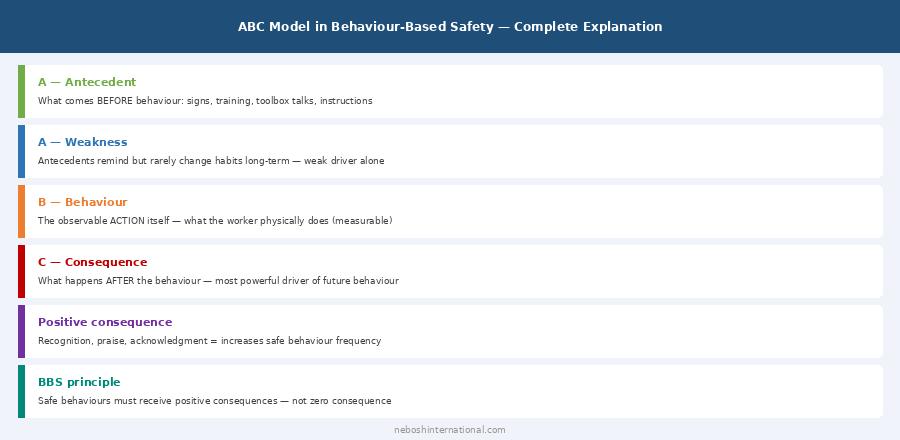
The ABC model explains how events before and after an action can influence behaviour. It provides a useful framework for understanding why workers follow or ignore safety procedures.
A — Antecedent
An antecedent is something that occurs before a behaviour and may influence it. Examples include safety signs, toolbox talks, supervisor instructions, written procedures, and reminders.
Consider a construction project in Lahore where workers receive instructions to use fall protection before working at height. The instruction establishes an expectation, but it may not be enough if suitable equipment is unavailable or the supervisor encourages workers to finish quickly.
Therefore, employers must ensure that instructions are supported by suitable equipment, realistic work schedules, and effective supervision.
B — Behaviour
Behaviour is the observable action performed by a worker.
Examples include:
- Wearing the required eye protection.
- Isolating electrical or mechanical energy before maintenance.
- Checking a ladder before climbing.
- Following a permit-to-work procedure.
- Testing the atmosphere before entering a confined space.
- Using suitable respiratory protection during hazardous work.
These actions can be observed and evaluated against clear workplace requirements.
C — Consequence
A consequence is what happens after a behaviour. Positive recognition, constructive feedback, or a timely correction can influence future actions.
For example, a supervisor who recognises a worker for correctly isolating machinery reinforces the importance of that safety practice. However, recognition must never reward shortcuts, discourage incident reporting, or replace the correction of dangerous conditions.
The ABC model helps HSE teams understand behaviour in context. It does not mean every incident results from an individual’s decision; workplace design, organisational culture, and management systems also matter.
Why Behaviour-Based Safety Matters in Pakistan
Pakistani workplaces face different safety challenges depending on their industries, equipment, working conditions, and organisational resources.
Construction companies may need to address falls from height, unsafe scaffolding, lifting operations, and electrical hazards. Textile and manufacturing facilities may focus on machine guarding, noise exposure, chemical handling, and equipment isolation. Oil and gas operations often require close attention to permit-to-work systems, confined spaces, hazardous energy, and atmospheric testing.
Behaviour-based safety in Pakistan can help employers understand whether workers can realistically follow the required precautions.
For instance, repeated non-use of PPE may indicate poor equipment selection, discomfort during hot weather, inadequate replacement supplies, or weak supervision. Similarly, repeated bypassing of a machine guard may reveal a maintenance problem or an unsafe production target.
In these situations, repeating the same toolbox talk is unlikely to solve the underlying problem. Management must identify and remove the barriers that make safe work difficult.
Identifying Critical Behaviours for Workplace Safety
A BBS programme should begin with a small number of clearly defined behaviours linked to significant workplace hazards. Organisations can select priorities using risk assessments, incident investigations, near-miss reports, and worker feedback.
Common examples include:
- Wearing the required hearing protection in designated noise zones.
- Using suitable fall protection when required by the risk assessment and safe system of work.
- Isolating hazardous energy before maintenance.
- Wearing appropriate respiratory protection during exposure to airborne hazards.
- Following confined-space entry requirements, including atmospheric testing where necessary.
- Maintaining safe ladder positioning and three points of contact when appropriate.
- Using machine guards as designed.
- Following permit-to-work and electrical isolation procedures.
- Keeping emergency exits and access routes unobstructed.
- Using suitable lifting techniques and mechanical aids where required.
The checklist should reflect actual site conditions. A textile factory in Faisalabad will not necessarily need the same observation priorities as a construction project in Karachi or an oil and gas facility near an industrial zone.
Avoid vague checklist items such as “work safely.” Instead, define observable actions and the conditions under which they are required.
How to Conduct a Behaviour-Based Safety Observation
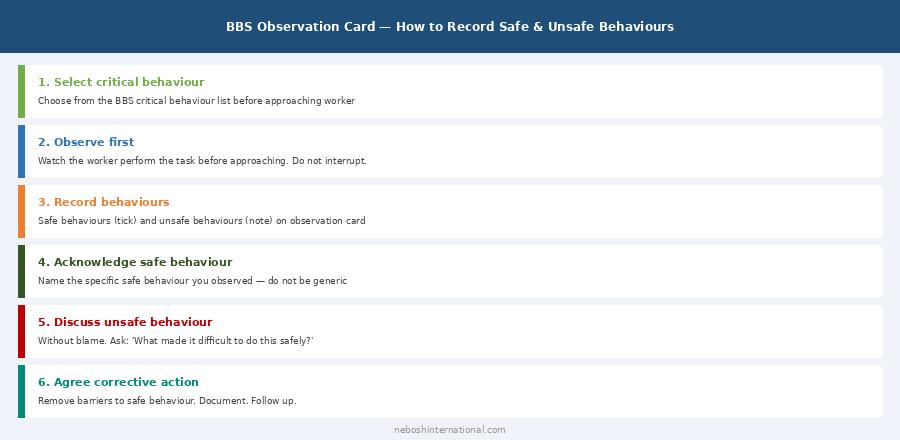
A behavioural safety observation is a structured review of work practices. It should help identify good practices, unsafe conditions, and opportunities to improve the work process.
Follow these eight steps
1. Select the task. Choose a work activity associated with a significant hazard and an established safe procedure.
2. Observe the work. Watch the task without distracting the worker or entering a hazardous area. Follow site rules and respect the worker’s privacy.
3. Record observable actions. Use a simple observation card to distinguish safe behaviours, unsafe behaviours, and relevant workplace conditions.
4. Start a respectful conversation. Explain the purpose of the observation and avoid an accusatory approach.
5. Recognise safe practices. Identify specific actions that the worker performed correctly, rather than giving vague praise.
6. Explore barriers. Ask questions such as, “Was any equipment or instruction missing that made this task difficult to complete safely?”
7. Agree on corrective action. Address equipment defects, unsuitable procedures, inadequate training, or other problems identified during the discussion.
8. Review and record findings. Record relevant observations, assign corrective actions, and check whether those actions have been completed.
An observation must never delay emergency intervention. If a person faces immediate danger, stop or control the hazardous activity in accordance with site procedures.
Six Steps to Implement BBS in Pakistani Workplaces
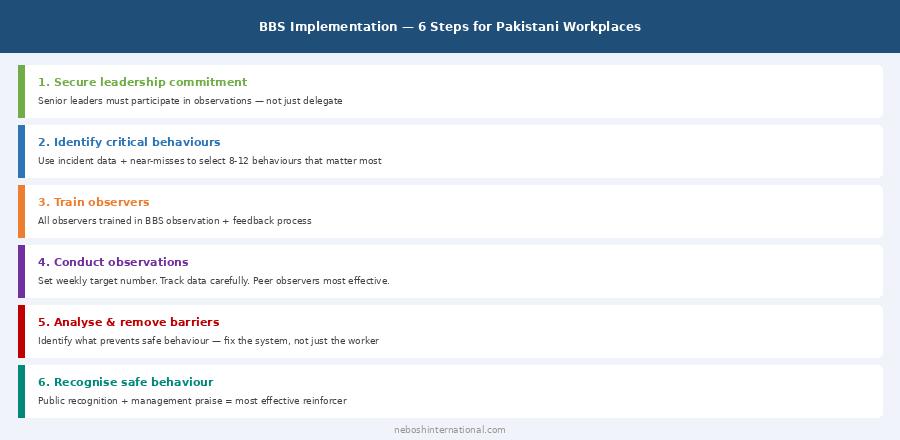
1. Obtain management commitment
Senior management must provide the time, resources, and authority needed to improve safety. Leaders should demonstrate that production targets never justify bypassing essential safety controls.
2. Select priority behaviours
Review risk assessments, incident trends, near misses, and feedback from workers. Begin with a manageable list of critical behaviours rather than trying to measure everything at once.
3. Train observers
Train supervisors, safety officers, and selected workers to observe tasks objectively, communicate respectfully, recognise hazards, and recommend practical improvements.
Peer observations can encourage participation, but workers must understand that the programme is not an excuse for surveillance, humiliation, or punishment for reporting problems.
4. Establish a consistent observation schedule
Set a realistic schedule for observations across shifts, work areas, and relevant tasks. Consistency matters more than collecting large numbers of observations without meaningful follow-up.
5. Analyse findings and remove barriers
Look for recurring patterns. If several workers repeatedly struggle with the same procedure, investigate the equipment, work design, workload, supervision, and training.
For example, repeated PPE non-compliance may require better-fitting equipment or improved ventilation, not simply another warning.
6. Review progress and reinforce safe work
Recognise constructive participation and track corrective actions to completion. Review whether the changes have improved working conditions and reduced exposure to hazards.
Use results to improve the programme rather than treating a high safe-behaviour percentage as proof that the workplace is completely safe.
Measuring BBS Performance: Which Indicators Should You Track?
A useful behavioural safety programme measures both participation and actual safety improvements.
| Indicator | What it helps assess |
|---|---|
| Observation participation | Whether workers and supervisors are engaging with the programme |
| Safe and unsafe behaviour trends | Which work practices need attention |
| Corrective-action closure | Whether identified problems are being resolved |
| Repeated observations | Whether improvements are sustained |
| Near-miss reporting | Whether workers are identifying potential hazards |
| Incident and injury trends | Whether overall safety performance is improving |
Avoid relying on one percentage or a fixed target as the only measure of success. Increased reporting can indicate improved trust and awareness rather than worsening safety. Similarly, fewer reported incidents do not automatically prove that risk has decreased.
BBS data should support risk management and learning, not create pressure to hide incidents or manipulate observation results.
Frequently Asked Questions
Behaviour-based safety in Pakistan is an approach to improving workplace safety through systematic observation, constructive feedback, and the identification of factors influencing workers’ actions. It supports safer practices across construction, manufacturing, textiles, and other industries.
No. BBS complements inspections, risk assessments, engineering controls, safe systems of work, and incident investigations. It cannot replace essential hazard controls or legal responsibilities.
Trained workers, supervisors, and HSE professionals can conduct observations. A combination of peer participation and management involvement can improve engagement, provided observations remain respectful and focused on learning.
Yes. Small organisations can start with a simple observation checklist, regular safety discussions, and a documented corrective-action process. Expensive software is not essential.
The timeline depends on management commitment, workforce participation, the quality of observations, and how quickly problems are resolved. Review trends over time rather than promising a specific improvement within a fixed number of months.
BBS knowledge can support an HSE professional’s understanding of worker engagement and safety management. However, Gulf employers also consider qualifications, relevant experience, technical competence, communication skills, and job-specific requirements.
Conclusion
Behaviour-based safety is most effective when organisations use observations to understand work, encourage safe practices, and correct the conditions that contribute to risk. It is not simply a method of identifying unsafe acts or blaming employees.
For safety officers in Lahore, Karachi, Faisalabad, Rawalpindi, and other industrial centres, a practical BBS programme can strengthen workplace communication and support more effective risk management. The most important principle is straightforward: observe objectively, listen to workers, correct underlying problems, and verify that improvements last.
For Pakistani HSE professionals developing their careers, behavioural safety is a useful skill to combine with formal safety knowledge and practical workplace experience. Learn to influence safer work while ensuring that engineering controls, suitable equipment, effective procedures, and management accountability remain at the centre of every safety programme.
Explore NEBOSH course information and HSE career guidance at NEBOSH International.

NEBOSH International General Certificate (IGC) certified HSE professional focused on occupational health and safety, workplace risk assessment, hazard identification, and safety management systems. The content published on NeboshInternational.com is based on current industry guidance, recognized safety best practices, and practical workplace examples to help professionals in Pakistan and the Gulf prepare for NEBOSH qualifications and build successful HSE careers.