How to Become a Safety Officer in Pakistan in 2026: Complete NEBOSH Career Roadmap
If you are a site engineer, diploma holder, graduate, supervisor or working professional in Pakistan and want to move into health and safety, becoming a Safety Officer can provide a practical route into construction, manufacturing, oil and gas, infrastructure and other HSE careers.
For example, a site engineer working on a construction project in Rawalpindi may already understand drawings, contractors and site operations but need formal health and safety knowledge to move into an HSE position. Similarly, professionals in Lahore, Karachi, Faisalabad, Islamabad and Peshawar may already have industry experience but need a recognised safety qualification to compete for better opportunities.
So, how do you become a Safety Officer in Pakistan in 2026?
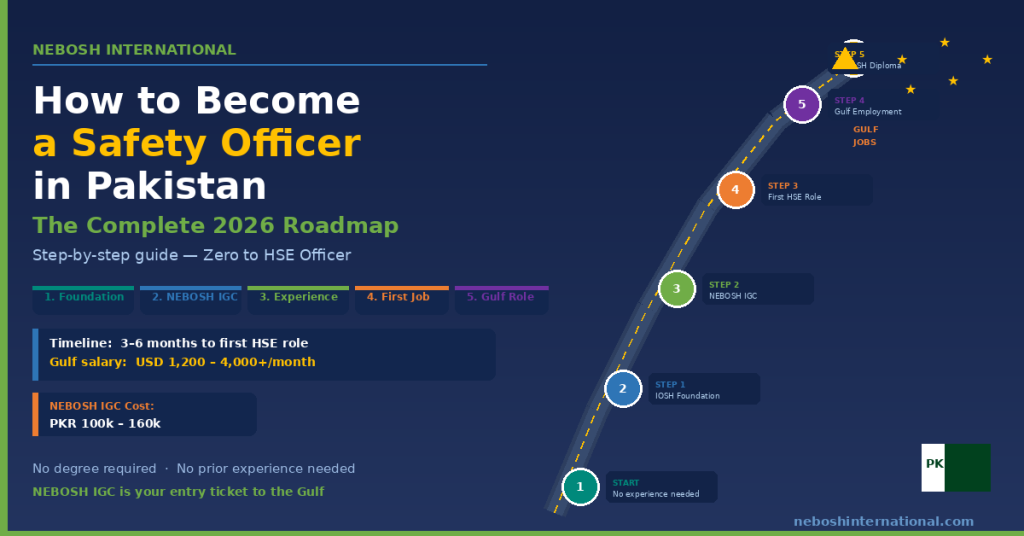
The practical route is to build safety knowledge, complete a recognised qualification such as the NEBOSH International General Certificate (IGC), gain workplace experience, develop practical HSE skills and then target Safety Officer or HSE Officer vacancies in Pakistan or the Gulf.
What Does a Safety Officer Do?
A Safety Officer helps an organisation identify workplace hazards, control risks and improve health and safety performance.
Typical responsibilities include:
- Conducting workplace inspections
- Identifying hazards and assessing risks
- Preparing risk assessments and method statements
- Monitoring personal protective equipment (PPE)
- Supporting permit-to-work systems
- Investigating incidents and near misses
- Conducting toolbox talks and safety briefings
- Monitoring emergency arrangements
- Checking contractor safety compliance
- Maintaining inspection and incident records
- Supporting internal audits and corrective actions
- Communicating safety requirements to workers and supervisors
The exact duties depend on the industry.
A construction Safety Officer may monitor excavation, scaffolding, lifting, electrical work and work at height. A manufacturing HSE Officer may focus more on machinery, chemicals, fire safety and occupational health. In oil and gas, permit-to-work, confined spaces, energy isolation and process safety can become much more important.
This is why practical knowledge matters just as much as collecting certificates.
What Qualification Do You Need to Become a Safety Officer in Pakistan?
1. NEBOSH IGC
For professionals targeting an HSE career in Pakistan or the Gulf, the NEBOSH International General Certificate is one of the most useful qualifications to consider.
NEBOSH states that learners must register with an accredited Learning Partner and complete the relevant learning before assessment; self-study alone is not the route to gaining a NEBOSH qualification.
You can learn more about the qualification and compare your options through our guide to NEBOSH courses in Pakistan.
Important: NEBOSH is an awarding organisation, while NEBOSH International is an independent information and referral platform. Always verify a Learning Partner through the official NEBOSH channels before registering.
2. IOSH Managing Safely
IOSH Managing Safely can be useful if you are completely new to workplace safety. It provides an introductory understanding of safety responsibilities and can help beginners become familiar with HSE terminology.
However, it should be viewed as an introductory management-safety course rather than a replacement for a professional qualification such as NEBOSH IGC.
IOSH’s current course calendar shows Managing Safely training available through approved providers, including providers in Pakistan.
3. OSHA 30-Hour
OSHA 30-Hour training can be useful for professionals working on projects where OSHA-based requirements or US-linked contractors are relevant.
However, there is an important distinction: OSHA explains that its Outreach 10- and 30-hour courses provide safety training and completion cards, but the card is not an OSHA certification or licence.
Therefore, Pakistani candidates should not assume that an OSHA 30-Hour card automatically replaces NEBOSH IGC for Gulf HSE positions.
Do You Need a University Degree?
Not necessarily.
A university degree can strengthen your CV, particularly for technical, engineering or management positions. However, employers may also consider candidates with diplomas, technical qualifications, industry experience and recognised HSE training.
For someone specifically targeting Safety Officer jobs, the combination of:
Education + NEBOSH IGC + practical safety skills + workplace experience
is generally more useful than relying on a degree alone.
5-Step Safety Officer Career Roadmap in Pakistan
Step 1: Learn the Basics of Occupational Safety
Start by understanding fundamental concepts such as:
- Hazard identification
- Risk assessment
- Hierarchy of controls
- PPE
- Fire safety
- Emergency procedures
- Manual handling
- Work at height
- Electrical safety
- Excavation safety
- Confined-space safety
- Incident investigation
If you already work on a construction or industrial site, begin observing these issues in your workplace.
Step 2: Complete NEBOSH IGC Through an Accredited Learning Partner
For many Pakistani candidates, NEBOSH IGC is the major qualification milestone.
Before enrolling, compare:
- Learning Partner status
- Course delivery method
- Total tuition cost
- Assessment fees
- Tutor support
- Study materials
- Past learner support
- Classroom or online format
- Assessment preparation
Do not select a provider simply because it advertises the cheapest NEBOSH course.
Use the official NEBOSH Learning Partner guidance to understand how to select a recognised provider.
You can also read our NEBOSH IGC exam preparation guide before starting your assessment preparation.
Step 3: Build Practical HSE Experience
This is where many new candidates struggle.
A certificate demonstrates knowledge, but employers also want evidence that you can apply safety principles in a real workplace.
If you already have a job, ask whether you can assist with:
- Safety inspections
- Risk assessments
- Toolbox talks
- PPE monitoring
- Incident reporting
- Emergency drills
- Contractor safety
- Safety documentation
Your NEBOSH practical work can also help demonstrate your ability to identify hazards and recommend controls.
For fresh candidates, consider internships, trainee HSE positions, site-based roles and junior Safety Officer vacancies.
Step 4: Build a Safety Officer CV and Portfolio
Do not make your CV a list of certificates only.
Show what you can actually do.
A strong entry-level HSE CV can include:
Qualifications
- NEBOSH IGC
- IOSH training, if relevant
- Other industry-specific training
Practical skills
- Risk assessment
- Workplace inspection
- Incident reporting
- Toolbox talks
- PPE monitoring
- Permit-to-work awareness
- Emergency response
Experience
- Construction
- Manufacturing
- Oil and gas
- Engineering
- Infrastructure
- Facilities management
You can also create a small portfolio containing sample risk assessments, inspection checklists, toolbox-talk topics and safety observations.
Step 5: Apply for Pakistan and Gulf HSE Jobs
Once you have the basic qualification and practical skills, start applying consistently.
For Pakistan, search for:
- Safety Officer
- HSE Officer
- HSE Executive
- Safety Supervisor
- Junior HSE Officer
- EHS Officer
- Site Safety Officer
For Gulf markets, search using terms such as:
- HSE Officer Saudi Arabia
- Safety Officer UAE
- HSE Supervisor Qatar
- Safety Officer Oman
- HSE Officer Kuwait
Do not apply only for jobs labelled “Safety Officer.” Different employers use different titles for similar responsibilities.
Safety Officer Career Path in Pakistan
A typical progression can look like this:
| Career stage | Possible role | Main focus |
|---|---|---|
| Beginner | HSE Trainee / Junior Safety Officer | Basic site safety |
| Entry level | Safety Officer / HSE Officer | Inspections, risk control and reporting |
| Intermediate | Senior Safety Officer / HSE Supervisor | Team and contractor supervision |
| Experienced | HSE Manager | HSE systems, audits and leadership |
| Senior | HSE Consultant / Head of HSE | Strategy, compliance and management |
Your progression will depend on your education, industry, experience, location, employer and additional qualifications.

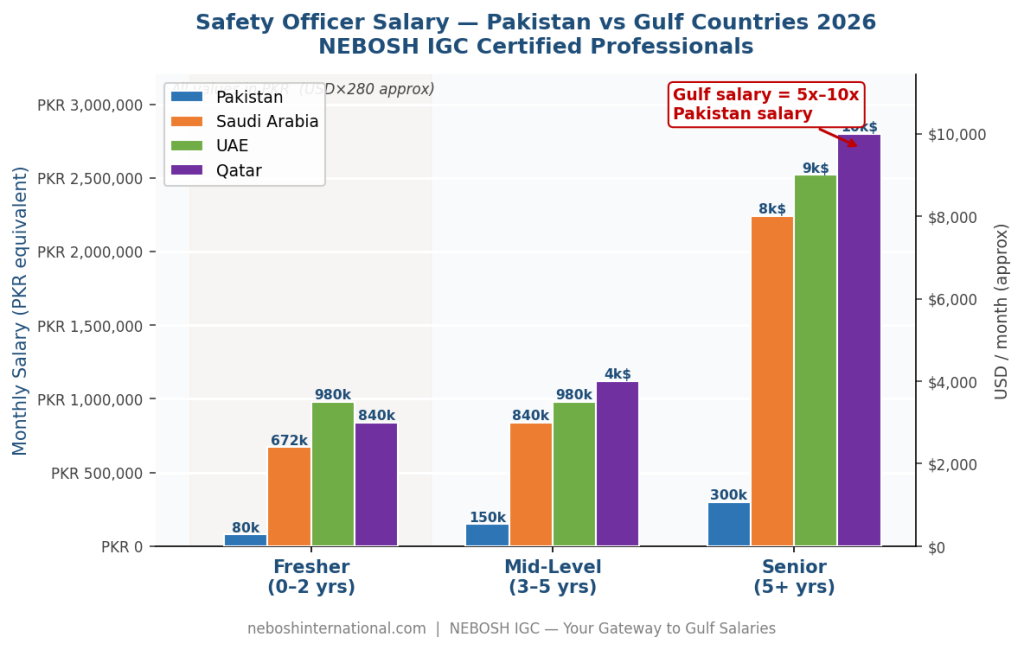
Safety Officer Salary in Pakistan in 2026
There is no single national salary because pay varies considerably by industry and experience.
As a practical market-oriented guide, candidates may encounter ranges such as:
| Experience | Indicative monthly range |
|---|---|
| Fresher / trainee | PKR 40,000–80,000 |
| 2–5 years | PKR 80,000–150,000 |
| Experienced HSE professional | PKR 150,000–300,000+ |
These figures should be treated as indicative ranges rather than guaranteed salaries. Large construction projects, multinational companies, oil and gas employers and specialised industrial roles may pay differently.
For a broader career comparison, see our guide to HSE Officer salaries in Gulf countries after NEBOSH IGC.
Where Can Safety Officers Work in Pakistan?
The career is not limited to construction.
Construction
Construction companies require Safety Officers for activities involving:
- Work at height
- Scaffolding
- Excavation
- Lifting operations
- Electrical work
- Heavy equipment
- Traffic management
This creates opportunities on projects in Rawalpindi, Islamabad, Lahore, Karachi and other major cities.
Manufacturing
Factories in Faisalabad, Lahore, Karachi, Sialkot and other industrial areas may recruit HSE professionals to manage machinery, fire safety, chemicals, PPE and workplace inspections.
Oil and Gas
Oil and gas can provide more specialised HSE opportunities. Candidates may encounter requirements involving permit-to-work, confined spaces, energy isolation, process safety and contractor management.
Infrastructure and Energy
Large infrastructure, power, utilities and development projects can also create demand for safety professionals.
Safety Officer Jobs in the Gulf for Pakistani Candidates
The Gulf remains an important career destination for Pakistani HSE professionals.
Common target markets include:
- Saudi Arabia
- United Arab Emirates
- Qatar
- Oman
- Kuwait
However, candidates should avoid treating NEBOSH IGC as an automatic job guarantee.
Employers can have different requirements for experience, industry knowledge, client approvals, local regulations, driving licences, medical fitness and additional training.
For this reason, read each vacancy carefully before applying.
If your long-term goal is Saudi Arabia, UAE, Qatar or another Gulf market, start building relevant experience in Pakistan rather than waiting until the day you receive your certificate.
Common Mistakes New Safety Officers Make
Choosing a Training Provider Without Checking Accreditation
Always verify the Learning Partner rather than relying only on advertisements.
Collecting Certificates Without Practical Skills
Five certificates do not automatically make someone an effective Safety Officer.
Learn how to inspect a workplace, identify hazards, assess risk and recommend realistic controls.
Ignoring Communication Skills
A Safety Officer must communicate with workers, supervisors, engineers, contractors and management.
Therefore, improve your English writing, report writing, presentation and toolbox-talk skills.
Applying Only for “Safety Officer” Jobs
Also search for HSE Officer, EHS Officer, Safety Supervisor, HSE Executive and Junior HSE roles.
Waiting for the Perfect Job
Your first role may not have the highest salary or the ideal company name.
The objective during the early stage is to build relevant experience and measurable responsibility.
Frequently Asked Questions
Yes. NEBOSH IGC can strengthen your qualifications for entry-level HSE positions, but employment is not guaranteed. Practical experience, communication skills and industry knowledge can significantly affect your job prospects.
Yes. Fresh graduates can target trainee, junior and entry-level HSE roles. Adding practical safety training and NEBOSH IGC can make the profile more relevant to employers.
They serve different purposes. IOSH Managing Safely is useful as an introductory course, while NEBOSH IGC is a more substantial professional qualification for people developing an occupational health and safety career.
Yes. A specific engineering degree is not the only route into HSE. Employers may consider candidates from different educational backgrounds, especially when they have recognised safety qualifications and relevant experience.
No. OSHA’s Outreach 30-Hour program provides hazard-awareness training and a course completion card; OSHA explicitly states that the card is not a certification or licence.
There is no fixed timeline. A motivated beginner can complete initial training within months, but becoming a competitive HSE professional requires continued practical experience and skill development.
Conclusion:
If you are starting from zero, keep the roadmap simple:
Learn safety basics → Choose an accredited NEBOSH Learning Partner → Complete NEBOSH IGC → Build practical experience → Create an HSE-focused CV → Apply for entry-level jobs → Develop specialist skills → Progress toward senior HSE roles.
For professionals in Rawalpindi, Islamabad, Lahore, Karachi, Faisalabad, Peshawar and other Pakistani cities, the strongest strategy is not simply to collect certificates. Instead, combine recognised qualifications with practical workplace knowledge and measurable experience.
If your long-term objective is a Gulf HSE career, start preparing for that market while building your Pakistani experience. Learn the terminology used in Gulf vacancies, understand industry-specific hazards and keep your CV focused on actual safety responsibilities.
You can also explore our NEBOSH FAQs for Pakistan, NEBOSH institute selection guide, and NEBOSH certificate verification guide before choosing your next step.
Important: NEBOSH International is an independent information and referral platform. It is not NEBOSH, does not issue NEBOSH qualifications and does not replace official NEBOSH guidance. Always verify qualification, Learning Partner and assessment information through official NEBOSH sources before making a training decision.

NEBOSH International General Certificate (IGC) certified HSE professional focused on occupational health and safety, workplace risk assessment, hazard identification, and safety management systems. The content published on NeboshInternational.com is based on current industry guidance, recognized safety best practices, and practical workplace examples to help professionals in Pakistan and the Gulf prepare for NEBOSH qualifications and build successful HSE careers.



9 Comments
Comments are closed.