Drug and Alcohol Policy in Pakistani Workplaces: Complete HSE Guide 2026
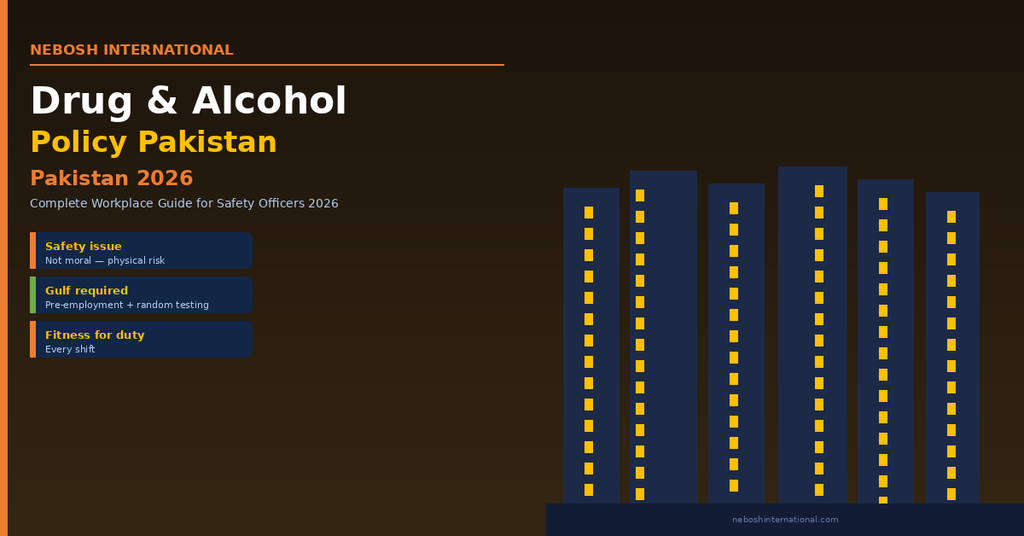
Imagine a construction site in Rawalpindi where a forklift operator arrives for the morning shift with poor coordination and unusual behaviour. The supervisor notices that the worker is struggling to communicate clearly. Although the worker insists that everything is fine, allowing them to operate heavy machinery could put colleagues, contractors and the entire project at risk.
This situation demonstrates why a drug and alcohol policy in Pakistan is an important part of workplace health and safety management. Employers need clear procedures for identifying possible impairment, removing immediate hazards and deciding whether a worker is fit to perform their assigned duties.
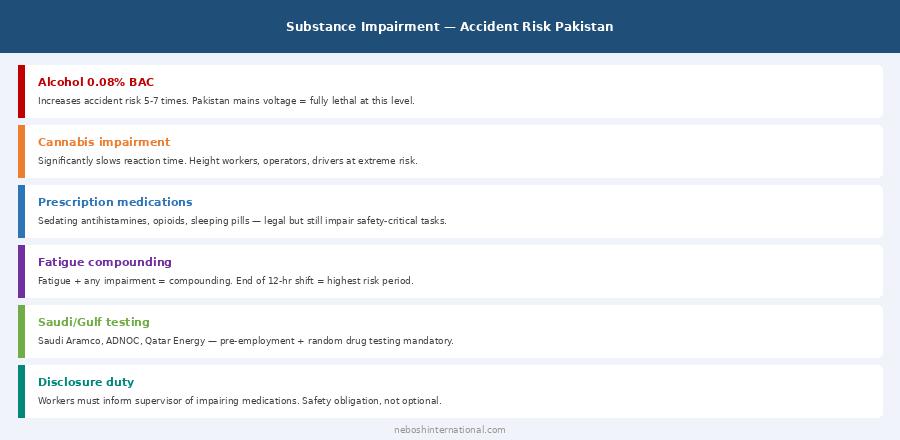
Alcohol, illegal drugs and certain prescription medicines can affect concentration, coordination, reaction time and decision-making. These effects are particularly dangerous in construction, manufacturing, transportation, textiles and oil and gas operations.
In Pakistan, employers should develop policies that reflect applicable laws, contractual requirements, occupational health considerations and the risks associated with their operations. This guide explains the essential elements of a workplace drug and alcohol policy, practical procedures for safety officers and considerations for organisations working with international clients.
What Is a Drug and Alcohol Policy in the Workplace?
A drug and alcohol policy is a written procedure explaining how an organisation prevents, identifies and manages substance-related impairment during work.
Its main purpose is to protect workers, visitors, contractors and the public from risks associated with impaired performance.
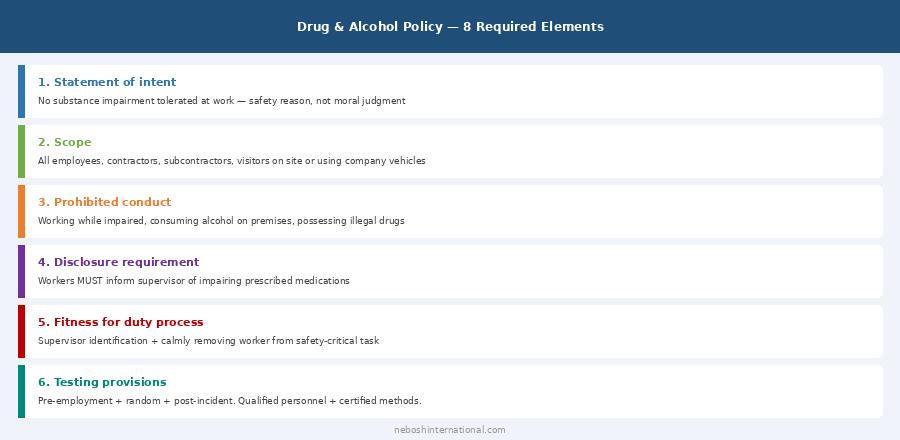
A practical policy should explain:
- Which behaviours and activities are prohibited.
- How supervisors identify possible impairment.
- When a worker must be removed from safety-critical duties.
- Whether and when workplace testing may be conducted.
- How prescribed medication and confidential information are managed.
- What disciplinary and support procedures apply.
- How workers can report concerns without unnecessary confrontation.
A policy should apply consistently to employees, subcontractors and other relevant personnel. Employers should communicate its requirements before workers begin their duties.
Why Is a Drug and Alcohol Policy Important in Pakistan?
Pakistani workplaces include construction projects, factories, warehouses, transport operations and industrial facilities where human error can have serious consequences.
For example, an impaired crane operator in Karachi could endanger workers below a suspended load. A driver transporting materials in Lahore could cause a road collision. Similarly, an impaired worker performing maintenance in a Faisalabad factory could face serious risks around moving machinery.
A well-designed workplace drug and alcohol policy helps organisations address these situations before they develop into accidents.
1. Preventing Workplace Accidents
Substance impairment can reduce awareness, coordination and the ability to respond to unexpected events. These effects can increase risks during lifting operations, vehicle movement, electrical maintenance and work at height.
Employers should therefore identify safety-critical tasks and establish clear fitness-for-duty requirements.
2. Improving Workplace Safety Culture
A consistent policy helps workers understand that safety requirements apply to everyone, regardless of job title or seniority.
Supervisors should explain the reasons behind the rules and encourage workers to report concerns responsibly.
3. Meeting Contractual and Client Requirements
Some international projects require contractors to follow specific fitness-for-work, substance-use or testing procedures. Pakistani companies planning to work on Gulf projects should review the actual contract, site rules and client requirements before developing their policies.
Requirements can differ between clients and projects, so employers should not assume that every contractor must follow an identical testing programme.
4. Protecting Productivity and Employee Wellbeing
Impairment can contribute to mistakes, equipment damage, absenteeism and avoidable interruptions. At the same time, workers who experience substance dependency may need appropriate occupational health support.
Combining clear safety rules with confidential reporting and suitable support can help organisations address risks more effectively.
Key Elements of a Drug and Alcohol Policy in Pakistan
1. Purpose and Scope
Begin by explaining that the policy exists to protect health, safety and operational reliability.
Define who is covered, including permanent employees, temporary workers, contractors and subcontractors where applicable. Specify whether the requirements apply to company vehicles, accommodation, operational sites and other controlled facilities.
For large construction projects in Lahore or industrial facilities in Karachi, consistent communication across contractor teams is particularly important.
2. Prohibited Activities
The policy should clearly explain that workers must not:
- Perform safety-critical tasks while impaired by alcohol or other substances.
- Consume alcohol during prohibited working periods or in restricted workplace areas.
- Possess or use illegal substances where prohibited by applicable law and company rules.
- Operate vehicles or machinery when unfit to do so.
- Ignore reporting requirements when medication could affect safe performance.
Rules should be written in clear language and explained during induction and toolbox talks.
3. Fitness-for-Duty Assessments
Fitness for duty means that a worker can safely perform their assigned tasks under the prevailing conditions.
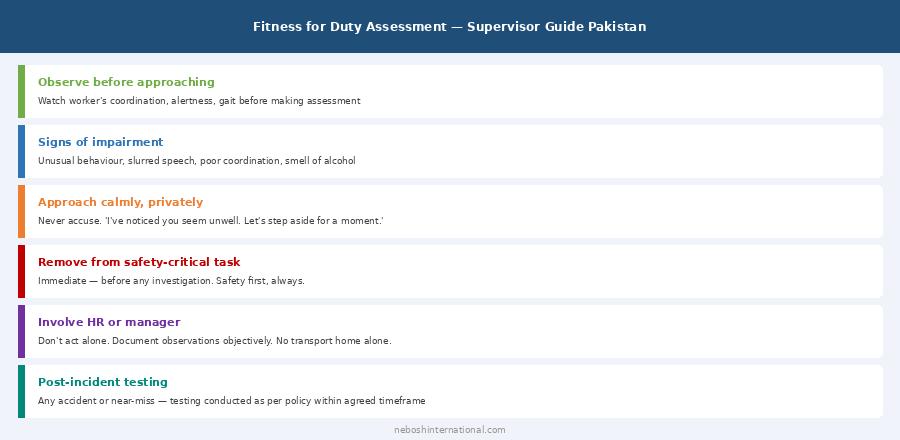
Supervisors may observe changes such as unusual confusion, poor balance, impaired coordination, difficulty following instructions or behaviour that creates a reasonable safety concern. However, these signs do not prove drug or alcohol use. Medical conditions, fatigue, stress and other factors can produce similar symptoms.
When impairment is suspected, the supervisor should:
- Stop the worker from performing the potentially hazardous task.
- Arrange a safe, private conversation where practical.
- Record objective observations rather than making accusations.
- Inform the designated manager, HR representative or occupational health professional.
- Arrange an appropriate assessment under company procedures.
- Prevent unsafe driving or equipment operation while the concern remains unresolved.
The priority is to control the immediate risk while treating the worker fairly.
4. Prescription Medication and Confidentiality
Some prescribed medicines can cause drowsiness, dizziness or reduced alertness. Workers in safety-critical positions should have a clear way to raise concerns about medication-related restrictions.
For example, a forklift operator taking a medicine that causes significant drowsiness may need temporary reassignment after appropriate assessment.
Employers should request only information necessary to assess fitness for work, restrict access to sensitive records and handle disclosures confidentially. Medication use alone should not automatically be treated as misconduct.
5. Workplace Drug and Alcohol Testing
Testing should be considered carefully rather than introduced without a defined purpose.
Depending on applicable law, contractual obligations and the circumstances, an organisation may consider pre-placement, random, reasonable-suspicion or post-incident testing. Each arrangement requires an appropriate legal and procedural review.
A written testing procedure should address:
- The circumstances in which testing may occur.
- The authorisation process and responsible personnel.
- The testing method and competence of the provider.
- Consent and applicable legal requirements.
- Confidential handling and retention of results.
- Confirmation procedures for non-negative screening results.
- A process for reviewing disputed results.
A preliminary screening result should not automatically be treated as conclusive proof of impairment. Employers should use suitable confirmation procedures and provide a fair opportunity to review the result.
Important legal note: Do not assume that workplace drug testing is automatically lawful in every situation in Pakistan, or that a single national rule covers all employers. Before implementing testing, obtain advice on applicable federal or provincial law, employment arrangements, privacy, consent and any relevant industry-specific requirements.
6. Disciplinary Procedures and Employee Support
The policy should explain possible consequences of a substantiated violation. Depending on the circumstances, these may include removal from duty, formal investigation, suspension or disciplinary action under applicable rules and employment procedures.
Decisions should consider the evidence, seriousness of the risk, consistency of treatment and relevant contractual or legal requirements.
Employers should also explain how workers can seek confidential help for substance-related difficulties. Appropriate occupational health referrals or counselling may support recovery and help prevent future incidents.
7. Training, Communication and Documentation
Supervisors need training to recognise potential impairment, stop unsafe work, document observations and follow reporting procedures.
Employers should communicate the policy during induction, refresher training and toolbox talks. They should also maintain appropriate records of training, incidents, assessments and policy reviews while protecting confidential information.
How Can Pakistani Employers Implement the Policy?
A practical implementation plan can follow these steps:
- Identify hazards: Assess tasks involving vehicles, machinery, lifting equipment, work at height and other safety-critical activities.
- Review requirements: Check relevant laws, employment rules, client contracts and site procedures.
- Prepare the policy: Define responsibilities, prohibited conduct, reporting arrangements and response procedures.
- Consult stakeholders: Involve HR, management, occupational health professionals, worker representatives and HSE teams where appropriate.
- Train supervisors: Use realistic scenarios to explain how to manage suspected impairment.
- Communicate expectations: Provide accessible written guidance and explain the policy before enforcement.
- Monitor effectiveness: Review incidents, near misses, worker feedback and the consistency of decisions.
- Update procedures: Revise the policy when legal requirements, contractual conditions or workplace risks change.
This approach can be adapted to construction sites in Rawalpindi, textile factories in Faisalabad, manufacturing facilities in Lahore and industrial operations in Karachi.
Drug and Alcohol Policies for Gulf Projects
Pakistani HSE professionals seeking opportunities in Saudi Arabia, the UAE, Qatar and other Gulf countries should understand that fitness-for-duty requirements can vary by employer, client, sector and project.
Contractors should review the applicable site HSE plan, employment conditions and client rules before mobilisation. Where testing is required, the procedure should identify the applicable standards, responsibilities and confidentiality safeguards.
A NEBOSH qualification can help professionals develop workplace risk management knowledge. However, certification alone does not establish expertise in every client’s drug testing or fitness-for-work procedures.
For career preparation, read our guide to Safety Officer Interview Questions and Answers in Pakistan 2026 and explore relevant HSE career resources.
How Does NEBOSH Relate to Workplace Fitness for Duty?
The NEBOSH International General Certificate develops knowledge of health and safety management, hazard identification, risk assessment and workplace risk control.
These principles are relevant when an HSE professional assesses the risks associated with impaired performance. However, the qualification should not be described as a substitute for specialist medical training, legal advice or employer-specific testing instruction.
Candidates in Pakistan can review the official NEBOSH International General Certificate qualification for the current syllabus and assessment information.
For additional learning, explore our NEBOSH course information and guidance and practical workplace safety articles.
Frequently Asked Questions
Requirements depend on applicable law, industry, contractual obligations and the nature of the work. Employers should assess their risks and obtain appropriate legal advice before deciding which policy provisions are required.
Testing should not be introduced on the assumption that it is automatically lawful in every circumstance. Employers should review applicable legislation, consent, privacy, employment arrangements and testing procedures with qualified legal and occupational health professionals.
Stop the worker from performing safety-critical duties, document objective observations, notify the responsible manager and follow the workplace procedure. Do not make an unsupported diagnosis or allow the worker to undertake a hazardous task while the concern remains unresolved.
Yes. The policy should explain how workers can confidentially report medication-related restrictions that could affect safe performance. Decisions should focus on fitness for duty rather than automatically penalising legitimate medication use.
Requirements vary by employer, client, contract, project and applicable law. Workers and contractors should check the specific requirements rather than assuming that every Gulf employer uses the same testing arrangements.
The subject is relevant to applying health and safety management and risk assessment principles. Learners should consult the current official NEBOSH syllabus for the qualification’s actual content.
Conclusion
A drug and alcohol policy in Pakistan should be a practical workplace risk control, not simply a document prepared for an audit. Clear rules, trained supervisors, confidential reporting, fair assessments and appropriate follow-up can help organisations prevent unsafe work while protecting employee dignity.
For employers in construction, manufacturing, transportation, textiles and oil and gas, the most effective approach is to identify safety-critical activities and develop procedures suited to their actual risks and legal obligations.
For HSE professionals in Pakistan and those targeting Gulf employment, understanding fitness for duty is an important part of applying workplace safety principles. Combine formal learning with practical experience, current legal knowledge and consistent implementation to help build safer workplaces.

NEBOSH International General Certificate (IGC) certified HSE professional focused on occupational health and safety, workplace risk assessment, hazard identification, and safety management systems. The content published on NeboshInternational.com is based on current industry guidance, recognized safety best practices, and practical workplace examples to help professionals in Pakistan and the Gulf prepare for NEBOSH qualifications and build successful HSE careers.