Lockout Tagout (LOTO) Procedure in Pakistan: 7 Essential Steps (2026)
Quick Answer: What Is the Lockout Tagout Procedure?
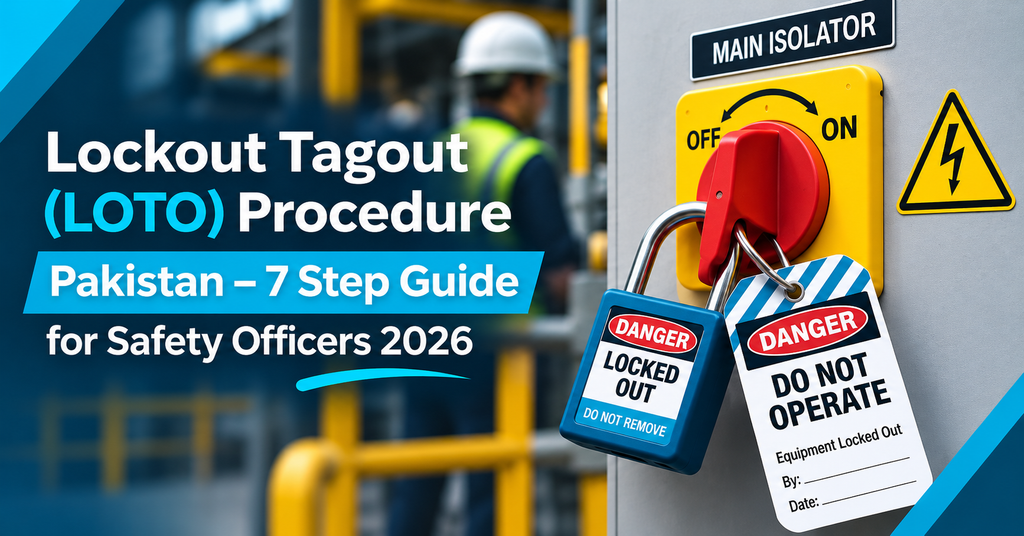
The lockout tagout procedure in Pakistan is a workplace safety process that prevents machinery from starting unexpectedly during maintenance, cleaning, inspection or repair. It involves isolating hazardous energy sources, applying personal safety locks and warning tags, controlling stored energy and verifying that equipment cannot restart.
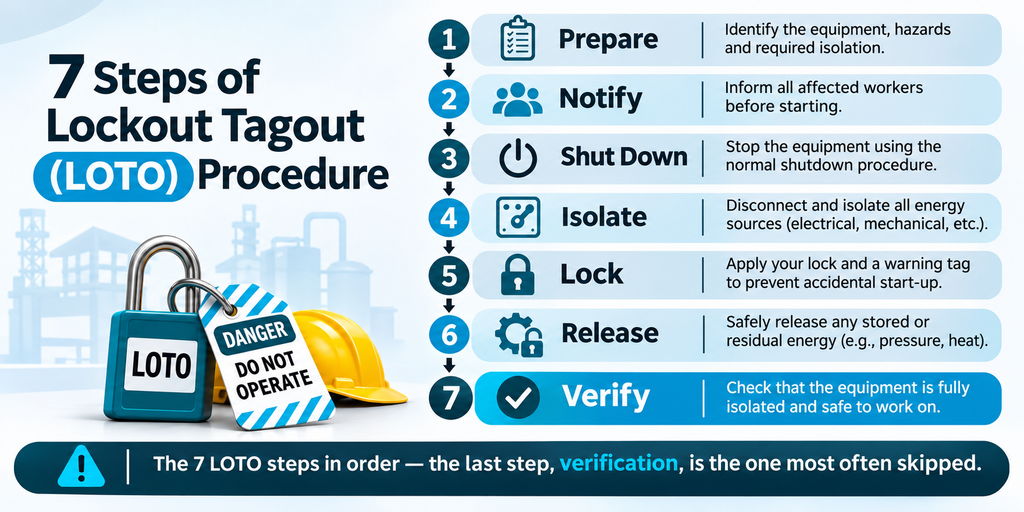
The seven main LOTO procedure steps are:
- Prepare for shutdown.
- Notify affected employees.
- Shut down the equipment.
- Isolate all energy sources.
- Apply locks and warning tags.
- Release or control stored energy.
- Verify isolation before starting work.
Remember: Switching off a machine is not enough. Workers must isolate all energy sources, apply personal locks, control stored energy and verify that the equipment is safe before maintenance begins.ficient. Workers need to isolate, lock, release hazardous energy and test equipment to ensure it is safe to operate.
Introduction: Why Is Lockout Tagout Important?
Introduction: Why Is Lockout Tagout Important?
Imagine a technician working on a conveyor belt inside a textile factory in Faisalabad. The machine appears to be switched off, but another operator presses the start button without knowing that maintenance is taking place.
Suddenly, the conveyor starts moving, putting the maintenance worker at risk of serious injury.
This is exactly the type of incident that a lockout tagout procedure is designed to prevent.
Machinery-related hazards are common across Pakistan’s textile mills, cement factories, construction sites, food processing plants, engineering workshops and manufacturing facilities.
A properly implemented LOTO system prevents unexpected machine startup and helps control the uncontrolled release of hazardous energy.
Understanding energy isolation is an essential part of workplace risk management for safety officers, maintenance supervisors and HSE professionals.
What Is Lockout Tagout (LOTO)?
Lockout tagout is a formal energy-control procedure that protects workers when machinery or equipment requires servicing or maintenance.
It consists of two important elements:
- Lockout: Applying a physical safety lock to an energy-isolating device so it cannot be operated.
- Tagout: Attaching a warning tag that identifies the person performing maintenance and explains why the equipment must not be operated.
A tag provides a warning, whereas a lock provides physical restraint. Therefore, use both whenever the isolation device can be locked.
The OSHA standard 29 CFR 1910.147 provides an internationally recognised reference for controlling hazardous energy during servicing and maintenance.
For a broader understanding of industrial hazards, safety professionals should also learn about machinery safety and guarding, which helps prevent contact with dangerous moving machine parts.
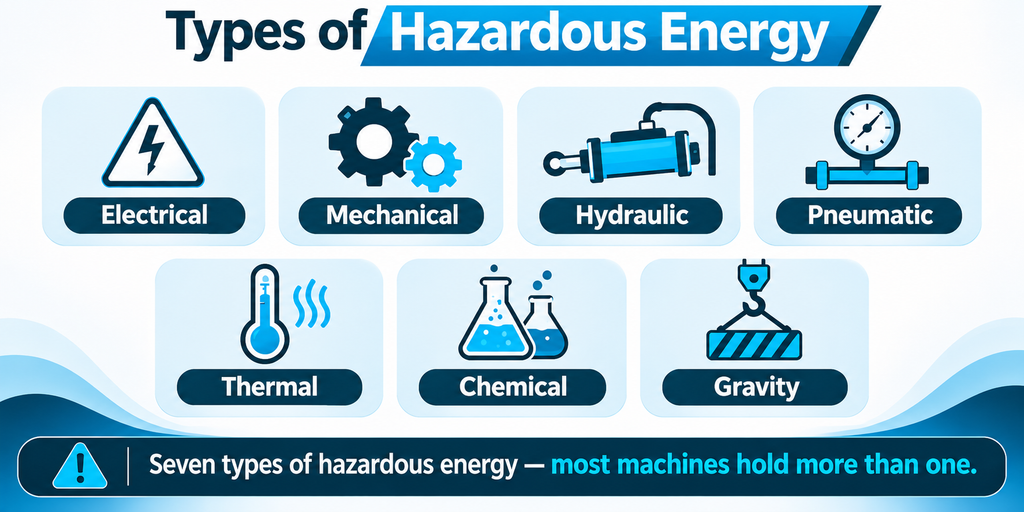
What Types of Hazardous Energy Require Isolation?
A machine may contain several energy sources, even after its main electrical supply has been switched off.
| Energy type | Common workplace example |
|---|---|
| Electrical | Motors, electrical panels and capacitors |
| Mechanical | Rotating shafts, flywheels and conveyors |
| Hydraulic | Hydraulic presses and lifting equipment |
| Pneumatic | Compressed air systems and packaging machines |
| Thermal | Boilers, steam pipes and hot surfaces |
| Chemical | Chemical processing lines and storage tanks |
| Gravitational | Raised loads, suspended equipment and press rams |
Important: Stored energy can remain dangerous after shutdown. Hydraulic pressure, compressed air, charged capacitors and suspended loads must be safely released, discharged or restrained before maintenance begins.
When Is a LOTO Procedure Required?
A lockout tagout procedure should be implemented whenever maintenance or servicing could expose workers to unexpected machine movement, energisation or stored-energy release.
Common situations include:
- Repairing industrial machinery.
- Cleaning conveyor belts and production equipment.
- Removing material jams and blockages.
- Replacing machine blades, belts and cutting tools.
- Maintaining electrical panels and motors.
- Servicing hydraulic and pneumatic systems.
- Inspecting equipment inside dangerous enclosures.
For example, clearing a blockage in a packaging machine may take only a few minutes. However, entering the danger zone without isolating the machine can result in crushing or entanglement injuries.
The 7 Steps of a Lockout Tagout Procedure
A reliable lockout tagout procedure follows a planned sequence. Every worker involved must understand their responsibilities.
Step 1: Prepare for Shutdown
Identify every energy source connected to the equipment.
Review the machine’s isolation diagram, manufacturer’s instructions and written energy-control procedure.
Identify electrical switches, hydraulic valves, compressed air connections and other isolation points.
Prepare the required locks, tags and isolation devices before beginning work.
Step 2: Notify Affected Employees
Inform machine operators, maintenance technicians, supervisors and other affected workers.
Explain which equipment will be stopped, why maintenance is necessary and how long the work is expected to take.
Clear communication prevents someone from attempting to restart the machine during maintenance.
Step 3: Shut Down the Equipment
Stop the machine using its normal operating controls.
Follow the manufacturer’s shutdown instructions and established workplace procedure.
Avoid sudden shutdowns that could introduce additional hazards, particularly in production lines and process plants.
Remember that pressing an emergency stop button does not provide complete energy isolation.
For maintenance activities involving multiple hazards, LOTO should be coordinated with an appropriate permit to work system. This helps ensure that hazardous work is authorised, assessed and properly supervised.
Step 4: Isolate All Energy Sources
Locate and operate every energy-isolating device.
Depending on the equipment, this may involve:
- Opening the main electrical disconnect.
- Closing hydraulic and pneumatic valves.
- Disconnecting power supplies.
- Isolating steam or process connections.
- Securing mechanical energy sources.
Check that each isolation point actually separates the machine from its energy supply.
A stop button, selector switch or software control should not be treated as a substitute for an appropriate energy-isolating device.
Step 5: Apply Locks and Warning Tags
Fit an appropriate safety padlock to every relevant isolation point.
Attach a warning tag containing:
- Employee’s name.
- Department or company.
- Date and time.
- Reason for isolation.
- Contact or identification details.
Each authorised worker should apply their own personal lock and retain control of its key.
Follow the principle of one worker, one personal lock, one key.
Step 6: Release or Control Stored Energy
After applying the locks, deal with all remaining hazardous energy.
Examples include:
- Releasing compressed air pressure.
- Draining hydraulic pressure.
- Discharging electrical capacitors.
- Lowering suspended loads.
- Blocking raised machine components.
- Allowing hot equipment to cool.
- Restraining springs and other mechanical components.
Where stored energy can build up again, continue monitoring it throughout the maintenance activity.
Step 7: Verify Isolation Before Starting Work
Verification is one of the most important LOTO procedure steps.
First, confirm that everyone is clear of the danger zone.
Attempt to operate the machine using its normal start controls. The equipment must not start.
Return the controls to the off position after testing.
For electrical maintenance, a competent person must use an appropriate voltage tester to confirm the circuit is de-energised, following the correct electrical safe-working procedure.
Only begin work after the effectiveness of isolation has been confirmed.
LOTO Equipment Required in Pakistani Workplaces
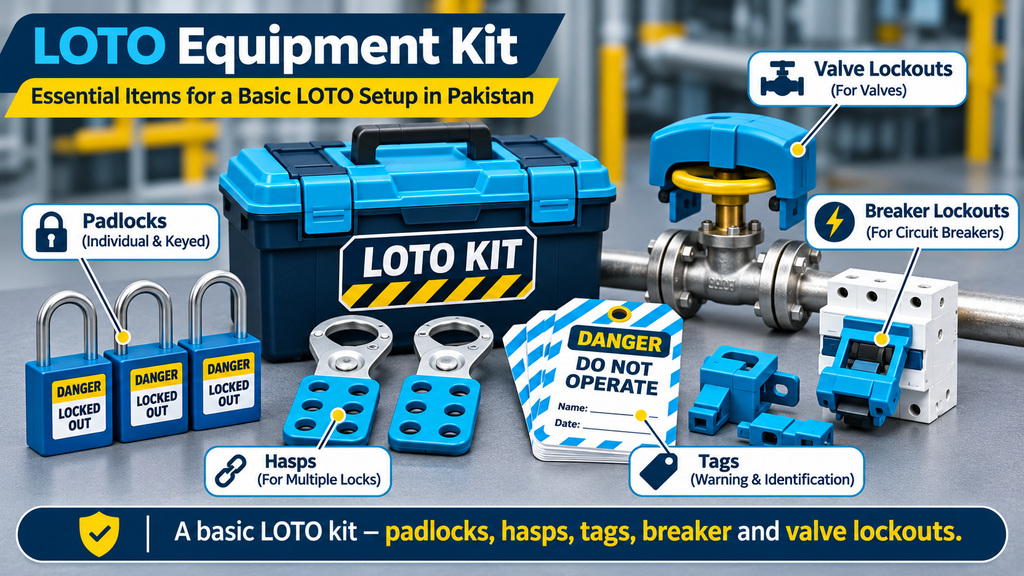
A workplace needs suitable equipment to implement energy isolation effectively.
| Equipment | Main purpose |
|---|---|
| Safety padlocks | Secure isolation points |
| Lockout hasps | Allow several personal locks |
| Warning tags | Identify workers and communicate hazards |
| Circuit breaker lockouts | Prevent operation of electrical breakers |
| Valve lockouts | Secure valves in the isolated position |
| Plug lockouts | Prevent unauthorised plug connection |
| Group lock boxes | Manage multiple workers during maintenance |
Factories in Karachi, Lahore, Faisalabad, Rawalpindi and other industrial areas should select equipment suitable for their machinery and working conditions.
Avoid ordinary shared padlocks that do not provide individual control. Use uniquely identifiable locks and maintain proper key-management arrangements.
Group Lockout: How Does It Work?
Group lockout is used when several maintenance workers need to work on the same machine.
For example, an industrial shutdown may involve electricians, mechanical technicians, contractors and maintenance supervisors.
Two common methods are:
1. Multi-lock hasp
A hasp is attached to an isolation point and accepts multiple personal padlocks. The equipment cannot be returned to service until all required locks are removed.
2. Group lock box
The authorised isolation coordinator secures the isolation points and places the associated keys inside a lock box. Each worker then applies their personal lock to the box.
The system must maintain individual protection, including during shift changes and contractor handovers.
Common Lockout Tagout Mistakes
Some workplaces have LOTO equipment but still fail to implement an effective machine isolation procedure.
Avoid these common mistakes:
- Using emergency stop buttons instead of proper isolation.
- Applying one supervisor’s lock for several workers.
- Using warning tags without locks where locking is possible.
- Forgetting hydraulic or pneumatic stored energy.
- Skipping isolation verification.
- Locking the wrong electrical breaker.
- Allowing unauthorised workers to remove safety locks.
- Restarting machinery before all workers are clear.
Unlabelled electrical panels are another serious problem. Every isolation point should be clearly identified so workers can select the correct energy source.
What Does Pakistani Law Say About Lockout Tagout?
Pakistan has occupational safety and factory legislation that provides a framework for protecting workers from machinery-related hazards.
For example:
- The Factories Act 1934 includes provisions relating to fencing dangerous machinery.
- The Punjab Occupational Safety and Health Act 2019 establishes workplace safety and health duties in Punjab.
- The Sindh Occupational Safety and Health Act 2017 provides an occupational safety and health framework for workplaces in Sindh.
These laws should be considered alongside applicable provincial rules, industry requirements and other relevant legislation.
Pakistan does not have a single nationwide LOTO regulation identical to OSHA 29 CFR 1910.147. However, employers can use recognised energy-isolation practices to support effective machinery safety management.
For international guidance, consult OSHA’s hazardous energy standard and the UK HSE’s PUWER Regulation 19.
How Is LOTO Relevant to NEBOSH IGC?
Lockout tagout is a useful practical example of hazard control and safe systems of work.
NEBOSH IGC learners can develop their understanding of:
- Machinery and workplace hazards.
- Electrical safety precautions.
- Risk assessment and control measures.
- Maintenance safety procedures.
- Employee responsibilities and supervision.
- Prevention of unexpected machine movement.
For Pakistani safety officers seeking employment in manufacturing, construction, oil and gas or Gulf industries, practical knowledge of energy isolation can also help demonstrate workplace safety competence.
Explore our NEBOSH International guidance and student resources to learn more about NEBOSH qualifications and choosing an approved Learning Partner.
If you are planning to develop your HSE career, explore our NEBOSH course guidance in Pakistan to understand available qualifications and how to choose an approved NEBOSH Learning Partner.
Frequently Asked Questions
The seven steps are preparation, notification, shutdown, energy isolation, lock and tag, stored-energy release and verification.
Lockout is when a physical lock is used to ensure that an isolation device cannot be operated. In Tagout, a warning tag is used to identify the hazard and to let people know that the equipment cannot be operated.
The specific legal conditions are dependent on the relevant provincial and industry laws. There is no single regulation in Pakistan which is exactly that of OSHA 1910.147, but employers should take into account their machinery and occupational safety obligations. LOTO is an accepted way to control hazardous energy.
The person who has used the personal lock would normally remove it. Where this employee is not available, the relevant exception process in accordance with the employer’s checks and communication procedures should be followed, see documentation of this process.
Try step is important to help confirm that the machine cannot be operated by its normal controls after isolation. It is a significant verification tool, but not an alternative to electrical testing or other specialist verification if necessary.
OSHA 1910.147 mandates that, at a minimum, energy-control procedures be periodically inspected annually. Employers in Pakistan should set up inspection and review procedures for their jobs and plan them according to the legal requirements and risk of their jobs.
Conclusion
Correct implementation of a lockout/tagout system can help to avoid serious injury from unexpected machine start-up and release of hazardous energy.
To have an effective LOTO system in place in a factory, construction project, or industrial workplace, safety padlocks are simply not enough for Pakistani factories. Employers are required to determine energy sources, train workers, and document isolation procedures and ensure that machinery is safe prior to maintenance.
Keep in mind the 7 steps: Prepare, Notify, Shut Down, Isolate, Lock and Tag, Release Stored Energy and Verify.
When a machine stops moving, it isn’t necessarily safe. Do not work on until hazardous energy is properly isolated and controlled.
Want to develop your knowledge of workplace safety and build a career in HSE? Visit NEBOSH International for independent NEBOSH qualification information and student guidance in Pakistan. You can also explore our NEBOSH FAQs in Pakistan for answers to common questions about NEBOSH qualifications.

NEBOSH International General Certificate (IGC) certified HSE professional focused on occupational health and safety, workplace risk assessment, hazard identification, and safety management systems. The content published on NeboshInternational.com is based on current industry guidance, recognized safety best practices, and practical workplace examples to help professionals in Pakistan and the Gulf prepare for NEBOSH qualifications and build successful HSE careers.