Heat Stress Prevention in Pakistani Workplaces: Complete Guide (2026)
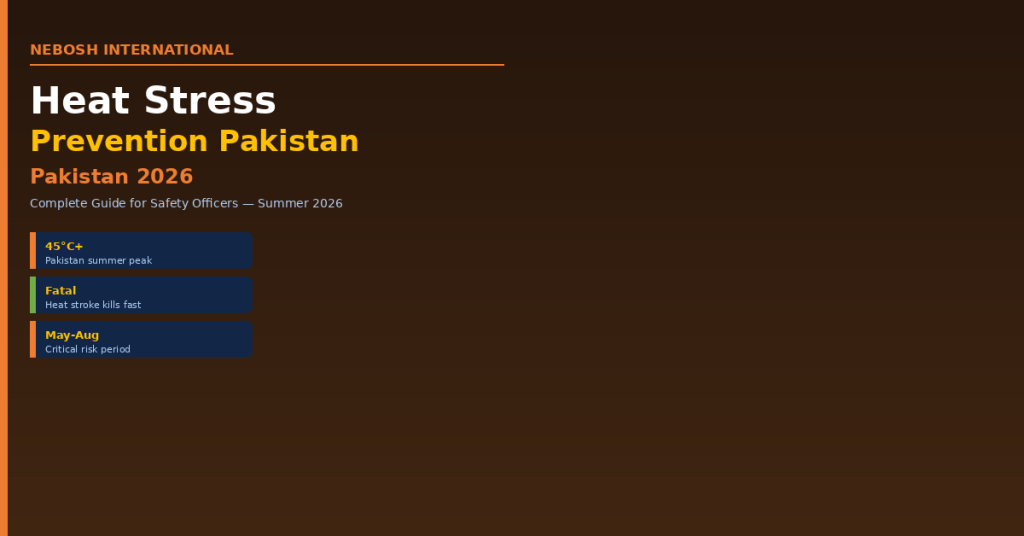
Pakistan experiences some of the world’s most extreme summer temperatures. Between May and September, outdoor temperatures can regularly reach 42–48°C across Punjab, Sindh, and Khyber Pakhtunkhwa (KPK). On construction sites, in textile mills, and on agricultural land, workers can face conditions that become dangerous or even fatal if heat stress prevention in Pakistan workplaces is not properly managed.
Heat stress is not simply discomfort. It can progress through several stages, from heat cramps and heat exhaustion to potentially fatal heat stroke. For safety officers, effective heat stress prevention in Pakistan workplaces is therefore a life-critical priority during the country’s hottest months.
This guide covers the main types of heat illness, how to recognise each stage, what control measures can help protect workers, and how to respond when a worker develops a serious heat-related illness.
Why Pakistani Workers Are at High Risk
Several factors make Pakistani workers particularly vulnerable to heat-related illness.
- Prolonged outdoor work — construction, agriculture, and road maintenance require extended periods in direct sunlight
- Physical labour — hard physical work generates body heat internally, in addition to environmental heat
- Heavy or dark clothing — some workers wear traditional clothing that limits sweat evaporation
- Dehydration — workers may not drink sufficient water, particularly during Ramadan or when water is not readily available on site
- Acclimatisation — workers returning from leave, new workers, or those recovering from illness have reduced heat tolerance
The Progression of Heat Illness
Heat illness develops in stages. Recognising each stage allows intervention before the situation becomes life-threatening.
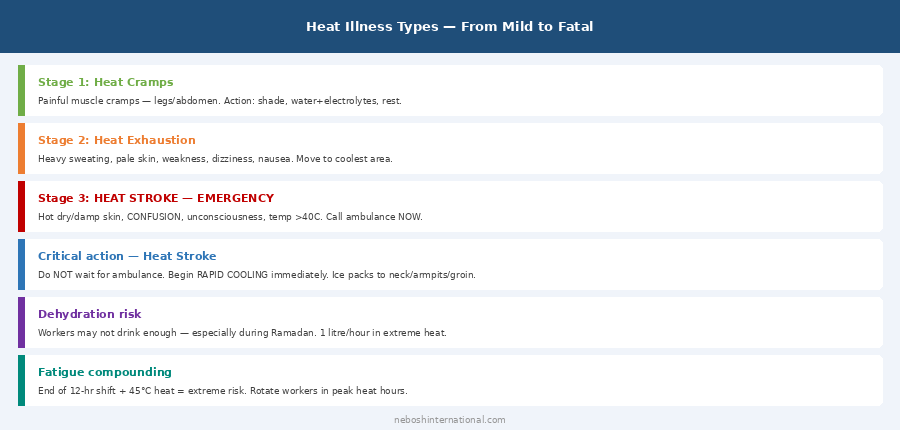
Stage 1 — Heat Cramps
Painful muscle cramps, particularly in the legs, abdomen, and arms. This occurs because heavy sweating depletes the body of salt and electrolytes.
Action: Move to shade. Provide water with electrolytes (ORS or sports drink). Rest. Do not return to heavy physical work immediately.
Stage 2 — Heat Exhaustion
Symptoms include heavy sweating, pale and clammy skin, weakness, dizziness, nausea, headache, and a rapid but weak pulse. The worker is conscious but distressed.
Action: Move to the coolest available location immediately. Remove excess clothing. Apply cool, wet cloths to the neck, armpits, and groin. Provide water to drink if conscious. Seek medical attention if no improvement within 30 minutes.
Stage 3 — Heat Stroke
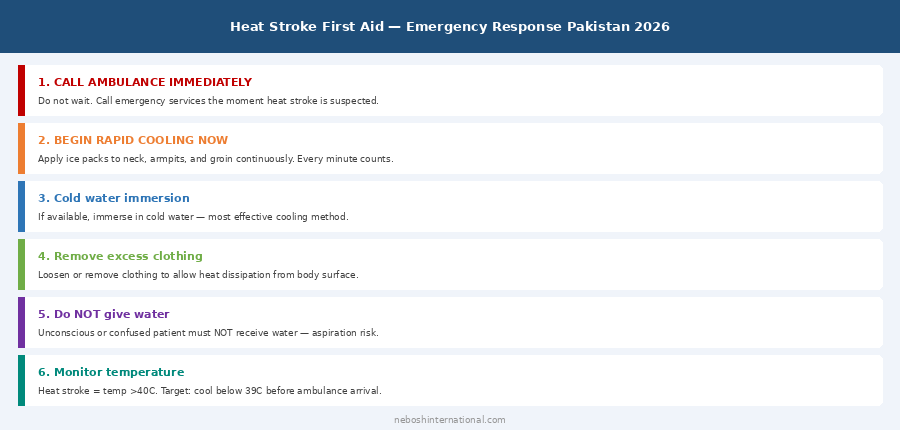
Heat stroke is a medical emergency. Symptoms include hot, dry or damp skin, confusion, loss of consciousness, rapid and strong pulse, and body temperature above 40°C. The worker may stop sweating entirely — a dangerous sign.
Action: Call an ambulance immediately. Begin rapid cooling — immerse in cold water if possible, or apply ice packs to neck, armpits, and groin continuously. This is life-saving — do not wait for the ambulance before cooling.
Control Measures for Heat Stress in Pakistan
Engineering Controls
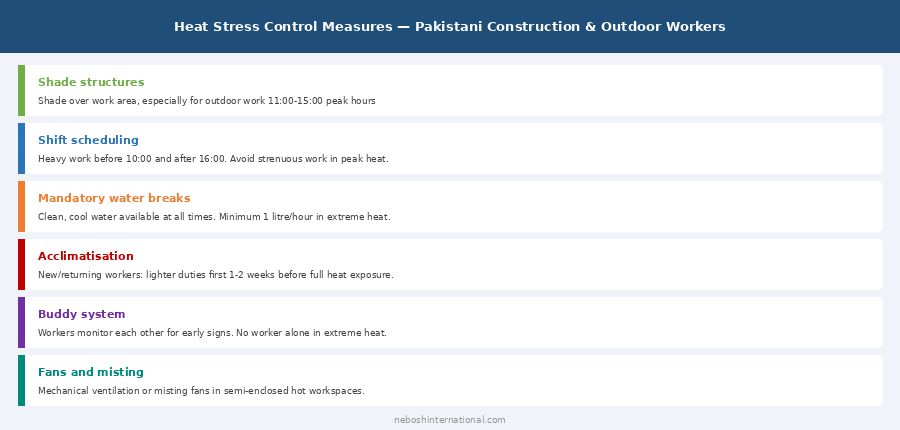
- Shade structures — shade at the work site, especially for outdoor work during peak heat hours (11:00–15:00)
- Rest facilities — shaded rest areas with seating, away from hot machinery and sun
- Fans and misting — in semi-enclosed or enclosed hot workspaces, mechanical ventilation or misting fans reduce heat load
- Insulation — insulate hot surfaces to reduce radiant heat in industrial settings
Administrative Controls
- Shift scheduling — schedule the heaviest outdoor work in the early morning (before 10:00) and evening (after 16:00); avoid strenuous work in peak heat hours
- Acclimatisation programme — new workers and those returning from leave should start on lighter duties for 1–2 weeks before full exposure to hot conditions
- Buddy system — workers monitor each other for early signs of heat illness; no worker should be alone in extreme heat
- Mandatory water breaks — provide water and shade breaks at least every 30 minutes in extreme heat conditions
- Water provision — clean, cool drinking water available at all times; minimum 1 litre per hour in extreme heat
What to Include in a Heat Stress Plan
A formal heat stress plan for Pakistani workplaces should include:
- Temperature thresholds — at what temperatures specific controls are activated
- Work/rest ratios — how long workers can work before a required rest break, based on temperature and activity level
- Water provision protocol — who provides water, where, and how often
- Acclimatisation schedule — for new and returning workers
- First aid response procedure — who responds to a heat illness casualty and how
- Emergency contacts — ambulance number, nearest hospital with emergency facilities
Frequently Asked Questions
At what temperature should outdoor work be stopped in Pakistan?
There is no single temperature that automatically applies to every workplace or activity. Heat risk depends on factors such as humidity, workload, clothing, direct sunlight, and worker acclimatisation. Safety officers should use a suitable heat-stress assessment method and increase controls as heat exposure becomes more severe.
What is the most practical heat-stress control for Pakistani construction sites?
Providing shaded recovery areas, readily available cool drinking water, appropriate rest breaks, and scheduling strenuous work during cooler periods are among the most practical measures for construction sites. These controls can significantly reduce workers’ exposure to extreme heat when implemented consistently.
Does NEBOSH IGC cover heat stress?
Yes. Heat-related hazards can form part of the physical hazard knowledge covered within the NEBOSH IGC. Students and safety professionals should understand how to identify heat hazards, assess risk, and recommend suitable control measures in workplace scenarios.
Should workers fasting during Ramadan continue working in extreme heat?
This requires careful consideration of both worker safety and workplace arrangements. Fasting can increase the risk of dehydration and heat-related illness for some workers, particularly during strenuous work in extreme temperatures. Employers and safety officers should assess the risks, provide suitable rest and cooling arrangements, and consider scheduling demanding tasks during cooler periods where practical.
How quickly can heat stroke become dangerous?
Heat stroke can cause serious organ damage and can be fatal without rapid treatment. Suspected heat stroke should always be treated as a medical emergency. Start appropriate cooling measures immediately while arranging emergency medical assistance.
Conclusion:
Effective heat stress prevention in Pakistan workplaces is an essential responsibility for employers, supervisors, and safety officers during the country’s extreme summer conditions. Construction workers, agricultural workers, industrial employees, and others exposed to high temperatures need adequate water, shade, rest, acclimatisation, training, and emergency arrangements.
Heat-related hazards are also relevant to occupational health and safety professionals studying the NEBOSH IGC. Understanding how to identify heat stress risks and implement appropriate controls can help safety officers protect workers more effectively.
If you are preparing for a career in HSE, you can also explore our guide to the Top 10 Safety Officer Jobs in Pakistan for NEBOSH to understand current career opportunities. Engineers interested in strengthening their occupational safety knowledge can also read our guide on NEBOSH IGC for Engineers in Pakistan 2026.
If you want to develop your occupational health and safety knowledge and prepare for a career in HSE, explore NEBOSH training and certification opportunities in Pakistan at Nebosh International.

NEBOSH International General Certificate (IGC) certified HSE professional focused on occupational health and safety, workplace risk assessment, hazard identification, and safety management systems. The content published on NeboshInternational.com is based on current industry guidance, recognized safety best practices, and practical workplace examples to help professionals in Pakistan and the Gulf prepare for NEBOSH qualifications and build successful HSE careers.