Safety Officer Interview Questions Pakistan: 2026 Preparation Guide
Preparing for a safety officer interview in Pakistan requires more than memorising health and safety definitions. Employers want candidates who can identify workplace hazards, recommend effective controls, communicate with workers and respond appropriately to emergencies.
Whether you are applying for a construction site position in Rawalpindi, an HSE job in a Lahore factory, an oil and gas role in Karachi or a safety position in Saudi Arabia or the UAE, practical knowledge is essential.
This guide covers 15 important safety officer interview questions and answers, including NEBOSH IGC topics, risk assessment, personal protective equipment (PPE), accident investigation, permit-to-work systems and workplace safety scenarios.
What Questions Are Asked in Safety Officer Interviews in Pakistan?
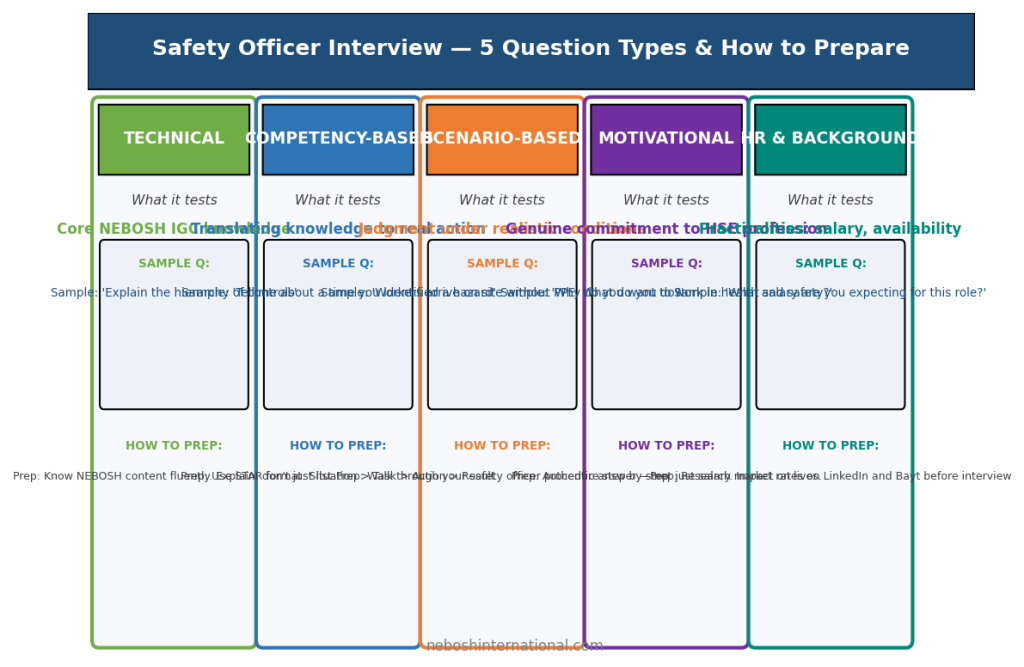
Most safety officer interviews cover five areas:
- Technical knowledge: Hazard identification, risk assessment, hierarchy of controls and emergency procedures.
- Practical scenarios: Responding to unsafe work, missing PPE and dangerous site conditions.
- NEBOSH knowledge: Applying course concepts to actual workplace situations.
- Behavioural questions: Communication, teamwork, leadership and professional integrity.
- HR questions: Experience, availability, salary expectations and career goals.
For example, a construction contractor in DHA Lahore may ask about scaffolding inspections and fall prevention. In contrast, an oil and gas employer may focus on confined spaces, hot work and permit-to-work procedures.
Therefore, prepare examples relevant to the industry and position you are applying for.
15 Safety Officer Interview Questions and Answers
1. Tell me about yourself.
Sample answer:
“I am a health and safety professional with a background in [your qualification and experience]. I have studied workplace hazard identification, risk assessment, accident prevention and safe working procedures. I am particularly interested in [construction, manufacturing or oil and gas] safety. I want to use my knowledge to help prevent workplace injuries, support legal and organisational compliance, and improve safety awareness among workers.”
Interview tip: Keep your introduction to approximately 60–90 seconds. Mention your actual qualifications and experience rather than claiming skills you have not developed.
2. What is the difference between a hazard and a risk?
Sample answer:
“A hazard is something that has the potential to cause harm, whereas risk refers to the likelihood of harm occurring and the possible severity of its consequences.”
For example, an unguarded machine is a hazard. If workers operate it without suitable guarding, the likelihood of serious injury increases.
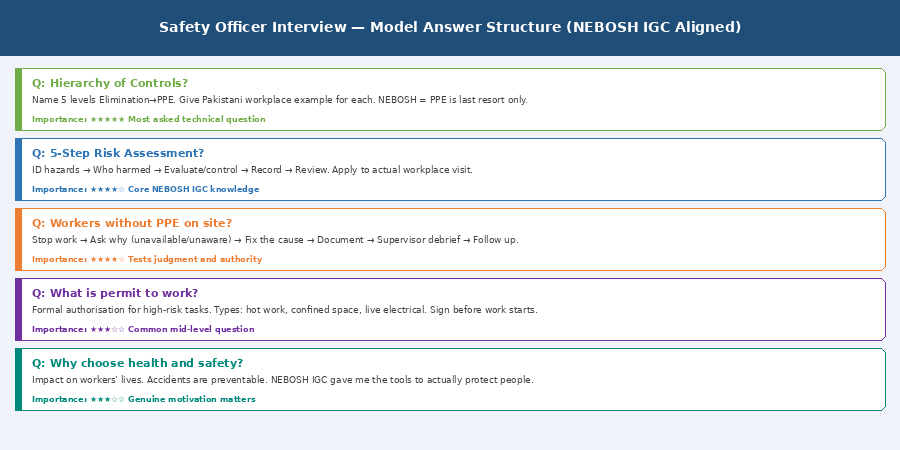
3. What is the hierarchy of controls?
Sample answer:
“The hierarchy of controls is a method of selecting measures to reduce workplace risks, starting with the most effective options.”
The five commonly recognised levels are:
- Elimination: Remove the hazard completely.
- Substitution: Replace it with a less hazardous alternative.
- Engineering controls: Isolate people from the hazard using guards, barriers or ventilation.
- Administrative controls: Introduce procedures, training, supervision and safe systems of work.
- PPE: Provide suitable protective equipment, such as helmets, gloves and safety footwear.
I would prioritise eliminating or controlling hazards at their source rather than relying on PPE alone.
4. How do you conduct a workplace risk assessment?
Sample answer:
“I identify hazards, determine who could be harmed, evaluate the risks, record and implement suitable control measures, and review the assessment when necessary.”
For instance, during a construction site inspection in Rawalpindi, I would examine work at height, electrical equipment, vehicle movement, excavation and housekeeping. I would then assess the risks, prioritise serious hazards and assign corrective actions with responsible persons and deadlines.
5. What would you do if workers were not wearing PPE?
Sample answer:
“I would assess the immediate danger and stop the affected work when necessary to prevent serious injury. I would explain the PPE requirements, identify why workers were not complying and ensure suitable equipment was available. I would also inform the supervisor, document the issue and arrange further training or corrective action where required.”
The objective is to correct unsafe behaviour while identifying whether poor supervision, unsuitable equipment or inadequate training contributed to the problem.
6. What is a permit-to-work system?
Sample answer:
“A permit-to-work system is a formal process for authorising specified hazardous activities under defined safety conditions. It identifies hazards, required precautions, authorised personnel and the period during which the work is permitted.”
Permits may be required for activities such as hot work, confined-space entry and certain electrical or excavation tasks, depending on the site’s procedures and risk assessment.
Before work begins, I would verify the necessary precautions, isolation arrangements, authorisations and communication between the responsible parties.
Read our guide to the permit-to-work system in Pakistan.
7. How would you investigate a workplace accident?
Sample answer:
“First, I would ensure that injured people receive assistance and that the area is made safe. Next, I would preserve relevant evidence, take photographs where appropriate, interview witnesses separately and review the risk assessment, training records and work procedures.”
I would identify immediate causes, underlying causes and contributing factors. Finally, I would prepare an investigation report, recommend corrective actions, assign responsibilities and follow up to check whether the actions prevent recurrence.
The purpose is to understand what happened and prevent similar incidents, not simply to blame an individual.
8. What would you do if you identified unsafe scaffolding?
Sample answer:
“I would prevent access to the affected scaffold and stop work where there was a risk of falling. I would inform the supervisor and arrange an inspection by a competent, authorised person. Work would resume only after the scaffold was confirmed safe and the required controls were in place.”
Depending on the circumstances, I would check access, working platforms, guardrails, toe boards, stability and inspection records.
9. What is a toolbox talk?
Sample answer:
“A toolbox talk is a short safety briefing delivered before work or when a particular hazard needs attention. It explains the task, potential hazards, control measures, emergency arrangements and workers’ responsibilities.”
For example, before excavation begins, I would discuss underground services, access and egress, protective systems, plant movement and emergency procedures. I would encourage questions and record attendance according to company requirements.
10. What would you do during a fire emergency?
Sample answer:
“I would raise the alarm, activate the emergency response procedure and ensure people evacuate through designated routes to the assembly point. I would notify the emergency response team and emergency services according to the site procedure.”
I would not attempt to fight a fire unless I was trained, authorised, had suitable equipment and could do so without unacceptable risk. Accountability and preventing re-entry until authorised are also important.
11. What is a near miss?
Sample answer:
“A near miss is an unplanned event that causes no injury or damage but had the potential to do so.”
For example, a tool falling from a scaffold and narrowly missing a worker should be reported and investigated. The organisation can then identify why the tool fell and introduce controls to prevent a future injury.
12. How do you manage work at height?
Sample answer:
“I would first consider whether the task can be completed without working at height. If not, I would assess the risks and select suitable access equipment and protective measures.”
Depending on the task, these may include properly erected scaffolding, suitable working platforms, guardrails, fall-restraint or fall-arrest systems, training and rescue arrangements. Equipment must be inspected and used according to applicable requirements and site procedures.
13. What is the difference between an unsafe act and an unsafe condition?
Sample answer:
“An unsafe act is a behaviour that increases risk, such as bypassing a machine guard. An unsafe condition is a hazardous workplace situation, such as a damaged electrical cable or an unprotected floor opening.”
Both should be addressed. I would correct immediate dangers and investigate underlying issues, including equipment maintenance, training, supervision and work planning.
14. What did you learn from your NEBOSH practical risk assessment?
Sample answer:
“My practical assessment helped me identify workplace hazards, evaluate risks and recommend appropriate control measures. I learned to prioritise significant risks and develop an action plan with responsibilities and target dates.”
I would support this answer with a genuine example from my assessment, explaining the workplace, the hazard identified, the proposed controls and the reasons for prioritising the issue.
NEBOSH’s official International General Certificate information explains the qualification’s focus on risk assessment and practical application. The current assessment requirements depend on the specification under which you are registered.
15. Why should we hire you as a safety officer?
Sample answer:
“You should consider me because I take workplace safety seriously, understand the importance of risk assessment and can communicate safety requirements clearly. I am willing to work with employees and supervisors, report hazards professionally and follow corrective actions through to completion. I also recognise the importance of learning from incidents and improving safety performance continuously.”
Support your answer with genuine examples of relevant training, workplace experience, inspections or practical assessments.
Industry-Specific Safety Officer Interview Preparation
| Industry or location | Topics to revise |
|---|---|
| Construction in Rawalpindi or Lahore | Scaffolding, excavations, lifting operations and fall prevention |
| Manufacturing in Karachi or Faisalabad | Machine guarding, chemical handling, fire prevention and lockout procedures |
| Oil and gas in Pakistan | Permit to work, confined spaces, isolation and emergency response |
| Saudi Arabia and UAE | Risk assessment, site safety, incident reporting and employer-specific HSE procedures |
These are preparation suggestions rather than a guarantee of the questions a particular employer will ask. Always review the job description before your interview.
Common Mistakes to Avoid
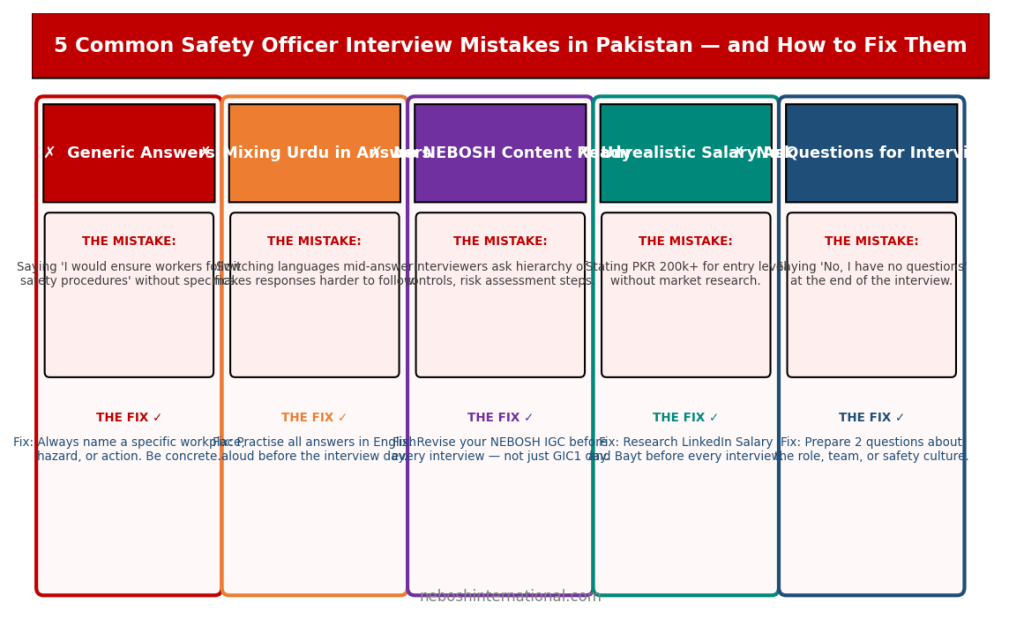
Candidates can weaken otherwise strong interviews by giving vague or memorised answers. Avoid these common mistakes:
- Giving definitions without explaining a practical example.
- Claiming work experience or qualifications you do not have.
- Recommending PPE without considering higher-level controls.
- Ignoring reporting, documentation and follow-up.
- Speaking negatively about previous employers.
- Giving an unsupported salary expectation.
- Failing to ask relevant questions about the role.
Instead, structure scenario answers around the hazard, immediate action, control measures, reporting and follow-up.
How to Prepare for a Safety Officer Interview in Pakistan
Use this simple seven-day preparation plan:
- Day 1: Revise hazard, risk, risk assessment and the hierarchy of controls.
- Day 2: Study work at height, scaffolding, excavation and lifting safety.
- Day 3: Revise fire safety, electrical hazards and emergency procedures.
- Day 4: Practise accident investigation, near-miss reporting and permit-to-work questions.
- Day 5: Prepare examples from your training, practical assessment or genuine workplace experience.
- Day 6: Complete a mock interview and practise answering in clear professional English.
- Day 7: Review the employer, job description, documents, clothing and interview arrangements.
For additional preparation, read our NEBOSH IGC exam preparation guide and NEBOSH course fees in Pakistan guide.
Frequently Asked Questions:
Common topics include hazard versus risk, risk assessment, the hierarchy of controls, PPE, accident investigation, fire emergencies, work at height and permit-to-work systems.
You can apply for suitable entry-level and trainee positions. However, employers may also require practical competence, communication skills, relevant industry knowledge or previous site experience. A qualification alone does not guarantee employment.
Bring your updated CV, relevant qualification certificates, identification if requested, experience letters, references where appropriate and copies of supporting documents. Follow the employer’s instructions and provide genuine information.
The technical foundations are similar, but employers may apply different local regulations, client standards, site procedures and experience requirements. Candidates targeting Saudi Arabia or the UAE should review the relevant employer requirements and applicable local rules.
Be honest. Explain what you do know, avoid guessing about critical safety requirements, and state that you would consult the applicable procedure or a competent person before making a safety-critical decision.
Conclusion
Preparing for safety officer interview questions in Pakistan requires technical understanding, practical judgement and clear communication. Employers need candidates who can identify hazards, recommend effective controls, report incidents and help workers follow safe systems of work.
Whether you are applying in Rawalpindi, Lahore, Karachi, Faisalabad or the Gulf, practise these questions using genuine examples from your training and experience. Research the employer, understand the job requirements and prepare to explain not only what a safety procedure is, but also why it matters and how you would apply it.
Your NEBOSH qualification can support your HSE career, but your ability to apply that knowledge responsibly is what you need to demonstrate in the interview.

NEBOSH International General Certificate (IGC) certified HSE professional focused on occupational health and safety, workplace risk assessment, hazard identification, and safety management systems. The content published on NeboshInternational.com is based on current industry guidance, recognized safety best practices, and practical workplace examples to help professionals in Pakistan and the Gulf prepare for NEBOSH qualifications and build successful HSE careers.


2 Comments
Comments are closed.