Job Safety Analysis (JSA): Step-by-Step Guide for Pakistan 2026
What Is Job Safety Analysis?
Job safety analysis (JSA) is a practical workplace safety method that identifies hazards before workers begin a particular task. It involves dividing a job into smaller steps, examining the dangers associated with each activity and selecting suitable control measures to prevent injuries and occupational illnesses.
In Pakistan, job safety analysis plays an important role in construction projects, manufacturing plants, textile factories, warehouses, power facilities and oil and gas operations. Safety officers use JSA to help supervisors and workers understand task-related risks and follow safe working procedures.
A job safety analysis is also known as a job hazard analysis (JHA) or task hazard analysis. Although organisations may use different terminology, the main objective remains the same: identify hazards, control risks and communicate safety requirements before work starts.
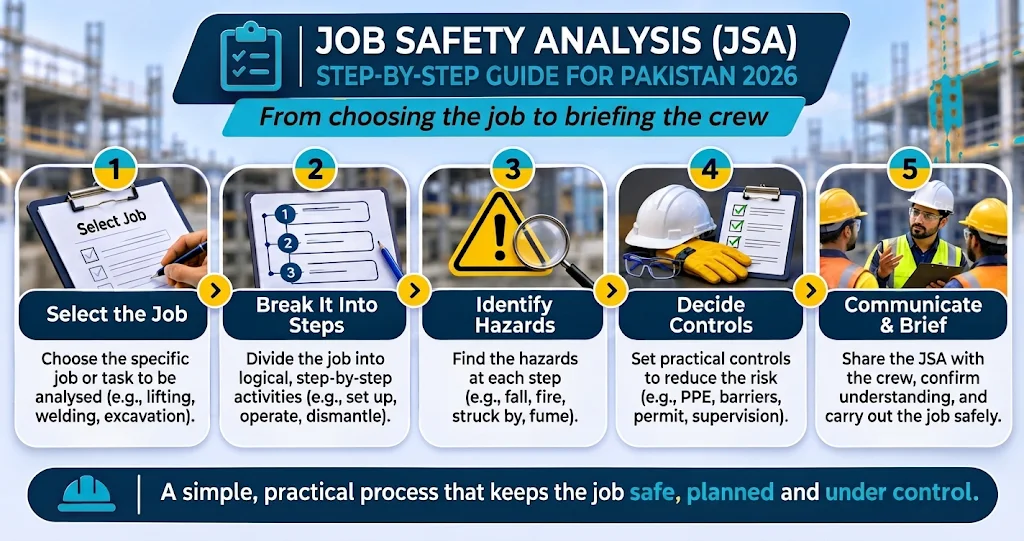
Quick Answer: A JSA follows five main stages: select the job, divide it into steps, identify hazards, establish control measures, and communicate the findings to workers. An effective JSA involves the people performing the task and reflects actual workplace conditions.
Why Is Job Safety Analysis Important in Pakistan?
Many workplace accidents occur because workers do not recognise hazards or understand the precautions required for a particular activity. A properly prepared JSA helps organisations identify these dangers before an incident happens.
For example, construction workers may face falling objects, unstable scaffolding, electrical hazards and unsafe lifting operations. Similarly, manufacturing employees may encounter moving machinery, chemical exposure, excessive noise and manual handling risks.
A job safety analysis helps Pakistani organisations:
- Identify hazards before starting hazardous activities.
- Reduce workplace injuries and near misses.
- Improve communication between safety officers, supervisors and workers.
- Establish suitable controls for individual job activities.
- Support permit-to-work procedures and safe systems of work.
- Improve safety awareness among contractors and employees.
- Provide a practical reference during toolbox talks.
However, completing a JSA form does not automatically make a workplace safe. Supervisors must ensure that workers understand and follow the controls throughout the activity.
When Should You Prepare a JSA?
Safety officers should prioritise tasks that involve significant hazards or changing working conditions.
Prepare a job safety analysis when:
- A task has previously caused injuries or near misses.
- Workers perform activities with potentially serious consequences.
- Employees use unfamiliar equipment or materials.
- Contractors carry out maintenance or shutdown activities.
- Workers perform non-routine operations.
- A job requires a permit-to-work system.
- New or inexperienced employees perform hazardous activities.
- An existing task changes because of equipment, personnel or environmental conditions.
For example, a maintenance team replacing machinery components should review the JSA if the original lifting equipment becomes unavailable and the team proposes an alternative method.
The revised procedure must reflect the actual work method and communicate any additional hazards and controls.
The 5 Essential Steps of Job Safety Analysis
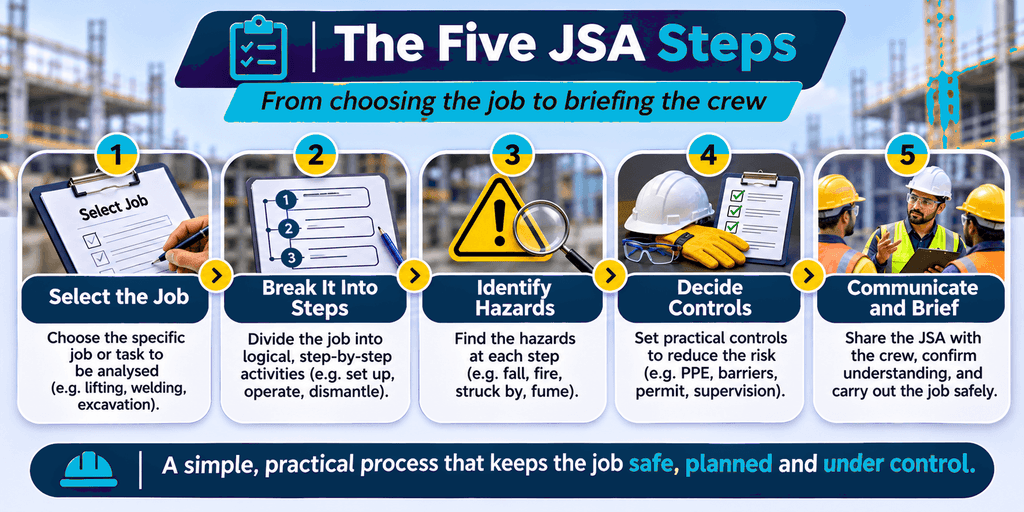
An effective job safety analysis follows a structured process. The following five steps help safety officers prepare a clear and practical assessment.
Step 1: Select the Job
Start by identifying the activity that requires analysis. Select jobs based on their potential severity, previous incidents, frequency and operational conditions.
Avoid broad descriptions such as “maintenance work” or “construction activities”.
Instead, use specific task descriptions, such as:
- Replacing a conveyor belt motor.
- Welding a steel support structure.
- Cleaning an industrial storage tank.
- Changing a lighting fixture using a stepladder.
- Loading materials onto a delivery vehicle.
A clearly defined task helps the safety team focus on relevant hazards.
Step 2: Break the Job into Individual Steps
Observe the activity and divide it into smaller actions in the order workers perform them.
For example, replacing a conveyor belt motor might involve:
- Prepare tools and equipment.
- Isolate the electrical supply.
- Remove protective covers.
- Disconnect the existing motor.
- Lift and remove the old motor.
- Install the replacement motor.
- Reconnect electrical connections.
- Test the equipment and restore operation.
Safety professionals can use the OSHA Job Hazard Analysis Worksheet as a reference when preparing a JSA. The worksheet helps organise job activities, identify potential hazards and document appropriate control measures. It can also help safety officers develop a consistent approach to task-based hazard identification.
Keep the steps simple enough for workers to understand. Five to ten steps may be suitable for many routine activities, but the correct number depends on the complexity of the task.
Consult experienced workers because they understand practical difficulties that may not appear in written procedures.
Step 3: Identify Hazards in Every Job Step
Examine each activity and ask what could cause injury, illness or property damage.
Consider the following hazard categories:
- Physical hazards: Noise, vibration, extreme temperatures and falling objects.
- Electrical hazards: Exposed wires, faulty equipment and unexpected energisation.
- Mechanical hazards: Moving machinery, rotating components and crushing points.
- Chemical hazards: Toxic substances, fumes, vapours and skin contact.
- Ergonomic hazards: Heavy lifting, repetitive movements and awkward postures.
- Environmental hazards: Poor lighting, slippery surfaces and inadequate ventilation.
- Work-at-height hazards: Unprotected edges, unstable ladders and falling materials.
Also identify who could be affected, including employees, contractors, visitors and nearby workers.
A good JSA explains the hazard and its possible consequences rather than simply listing general words such as “electricity” or “falling”.
Step 4: Establish Suitable Control Measures
After identifying hazards, select controls that eliminate or reduce the associated risks.
Follow the hierarchy of controls:
- Elimination: Remove the hazard completely.
- Substitution: Replace a dangerous material or process with a safer alternative.
- Engineering controls: Install machine guards, barriers, ventilation or other protective systems.
- Administrative controls: Introduce safe procedures, training, supervision and restricted access.
- Personal protective equipment (PPE): Provide suitable gloves, helmets, eye protection and safety footwear.
PPE should not become the automatic solution to every hazard.
For example, when workers handle sharp metal sheets, consider safer handling arrangements and suitable mechanical assistance before relying on cut-resistant gloves alone.
Every control should describe a specific action and identify the responsible person where appropriate.
For additional guidance, safety officers can consult the UK Health and Safety Executive (HSE) risk assessment guidance. This resource explains how organisations can identify workplace hazards, evaluate risks and introduce suitable preventive measures. These principles can help Pakistani safety professionals improve their workplace risk assessment and JSA procedures.
Step 5: Communicate, Brief and Review the JSA
A JSA only becomes useful when workers understand its contents.
Before starting the activity, the supervisor should:
- Explain the work sequence and associated hazards.
- Discuss the required control measures.
- Confirm that workers have suitable equipment and PPE.
- Explain emergency arrangements.
- Allow workers to raise concerns or identify missing hazards.
- Record attendance and required acknowledgements.
Deliver the briefing in a language workers understand. In Pakistan, this may involve Urdu, Punjabi, Pashto or another regional language.
Review the JSA whenever the work method, equipment, personnel or site conditions change. Also review it following an incident, near miss or discovery of an ineffective control.
Practical JSA Example: Changing a Light Fitting from a Stepladder
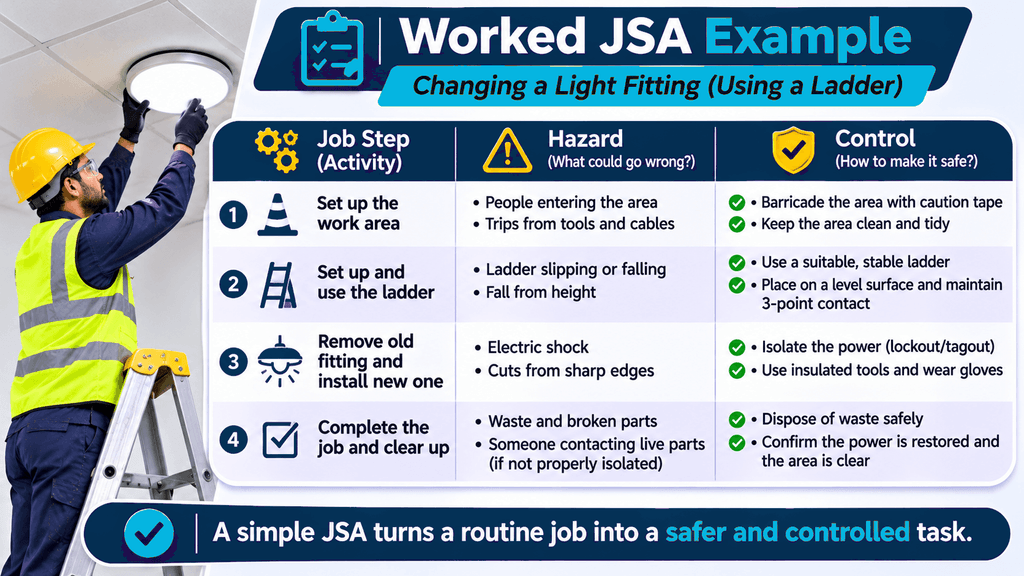
The following example demonstrates how a safety officer can prepare a job safety analysis for a simple maintenance activity.
| Job step | Potential hazard | Recommended control |
|---|---|---|
| Isolate the lighting circuit | Electric shock from incorrect isolation | Authorised electrician identifies the correct circuit, isolates it, applies lockout/tagout and verifies the absence of voltage |
| Carry the stepladder | Strain or collision with nearby workers | Use safe manual handling techniques and obtain assistance when necessary |
| Position the stepladder | Ladder slipping or tipping | Inspect the ladder and position it on a firm, level surface with locking mechanisms secured |
| Climb and remove the fitting | Fall from height or falling materials | Use suitable access equipment, maintain safe positioning and restrict access below |
| Install the replacement fitting | Overreaching or dropped tools | Reposition the ladder or use a safer access platform; secure tools appropriately |
| Restore electrical supply | Contact with exposed electrical components | Check that connections and covers are secure; clear the work area and follow the authorised restoration procedure |
| Remove equipment and waste | Trips or injuries from broken glass | Remove waste safely and leave the work area clean |
Important: This example is for learning purposes. Actual controls must reflect the equipment, electrical system, working conditions and competent-person requirements at the site. A stepladder is not automatically suitable for every work-at-height task.
JSA vs Risk Assessment vs Method Statement
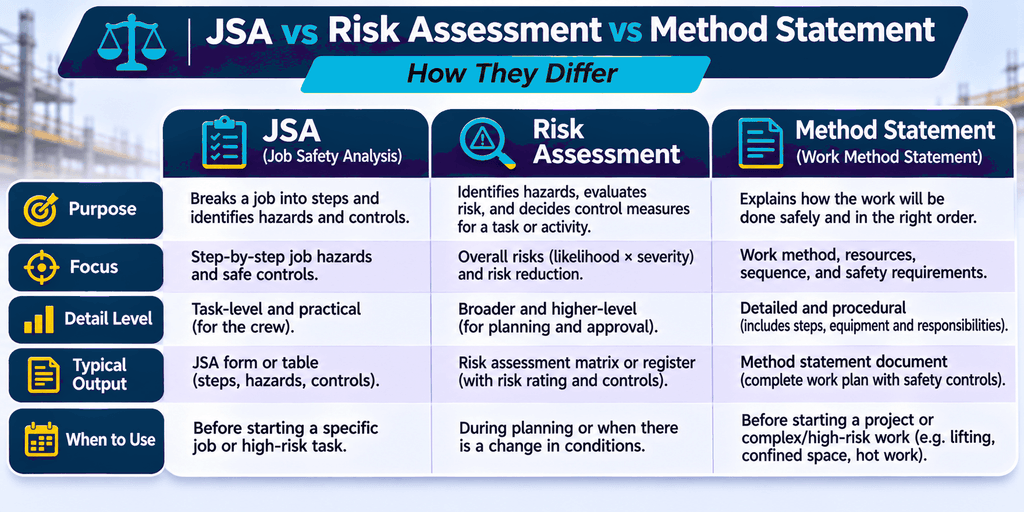
Safety professionals often use these three documents together, but they have different purposes.
| Document | Main purpose | Typical application |
|---|---|---|
| Job Safety Analysis (JSA) | Examines hazards associated with individual job steps | Task-level safety briefing |
| Risk Assessment | Identifies hazards, evaluates risks and determines suitable controls | Workplace and activity risk management |
| Method Statement | Explains how work will be carried out, including the sequence and resources | Planning and approval of work activities |
A risk assessment evaluates the hazards and risks. A method statement explains the planned working method. A JSA helps the work team understand the hazards and controls associated with the actual task.
These documents should remain consistent. If the JSA describes a different working method from the approved method statement, the supervisor should resolve the difference before work begins.
For related guidance, read our permit to work system guide in Pakistan.
Common Job Safety Analysis Mistakes in Pakistani Workplaces
Even organisations with established safety procedures can prepare ineffective JSAs.
Watch out for these common mistakes:
- Copying old documents: Reusing a previous JSA without checking the actual task and location.
- Ignoring workers: Preparing the assessment without consulting the people performing the activity.
- Writing unclear controls: Using instructions such as “be careful” or “follow safety rules”.
- Depending only on PPE: Ignoring elimination, substitution and engineering controls.
- Collecting signatures without briefing: Treating the JSA as an administrative requirement.
- Ignoring changing conditions: Continuing work when the original procedure no longer applies.
- Using difficult language: Giving workers instructions they cannot understand.
A practical JSA should be specific, understandable and regularly reviewed. It should help workers make safer decisions rather than simply satisfy a documentation requirement.
How Job Safety Analysis Supports NEBOSH IGC
Job safety analysis is closely connected with the practical principles taught in the NEBOSH International General Certificate (IGC).
For detailed information about the qualification, learners should consult the official NEBOSH International General Certificate syllabus guide. It provides information about the qualification’s learning outcomes and helps candidates understand the health and safety knowledge required for professional practice.
NEBOSH learners study hazard identification, risk assessment, workplace control measures and health and safety management. Understanding how to break a task into individual steps also helps candidates develop a systematic approach to identifying hazards.
For example, when examining a maintenance activity, a safety professional should consider:
- What work will take place?
- Which hazards are associated with each stage?
- Who could be harmed?
- What injuries or illnesses could occur?
- Which controls will reduce the risks?
- Who will implement and monitor those controls?
These skills are useful in construction, manufacturing, oil and gas, logistics and other industries in Pakistan and the Gulf region.
You can also read our NEBOSH IGC 2026 Pakistan student guide to understand the qualification and its practical learning objectives.
For interview preparation, explore our Safety Officer Interview Questions Pakistan guide.
Frequently Asked Questions
The main purpose is to identify hazards associated with individual job steps and establish appropriate control measures before workers begin an activity.
JSA means Job Safety Analysis, while JHA means Job Hazard Analysis. Organisations commonly use both terms for the same basic task-based hazard identification method.
The responsible supervisor should normally lead the process with input from workers performing the task. A safety officer can provide technical guidance, review hazards and recommend suitable controls.
There is no fixed number for every task. Many straightforward jobs can be divided into five to ten steps. Complex activities may require more detailed analysis or separate JSAs for different tasks.
Review it before each use and whenever working methods, equipment, personnel or site conditions change. Review it following incidents, near misses or problems with existing controls.
JSA is widely used by employers, contractors and industrial clients as part of workplace risk management and permit-to-work arrangements. Whether a specific JSA document is required depends on applicable provincial and sector-specific requirements, contractual conditions and site procedures. Employers should verify their legal obligations rather than assume that one JSA format applies everywhere.
No. A JSA focuses on hazards associated with the individual steps of a particular task. A risk assessment has a broader role in identifying hazards, evaluating risks and determining suitable preventive measures.
Conclusion
Job safety analysis is an important practical tool for preventing workplace accidents and improving safety communication. By selecting the right job, breaking it into manageable steps, identifying hazards and implementing effective controls, safety officers can help workers perform activities more safely.
For Pakistani workplaces, the most important principle is simple: prepare the JSA with the people doing the job, explain the controls clearly and update the assessment whenever conditions change.
A signed JSA is not proof that a job is safe. Its real value comes from workers understanding and applying the precautions throughout the task.
Build your workplace safety knowledge with NEBOSH International. Explore NEBOSH IGC learning guidance and develop the practical understanding needed to identify hazards, assess risks and support safer working environments.

NEBOSH International General Certificate (IGC) certified HSE professional focused on occupational health and safety, workplace risk assessment, hazard identification, and safety management systems. The content published on NeboshInternational.com is based on current industry guidance, recognized safety best practices, and practical workplace examples to help professionals in Pakistan and the Gulf prepare for NEBOSH qualifications and build successful HSE careers.