Electrical Safety at Work in Pakistan (2026): Complete Guide for Safety Officers
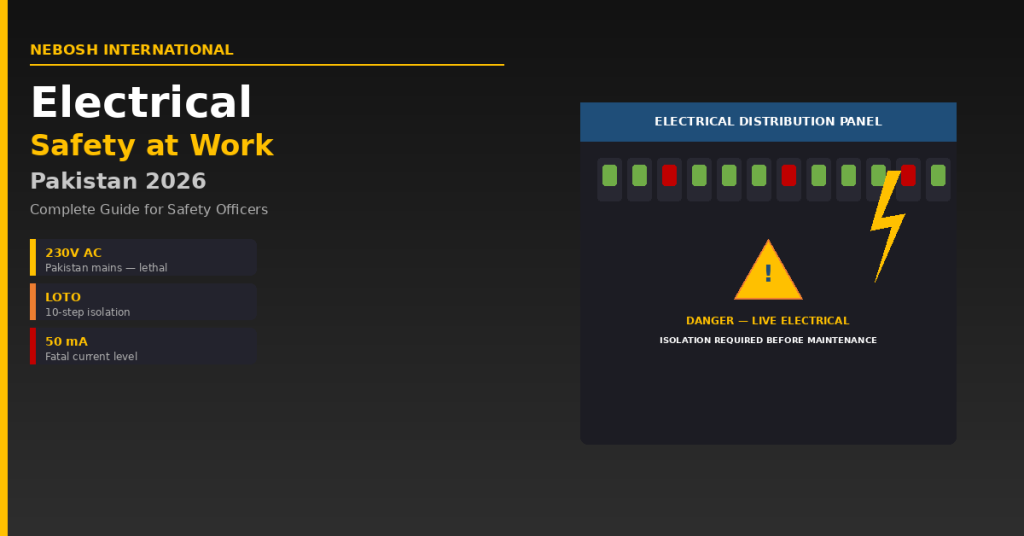
Electrical safety at work in Pakistan is an essential responsibility for safety officers, construction supervisors, maintenance teams and industrial employers. Damaged cables, overloaded sockets, unsafe temporary wiring and poorly controlled maintenance activities can cause electric shocks, burns, fires and fatal injuries.
Consider a construction project in Rawalpindi after heavy rainfall. A safety officer notices damaged electrical cables crossing a wet access road. Workers are continuing their activities because the project is behind schedule. If the hazard remains uncontrolled, a worker could suffer an electric shock or an electrical fault could start a fire.
The correct response is to stop the affected activity, restrict access, arrange safe isolation where necessary and have a competent electrician assess the installation before work resumes.
These precautions apply across construction projects in Lahore, manufacturing facilities in Faisalabad, industrial areas in Karachi and oil and gas operations throughout Pakistan.
This guide explains common electrical hazards, workplace risk assessments, the hierarchy of controls, Lockout/Tagout (LOTO) procedures and practical inspection requirements. It also explains how electrical safety knowledge supports NEBOSH IGC learning and professional HSE development.
1. How Electricity Causes Workplace Injuries
Electricity can harm workers in several ways:
- Electric shock and electrocution: Current passing through the body can interfere with breathing and heart function. The outcome depends on factors such as current, exposure duration, body pathway and environmental conditions.
- Electrical burns: Contact with live conductors or electrical faults can produce serious burns, including internal tissue damage.
- Arc flash injuries: An electrical arc can release intense heat, light and molten material. Severe injuries may occur even without direct contact with a conductor.
- Electrical fires: Faulty wiring, damaged insulation and overloaded circuits can generate heat and ignite nearby combustible materials.
- Secondary injuries: An electric shock may cause involuntary movement, resulting in falls from ladders, contact with machinery or injuries to nearby workers.
Pakistan’s nominal low-voltage supply is commonly around 230V AC. This voltage must never be assumed safe for human contact. Wet conditions, damaged insulation and conductive surroundings can increase the danger.
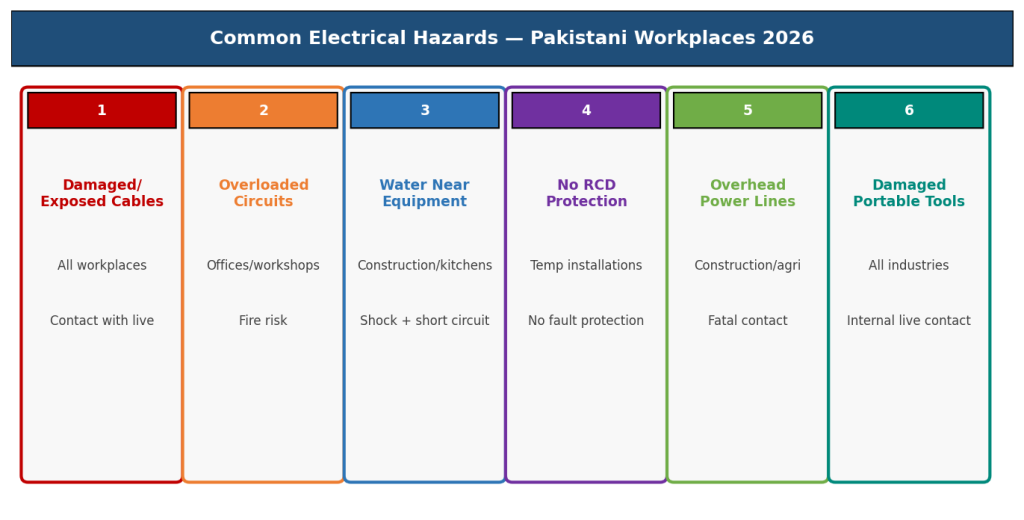
2. Common Electrical Hazards in Pakistani Workplaces
| Electrical hazard | Typical workplace | Possible consequence |
|---|---|---|
| Damaged cables and plugs | Construction sites and workshops | Electric shock or burns |
| Overloaded sockets | Offices and factories | Overheating and fire |
| Water near electrical equipment | Outdoor sites and wet-processing areas | Shock and short circuits |
| Improvised temporary wiring | Housing and infrastructure projects | Exposed conductors and electrical faults |
| Unprotected overhead power lines | Construction and agricultural sites | Fatal electric shock or arcing |
| Maintenance without isolation | Factories and industrial plants | Unexpected energisation |
| Defective portable tools | Construction and maintenance work | Shock, burns or fire |
| Missing or unsuitable protective devices | Temporary electrical distribution systems | Increased risk during electrical faults |
For example, construction projects in DHA or Bahria Town developments may require temporary power supplies as work progresses. Cable routes, connections and equipment locations can change frequently. Therefore, electrical inspections should take place throughout the project rather than only during initial setup.
3. Electrical Risk Assessment: A Practical Method
A workplace electrical risk assessment identifies hazards, evaluates the people who could be harmed and establishes effective controls.
Safety officers can follow these steps:
- Identify hazards: Inspect distribution boards, plugs, extension leads, portable tools, temporary wiring and nearby power lines.
- Identify people at risk: Consider electricians, labourers, contractors, cleaners, visitors and workers using adjacent areas.
- Evaluate existing controls: Check insulation, earthing, protective devices, access restrictions and isolation arrangements.
- Assess the risk: Consider the likelihood of exposure and the potential severity of injury.
- Implement additional controls: Remove defective equipment, improve cable routing, restrict access or arrange competent electrical repairs.
- Record and review: Document findings, assign responsibility and review controls after incidents, equipment changes or new work activities.
Example: If a damaged extension cable lies in a wet construction area, the immediate action is to stop its use and prevent access. A competent person should isolate the supply safely, inspect the equipment and arrange repair or replacement. Simply covering the cable with tape is not an acceptable substitute for proper assessment and repair.
For further learning, read our NEBOSH IGC risk assessment terminology guide.
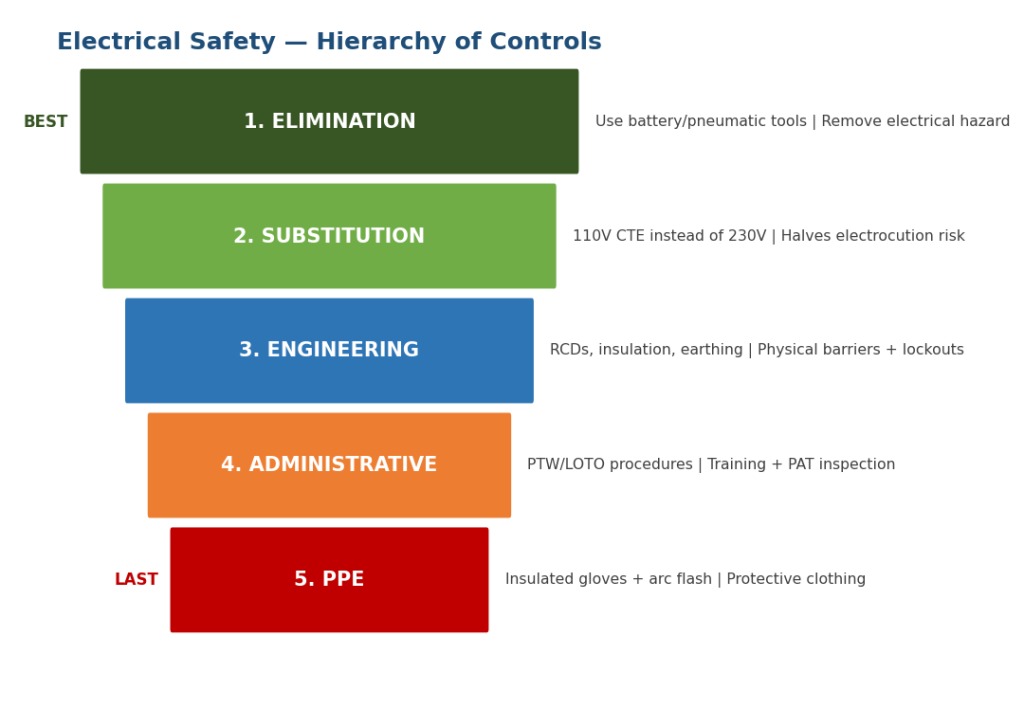
4. Apply the Hierarchy of Controls
The hierarchy of controls helps safety officers select measures that reduce electrical risks effectively.
- Elimination: Remove the electrical hazard where practicable. For example, eliminate unnecessary temporary cables or relocate work away from an electrical hazard.
- Substitution: Use a safer alternative, such as suitable battery-powered tools, where this genuinely reduces risk.
- Engineering controls: Install suitable protective devices, effective earthing, appropriate insulation, secure enclosures and barriers. Residual Current Devices (RCDs) provide additional protection against certain earth-leakage faults but do not eliminate every electric-shock risk.
- Administrative controls: Introduce safe systems of work, electrical permits where required, inspections, training, access restrictions and documented isolation procedures.
- Personal protective equipment: Provide appropriately rated electrical gloves, arc-rated clothing and other specialist equipment when the risk assessment requires them. PPE must be selected for the specific hazard and used alongside other controls.
Safety officers should not rely on warning signs or PPE alone when the electrical hazard can be eliminated or isolated.
5. Lockout/Tagout (LOTO): Electrical Isolation Procedure
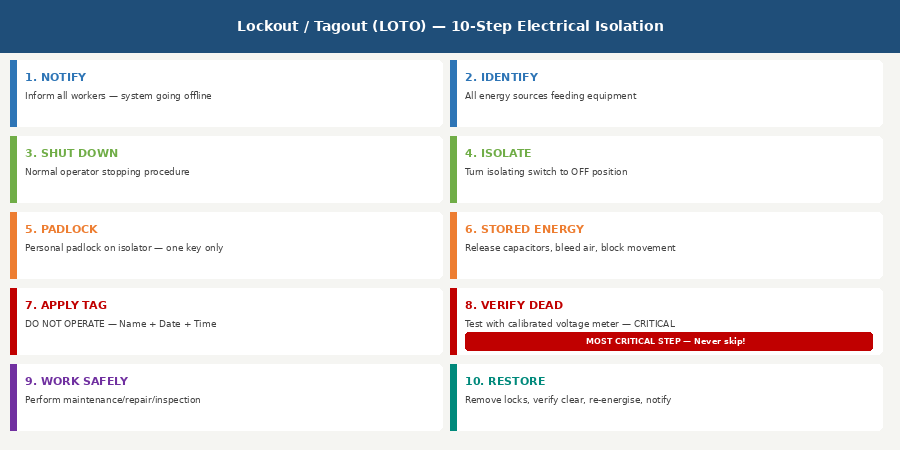
Lockout/Tagout is a system for preventing the unexpected energisation or release of hazardous energy during maintenance and servicing. It is particularly important in manufacturing, construction and industrial environments.
A typical controlled isolation procedure includes these steps:
- Notify affected workers and obtain the required work authorisation.
- Identify every relevant energy source, including alternative electrical supplies and stored energy.
- Shut down the equipment using the approved procedure.
- Operate the correct energy-isolating devices.
- Apply personal locks and identification tags according to the site’s isolation procedure.
- Release or control stored energy, including electrical charge where applicable.
- Verify the isolation using the appropriate approved testing method and suitable test equipment.
- Confirm the equipment is safe before work begins.
- Complete the authorised maintenance or inspection.
- Check that the work is complete, personnel are clear and protective devices are restored before authorised re-energisation.
For electrical work, verification must be performed by a competent, authorised person using an appropriate voltage tester. The tester should be checked before and after testing in accordance with the approved procedure. Never assume equipment is de-energised merely because a switch is off.
Where multiple workers are involved, the isolation arrangement must protect each person. A permit to work supports the process where required, but a permit alone does not make electrical equipment safe.
Read the official OSHA Lockout/Tagout guidance for additional information about hazardous-energy control. Its legal requirements apply in the United States; Pakistani workplaces must also follow their applicable local requirements and site procedures.
6. Electrical Safety on Pakistani Construction Sites
Construction sites need particular attention because temporary installations, outdoor exposure, moving machinery and excavation work can introduce changing electrical risks.
Safety officers should verify the following controls:
- Route cables away from vehicle movements, standing water and sharp edges.
- Protect temporary distribution boards against environmental conditions and unauthorised access.
- Provide suitable RCD protection where required by the risk assessment and applicable standards.
- Arrange regular checks of cables, plugs, tools and electrical enclosures.
- Remove defective equipment from service and clearly identify it until repaired or replaced.
- Identify underground services before excavation and use suitable detection and safe digging procedures.
- Establish site-specific exclusion zones around overhead power lines in consultation with the relevant utility and competent personnel.
- Ensure electrical installation and repair work is undertaken by suitably qualified and authorised personnel.
- Stop work when weather, flooding or equipment damage makes electrical conditions unsafe.
Do not use a single assumed clearance distance for every overhead power line. Safe distances depend on voltage, equipment, operating conditions and applicable requirements.
For additional background, consult the UK Health and Safety Executive’s electrical safety at work guidance. Use it as technical guidance rather than as a substitute for Pakistani legal requirements.
7. Electrical Inspections and Safety Documentation
Electrical safety requires documented checks and follow-up actions, not just visual supervision.
Safety officers should maintain or verify the following records:
- Electrical risk assessments and safe systems of work.
- Installation inspection and testing certificates.
- Portable equipment inspection and testing records.
- RCD inspection and test records, including required functional checks.
- LOTO and electrical isolation records.
- Electrical permits and authorisation records where applicable.
- Defect reports, repair records and equipment withdrawal logs.
- Worker training and competency records.
Inspection frequency should reflect the equipment, working environment, manufacturer’s instructions, applicable standards and previous defect history. High-risk environments, including wet outdoor areas and construction sites, may require more frequent checks than low-risk office environments.
For example, an electrical tool used daily on a wet construction site may need more frequent inspection than a stationary office printer. There is no single inspection interval that is appropriate for every item of equipment.
In Karachi’s industrial areas, Faisalabad’s textile facilities and Lahore’s manufacturing sector, well-maintained records help demonstrate that identified hazards receive appropriate attention.
8. Electrical Safety and NEBOSH IGC
Electrical hazards are useful examples when learning workplace hazard identification, risk assessment and control measures for the NEBOSH International General Certificate.
Candidates should practise explaining:
- The hazard and how it could cause harm.
- Who might be affected and under what circumstances.
- Existing controls and why they may be insufficient.
- Additional controls, prioritised according to their effectiveness.
- How the employer can monitor and review those controls.
For example, an exposed conductor near a wet access route is more than a statement that electricity is dangerous. A strong risk assessment explains the exposure, the potential consequences, the immediate corrective action and the measures required to prevent recurrence.
Explore our guide to passing the NEBOSH IGC open-book examination for further study advice.
Frequently Asked Questions
Yes. A 230V AC supply can cause fatal electric shock, serious burns and fires. Never touch exposed conductors or assume a circuit is safe without proper isolation and verification.
No. An RCD can reduce the risk from certain earth-leakage faults, but it cannot prevent every dangerous contact or electrical incident. Correct isolation, earthing, insulation and safe working practices remain essential.
A safety officer should not perform electrical repairs unless they are separately qualified, authorised and competent for the specific work. The HSE role is to identify hazards, verify controls and ensure that appropriate specialists perform the work safely.
Do not touch a casualty who may still be in contact with a live source. Arrange emergency assistance and ensure the electricity is isolated by a safe method. Approach only when it is safe, follow emergency procedures and provide CPR or first aid if trained. Seek urgent medical assessment for anyone who has suffered an electric shock.
LOTO helps prevent unexpected equipment start-up and the release of hazardous energy during maintenance. Safety officers should understand the procedure, verify that authorised personnel follow it and confirm that work does not begin until the required isolation checks are complete.
Conclusion
Electrical safety at work in Pakistan depends on identifying hazards early, using effective engineering controls, maintaining safe electrical installations and controlling hazardous energy during maintenance. These practices are important on construction sites, in factories, in industrial facilities and wherever workers use electrical equipment.
For safety officers in Rawalpindi, Lahore, Karachi, Faisalabad and other Pakistani cities, practical knowledge of electrical risk assessments, inspections and isolation procedures can strengthen workplace safety performance and support professional development.
If you are preparing for the NEBOSH IGC or developing your HSE career, explore the learning resources available at NEBOSH International. Build your knowledge around recognised safety principles and apply it responsibly in your workplace.
Editorial note: This article provides general safety guidance, not a substitute for a competent electrical assessment or applicable Pakistani legal requirements. Electrical work must be performed by appropriately qualified and authorised personnel.

NEBOSH International General Certificate (IGC) certified HSE professional focused on occupational health and safety, workplace risk assessment, hazard identification, and safety management systems. The content published on NeboshInternational.com is based on current industry guidance, recognized safety best practices, and practical workplace examples to help professionals in Pakistan and the Gulf prepare for NEBOSH qualifications and build successful HSE careers.