Workplace Risk Assessment: 5-Step Guide for 2026
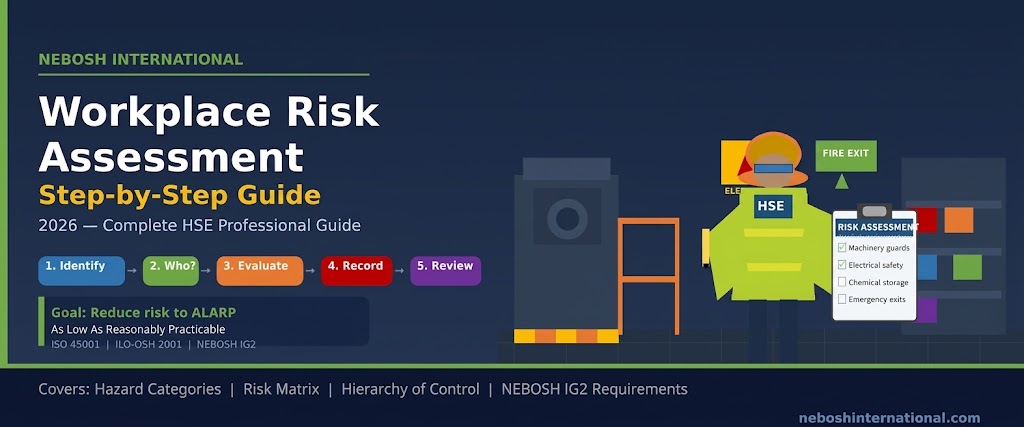
A workplace risk assessment is a practical method for identifying hazards, understanding who may be affected, evaluating risk and deciding what controls are needed to prevent harm. It is an important part of health and safety management across construction, manufacturing, oil and gas, logistics, offices and other workplaces.
For this reason, HSE professionals and NEBOSH IGC learners in Pakistan can benefit from knowing how to conduct a risk assessment. For example, HSE professionals can apply the same principles on a construction project in Rawalpindi, a textile factory in Faisalabad, an oil and gas facility in Karachi, or an industrial workplace in Lahore.
In this guide, you will learn the five steps of workplace risk assessment, review practical examples, understand the hierarchy of control and see how these principles relate to NEBOSH IG2.
What Is a Workplace Risk Assessment?
In simple terms, a workplace risk assessment helps organisations identify hazards, determine who could suffer harm, evaluate risk and select suitable control measures.
Before starting the assessment, understand these three basic terms:
- Hazard: Something with the potential to cause harm.
- Risk: The likelihood that harm could occur and the possible severity of the outcome.
- Control measure: A precaution used to eliminate or reduce the risk.
For example, an exposed electrical conductor is a hazard. For example, an electrical shock could injure a worker, while isolating the electrical supply, repairing the installation and preventing unauthorised access can reduce the risk.
A risk assessment should not simply become paperwork. Instead, its purpose is to help an organisation understand significant hazards and then take practical action to control them.
For wider occupational health and safety information, consult the International Labour Organization’s safety and health resources and ISO 45001 occupational health and safety resources.
What Are the 5 Steps of a Workplace Risk Assessment?
The workplace risk assessment process can be divided into five practical stages:
- Identify the hazards
- Identify who may be harmed and how
- Evaluate the risks and select controls
- Record findings and implement controls
- Review and update the assessment
In practice, these five steps provide a useful framework. However, each organisation should adapt its assessment procedure to the workplace, activity and applicable requirements.
Step 1: Identify Workplace Hazards
First, identify anything that could cause injury, ill health or other harm.
In addition, look beyond normal production activities.
In addition, look beyond normal production activities. A good assessment should consider routine and non-routine work, including maintenance, cleaning, equipment breakdowns, loading and unloading, contractor activities and emergency situations.
Common workplace hazards
| Hazard | Examples |
|---|---|
| Physical | Noise, vibration, slips, trips and falls |
| Mechanical | Moving machinery, vehicles and lifting equipment |
| Electrical | Damaged cables, exposed conductors and faulty equipment |
| Chemical | Solvents, fuels, gases, dusts, fumes and cleaning chemicals |
| Fire | Flammable materials, ignition sources and blocked escape routes |
| Ergonomic | Manual handling, repetitive tasks and awkward postures |
| Biological | Bacteria, viruses, mould and contaminated materials |
| Work at height | Ladders, scaffolds, platforms and open edges |
| Psychosocial | Excessive workload, fatigue, violence and work-related stress |
To identify hazards accurately, use information from sources such as:
- Workplace inspections
- Worker discussions
- Accident and near-miss records
- Safety observations
- Safety Data Sheets
- Equipment manuals
- Maintenance records
- Previous assessments
- Manufacturer information
- Competent HSE advice
Pakistan workplace example
Consider a construction site in Rawalpindi. A safety officer may identify open edges, excavation hazards, temporary electrical supplies, moving vehicles, falling objects and poor housekeeping.
Similarly, a textile facility in Faisalabad may present different significant hazards, including machinery, noise, cotton dust, fire, manual handling and chemical exposure.
Therefore, a workplace risk assessment should reflect the actual workplace rather than rely on a generic template.
Step 2: Identify Who May Be Harmed and How
Next, determine who could be exposed and how each hazard could cause harm.
Next, consider everyone who could encounter the hazard, including:
- Employees
- Contractors
- Temporary workers
- Visitors
- Maintenance personnel
- Delivery drivers
- New or inexperienced workers
- People working alone
- Members of the public where relevant
For example, an unprotected edge on a construction platform could expose workers installing materials, contractors carrying equipment and maintenance personnel entering the area.
Instead of simply writing “workers may be harmed,” explain the exposure.
For example:
Hazard: Open edge on elevated platform
Person at risk: Construction workers and contractors
Possible harm: Fall from height causing fractures, serious injury or fatality
This creates a clearer connection between the hazard, exposure and potential consequence.
Step 3: Evaluate the Risk and Select Control Measures
Once you identify the hazards and exposed people, assess the risk and determine whether existing precautions provide enough protection.
For this purpose, many organisations use a risk matrix based on likelihood and severity. For example, a common approach is:
Risk = Likelihood × Severity
However, organisations may use different scoring systems. Therefore, follow the workplace’s established risk-rating method when assigning a risk rating.
Example risk assessment
| Hazard | Existing control | Additional control |
|---|---|---|
| Open edge | Warning signs | Suitable edge protection |
| Chemical exposure | Gloves | Substitution, ventilation and suitable PPE |
| Machine entanglement | Operator training | Fixed/interlocked guarding |
| Excessive noise | Hearing protection | Engineering controls and noise reduction |
| Manual handling | Basic training | Mechanical handling equipment and task redesign |
Use the Hierarchy of Control
When selecting controls, use the hierarchy of control to identify the most suitable approach:
- Elimination – Remove the hazard completely.
- Substitution – Replace it with a less hazardous alternative.
- Engineering controls – Physically separate people from the hazard.
- Administrative controls – Use procedures, training, supervision or organisational arrangements.
- PPE – Protect the individual from remaining exposure.
For example, if a workplace has excessive noise, providing hearing protection may be necessary, but it should not automatically be the only solution. Instead, depending on the circumstances, the organisation can consider quieter equipment, engineering controls, isolation, maintenance and reduced exposure.
Ultimately, the appropriate control depends on the hazard, exposure, workplace conditions and available options.
Step 4: Record the Findings and Implement Controls
Next, document the important findings and make sure the responsible people implement the agreed controls.
For effective follow-up, a workplace risk assessment record should contain:
- Hazard
- People exposed
- Possible harm
- Existing controls
- Initial risk rating
- Additional control measures
- Responsible person
- Target completion date
- Residual risk
- Review date
Workplace risk assessment example
Hazard: Unprotected edge on a construction platform
People at risk: Workers and contractors
Possible harm: Fall from height
Existing control: Warning signage
Additional control: Suitable edge protection and controlled access
Responsible person: Site management
Completion: Before work continues in the affected area
Most importantly, recording a control does not mean that management has implemented it.
A risk assessment becomes more useful when responsibilities, deadlines and follow-up arrangements are clearly established.
Step 5: Review and Update the Risk Assessment
Finally, keep the workplace risk assessment relevant as conditions change.
In particular, review the assessment when:
- New machinery is installed.
- A work process changes.
- New chemicals or substances are introduced.
- An accident or near miss occurs.
- Workers report a new hazard.
- Existing controls are not effective.
- Workplace conditions change.
- Contractors introduce new activities.
- Relevant organisational or legal requirements change.
- A scheduled review is due.
For instance, a manufacturing facility in Faisalabad may need to reassess hazards after installing a new production line.
Similarly, a construction project in Lahore may need different assessments as workers move from excavation to structural work, mechanical installation and finishing.
Risk assessment is therefore an ongoing safety-management activity, not a document that should simply be completed and forgotten.
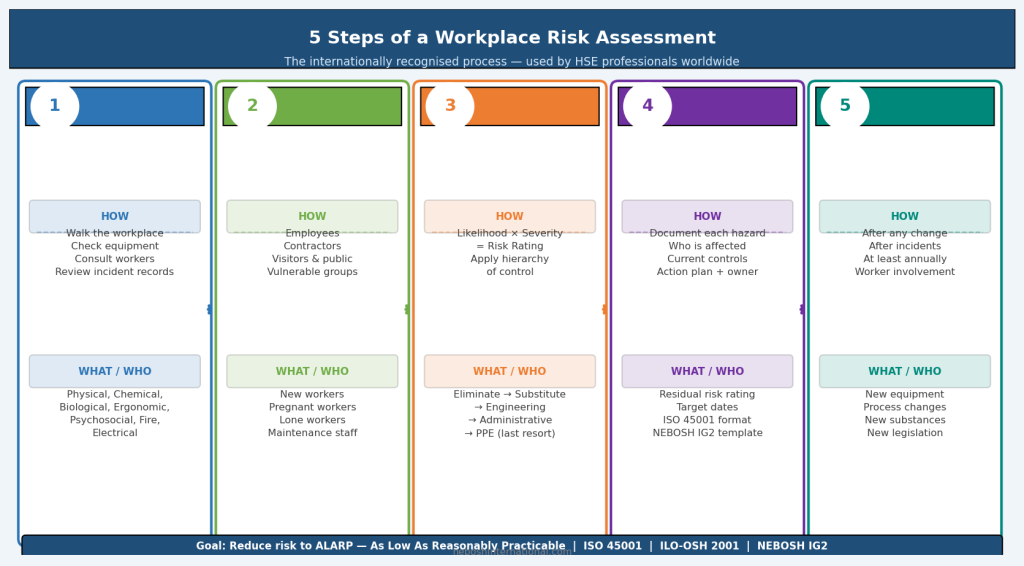
Workplace Risk Assessment Example: Portable Cutting Machine
For example, consider a worker using a portable cutting machine.
Hazard: Contact with the cutting wheel
Who may be harmed: Operator and nearby workers
Possible harm: Cuts, serious hand injuries or eye injuries from flying particles
Existing controls: Machine guarding and operator instruction
Additional controls: Equipment inspection, maintenance, safe operating procedures, suitable work positioning and appropriate PPE where required
Review: Check whether the controls remain effective and whether changes to equipment or work methods have introduced additional hazards.
As a result, this example shows how a good assessment connects the hazard, exposed people, possible harm, existing controls and additional actions.
Common Workplace Risk Assessment Mistakes
1. Copying a Generic Risk Assessment
Templates can provide a useful structure. However, assessors should adapt them to the actual workplace.
For example, a construction assessment should not simply become the template for a textile factory because the hazards, activities and exposed people may differ.
2. Treating PPE as the First Solution
PPE can be an important control, but it should not automatically be the first option considered.
Instead, use the hierarchy of control to determine whether you can eliminate or substitute the hazard or control it through engineering or administrative measures.
3. Ignoring Non-Routine Activities
Furthermore, maintenance, cleaning, repairs, shutdowns and emergency work can create hazards that do not occur during normal operations.
Therefore, assessors should consider these activities whenever their risks differ from routine work.
4. Not Consulting Workers
Workers who perform a task regularly may have practical knowledge about hazards, shortcuts, equipment problems and changing conditions.
As a result, worker input can improve the quality of the assessment.
5. Listing Controls Without Implementing Them
A control measure written on a form does not reduce risk unless it is actually put into practice.
Therefore, assign responsibility and completion dates to turn assessment findings into action.
6. Failing to Review
Over time, equipment, substances, processes or working arrangements can change and make a risk assessment outdated.
Therefore, conduct regular and event-driven reviews to keep the assessment relevant.
Workplace Risk Assessment for NEBOSH IG2
For NEBOSH IGC learners, risk assessment provides practical experience with hazard identification and control selection, which are important HSE skills.
When preparing for the practical assessment, learners should therefore understand how to:
- Identify realistic workplace hazards.
- Explain who could be harmed and how.
- Describe existing controls.
- Recommend additional controls.
- Apply the hierarchy of control.
- Prioritise significant risks.
- Suggest practical actions.
- Present findings clearly.
However, assessment requirements can change. Always check the latest instructions directly from NEBOSH before preparing or submitting an assessment.
You can also read our internal guide on how to pass the NEBOSH IGC Open Book Exam and explore our NEBOSH FAQs in Pakistan.
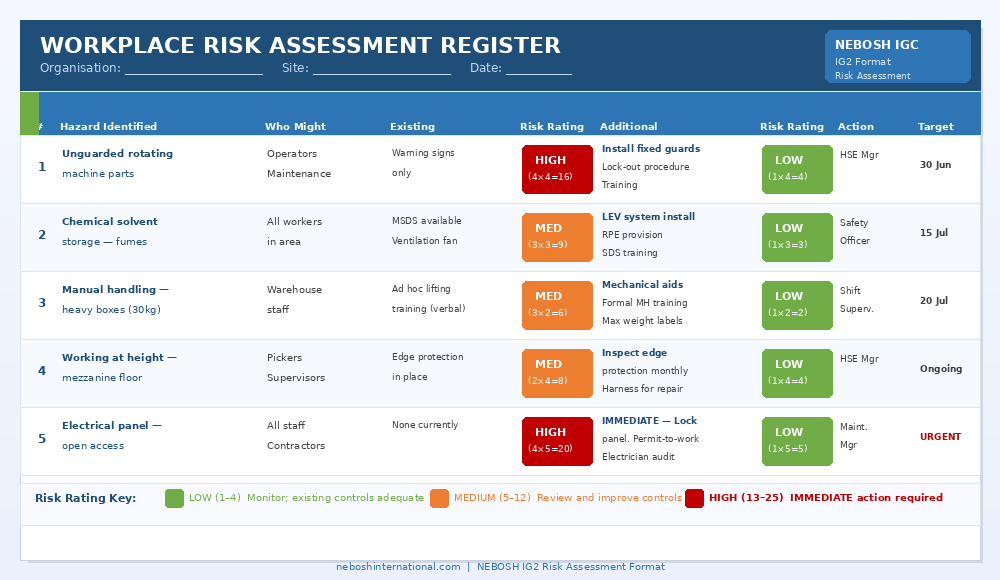
Workplace Risk Assessment in Pakistan: Industry Examples
In Pakistan, HSE professionals can apply this five-step process across different industries.
Construction
For instance, construction assessments commonly cover:
- Work at height
- Excavation
- Lifting operations
- Temporary electrical systems
- Mobile plant
- Falling objects
Manufacturing and Textiles
Similarly, manufacturing and textile assessments may cover:
- Machinery guarding
- Noise
- Dust
- Fire
- Manual handling
- Chemical exposure
Oil and Gas
In oil and gas workplaces, risk assessments may consider:
- Flammable substances
- Confined spaces
- Pressure systems
- Hot work
- Gas exposure
- Vehicle movements
Offices
Meanwhile, office assessments can include:
- Slips and trips
- Electrical equipment
- Ergonomic arrangements
- Fire evacuation
- Manual handling
- Workplace environment
This industry-based approach also makes risk assessment more useful for HSE professionals working in different cities and sectors across Pakistan.
Frequently Asked Questions
The five steps are straightforward: identify hazards, identify who might suffer harm and how, evaluate risks and decide on precautions, record and implement findings, and review the assessment.
In simple terms, a hazard is something that can cause harm. In contrast, risk considers the likelihood of that harm occurring and the potential severity of the consequences.
In practice, every stage contributes to effective risk management.In practice, the assessment should identify significant hazards accurately and lead to suitable controls that are actually implemented and maintained.
Generally, PPE is one level within the hierarchy of control. Instead, where reasonably practicable, consider higher-level controls such as elimination, substitution and engineering controls.
There is no single review period suitable for every workplace. Instead, review the assessment when significant changes occur, after relevant incidents, when controls prove ineffective and according to the organisation’s review arrangements.
Yes. In particular, understanding hazards, people at risk, risk evaluation, control measures and the hierarchy of control provides important practical knowledge for NEBOSH learners and HSE professionals.
Yes, a template can provide a useful structure. However, adapt it to the specific workplace, activities, hazards, people exposed and existing controls.
Conclusion
A workplace risk assessment provides a structured way to identify hazards, understand who could be harmed, evaluate risks, select suitable controls and check whether those controls remain effective.
The five-step process is straightforward:
Identify hazards → identify people at risk → evaluate risk and select controls → record and implement actions → review and update.
In Pakistan, HSE professionals can apply these principles across construction, manufacturing, textiles, oil and gas, logistics and office environments. For NEBOSH IGC learners, the same concepts provide useful practical knowledge for understanding workplace hazards and control measures.
For independent Pakistan-focused information about NEBOSH courses, examinations and HSE careers, explore NEBOSH International.
Disclaimer: NEBOSH International is an independent information and learner-referral platform. It is not NEBOSH and does not issue NEBOSH qualifications.

NEBOSH International General Certificate (IGC) certified HSE professional focused on occupational health and safety, workplace risk assessment, hazard identification, and safety management systems. The content published on NeboshInternational.com is based on current industry guidance, recognized safety best practices, and practical workplace examples to help professionals in Pakistan and the Gulf prepare for NEBOSH qualifications and build successful HSE careers.



2 Comments
Comments are closed.