Hot Work Safety Pakistan: 7 Essential Fire Prevention Tips (2026)
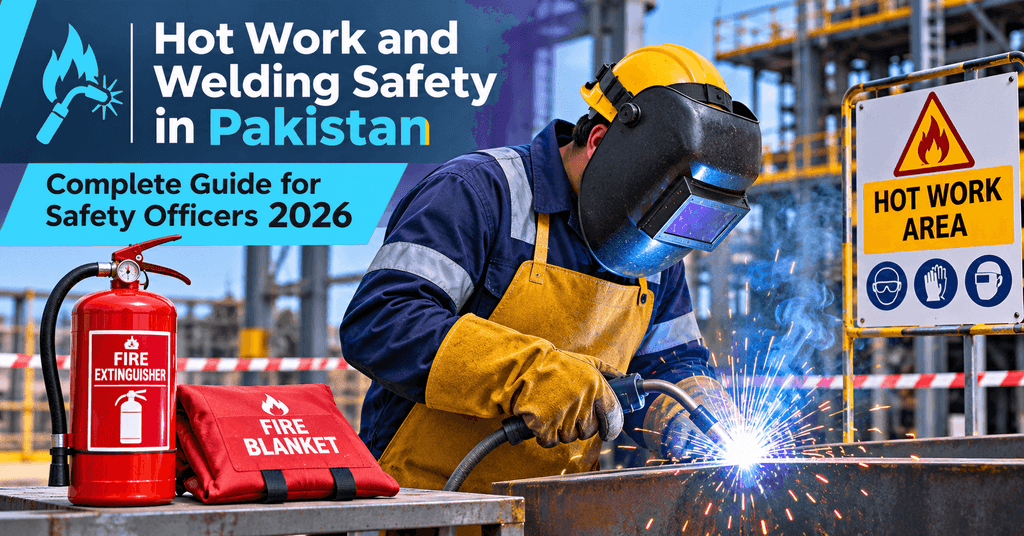
Hot work safety in Pakistan helps employers prevent workplace fires, explosions, burns and occupational diseases during welding, gas cutting, grinding and other heat-producing activities. Therefore, every employer must identify hot work hazards, assess workplace conditions and implement suitable fire prevention procedures.
In Pakistan, hot work is common in construction projects, textile factories, manufacturing plants, engineering workshops, shipyards and oil and gas facilities. However, sparks, molten metal and welding fumes can create serious risks when workers perform these activities without proper controls.
Furthermore, inadequate supervision and poor permit-to-work procedures can increase the likelihood of workplace accidents. For this reason, employers should establish clear safety arrangements before allowing hot work to begin.
This guide explains hot work safety procedures, welding hazards, hot work permit requirements, fire watch responsibilities, respiratory protection and practical precautions for Pakistani workplaces in 2026.
What Is Hot Work?
Workers perform hot work whenever an activity generates flames, sparks or enough heat to ignite combustible materials or trigger an explosion.
Common examples include:
- Electric arc welding
- Gas welding and oxy-fuel cutting
- Grinding and abrasive cutting
- Brazing and soldering
- Flame heating and blow-torch operations
- Bitumen torch applications during roofing
- Other maintenance activities involving ignition sources
Importantly, safety officers sometimes overlook grinding during workplace inspections. However, an angle grinder can generate hot particles capable of igniting nearby packaging, timber, chemicals and other combustible materials.
Therefore, employers should include welding, cutting and grinding in their hot work risk assessments and permit procedures.
7 Major Hot Work Hazards in Industrial Workplaces
Understanding workplace hazards is the first step towards effective hot work safety in Pakistan. Moreover, identifying potential consequences helps safety officers select appropriate preventive measures.
| Hazard | Possible consequences | Essential controls |
|---|---|---|
| Flying sparks | Fire and property damage | Remove combustibles and use fire blankets |
| Flammable gases | Explosion and serious injuries | Gas testing and isolation |
| Welding fumes | Lung disease and cancer | Extraction and suitable respiratory protection |
| UV and infrared radiation | Arc eye and skin burns | Welding helmets and protective screens |
| Electrical hazards | Electric shock and electrocution | Equipment inspection and safe connections |
| Gas cylinders | Fire, explosion and flashback | Secure cylinders and fit flashback arrestors |
| Hot surfaces | Burns and injuries | Protective clothing and warning signs |
In addition, confined-space welding can expose workers to dangerous concentrations of fumes and gases or oxygen-deficient atmospheres. Consequently, employers must conduct additional risk assessments, obtain authorisation and establish emergency arrangements for these activities.
Fire Precautions Before Starting Hot Work
Fire prevention should begin before the welding machine or cutting torch is switched on. First, employers should determine whether the work can be moved to a designated hot work area.
However, if workers need to perform the job inside an operating factory or construction site, the responsible supervisor should prepare the work area carefully.
Follow these essential precautions:
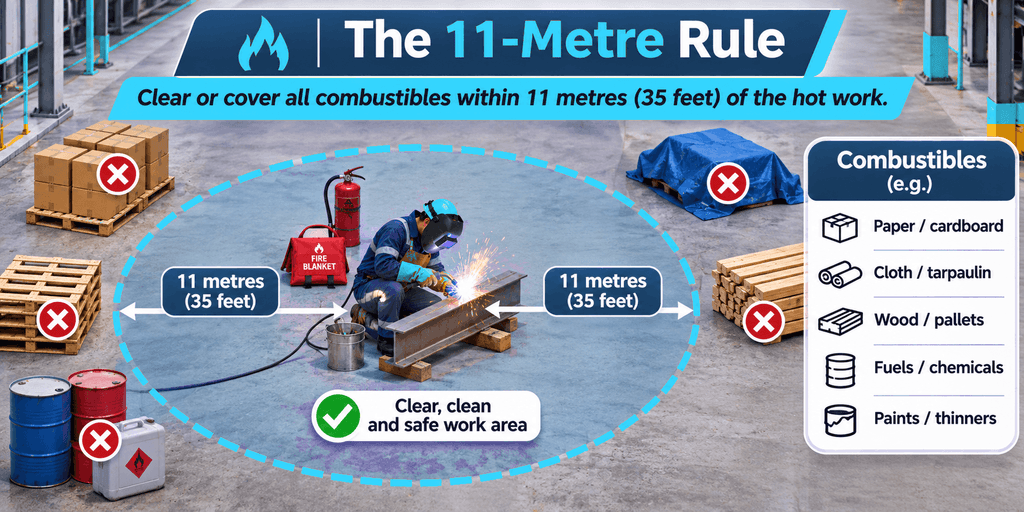
- Remove combustible materials: Clear paper, cardboard, timber, packaging, oil and other flammable materials from the work area.
- Maintain a safe clearance: Maintain an appropriate clearance of 11 metres (35 feet) where applicable to reduce fire risks. Nevertheless, assess whether additional clearance is necessary.
- Protect materials that workers cannot remove with suitable fire-resistant blankets or screens.
- Inspect hidden areas: Check openings, floor gaps, drains, ducts and the opposite sides of walls or metal partitions.
- Control flammable atmospheres: Isolate hazardous substances and arrange atmospheric testing where flammable gases or vapours may be present.
- Provide firefighting equipment: Provide an appropriate fire extinguisher and inspect it regularly.
- Check fire protection systems: Confirm that alarms and sprinklers are operational. Furthermore, manage any necessary impairment under the site procedure.
- Appoint a fire watcher: Provide a trained person whenever the risk assessment or site procedure requires one.
For example, a welder repairing machinery inside a textile factory in Faisalabad may create sparks near cotton fibres, fabric rolls and packaging. Therefore, removing combustible materials and protecting surrounding areas can significantly reduce the likelihood of fire.
What Is a Hot Work Permit?
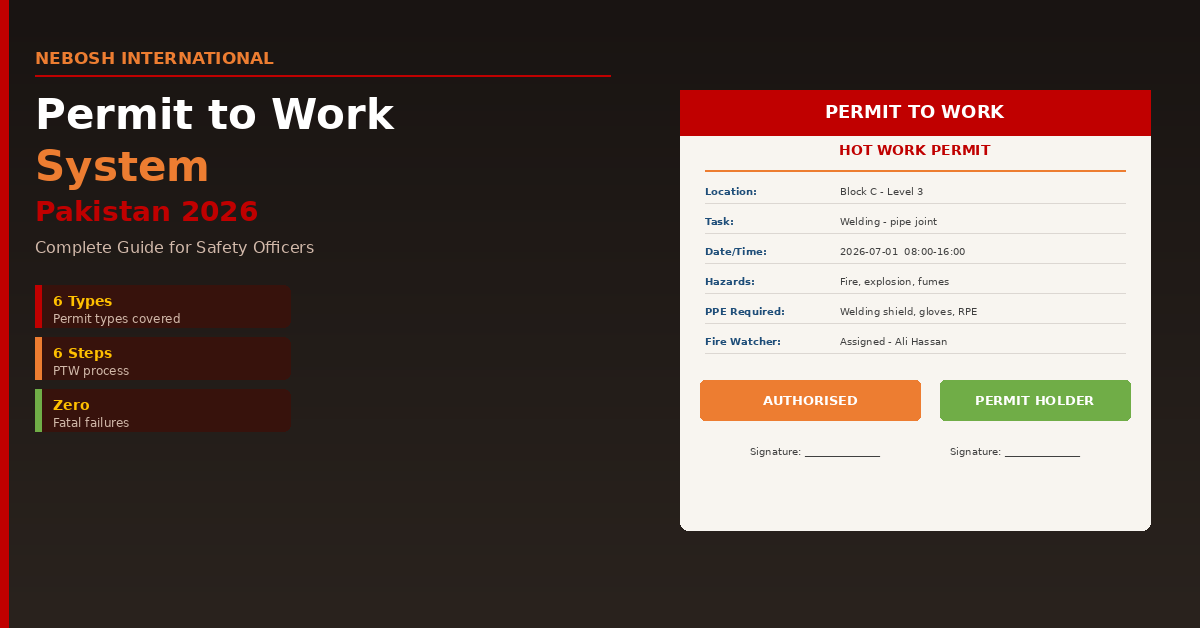
A hot work permit is a formal written authorisation used to control activities that generate flames, sparks or heat in locations where ignition could create a hazard.
In particular, responsible personnel use the permit to assess the work, implement necessary precautions and authorise the activity.
Employers should follow these steps when issuing a hot work permit:
- Work request: The supervisor identifies the job, location, equipment and expected duration.
- Risk assessment: Responsible personnel identify fire, explosion, electrical and health hazards.
- Worksite inspection: The permit issuer checks combustible materials, surrounding areas and required protective measures.
- Gas testing: A competent person conducts atmospheric testing where flammable gases or vapours may be present.
- Authorisation: An authorised person approves the permit for a specified period.
- Work monitoring: The supervisor ensures that workers follow the permit conditions.
- Fire watch and close-out: The fire watcher completes the required post-work monitoring, inspects the area and reports to the responsible supervisor before the supervisor closes the permit.
Importantly, a hot work permit should never replace risk assessment, competent supervision or safe working procedures.
For a better understanding of workplace authorisation procedures, read our guide to the Permit to Work System in Pakistan.
Additionally, consult the NFPA 51B Hot Work Safety Standard for further guidance on fire prevention during welding, cutting and other hot work activities.
Fire Watch Responsibilities During and After Welding
A fire watcher checks the work area for fires during hot work and throughout the required post-work monitoring period.
The fire watcher should:
- Remain focused on the welding or cutting operation.
- Monitor exposed combustible materials and nearby areas.
- Watch for sparks entering concealed spaces.
- Keep suitable firefighting equipment ready.
- Understand the emergency alarm and reporting procedure.
- Raise the alarm if a fire develops beyond their ability to control safely.
- Continue monitoring after hot work stops according to applicable site requirements.
Furthermore, employers should determine the post-work fire watch period using the applicable standard, risk assessment and site procedure.
For example, OSHA 29 CFR 1910.252 specifies at least 30 minutes after welding or cutting in the circumstances covered by its standard. However, some workplace procedures require 60 minutes or longer depending on the hazards.
For additional information, refer to the OSHA Welding, Cutting and Brazing Standard.
Consequently, safety officers should schedule hot work so that adequate monitoring can be completed before responsible personnel leave the site.
Welding Fume Hazards and Health Protection
Although fire is an immediate hot work hazard, Welding fumes can also damage workers’ health over the long term.
The International Agency for Research on Cancer (IARC) classifies welding fumes as carcinogenic to humans. Therefore, employers must control exposure and provide suitable protection.
Different welding materials create different exposure risks:
- Mild steel: Welding fumes contain fine particles and metals that can damage respiratory health.
- Galvanised steel: Heating zinc coatings can release zinc oxide fumes associated with metal fume fever.
- Stainless steel: Fumes may contain chromium and nickel compounds that create additional health concerns.
To reduce these risks, employers should implement the following controls:
- Reduce unnecessary welding and consider alternative joining methods.
- Use local exhaust ventilation (LEV) to capture fumes close to their source.
- Maintain effective general ventilation as a supporting measure.
- Provide suitable respiratory protective equipment (RPE) when engineering controls do not adequately control exposure.
- Inspect and maintain extraction systems and respiratory equipment.
- Train workers about fume exposure, equipment use and associated health risks.
Moreover, the UK HSE welding fume protection guidance provides further information about ventilation and respiratory protection.
For scientific information about occupational carcinogens, consult the International Agency for Research on Cancer (IARC).
Remember, a cloth covering the face is not an effective substitute for suitable respiratory protection.
Gas Welding and Cutting Safety
Oxy-fuel welding and gas cutting involve oxygen and fuel gas cylinders. However, incorrect handling can result in fires, explosions and serious injuries.
Therefore, workers should follow these precautions:
- Store cylinders upright and secure them against falling.
- Use suitable regulators and flashback arrestors.
- Inspect hoses and connections before use.
- Check connections using approved leak-detection solutions, never an open flame.
- Keep oil and grease away from oxygen equipment.
- Separate cylinders from ignition sources and excessive heat.
- Close cylinder valves when equipment is not in use.
- Transport cylinders using appropriate trolleys and protective arrangements.
In addition, workers should understand equipment isolation procedures before carrying out maintenance.
For this purpose, read our Lockout Tagout Procedure in Pakistan. Proper isolation helps prevent unexpected equipment energisation during maintenance.
Special Warning: Welding Empty Drums and Tanks
Cutting or welding an apparently empty drum can cause a fatal explosion.
This is because containers that previously held petrol, diesel, solvents, oils or other chemicals may retain flammable residues and vapours even after emptying.
Therefore, never apply heat to a drum, tank or pipeline without appropriate cleaning, isolation and verification by a competent person that it is safe for the intended work.
Where suitable, consider cold-cutting methods that avoid introducing an ignition source.
This precaution is particularly important in scrap yards, vehicle workshops, oil storage facilities and industrial maintenance operations across Pakistan.
Essential PPE for Welding and Cutting
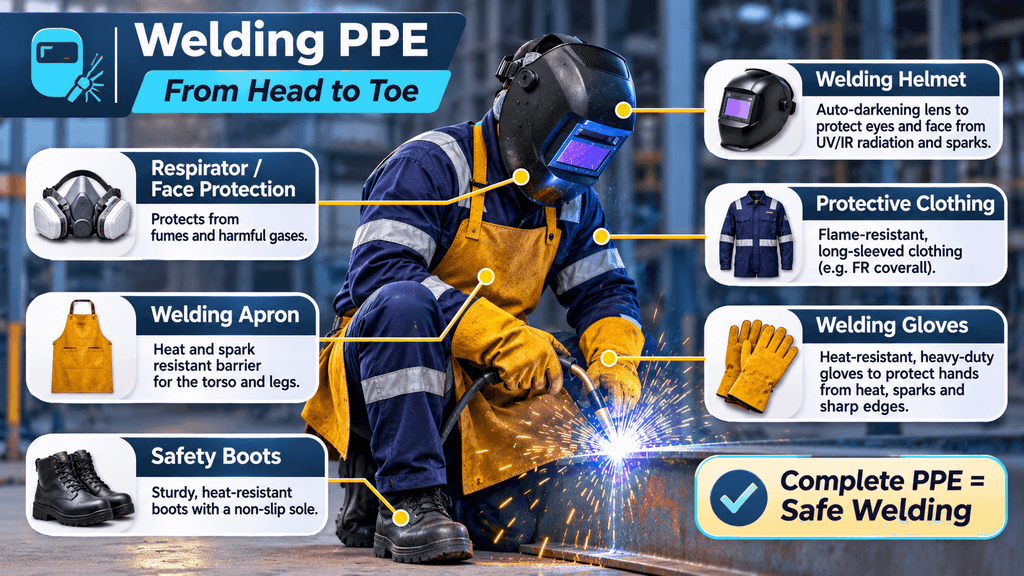
Personal protective equipment (PPE) helps protect workers from burns, sparks, radiation, noise and other hot work hazards.
| Body area | Recommended PPE | Main protection |
|---|---|---|
| Eyes and face | Welding helmet with suitable filter | UV, infrared and sparks |
| Lungs | Suitable respirator or powered air helmet | Welding fumes |
| Hands | Leather welding gloves | Heat and molten metal |
| Body | Flame-resistant clothing and leather apron | Burns and sparks |
| Feet | Safety boots and suitable spats | Falling objects and hot particles |
| Ears | Suitable hearing protection | Grinding and cutting noise |
Furthermore, Employers should install welding screens to protect nearby workers and visitors from arc radiation.
However, PPE should remain the last line of defence. Employers should prioritise eliminating hazards and implementing effective engineering and administrative controls wherever possible.
Hot Work Safety Checklist for Pakistani Safety Officers
Before authorising welding or cutting, safety officers should use a practical checklist to verify every essential precaution.
- Is the work necessary, or can it be moved to a designated workshop?
- Has a suitable risk assessment been completed?
- Has the required hot work permit been approved?
- Have combustible materials been removed or protected?
- Have nearby openings and concealed spaces been inspected?
- Has atmospheric testing been completed where necessary?
- Are gas cylinders and welding equipment in safe condition?
- Are suitable fire extinguishers available?
- Is a trained fire watcher appointed where required?
- Are workers wearing suitable PPE?
- Is effective fume extraction or respiratory protection available?
- Are emergency arrangements understood?
- Will the required post-work fire watch be completed?
Finally, safety officers should adapt this checklist to the equipment, workplace conditions, task risk assessment and company procedures.
Why Hot Work Safety Matters for NEBOSH IGC Candidates
Hot work is a useful practical example for understanding several NEBOSH IGC subjects, including fire prevention, risk assessment, hazardous substances, electrical safety, PPE and permit-to-work systems.
For example, during workplace-based assessment scenarios, candidates may need to identify ignition sources, explain fire precautions or recommend suitable controls for welding activities.
Therefore, candidates should explain how each control reduces the risk rather than simply listing general safety measures.
For more learning resources and information about NEBOSH qualifications, visit NEBOSH International.
You can also explore our Safety Officer Interview Questions Pakistan guide to strengthen your understanding of practical workplace safety responsibilities.
Frequently Asked Questions
Hot work safety involves procedures and precautions that prevent fires, explosions, burns and harmful exposure during activities that generate heat, sparks or flames.
A hot work permit is a formal written authorisation that confirms the necessary safety precautions have been checked before welding, cutting or other ignition-producing work begins.
OSHA 29 CFR 1910.252 refers to a 35-foot (10.7-metre) distance for relocating combustible materials where practicable. Additional protection may be necessary depending on workplace conditions.
OSHA specifies at least 30 minutes after welding or cutting in the circumstances covered by its standard. Some workplaces require 60 minutes or longer based on their risk assessment and applicable procedures.
Yes. Grinding produces sparks and hot particles that can ignite combustible materials. It should be included in hot work risk assessments and permit procedures where required.
Yes. Welding fumes can cause lung cancer and other respiratory health problems. Consequently, employers should use suitable extraction, ventilation and respiratory protection.
Typical welding PPE includes a suitable welding helmet, protective gloves, flame-resistant clothing, safety boots and appropriate respiratory and hearing protection according to the risk assessment.
No. An apparently empty drum may still contain flammable vapours. Therefore, it must be properly cleaned, assessed and verified safe by a competent person before any hot work is considered.
Conclusion
Effective hot work safety Pakistan requires more than providing a welding helmet and fire extinguisher. Employers must assess hazards, control ignition sources, implement suitable permit procedures and protect workers from welding fumes.
Furthermore, effective fire monitoring and competent supervision are essential for preventing workplace accidents.
These measures are particularly important in Pakistan’s construction, manufacturing, textile and oil and gas industries, where welding and cutting are routine maintenance activities.
For safety officers and NEBOSH IGC candidates, understanding these controls helps develop practical knowledge of workplace fire prevention and occupational health and safety.
Finally, learn more about NEBOSH qualifications and workplace safety through NEBOSH International, an independent information and student guidance platform connecting learners with approved NEBOSH Learning Partners.

NEBOSH International General Certificate (IGC) certified HSE professional focused on occupational health and safety, workplace risk assessment, hazard identification, and safety management systems. The content published on NeboshInternational.com is based on current industry guidance, recognized safety best practices, and practical workplace examples to help professionals in Pakistan and the Gulf prepare for NEBOSH qualifications and build successful HSE careers.