NEBOSH IGC After University Pakistan 2026: A Complete Career Guide

Choosing a career after university can be challenging. Many graduates in Pakistan have a degree but are still deciding which professional skills will help them stand out in the job market. For those interested in workplace health and safety, the NEBOSH International General Certificate (IGC) can provide a structured route into the HSE profession.
For example, a civil engineering graduate in Rawalpindi may want to work on construction projects, while a chemistry graduate in Karachi may be interested in industrial safety. Both can consider NEBOSH IGC to develop knowledge of workplace hazards, risk assessment and health and safety management.
NEBOSH IGC after university in Pakistan can be a valuable option for graduates who want to pursue health, safety and environment (HSE) careers in 2026. However, the qualification does not guarantee a job. Employers may also consider relevant education, practical experience, communication skills and the specific requirements of each vacancy.
This guide explains who should consider NEBOSH IGC, whether to study during university or after graduation, which jobs to explore and how Pakistani graduates can prepare for opportunities in Pakistan and the Gulf.
What Is NEBOSH IGC, and Why Should Graduates Consider It?
The NEBOSH International General Certificate in Occupational Health and Safety is an internationally recognised professional qualification designed for people developing or managing workplace health and safety responsibilities.
According to the official NEBOSH qualification information, the course covers health and safety management, hazard control, risk assessment and workplace safety improvement. It is suitable for people beginning an HSE career as well as those who already have safety responsibilities.
Official reference: https://www.nebosh.org.uk/qualifications/international-general-certificate/
A university degree provides academic knowledge in a particular field. NEBOSH IGC complements that foundation by helping learners understand how to identify workplace hazards, assess risks and recommend appropriate control measures.
For Pakistani graduates, this combination may support applications for relevant entry-level positions and technical safety roles where employers request a degree alongside a safety qualification.
The potential benefits include:
- Understanding workplace health and safety responsibilities.
- Developing risk assessment and hazard identification skills.
- Learning how safety management systems operate.
- Applying technical knowledge to real workplace situations.
- Preparing for interviews for suitable HSE positions.
- Building a foundation for further professional development.
The value of the qualification depends on how well you apply what you learn and whether your skills match the requirements of your target job.
Which University Graduates Should Study NEBOSH IGC in Pakistan?
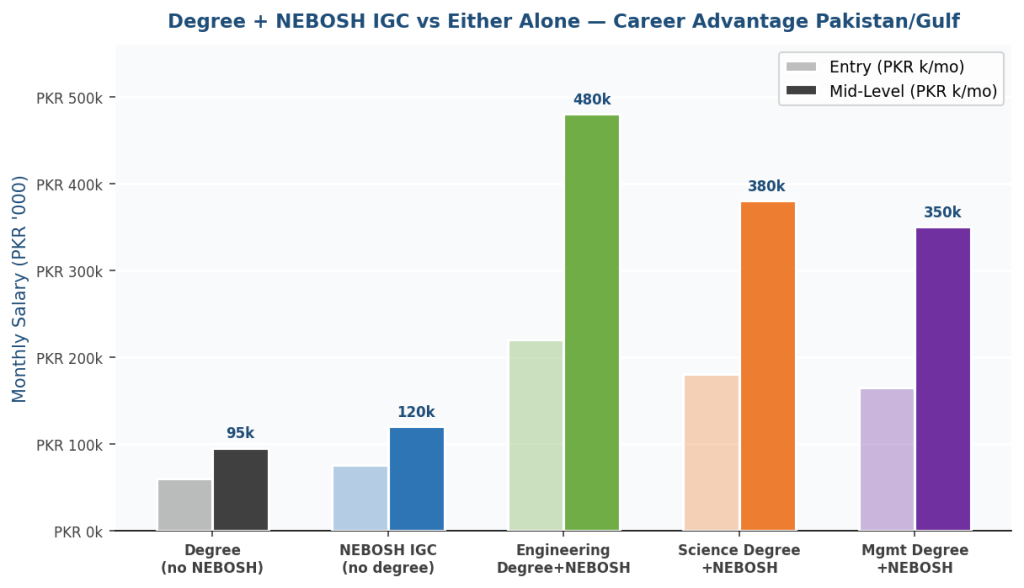
NEBOSH IGC is not restricted to engineering graduates. People from different academic backgrounds can consider it if they want to develop a career in occupational health and safety.
1. Engineering graduates
Civil, mechanical, electrical and chemical engineering graduates may find clear connections between their degrees and HSE responsibilities.
For example, a civil engineer in Lahore may understand construction methods but need additional knowledge of fall prevention, excavation safety, lifting operations and site risk assessments.
Similarly, an electrical engineering graduate may apply their technical knowledge when learning about electrical hazards, isolation procedures and safe systems of work.
Depending on employer requirements, these graduates may explore positions such as:
- Junior HSE Officer
- HSE Engineer
- Construction Safety Officer
- Electrical Safety Officer
- Industrial Safety Officer
An engineering degree does not automatically qualify someone for every engineering-level HSE position. Employers may require relevant experience, industry-specific skills or additional qualifications.
Related guide: NEBOSH IGC for Engineers in Pakistan 2026 — link to your relevant article.
2. Science graduates
Chemistry, biology and physics graduates can also consider NEBOSH IGC.
Their academic background may help them understand chemical exposure, biological hazards, physical agents, laboratory safety and industrial processes.
For example, a chemistry graduate seeking work in manufacturing may benefit from learning how organisations assess hazardous substances, implement control measures and monitor workplace risks.
Possible career pathways include junior HSE roles, laboratory safety support and environmental or industrial safety positions, depending on the employer’s requirements.
3. Business and management graduates
Business administration and management graduates may bring useful skills in planning, communication, documentation and organisational processes.
NEBOSH IGC can complement these skills with knowledge of safety responsibilities, risk management and workplace health and safety systems.
However, candidates should review individual vacancies carefully. Some employers require a technical degree or previous industrial experience for particular HSE positions.
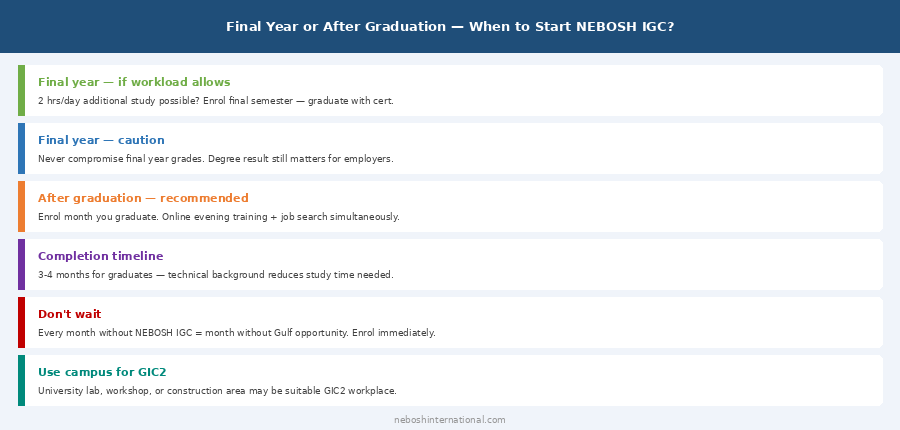
Should You Study NEBOSH IGC During University or After Graduation?
The best time depends on your academic workload, budget, career goals and ability to manage additional study.
Option 1: Study during your final year
Final-year students who can manage their university assignments and examinations may consider beginning NEBOSH IGC before graduation.
Potential advantages:
- You can begin developing HSE knowledge before entering the job market.
- You may be able to apply for relevant vacancies soon after graduation.
- You can use your remaining university time to explore possible career pathways.
However, avoid compromising your degree results. Engineering projects, laboratory work, examinations and other university responsibilities can require significant time.
Option 2: Study NEBOSH IGC after university
For graduates with demanding academic schedules, NEBOSH IGC after university in Pakistan may be a more manageable choice.
You can focus on the course while preparing your CV, researching vacancies and applying for appropriate entry-level positions.
Online or classroom learning may be available through accredited NEBOSH Learning Partners, depending on their course offerings.
Before enrolling, check the provider’s accreditation, course structure, assessment support, total fees and registration arrangements.
Which option is better?
Choose the final-year route if you can maintain a reasonable study schedule without affecting your degree. Choose the post-graduation route if you need more time to concentrate on NEBOSH assessments.
Neither approach guarantees faster employment. The priority is to understand the qualification and build skills relevant to the positions you want.
NEBOSH IGC Eligibility and Course Structure in 2026
One reason graduates consider NEBOSH IGC is its accessible entry route.
NEBOSH states that the International General Certificate has no formal entry requirements. However, learners need a suitable standard of English to understand the syllabus and explain health and safety concepts. NEBOSH recommends English proficiency equivalent to IELTS 6.0 or higher.
The revised qualification introduced for 2026 consists of two units:
| Unit | Main focus |
|---|---|
| GIC1 | Management of health and safety |
| GIC2 | Practical risk assessment |
GIC1 uses a scenario-based open-book assessment. GIC2 requires learners to complete a practical risk assessment and develop an action plan.
The official qualification information describes a minimum of 63 taught hours and approximately 40 hours of private study and background reading. Actual completion time depends on the learner and the training arrangement.
Important: Check whether your provider is offering the revised 2025 specification or an earlier specification. Assessment names, requirements and final assessment dates differ between versions.
Official course details: https://www.nebosh.org.uk/qualifications/international-general-certificate/
What Jobs Can Graduates Target After NEBOSH IGC?
After completing NEBOSH IGC, graduates can research vacancies that match their qualifications, experience and technical background.
| Potential job title | Relevant background | What to check |
|---|---|---|
| Junior HSE Officer | Various degrees, depending on vacancy | Entry-level eligibility and industry requirements |
| Safety Officer | Technical or other relevant qualifications | Required experience and site responsibilities |
| HSE Engineer | Often an engineering degree | Engineering discipline and practical experience |
| EHS Coordinator | Depends on the employer | Safety documentation and coordination skills |
| Construction Safety Officer | Construction or technical background may help | Site experience and construction safety knowledge |
| Industrial Safety Officer | Relevant technical knowledge may be useful | Machinery, process and industrial hazard requirements |
These are potential career paths, not guaranteed outcomes. Some vacancies advertised as entry-level still request previous experience or additional training.
For graduates without HSE experience, it can be sensible to target junior roles, internships, trainee positions or supervised site opportunities before pursuing more senior responsibilities.
Explore related content: Safety Officer Jobs in Pakistan — link to your existing article.
Can NEBOSH IGC Help Pakistani Graduates Find Jobs in the Gulf?
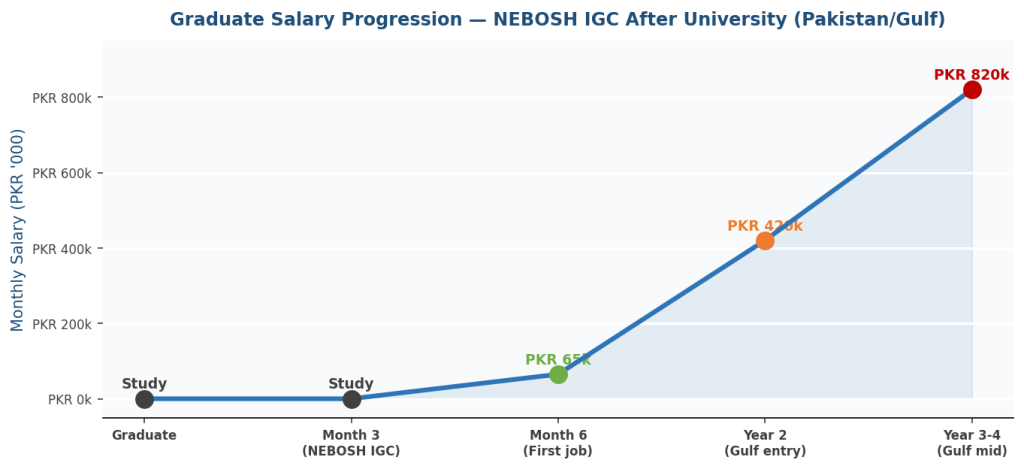
Yes, NEBOSH IGC can strengthen a candidate’s profile for relevant Gulf HSE vacancies. However, employers in Saudi Arabia, the United Arab Emirates, Qatar, Oman and Kuwait set their own requirements.
A graduate applying for a construction safety position in Saudi Arabia may need a relevant degree, NEBOSH qualification, site experience and knowledge of construction hazards. An industrial employer in the UAE may prioritise experience with its particular operations and safety procedures.
Before applying, review the vacancy for:
- Required degree or technical qualification.
- Minimum years of HSE experience.
- Industry-specific knowledge.
- Communication and reporting skills.
- Additional certifications or registrations.
- Work authorisation and other employment conditions.
What about Gulf salaries?
There is no single salary for everyone holding NEBOSH IGC. Earnings vary by country, employer, industry, experience, job responsibilities and contract conditions.
Rather than relying on a salary figure attached to the qualification, Pakistani graduates should compare current job advertisements for their target role and location.
Also check whether advertised compensation includes accommodation, transport, medical insurance, overtime or other benefits. These can materially affect the overall employment package.
NEBOSH IGC is one part of a candidate’s professional profile. It does not guarantee a Gulf job, a particular salary or visa approval.
How Much Does NEBOSH IGC Cost in Pakistan?
Course fees depend on the accredited Learning Partner, teaching method, level of support and what the package includes.
Before choosing a provider in Lahore, Karachi, Islamabad, Rawalpindi, Faisalabad or another city, request a written breakdown of the total cost.
Ask whether the quoted amount includes:
- Tuition and learning materials.
- NEBOSH registration and assessment fees.
- Support for the practical risk assessment.
- Mock assessments and tutor feedback.
- Resit charges, if applicable.
- Taxes or other additional costs.
Compare at least two or three providers offering the same qualification specification. A low advertised price may not represent the complete cost.
For more details, read our guide to NEBOSH IGC Course Fees in Pakistan 2026 — link to your existing fees article.
A Practical Career Plan for Fresh Graduates
Completing the course is an important milestone, but it should be part of a broader career plan.
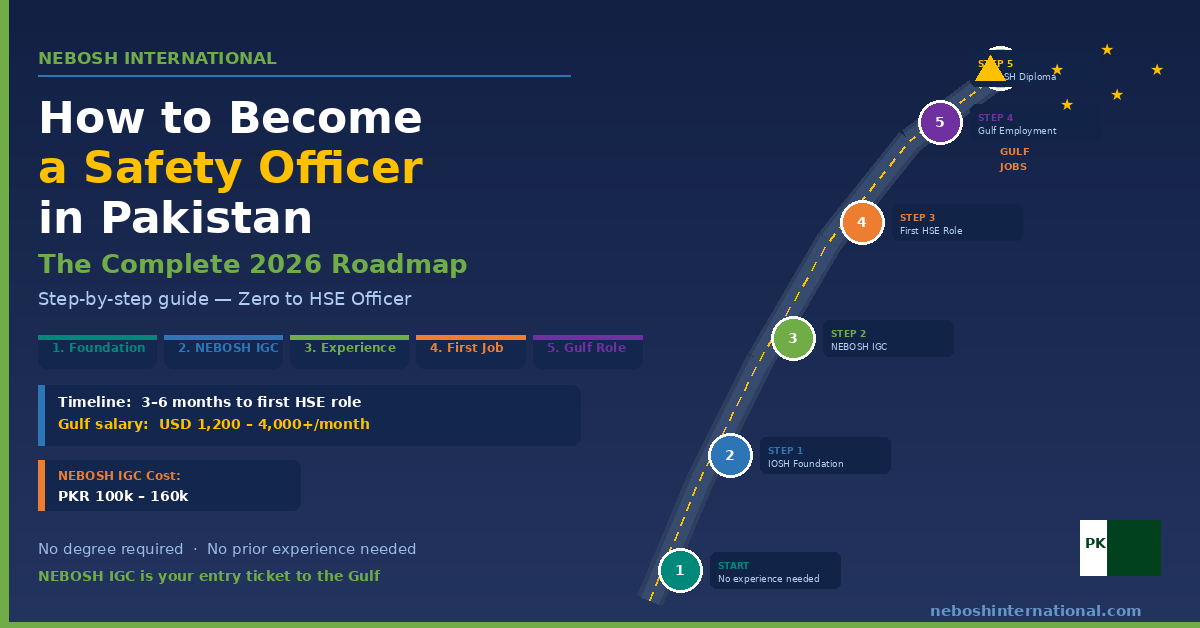
Step 1: Choose your target industry
Decide whether you want to pursue construction, manufacturing, oil and gas, textiles, energy or another sector. Your choice will help you identify the most relevant skills and vacancies.
Step 2: Prepare an HSE-focused CV
List your university degree, NEBOSH qualification status, relevant projects, technical skills and any practical training. Describe genuine experience accurately; do not claim professional site experience you have not gained.
Step 3: Develop practical knowledge
Practise identifying hazards, evaluating risks, proposing control measures and explaining your decisions. Learn about incident reporting, workplace inspections and safety documentation.
Step 4: Apply for suitable positions
Search for junior HSE roles, trainee opportunities and graduate vacancies in your preferred city. Graduates in Rawalpindi, Lahore, Karachi, Peshawar and Faisalabad can use location-specific searches to find relevant openings.
Step 5: Prepare for interviews
Be ready to explain how you would assess a hazard, select controls, report an unsafe condition and respond to a workplace incident.
Step 6: Continue learning
As you gain experience, identify further training that aligns with your target industry and career progression. Build your competence through supervised work and ongoing professional development.
Frequently Asked Questions
It can be worthwhile for graduates who want to enter occupational health and safety. The qualification develops relevant HSE knowledge and can complement a university degree, but employment depends on the complete candidate profile and employer requirements.
Yes. NEBOSH lists no formal entry requirements for the International General Certificate. However, learners need suitable English proficiency and must complete the required learning and assessments through an accredited Learning Partner.
Online or distance-learning options may be available through accredited Learning Partners. Check that the provider offers the correct qualification specification, required learning support and assessment arrangements.
It is possible to apply for relevant vacancies, but selection depends on the job requirements and your qualifications, experience and other skills. Completing NEBOSH IGC does not guarantee employment in Saudi Arabia or any other Gulf country.
No. Graduates from science, business, management and other backgrounds can consider it. However, particular vacancies may require an engineering degree, technical expertise or previous industry experience.
A university location may be suitable only if it meets the applicable assessment requirements and provides an appropriate environment for the practical risk assessment. Confirm suitability and submission requirements with your Learning Partner and consult the official GIC2 guidance before starting.
The answer depends on your career objective, current education, budget and the requirements of your target employers. NEBOSH IGC focuses on occupational health and safety knowledge, while postgraduate programmes may have broader academic or specialist objectives. Compare the actual curricula and entry requirements before deciding.
Conclusion:
For graduates in Pakistan, NEBOSH IGC after university Pakistan 2026 can be a useful step towards a career in occupational health and safety.
It can complement an engineering, science, business or management degree and help develop knowledge of workplace hazards, risk assessment and safety management. These skills may support applications for suitable positions in Pakistan and, where employer requirements are met, the Gulf.
Nevertheless, a certificate alone is not a career plan. Graduates should combine their education with practical learning, a well-prepared CV, interview preparation and consistent applications for appropriate vacancies.
If you are considering NEBOSH IGC, start by reviewing the official qualification requirements and comparing accredited Learning Partners. Choose a learning route that fits your schedule, finances and professional goals.
NEBOSH International provides independent NEBOSH guidance for learners in Pakistan, helping students and graduates understand qualification options and explore potential HSE career pathways.
Explore our NEBOSH course guidance and review relevant career resources before making your next move.

NEBOSH International General Certificate (IGC) certified HSE professional focused on occupational health and safety, workplace risk assessment, hazard identification, and safety management systems. The content published on NeboshInternational.com is based on current industry guidance, recognized safety best practices, and practical workplace examples to help professionals in Pakistan and the Gulf prepare for NEBOSH qualifications and build successful HSE careers.


One Comment
Comments are closed.