NEBOSH Closing Interview Guide 2026: Questions, Format and 6 Preparation Tips
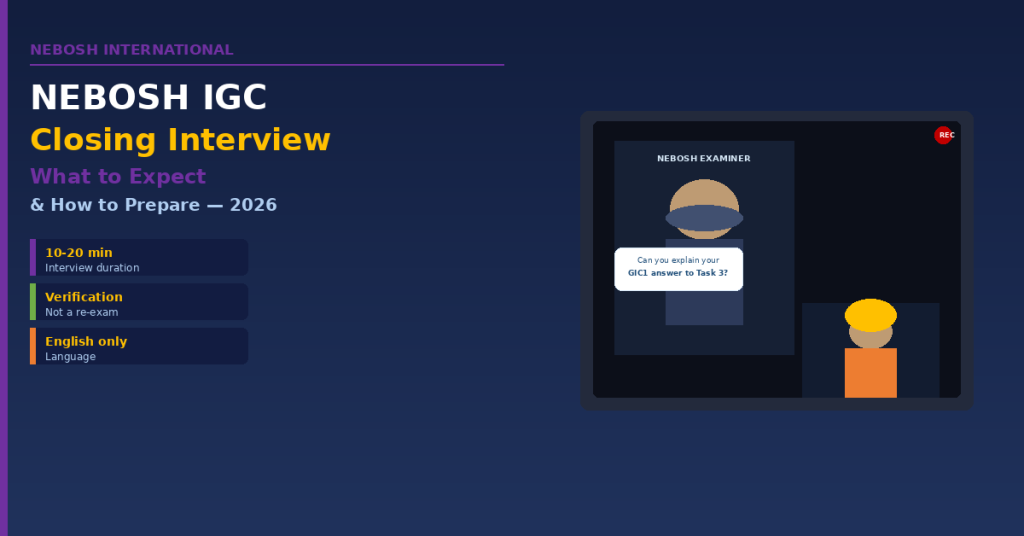
Imagine you have submitted your NEBOSH GIC1 assessment after days of studying and carefully preparing your answers. You are relieved that the written assessment is complete, but then your training provider contacts you about your closing interview. Suddenly, you start wondering what the interviewer will ask, whether your English is good enough and how the conversation could affect your result.
For many NEBOSH learners in Pakistan, these concerns are understandable. Candidates in Lahore, Karachi, Rawalpindi, Islamabad, Faisalabad and other cities may have strong health and safety knowledge but limited experience with formal assessment interviews.
The good news is that the NEBOSH closing interview is designed to verify your submitted work and understanding, not award a separate examination mark. You should prepare by reviewing your answers, understanding your reasoning and following the instructions provided by your Learning Partner.
This NEBOSH closing interview guide for 2026 explains the purpose of the interview, its format, common questions, six practical preparation tips and what happens afterwards.
What Is the NEBOSH Closing Interview?
The NEBOSH closing interview is a verification stage associated with the GIC1 scenario-based digital assessment under the 2025 specification. Its purpose is to help confirm that the submitted assessment represents your own work and that you understand the health and safety concepts behind your answers.
According to NEBOSH’s official closing interview and malpractice guidance, Learning Partners conduct interviews using questions designed for the relevant examination paper.
The interviewer may ask you to explain points from your submission or demonstrate your understanding of the scenario. Therefore, reviewing your own work is more useful than memorising a collection of generic interview questions.
The closing interview is not a separate scored examination. However, attendance is essential because NEBOSH will not publish your result until you have completed the required interview.
NEBOSH Closing Interview Format and Process in 2026
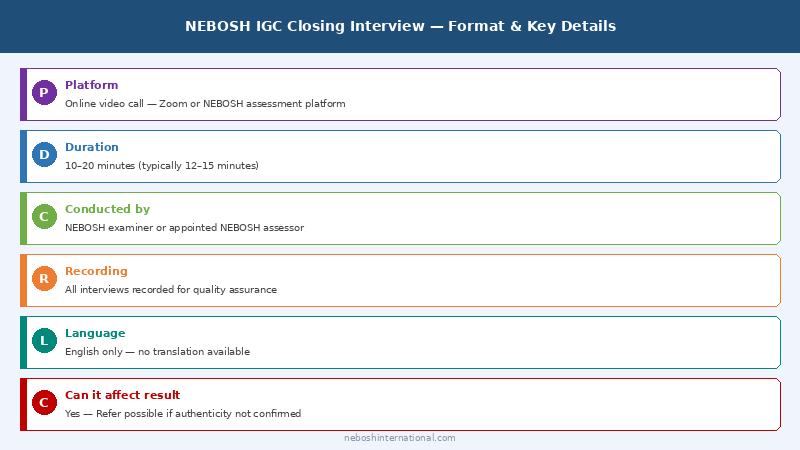
The precise arrangements depend on the instructions issued by your Learning Partner. The official learner guidance explains that the interview may take place through a video link or in person.
| Interview detail | What candidates should know |
|---|---|
| Purpose | Verify the authenticity of your submitted assessment and your understanding |
| Arranged by | Your NEBOSH Learning Partner |
| Interviewer | A person nominated by the Learning Partner |
| Format | Video interview or face-to-face meeting, as arranged |
| Questions | Questions based on the relevant assessment paper and your responses |
| Identification | Prepare an accepted identity document, such as a passport, driving licence or national identity card |
| Separate interview mark | No separate mark is awarded for the interview |
| Result publication | Your result cannot be published until the required interview is completed |
Important: Do not rely on a fixed interview duration or assume that every candidate receives the same questions. Follow your individual appointment instructions and the current official learner guidance.
For more details, read the NEBOSH Certificate Scenario-Based Digital Assessment Learner Guide.
What Questions Can You Expect in a NEBOSH Closing Interview?
The questions are intended to establish whether you understand your assessment. They may focus on specific tasks, hazards, control measures or explanations in your submitted answers.
The following are practice examples, not official or guaranteed interview questions.
1. Clarification Questions
The interviewer may ask you to explain a point that you included in your assessment.
Example: “You recommended improving workplace supervision. Why would this help in the scenario?”
How to prepare: Explain the particular problem you identified and how supervision could reduce the associated risk.
2. Hazard Identification Questions
You may need to explain why you identified a particular hazard as important.
Example: “Why did you consider the unsafe work at height a significant concern?”
How to prepare: Connect the hazard to its potential consequences and the conditions described in the scenario.
3. Control Measure Questions
The interviewer may ask you to explain a control you recommended.
Example: “How could the organisation reduce the risk associated with moving vehicles?”
How to prepare: Discuss practical controls that address the hazard, using your original answer as a starting point.
4. Reasoning Questions
These questions explore why you reached a particular conclusion.
Example: “Why did you recommend taking action immediately rather than waiting for the next inspection?”
How to prepare: Explain the severity of the potential harm, the likelihood of an incident and the urgency of the situation.
5. Application Questions
You may be asked how a safety principle applies to the workplace described in your assessment.
Example: “How would you put your recommended control into practice on a construction site?”
How to prepare: Describe the practical steps, responsibilities and checks needed to make the control effective.
6. Health and Safety Concept Questions
The interviewer may explore a technical concept mentioned in your answers.
Example: “Can you explain the hierarchy of controls and why it is important?”
How to prepare: Understand the concept well enough to explain it in your own words and relate it to your assessment.
Six Tips to Prepare for Your NEBOSH Closing Interview
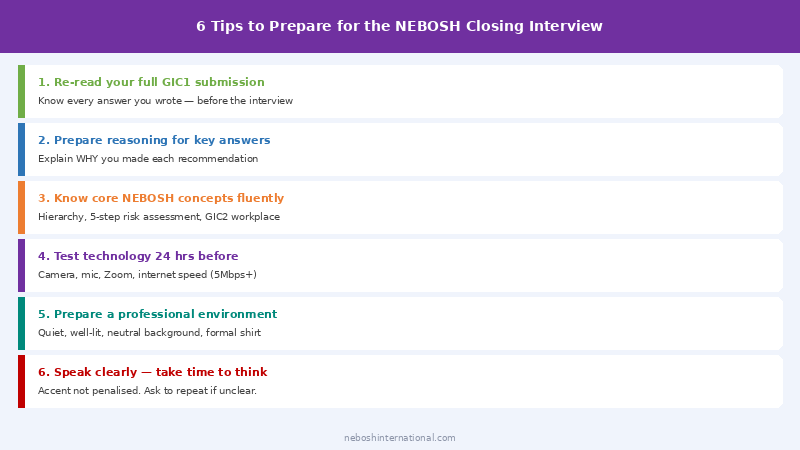
Use these six preparation steps to organise your revision and approach the interview with confidence.
[Image 1: NEBOSH closing interview format and process]
Tip 1: Read Your Submitted GIC1 Assessment Again
Start with the exact answers you submitted. Read each task and identify the hazards, risks, control measures and explanations you included.
For every important point, ask yourself:
- What did I mean by this statement?
- Which details from the scenario support my answer?
- Why did I recommend this control?
- What would happen if the organisation ignored this risk?
For example, if you recommended improving housekeeping, be ready to explain how poor housekeeping could contribute to slips, trips, blocked access routes or other relevant workplace hazards.
Practical action: Create a one-page revision sheet containing your main answers and the reasons behind them. Use it before the interview, not as unauthorised assistance during the interview.
Tip 2: Practise Explaining Your Answers in Your Own Words
Reading your assessment silently is not enough if you struggle to explain your reasoning aloud.
Practise speaking about your answers without attempting to reproduce every sentence exactly. This helps you check whether you genuinely understand the points you submitted.
For example, rather than memorising a definition of risk assessment, explain how identifying hazards and evaluating risks can help an organisation choose appropriate controls.
You can practise with a colleague or record yourself answering questions. Listen for unclear explanations, unnecessary repetition and statements that do not directly address the question.
Tip 3: Revise the Main Health and Safety Concepts You Used
Although the interview focuses on the assessment, you should understand the principles supporting your answers.
Prioritise:
- Hazard identification and risk assessment.
- The hierarchy of controls.
- Employer and worker responsibilities.
- Consultation and communication.
- Incident prevention and reporting.
- Safe systems of work and monitoring.
- The command words used in your assessment tasks.
Concentrate on concepts that appear in your submitted work instead of trying to memorise the entire syllabus immediately before the interview.
If your assessment discusses working at height, for example, understand why falls occur and how suitable planning, equipment, supervision and protective measures can reduce the risk.
[Image 2: NEBOSH IGC closing interview preparation tips]
Tip 4: Test Your Equipment and Prepare Your Identification
If your interview is online, check your internet connection, camera, microphone and device before the scheduled appointment.
Also prepare the identity document specified in your official instructions. Keep your appointment details accessible before the interview begins.
A backup internet connection, such as a mobile hotspot, may be helpful for candidates in Pakistan who experience unreliable broadband.
However, remember that the official guidance requires a suitable interview arrangement for identity verification. A telephone call alone may not be sufficient. Contact your Learning Partner if you anticipate technical difficulties or cannot meet the stated requirements.
Tip 5: Arrange a Quiet and Private Interview Space
Choose a quiet, well-lit room where you can speak without interruption. Inform family members or colleagues about your appointment so that unexpected interruptions are less likely.
For a video interview, follow the instructions about camera positioning, room checks and access to notes or electronic devices. The official learner guide explains that the interviewer may need to see the room and confirm that unauthorised assistance is not available.
Wear appropriate clothing, sit comfortably and keep the equipment you need ready before the appointment.
Whether you are joining from Lahore, Karachi, Islamabad or a smaller city, preparing your environment in advance can help you focus on the conversation.
Tip 6: Speak Clearly, Listen Carefully and Answer Honestly
You do not need to memorise a perfect speech. Listen to the complete question, take a moment to think and explain your answer directly.
If you do not understand something, politely ask the interviewer to repeat or clarify it. If you cannot remember a specific detail, avoid inventing an answer. Explain what you genuinely understand.
For candidates who use English as a second language, regular speaking practice can improve confidence. Focus on clear communication rather than trying to eliminate your accent.
The most important principle is consistency: your spoken explanation should reflect the understanding demonstrated in your submitted work.
Can You Fail the NEBOSH Closing Interview?
The closing interview does not receive a separate pass or fail mark. Nevertheless, it is a mandatory part of the assessment process, and concerns about the authenticity of your work can affect how your result is handled.
If the interviewer is not satisfied that the submission is your own work, the matter may be referred to NEBOSH for further action. Depending on the circumstances, this could involve another interview or an investigation under the applicable malpractice procedures.
To reduce avoidable problems:
- Complete your assessment honestly.
- Follow the assessment rules and permitted-support requirements.
- Make sure you understand the answers you submit.
- Attend the scheduled interview.
- Contact your Learning Partner promptly if you have a genuine scheduling or technical problem.
Do not assume that missing the interview is harmless. NEBOSH states that results will not be published until the required interview has taken place.
What Happens After the Closing Interview?
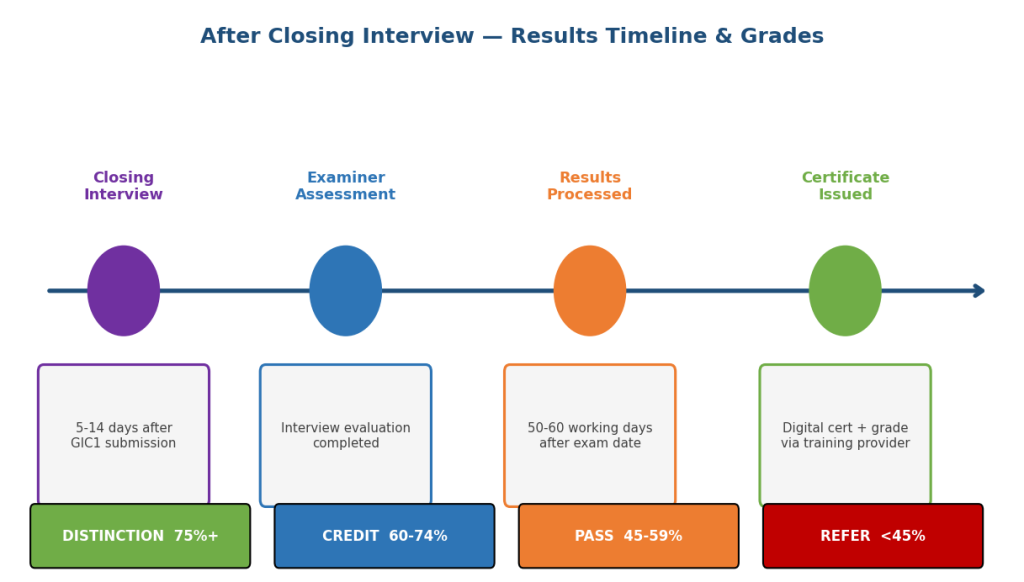
After the interview, the interviewer completes the required process. If the work is accepted as authentic, your result can be released according to the applicable NEBOSH result schedule.
If there is an authenticity concern, NEBOSH may need to investigate before deciding the next steps.
For the 2025-specification International General Certificate, the published GIC1 grading boundaries are:
| GIC1 mark | Grade |
|---|---|
| 75 or above | Distinction |
| 65–74 | Credit |
| 45–64 | Pass |
| Below 45 | Refer |
These are GIC1 grading boundaries, not closing interview scores. You must also achieve a Pass in GIC2 to complete the qualification.
Check the official NEBOSH International General Certificate page and the relevant digital assessment schedule for current requirements and result dates.
Frequently Asked Questions
The duration can depend on the arrangements for your assessment. Follow the appointment information provided by your Learning Partner rather than relying on an unofficial fixed duration.
Your Learning Partner arranges the interview and communicates the details. The exact waiting time may vary, so contact your provider if you have not received an update or need clarification.
The available language arrangements depend on the applicable assessment and interview guidance. Check your official instructions and ask your Learning Partner whether any approved language or accessibility arrangements apply to your circumstances.
Do not assume that an interpreter is available without confirmation.
Focus on explaining your answers clearly and demonstrating genuine understanding. You do not need to imitate a particular accent, but your interviewer must be able to understand your responses.
Stay calm and explain what you genuinely remember. If necessary, acknowledge that you cannot recall a particular detail rather than fabricating an explanation. Your aim should be to demonstrate your understanding honestly.
Follow the official instructions. The learner guidance states that the interviewer may check your room to ensure that notes or electronic devices are not available for unauthorised use. Do not assume that revision notes can be consulted during the interview.
No. The closing interview verifies the GIC1 submission and is not a separate qualification unit. You must meet the requirements for both GIC1 and GIC2 to complete the International General Certificate.
Conclusion:
The NEBOSH closing interview is an important part of the GIC1 assessment process, but you can prepare for it systematically. Review your submitted answers, practise explaining your reasoning, revise the relevant safety concepts, test your equipment, arrange a suitable interview space and communicate honestly.
For Pakistani candidates pursuing health and safety careers in construction, manufacturing, oil and gas or other industries, these habits also help develop the communication skills needed in professional HSE roles.
For further preparation, explore our NEBOSH open-book assessment guidance, fire risk assessment guide and NEBOSH course fees in Pakistan.
If you are comparing learning options, visit our NEBOSH course guidance for Pakistan to learn about available study routes and how to identify a suitable Learning Partner. NEBOSH International is an independent information and learner-referral platform; confirm accreditation, fees, assessment support and enrolment directly with the relevant provider.
Your best preparation is simple: understand your own work, follow the official rules and explain your reasoning in your own words.

NEBOSH International General Certificate (IGC) certified HSE professional focused on occupational health and safety, workplace risk assessment, hazard identification, and safety management systems. The content published on NeboshInternational.com is based on current industry guidance, recognized safety best practices, and practical workplace examples to help professionals in Pakistan and the Gulf prepare for NEBOSH qualifications and build successful HSE careers.