HSE Officer Salary in Pakistan 2026: Complete Industry-Wise Guide
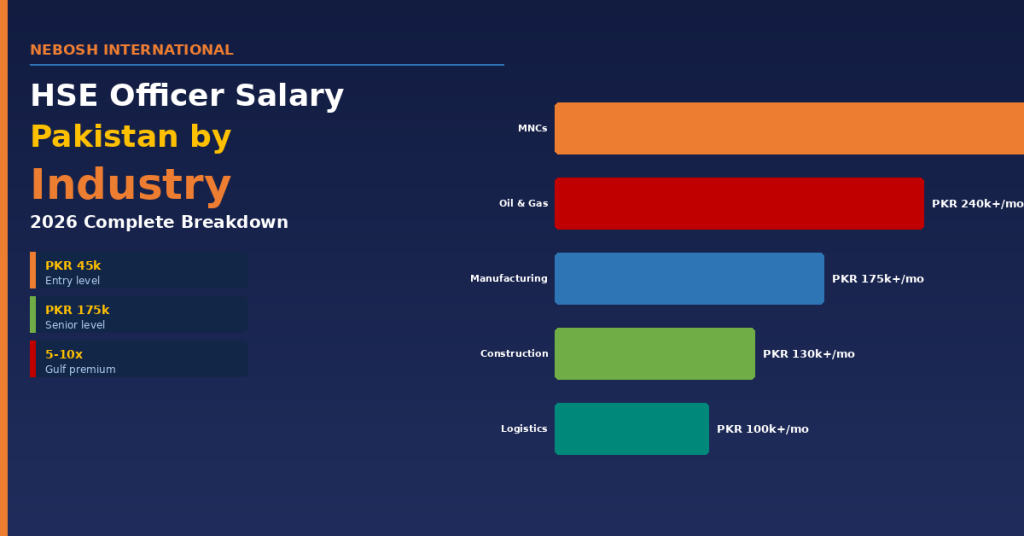
HSE officer salary in Pakistan 2026 depends on several factors, including industry, professional experience, location, employer requirements and health and safety qualifications. Oil and gas companies, multinational organisations and major infrastructure projects may offer higher compensation than smaller contractors. However, salary differences can be substantial even between employers in the same industry.
For Pakistani professionals considering the NEBOSH International General Certificate (IGC), understanding these differences can help them plan their careers more realistically. This guide compares estimated monthly salaries across major industries, explains how qualifications affect employability, and explores career opportunities in Pakistan and the Gulf.
Salary figures in this article are indicative market estimates for career planning, not verified national averages or guaranteed offers. Actual compensation depends on the vacancy, employer, location and experience.
HSE Officer Salary in Pakistan 2026: Quick Overview
An HSE (Health, Safety and Environment) Officer helps organisations identify workplace hazards, assess risks, implement safety procedures and prevent accidents. Their responsibilities vary according to the type and size of the workplace.
The following table provides an indicative salary overview for different experience levels.
| Experience level | Estimated monthly salary | Annual equivalent |
|---|---|---|
| Entry level: 0–2 years | PKR 45,000–90,000 | PKR 540,000–1,080,000 |
| Mid-level: 3–5 years | PKR 90,000–175,000 | PKR 1,080,000–2,100,000 |
| Senior: 5–8 years | PKR 175,000–320,000 | PKR 2,100,000–3,840,000 |
| HSE Manager: 8+ years | PKR 300,000–600,000+ | PKR 3,600,000–7,200,000+ |
These estimates are broad planning ranges rather than official salary statistics. Some entry-level positions pay less, while specialist or senior management roles may exceed the ranges shown.
Furthermore, annual salary equivalents do not include potential bonuses, overtime or allowances. Always check whether an advertised package includes transport, accommodation, medical insurance, provident fund contributions and other benefits.
HSE Officer Salary in Pakistan by Industry
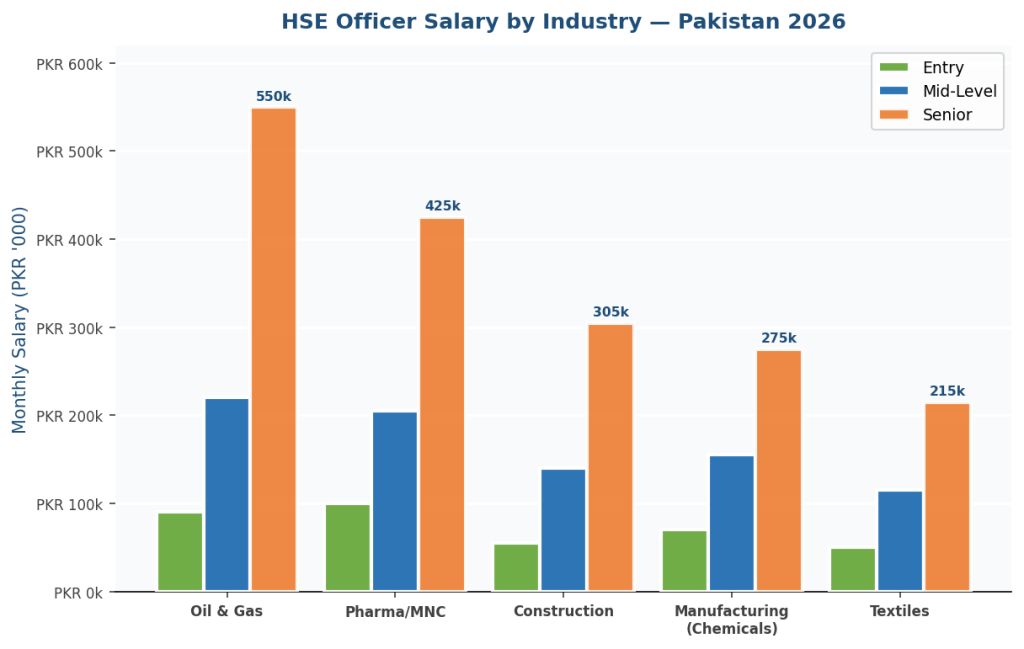
Industry is an important factor when comparing HSE jobs. High-risk operations, complex contractor arrangements and strict client requirements can increase the level of responsibility expected from safety professionals.
1. Oil and Gas Industry
Oil and gas is an attractive career path for HSE professionals because work may involve hazardous energy, confined spaces, drilling operations, process safety and emergency response.
| Position | Experience | Estimated monthly salary |
|---|---|---|
| HSE Officer | 0–3 years | PKR 90,000–160,000 |
| Senior HSE Officer | 3–6 years | PKR 160,000–280,000 |
| HSE Supervisor | 5–8 years | PKR 250,000–400,000 |
| HSE Manager | 8+ years | PKR 400,000–700,000+ |
Employers and contractors operating in the oil and gas sector may seek NEBOSH qualifications, permit-to-work knowledge, incident investigation skills and practical site experience. Opportunities may be available through contractors serving organisations such as Oil and Gas Development Company Limited (OGDCL) and Pakistan Petroleum Limited (PPL).
Nevertheless, these roles are competitive. A certificate alone does not guarantee entry into an operator company. Candidates can strengthen their applications by documenting inspections, toolbox talks, risk assessments and corrective actions completed in previous roles.
2. Construction Industry
Construction sites need skilled safety professionals to control hazards such as falls from height, excavation work, lifting activities, electrical risks, operating equipment and the coordination of different contractors.
| Position | Experience | Estimated monthly salary |
|---|---|---|
| Site Safety Officer | 0–3 years | PKR 55,000–100,000 |
| Safety Supervisor | 3–5 years | PKR 100,000–180,000 |
| HSE Manager | 5+ years | PKR 180,000–350,000 |
Large infrastructure developments, commercial buildings, industrial facilities and housing projects can offer opportunities for new and experienced safety officers.
For example, a safety officer working on a Lahore construction site may conduct daily inspections, check excavation protection, verify personal protective equipment and deliver toolbox talks. Employers may value candidates who can demonstrate these practical skills rather than relying solely on qualifications.
3. Manufacturing, Textiles and Garments
Manufacturing covers a wide range of workplaces, from textile mills and garment factories to food-processing plants and engineering facilities. Typical hazards include machinery, electrical systems, noise, manual handling and fire risks.
| Manufacturing sector | Entry level | Mid-level | Senior |
|---|---|---|---|
| Textiles and garments | PKR 50k–80k | PKR 80k–150k | PKR 150k–280k |
| Pharmaceuticals | PKR 65k–100k | PKR 100k–180k | PKR 180k–320k |
| Cement and steel | PKR 60k–95k | PKR 95k–170k | PKR 170k–300k |
| Food processing | PKR 50k–80k | PKR 80k–140k | PKR 140k–250k |
| Chemicals | PKR 70k–110k | PKR 110k–200k | PKR 200k–350k |
All amounts are estimated monthly salaries in Pakistani rupees.
Manufacturing opportunities are particularly relevant in industrial areas of Faisalabad, Lahore and Karachi. However, employers have different requirements depending on production processes, workforce size and operational risks.
Candidates can improve their prospects by learning machine safety, fire prevention, chemical handling, emergency procedures and incident reporting.
4. Multinational Companies
Multinational employers may offer competitive compensation and structured employee benefits. Depending on the organisation, relevant roles may use titles such as EHS Officer, HSE Coordinator or Safety Specialist.
| Position | Estimated monthly salary |
|---|---|
| HSE Coordinator | PKR 100,000–160,000 |
| EHS Officer | PKR 160,000–250,000 |
| HSE Manager | PKR 300,000–550,000 |
These are indicative estimates, not confirmed salary scales for specific companies. Employers in consumer goods, pharmaceuticals, logistics and industrial manufacturing may have different pay structures.
In addition to salary, review medical coverage, retirement contributions, paid leave, training opportunities and annual bonuses. Some employers require experience with internal audits, incident investigations, environmental management and occupational health and safety management systems.
5. Power, Cement and Heavy Engineering
Power generation, cement production and heavy engineering involve hazards such as electrical energy, rotating equipment, maintenance work, lifting operations and exposure to dust or chemicals.
Estimated monthly salaries can range from PKR 60,000–100,000 for some entry-level positions to PKR 150,000–350,000 or more for experienced specialists and managers.
However, pay depends on whether the position is permanent, contractual, site-based or part of a major project. Technical knowledge and experience with high-risk operations can be important advantages.
6. Logistics, Warehousing and Ports
Warehouses, distribution centres and port operations require effective management of vehicle movements, loading activities, storage systems, manual handling and emergency preparedness.
Entry-level roles may offer approximately PKR 50,000–90,000 per month, while experienced officers and managers may earn PKR 100,000–300,000 or more.
Employers may value practical knowledge of traffic management, warehouse inspections, contractor safety and incident prevention.
7. International Projects and Gulf-Linked Contractors
Some Pakistani contractors work on projects that follow international client requirements. These roles may involve detailed documentation, stricter reporting processes and additional training requirements.
Compensation can be higher than that offered by smaller local contractors, but this is not universal. Compare the complete job package, working hours, project duration, travel arrangements and employment conditions before accepting an offer.
Does NEBOSH IGC Increase Salary in Pakistan?
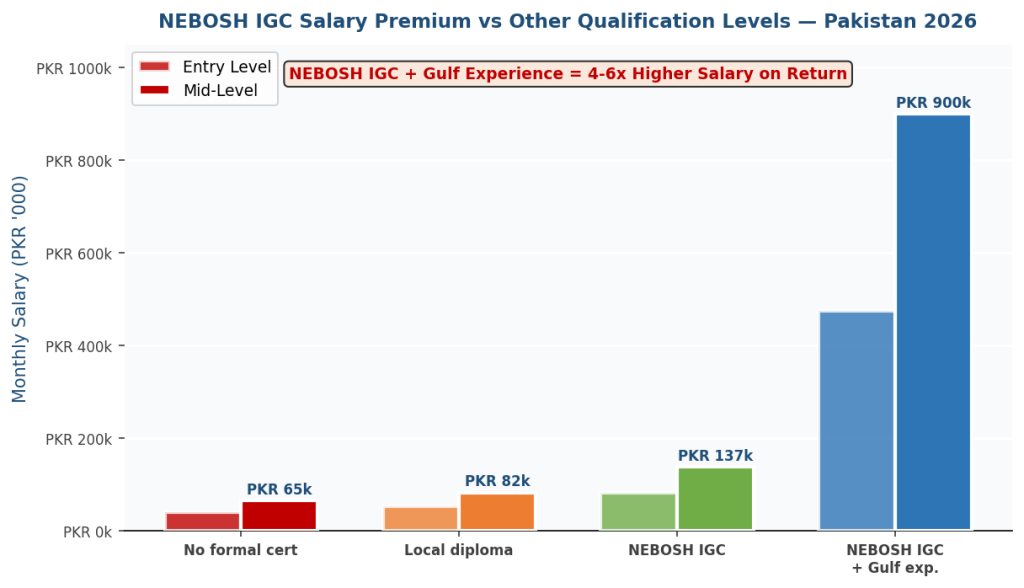
Holding a NEBOSH IGC qualification can improve your suitability for occupational health and safety roles by demonstrating a solid understanding of workplace hazards and risk control practices. Nevertheless, employers consider multiple factors, including experience, technical competence, communication skills and the responsibilities of the vacancy.
Candidates who lack a formal health and safety qualification may start by seeking entry-level positions, whereas those with a NEBOSH IGC can apply for a wider range of safety-related opportunities, depending on their experience and employers’ requirements qualify for a wider selection of vacancies. The actual salary difference depends on the employer and the candidate’s background.
To improve your career prospects, combine your qualification with practical experience in:
- Hazard identification and risk assessment.
- Workplace inspections and safety observations.
- Toolbox talks and worker engagement.
- Incident reporting and investigation.
- Permit-to-work procedures and emergency response.
- Corrective-action tracking and safety documentation.
For course information, review the official NEBOSH website and verify current qualification requirements before enrolling.
You can also read our NEBOSH course fees in Pakistan guide to understand the costs involved. Compare course fees, assessment charges, learning support and other expenses rather than choosing a provider on price alone.
HSE Officer Salary by City in Pakistan
Location influences salaries because industrial activity, employer budgets and the cost of living differ across the country.
| City or region | Relevant employment sectors |
|---|---|
| Karachi | Ports, manufacturing, oil and gas, logistics |
| Lahore | Construction, manufacturing, pharmaceuticals |
| Islamabad and Rawalpindi | Infrastructure, government-related projects, contractors |
| Faisalabad | Textiles, garments, manufacturing |
| Peshawar | Construction, infrastructure, industrial projects |
| Other industrial areas | Factories, warehouses, energy and construction |
Karachi, Lahore and the Islamabad–Rawalpindi region offer access to different types of employers. However, it would be misleading to assign a fixed salary premium to every city without current, comparable job-market data.
Before accepting a role, compare local vacancies for the same job title and experience level. Also calculate commuting costs, accommodation expenses and other deductions to understand your likely take-home income.
How to Progress from Safety Officer to HSE Manager
A successful HSE career usually develops through practical responsibility rather than qualifications alone.
Stage 1: Build foundational knowledge. Learn workplace hazard identification, risk assessment, emergency procedures and relevant health and safety requirements.
Stage 2: Secure an entry-level position. Apply to construction contractors, factories, warehouses or other employers where you can gain supervised experience.
Stage 3: Document your achievements. Keep accurate records of inspections, toolbox talks, training sessions, incident investigations and corrective actions. Never disclose confidential employer information.
Stage 4: Develop specialist skills. Depending on your industry, consider further learning in auditing, environmental management, fire safety, process safety or contractor management.
Stage 5: Apply for senior positions. Once you can demonstrate relevant experience and leadership, target senior officer, supervisor and management vacancies.
For additional career guidance, read our safety officer career roadmap in Pakistan.
Pakistan vs Gulf HSE Salaries
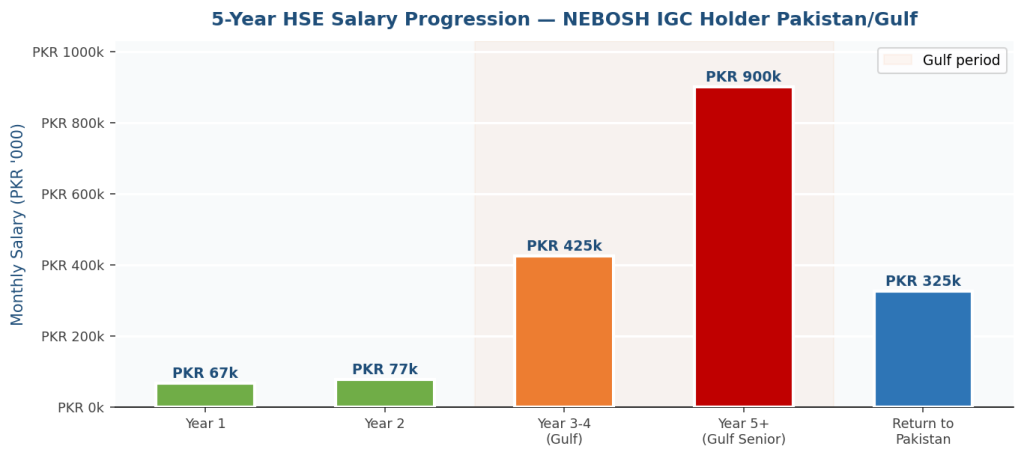
Saudi Arabia, the United Arab Emirates, Qatar and other Gulf countries attract Pakistani safety professionals. Some positions offer substantially higher nominal pay than comparable domestic roles. However, salaries vary widely by country, employer, project, experience and job grade.
International opportunities may require relevant site experience, recognised qualifications, client-specific training and strong communication skills. Some vacancies also require additional certifications or industry-specific experience.
Do not compare salaries using currency conversion alone. Evaluate accommodation, transport, medical coverage, visa arrangements, overtime, leave, contract terms and living expenses. A higher advertised salary does not automatically mean greater savings.
Before accepting overseas employment, verify the employer and recruitment arrangements through the relevant official channels. Never assume that a NEBOSH IGC guarantees a Gulf job or a particular salary.
Frequently Asked Questions
An entry-level HSE Officer may earn approximately PKR 45,000–90,000 per month, depending on the employer, industry, location and practical skills. Some vacancies may fall outside this range.
Senior oil and gas, specialist industrial and multinational management positions may offer competitive compensation. However, there is no single highest-paying industry for every experience level.
A NEBOSH IGC holder may find entry-level opportunities around PKR 55,000–100,000 per month in some sectors. Actual offers depend on the role and the candidate’s experience; the qualification does not guarantee this range.
Yes, some employers recruit fresh candidates for junior positions. Candidates can improve their applications by learning practical safety procedures, preparing a clear CV and applying for roles that match their experience.
Relevant experience can strengthen a Gulf job application, especially when it includes documented responsibilities in high-risk workplaces. Nevertheless, recruitment requirements differ by employer and position.
Compare recent job advertisements, recruitment agency listings and employer vacancies. Check the job title, location, required experience and benefits before comparing offers. Treat salary estimates from general online articles as guidance rather than verified offers.
Conclusion
The HSE officer salary in Pakistan in 2026 varies significantly by industry, experience, location and employer. Oil and gas, major construction projects, manufacturing and multinational organisations can provide promising career pathways, but the best opportunity depends on your skills and professional background.
For aspiring safety professionals, NEBOSH IGC can be a useful step towards developing recognised health and safety knowledge. However, practical experience, continuous learning, professional communication and the ability to apply safety procedures are equally important for long-term progression.
NEBOSH International is an independent information and learner-referral platform that helps Pakistani learners explore NEBOSH qualifications and learning options. We do not issue NEBOSH certificates or represent NEBOSH itself. Before selecting a course, verify the learning provider’s current accreditation and confirm all fees and assessment arrangements.
Explore our NEBOSH course guidance for Pakistan to learn more about qualification options and plan your next career step.

NEBOSH International General Certificate (IGC) certified HSE professional focused on occupational health and safety, workplace risk assessment, hazard identification, and safety management systems. The content published on NeboshInternational.com is based on current industry guidance, recognized safety best practices, and practical workplace examples to help professionals in Pakistan and the Gulf prepare for NEBOSH qualifications and build successful HSE careers.