NEBOSH IGC for Fresh Graduate in Pakistan 2026: Can You Get a Job Without Experience?

Can you get a safety officer job in Pakistan after completing NEBOSH IGC without previous experience? Yes, fresh NEBOSH IGC holders can apply for entry-level HSE positions, internships and trainee safety roles. However, getting hired depends on your practical knowledge, communication skills, location and the employer’s requirements.
Many Pakistani graduates face the same challenge. They complete their qualification, prepare a CV and start applying for safety officer jobs, only to discover that many vacancies request one to three years of experience.
The good news is that previous employment is not the only way to demonstrate your potential. Your NEBOSH learning, practical risk assessment, safety documentation skills and understanding of workplace hazards can help you compete for suitable entry-level positions.
This guide explains how fresh NEBOSH IGC graduates can start an HSE career in Pakistan, where to look for jobs, how to prepare a CV, what salaries to research and when to consider opportunities in Saudi Arabia or the UAE.
Can Fresh NEBOSH IGC Graduates Get Jobs in Pakistan?
Yes, but a NEBOSH IGC qualification does not guarantee employment. Some employers consider fresh candidates for junior positions, while others require previous site experience, a technical diploma or a relevant degree.
Your first goal should be to identify vacancies that match your current skills rather than applying exclusively for senior safety officer positions.
Suitable job titles to search for include:
- Trainee Safety Officer
- Junior HSE Officer
- Assistant Safety Officer
- HSE Intern
- Safety Supervisor Trainee
- Junior EHS Coordinator
Job titles and responsibilities differ between employers. For example, a small construction contractor may consider a qualified beginner for an assistant position, whereas a large oil and gas company may require several years of relevant experience.
Your qualification provides a foundation. Nevertheless, employers also want to know whether you can identify hazards, communicate with workers, complete inspection records and follow site procedures.
If you are still comparing qualifications, read our guide to NEBOSH vs IOSH to understand their different purposes.
Which Industries Offer Entry-Level HSE Opportunities in Pakistan?
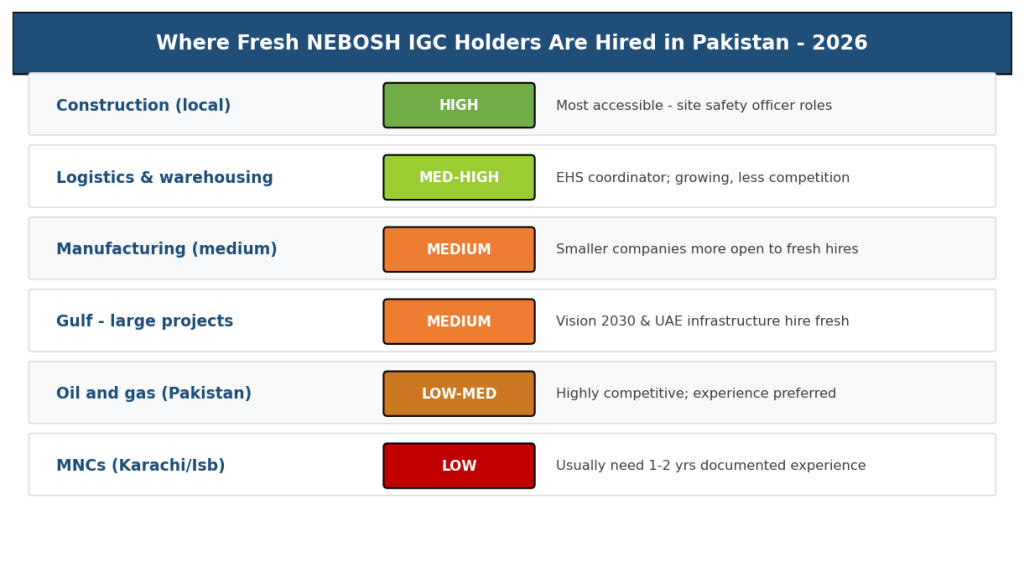
Fresh graduates should explore several industries rather than relying on a single employer or job title.
| Industry | Roles to explore | Skills to prepare |
|---|---|---|
| Construction | Trainee or junior safety officer | PPE, scaffolding, work at height and site inspections |
| Manufacturing | Junior HSE or EHS assistant | Machine guarding, chemical safety and housekeeping |
| Warehousing and logistics | Safety assistant or HSE trainee | Vehicle movement, manual handling and emergency procedures |
| Facilities management | Junior safety or compliance assistant | Fire safety, maintenance hazards and inspections |
| Oil and gas | Graduate or trainee opportunities where available | Permit to work, isolation and process safety fundamentals |
Construction can be a practical starting point because projects need people who understand site hazards and safe working procedures. However, individual vacancies may still require previous experience or technical qualifications.
In Lahore, search for relevant opportunities around industrial and commercial developments. In Karachi, investigate manufacturing, logistics and industrial employers. Candidates in Rawalpindi and Islamabad can look at construction, facilities management and infrastructure projects. Faisalabad candidates may also explore textile and manufacturing businesses.
These are locations and sectors to investigate, not guarantees that a particular employer is recruiting fresh graduates.
Does Your NEBOSH IGC Practical Risk Assessment Count as Experience?
Your practical risk assessment is valuable evidence of applied learning, but it should not be presented as paid employment or professional work experience unless you actually held such a position.
The assessment can demonstrate your ability to identify hazards, evaluate risks and recommend control measures. During an interview, explain what you assessed, why particular hazards mattered and how you selected suitable precautions.
For example, if your assessment covered a construction workplace, you might discuss:
- Working at height and falling objects.
- Electrical hazards and damaged equipment.
- Manual handling and ergonomic risks.
- Fire hazards and emergency arrangements.
- Housekeeping and access routes.
Explain the actual findings and recommendations from your assessment. Do not invent a workplace, claim responsibility for implementing controls you only recommended, or describe a training assessment as a completed company safety project.
For more preparation, read our guide to NEBOSH IGC for Engineers in Pakistan.
How to Write a Safety Officer CV Without Experience
A strong entry-level CV should show employers what you know, what you have practised and how you can contribute to their safety team.
1. Start with a clear professional summary
Use a short introduction that identifies your qualification, relevant knowledge and target role.
Example:
“Entry-level HSE candidate holding the NEBOSH International General Certificate in Occupational Health and Safety. Familiar with hazard identification, workplace risk assessment, hierarchy of controls, incident reporting and PPE requirements. Seeking a junior safety officer or trainee HSE position to apply my knowledge, develop practical skills and contribute to workplace safety.”
Only mention a qualification you have actually achieved. If you are awaiting results or completing the course, describe your status accurately.
2. Highlight your qualification
Include your NEBOSH qualification title, achievement date and grade where applicable. You can also list relevant technical education, first-aid training or other genuine certifications.
Check the official NEBOSH website for qualification information and certificate verification guidance.
3. Add a practical skills section
Include skills you can explain confidently, such as:
- Hazard identification and risk assessment.
- PPE selection and compliance monitoring.
- Toolbox talk preparation.
- Basic incident and near-miss reporting.
- Fire prevention and emergency procedures.
- Workplace inspection checklists.
- Safety documentation and action tracking.
Do not claim expertise in specialist activities simply because you have studied them.
4. Include your practical assessment
You can add a section titled “Practical Risk Assessment” or “Relevant Training Projects.” Describe the workplace type, hazards assessed, proposed controls and lessons learned.
This helps recruiters evaluate your knowledge without confusing academic work with professional employment.
5. Tailor the CV to each vacancy
Read the job description and match your genuine skills to the listed responsibilities. Use a clear file name, professional email address and concise formatting. Save your CV as a PDF unless the employer requests another format.

How to Get Your First Safety Officer Job After NEBOSH IGC
Finding your first HSE position requires a consistent job-search process.
Step 1: Search for entry-level vacancies. Use terms such as “junior HSE officer,” “trainee safety officer,” “safety internship” and “fresh NEBOSH IGC.”
Step 2: Apply through multiple channels. Check LinkedIn Jobs, Rozee.pk and employers’ official career pages. Verify each vacancy before sharing personal documents.
Step 3: Contact relevant employers professionally. You can send your CV to construction contractors, factories, warehouses and facilities management companies that recruit junior HSE staff.
Step 4: Practise interviews. Prepare examples about risk assessment, unsafe conditions, PPE, work at height, fire emergencies and accident investigation.
Step 5: Build genuine experience. Consider suitable internships, supervised site exposure and trainee positions. Record the tasks you actually perform and the skills you develop.
Step 6: Follow up and improve. Review which applications receive responses. If interviews are not progressing, improve your CV, technical explanations and communication skills.
You can also explore our guide to safety officer jobs in Pakistan for NEBOSH holders.
What Salary Can a Fresh NEBOSH IGC Holder Expect in Pakistan?
There is no single salary for every fresh NEBOSH IGC graduate. Pay depends on the city, industry, working hours, project conditions, education, employer and whether accommodation or transport is provided.
Rather than relying on a single national estimate, compare recent vacancies for similar entry-level roles in your target city.
When evaluating an offer, consider:
- Monthly basic salary and any allowances.
- Accommodation, transport and meal arrangements.
- Working hours, overtime and weekly rest days.
- Medical coverage and other employment benefits.
- Training, supervision and opportunities for progression.
- Whether the position provides genuine, documented HSE experience.
A lower starting salary may be worth considering if the role provides proper supervision and relevant experience. However, do not accept unsafe working conditions, misleading employment terms or responsibilities beyond your competence simply to obtain experience.
For additional guidance, consult our NEBOSH course fees in Pakistan guide when planning your training investment.
Can Fresh NEBOSH IGC Graduates Get Gulf Jobs Without Experience?
Some overseas vacancies may accept entry-level applicants, but many Gulf employers require prior experience, industry-specific knowledge or additional qualifications. Fresh Pakistani candidates should therefore approach overseas recruitment with realistic expectations.
Saudi Arabia and the UAE are potential destinations to investigate, particularly for construction, facilities management and industrial safety roles. However, large infrastructure projects do not automatically accept inexperienced applicants, and a NEBOSH certificate alone does not guarantee a job or work visa.
Before applying, check:
- The minimum experience and education stated in the vacancy.
- Whether the employer accepts applicants currently living in Pakistan.
- The authenticity of the employer and recruitment agency.
- The employment contract, salary, benefits and working conditions.
- The applicable visa, work authorisation and medical requirements.
- Whether the requested qualifications can be verified.
Be cautious if an agent guarantees employment or a visa in exchange for a large upfront payment. Verify the recruiter and relevant overseas employment requirements through official channels.
For many fresh graduates, gaining relevant local experience first can help build stronger evidence of competence. You can still monitor genuine overseas graduate and trainee vacancies while developing your skills in Pakistan.
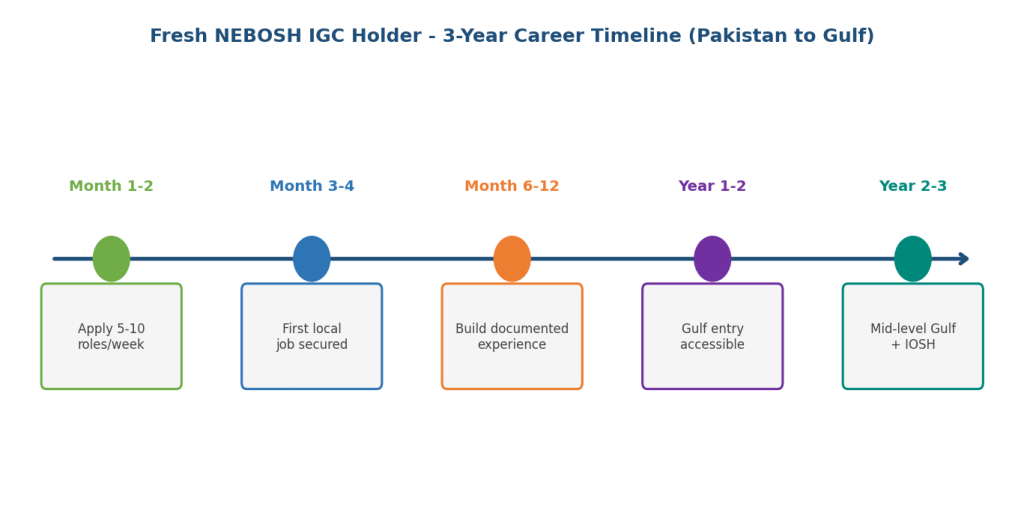
A Practical 90-Day Career Plan for Fresh Graduates
Use the following plan to organise your job search. The timeline is a suggested structure, not a promise of employment.
Days 1–30: Prepare your application
Finalise your CV, organise qualification documents, improve your LinkedIn profile and revise core NEBOSH topics. Identify suitable employers in your city and begin applying for relevant vacancies.
Days 31–60: Build practical readiness
Practise mock interviews, develop sample inspection checklists and revise workplace scenarios. Pursue genuine internships, supervised exposure or trainee roles where available. Continue applying for full-time opportunities.
Days 61–90: Review and refine
Assess which applications have generated responses. Improve weak interview answers, follow up professionally and broaden your search to nearby cities or related industries if practical.
Keep a record of applications, interviews, feedback and skills developed. This makes it easier to identify what needs improvement.
Frequently Asked Questions:
Yes, some employers recruit fresh candidates for junior, trainee and internship positions. However, many vacancies require experience, so apply according to the stated requirements and demonstrate your practical understanding.
Candidates can investigate opportunities in Lahore, Karachi, Rawalpindi, Islamabad and Faisalabad. The most suitable location depends on available vacancies, industry demand, commuting costs and willingness to relocate.
A genuine internship can provide valuable exposure if it offers appropriate supervision, meaningful tasks and safe working conditions. Check the duration, compensation and learning objectives before accepting.
No. Employers may also require experience, education, communication skills and additional competencies. Recruitment and visa approval depend on the applicable requirements and individual circumstances.
No. A strong grade can help demonstrate academic performance, but hiring decisions also depend on practical skills, experience, communication and employer requirements.
Focus on practical risk assessment, inspections, incident reporting, toolbox talks, emergency procedures and the requirements relevant to your target industry. Additional training should be selected according to genuine job requirements.
Conclusion
NEBOSH IGC for fresh graduate in Pakistan can provide a foundation for an HSE career, even when you have no previous safety employment. However, the qualification is a starting point rather than a guarantee of a job.
Improve your CV, explain your practical risk assessment honestly, target entry-level vacancies and develop the communication and workplace skills employers need. Explore opportunities across construction, manufacturing, logistics and facilities management before limiting your search to senior or overseas positions.
Whether you are starting in Rawalpindi, Lahore, Karachi, Islamabad or Faisalabad, a consistent and realistic approach can help you move towards your first HSE role and prepare for future opportunities in Pakistan and the Gulf.
Your next step: Review current vacancies, identify the skills they request and build your application around the qualifications and practical abilities you genuinely possess.
NEBOSHInternational.com provides independent NEBOSH guidance for learners in Pakistan and helps candidates explore learning options. It is an independent information and referral platform, not NEBOSH itself and not a certificate-issuing organisation.

NEBOSH International General Certificate (IGC) certified HSE professional focused on occupational health and safety, workplace risk assessment, hazard identification, and safety management systems. The content published on NeboshInternational.com is based on current industry guidance, recognized safety best practices, and practical workplace examples to help professionals in Pakistan and the Gulf prepare for NEBOSH qualifications and build successful HSE careers.