NEBOSH IGC vs International Diploma 2026: Which Is Right for You?
If you are planning a career in health and safety, one of the most important questions is whether you should start with the NEBOSH International General Certificate (IGC) or progress to the NEBOSH International Diploma.
For Pakistani HSE professionals, the answer depends mainly on your current qualification, workplace experience, career target, study time, and budget. The IGC is designed to provide a strong foundation in occupational health and safety, while the International Diploma develops more advanced knowledge and skills for people progressing towards senior HSE responsibilities.
This guide explains the NEBOSH IGC vs International Diploma difference, including qualification level, assessment, study requirements, cost considerations, career applications, and the pathway from Pakistan to Gulf HSE opportunities.
Important: NEBOSH qualification specifications have changed. If you are comparing older articles with the current 2026 structure, always check the latest information from NEBOSH and your accredited Learning Partner.
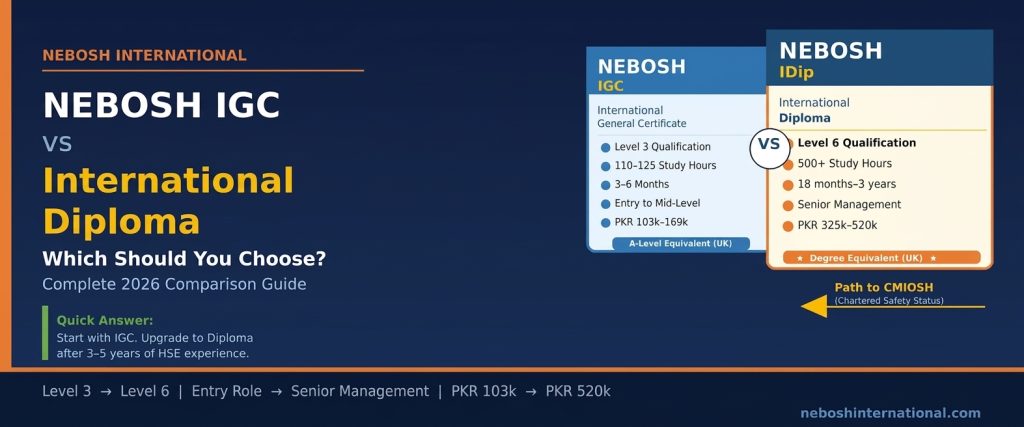
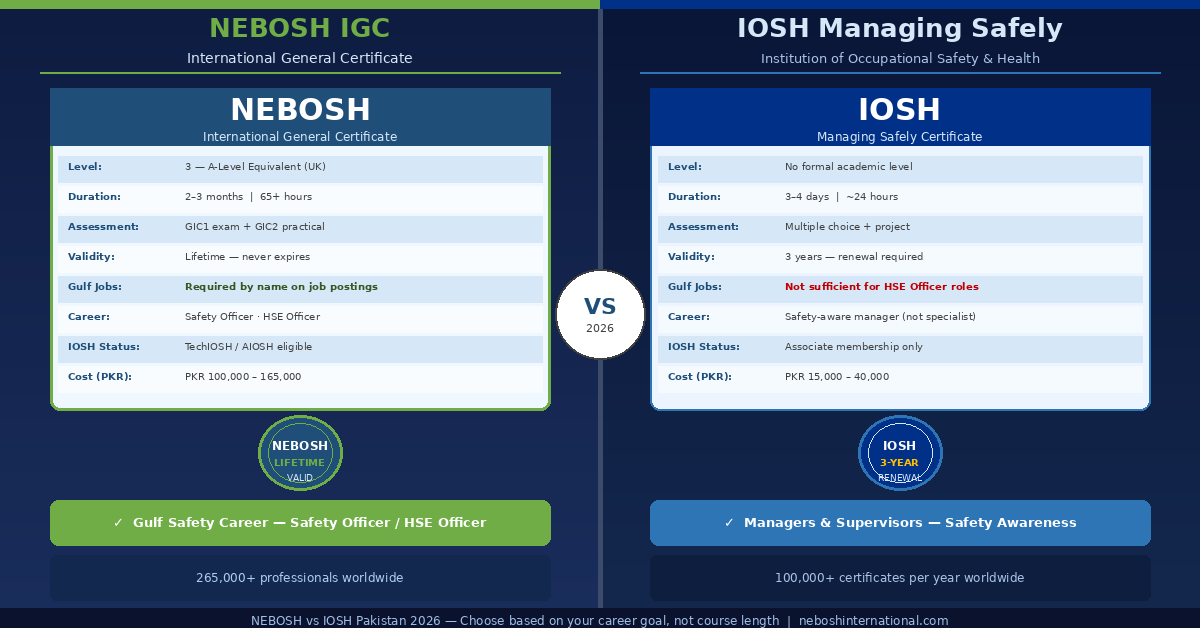
NEBOSH IGC vs International Diploma: Quick Comparison
| Feature | NEBOSH International General Certificate | NEBOSH International Diploma |
|---|---|---|
| Typical purpose | Foundation and professional development | Advanced HSE management |
| Qualification level | SCQF Level 6 / comparable to RQF Level 3 | RQF Level 6 |
| Current structure | GIC1 + GIC2 | DI1 + DI2 + DI3 |
| Entry requirements | No formal entry requirements | No formal entry requirements |
| Recommended background | Suitable for beginners and existing HSE workers | IGC or equivalent knowledge is recommended |
| Study commitment | Around 112 notional hours | Around 409 notional hours |
| Main focus | Management of health and safety and practical risk assessment | Advanced health and safety management and technical application |
| Typical career stage | Entry to intermediate HSE roles | More advanced and senior HSE responsibilities |
| Pakistan relevance | Strong starting qualification for HSE careers | Useful for professionals developing towards senior roles |
NEBOSH states that the current International General Certificate has two units, GIC1 and GIC2, with approximately 49 and 63 notional learning hours respectively. The qualification is at SCQF Level 6, comparable to RQF Level 3.
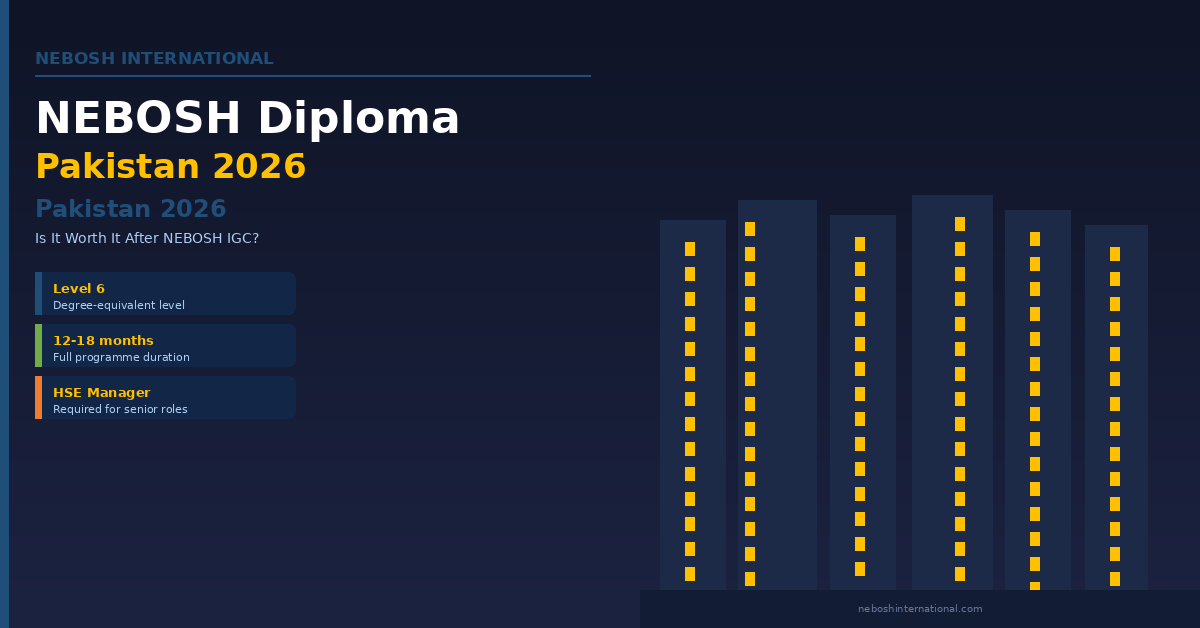
The current International Diploma is an RQF Level 6 qualification carrying 42 credits. NEBOSH’s Learning Partner guide lists 169 notional hours for DI1, 125 for DI2 and 115 for DI3.
What Is the NEBOSH International General Certificate?
The NEBOSH International General Certificate (IGC) is commonly used as a foundation qualification for people entering or developing within occupational health and safety.
It covers important areas such as health and safety management, workplace hazards, risk assessment and control measures. This makes it relevant to professionals working in construction, manufacturing, oil and gas, logistics, engineering and other industries.
For example, a Safety Officer working on a construction project in Rawalpindi may use the knowledge from the IGC to identify hazards, assess risks and recommend suitable controls. A professional working in a textile factory in Faisalabad may apply the same principles to machinery, chemicals, fire safety, workplace transport and other hazards.
The current IGC has two units:
- GIC1 – Management of Health and Safety
- GIC2 – Risk Assessment
NEBOSH states that GIC1 is assessed through an open-book examination and GIC2 through a practical assessment. The current qualification has no formal entry requirements.
If you are completely new to NEBOSH, see our What Is NEBOSH Course? Complete Guide for Pakistan 2026 before choosing a qualification.
What Is the NEBOSH International Diploma?
The NEBOSH Level 6 International Diploma for Occupational Health and Safety Management Professionals is an advanced qualification for people developing their knowledge beyond certificate level.
Unlike the IGC, the Diploma requires substantially more study and deeper application of health and safety management principles.
The current qualification consists of:
- DI1 – Know – Workplace Health and Safety Principles
- DI2 – Do – Controlling Workplace Health Hazards
- DI3 – Do – Controlling Workplace Safety Risks
The qualification is accredited by Ofqual at RQF Level 6 with 42 credits. NEBOSH also recommends that learners have passed the International General Certificate or an equivalent Level 3 or 4 qualification because the Diploma assumes prior knowledge.
There are no formal entry requirements, but that does not mean the Diploma is designed only for complete beginners. The recommended prior knowledge is important when deciding whether you are ready for it.
NEBOSH IGC vs International Diploma: Main Difference
The biggest difference is the depth of knowledge and level of responsibility.
The IGC focuses on building practical health and safety knowledge. You learn how health and safety should be managed, how hazards can be identified, and how risks can be assessed and controlled.
The Diploma moves further into advanced professional practice. You need to understand health and safety principles in greater depth and apply them to complex workplace situations.
Therefore, someone who has just started working as a Safety Officer may find the IGC more appropriate as a foundation, whereas an experienced HSE professional planning to move towards senior responsibilities may consider the International Diploma.
Assessment Difference
The assessment structure is another important difference.
For the current IGC, GIC1 is an open-book examination and GIC2 is a practical assessment. NEBOSH lists approximately 112 total notional learning hours across the two units.
The Diploma contains three substantially larger units. NEBOSH’s current guide lists:
- DI1: 169 notional hours
- DI2: 125 notional hours
- DI3: 115 notional hours
That gives approximately 409 notional learning hours for the qualification.
This difference is important for Pakistani candidates who are working full-time. Before enrolling on the Diploma, consider whether you can realistically manage study, assignments and professional responsibilities.
NEBOSH IGC vs International Diploma Cost in Pakistan
There is no single nationwide price for either qualification in Pakistan.
Your final cost can depend on the accredited Learning Partner, delivery method, tutor support, learning materials and NEBOSH assessment or registration charges.
For that reason, avoid treating one advertised package price as the official NEBOSH fee.
A practical way to compare providers is to separate the quotation into:
- Tuition or training fee
- NEBOSH registration and assessment fees
- Study materials
- Tutor support
- Resubmission or additional assessment costs, where applicable
You can also compare current Pakistan pricing in our NEBOSH Course Fees in Pakistan 2026 guide.
For official qualification information, always check the NEBOSH International General Certificate and NEBOSH International Diploma pages.

Which Qualification Is Better for a New HSE Professional?
If you are new to occupational health and safety, the IGC can provide a structured foundation.
It may be particularly relevant if you:
- Are starting your first HSE or Safety Officer role
- Work in construction, manufacturing or engineering
- Want to move from another profession into HSE
- Need a recognised health and safety qualification
- Want to develop practical risk assessment knowledge
- Are planning to build workplace experience before progressing further
For example, a Safety Officer in Lahore, Karachi, Peshawar or Rawalpindi may first develop practical experience alongside the IGC before considering an advanced qualification.
The IGC does not guarantee employment, promotion or a particular salary. Employers can have different qualification and experience requirements.
Who May Consider the International Diploma?
The International Diploma may be relevant if you already have a strong foundation in health and safety and want to develop towards more advanced responsibilities.
It can be considered by professionals who:
- Already hold the NEBOSH IGC or an equivalent qualification
- Have meaningful workplace HSE experience
- Want to strengthen advanced technical knowledge
- Are progressing towards HSE management responsibilities
- Work in larger organisations with structured HSE systems
- Want an advanced qualification that can support professional membership routes
NEBOSH states that the International Diploma meets the academic requirements to apply for IOSH membership at the appropriate grade, subject to IOSH’s current membership requirements.
This is different from saying that the Diploma automatically gives someone CMIOSH. Membership progression depends on the relevant professional body’s current requirements and the individual’s experience and competence.
NEBOSH IGC or Diploma for Gulf Jobs?
Pakistani professionals frequently consider NEBOSH qualifications when planning careers in Saudi Arabia, the UAE, Qatar, Oman and other Gulf markets.
However, qualification requirements vary between employers and job levels.
An employer recruiting a Safety Officer may specify a certificate-level qualification and relevant experience, while a senior HSE vacancy may ask for a Diploma-level qualification, extensive experience, professional membership or additional industry-specific credentials.
Therefore, instead of choosing a qualification solely because you want to work in the Gulf, check actual job descriptions for the role you want.
For example, if your target is an HSE Manager position in Saudi Arabia, review several current vacancies and identify recurring requirements such as:
- Years of HSE experience
- NEBOSH qualification level
- ISO 45001 knowledge
- Lead Auditor training
- Industry experience
- Communication skills
- Professional membership
- Client or project experience
You can then decide whether the IGC, Diploma or additional professional development fits your career plan.
For salary-related research, see our HSE Officer Salary in Gulf Countries After NEBOSH IGC guide.
Should You Do the Diploma Immediately After IGC?
There is no universal rule that every IGC holder must wait several years before starting the Diploma.
NEBOSH’s current Diploma guide states that there are no formal entry requirements, but recommends the IGC or an equivalent qualification because of the assumed prior knowledge.
Your decision should therefore consider your existing HSE knowledge, practical experience, English ability, available study time and career objectives.
For some learners, moving directly from IGC to Diploma may be realistic. Others may benefit from gaining workplace experience first.
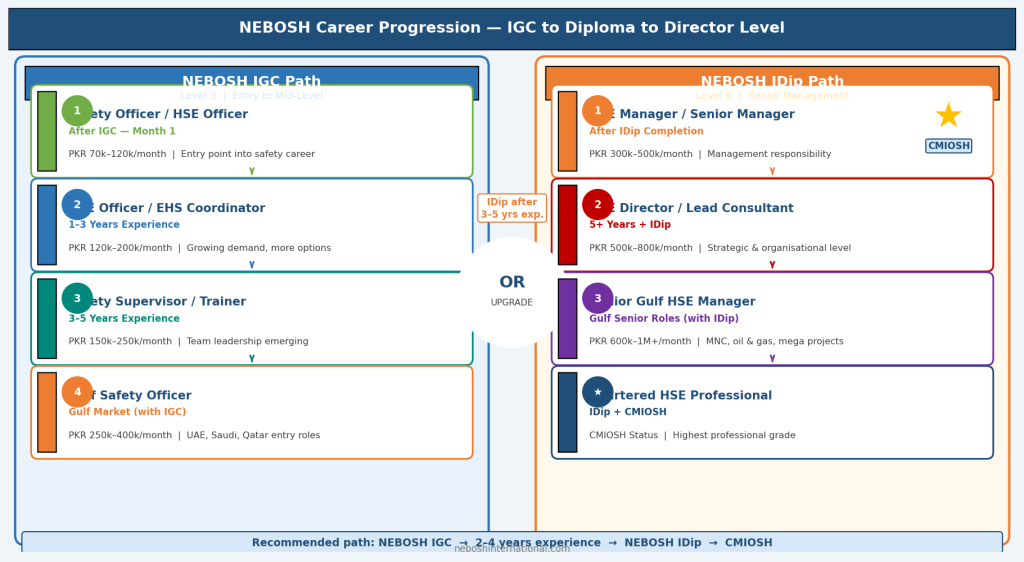
A useful pathway can look like this:
NEBOSH IGC → HSE/Safety experience → advanced technical development → NEBOSH International Diploma → senior HSE responsibilities
This is a pathway, not a mandatory sequence.
NEBOSH IGC vs International Diploma: Which One Should You Choose?
Use your current career stage as the starting point.
Choose the IGC if:
- You are new to HSE.
- You need a foundation in occupational health and safety.
- You are changing careers into safety.
- You are building your first professional HSE qualification.
- You want to develop practical risk assessment knowledge.
Consider the International Diploma if:
- You already have a strong HSE foundation.
- You understand basic health and safety management principles.
- You can manage a significantly larger study commitment.
- You want to develop advanced HSE knowledge.
- Your target roles or employer requirements commonly ask for Diploma-level qualifications.
Frequently Asked Questions
Is NEBOSH IGC the same as the International Diploma?
No. They are different qualifications at different levels. The current IGC is a foundation-level occupational health and safety qualification, while the International Diploma is an RQF Level 6 advanced qualification with 42 credits.
Can I study the NEBOSH Diploma without IGC?
Yes, there are no formal entry requirements. However, NEBOSH recommends the International General Certificate or an equivalent qualification because the Diploma assumes prior knowledge.
How long does the NEBOSH Diploma take?
The time varies according to the study method and learner. NEBOSH’s current guide lists 409 notional learning hours across DI1, DI2 and DI3. Providers may structure these hours differently through full-time, part-time, distance-learning or eLearning programmes.
Does the NEBOSH Diploma guarantee a higher salary?
No. A qualification alone does not guarantee a particular salary. Pay can depend on experience, industry, employer, location, job responsibilities and other qualifications.
Is NEBOSH IGC enough for an HSE career?
It can provide a useful foundation, but career requirements vary. Some HSE roles may require additional experience, technical qualifications or higher-level credentials.
Conclusion:
The NEBOSH IGC vs International Diploma decision should be based on your current career stage rather than simply choosing the higher qualification.
The IGC can help build a foundation in health and safety management and risk assessment. The International Diploma is a much larger Level 6 qualification designed for advanced professional development and assumes prior knowledge.
For a Pakistani learner starting an HSE career, a practical route may be to develop IGC-level knowledge, gain workplace experience and then consider the Diploma when the advanced content matches your responsibilities and career goals.
If you are already an experienced HSE professional, review your target vacancies, compare the current Diploma requirements and calculate whether you can commit to the additional study workload.
For independent information about NEBOSH qualifications and finding accredited Learning Partners in Pakistan, explore NEBOSH International.

NEBOSH International General Certificate (IGC) certified HSE professional focused on occupational health and safety, workplace risk assessment, hazard identification, and safety management systems. The content published on NeboshInternational.com is based on current industry guidance, recognized safety best practices, and practical workplace examples to help professionals in Pakistan and the Gulf prepare for NEBOSH qualifications and build successful HSE careers.


One Comment
Comments are closed.