Looking for answers to NEBOSH FAQs in Pakistan? Whether you are planning to enrol in the NEBOSH International General Certificate (IGC), comparing course fees, or exploring international HSE career opportunities, this guide answers the most common questions Pakistani learners ask before choosing a NEBOSH qualification.
NEBOSH is a UK-based awarding body that provides internationally recognised qualifications in occupational health and safety. Its qualifications help learners develop practical knowledge of workplace hazards, risk assessment, health and safety management, and accident prevention.
In this guide, you will learn about NEBOSH course fees in Pakistan, IGC duration, eligibility requirements, the updated 2026 syllabus, online learning, examination arrangements, certificate verification, and career opportunities in Pakistan and Gulf countries.
Quick Answer: NEBOSH IGC is an internationally recognised health and safety qualification suitable for aspiring and practising HSE professionals. Pakistani learners can study through an accredited NEBOSH Learning Partner using classroom, live online, or distance-learning arrangements.
Below, you will find answers to the most frequently asked questions about NEBOSH courses in Pakistan. Additionally, this guide covers fees, duration, eligibility requirements, certification value, and training institutes.
General Questions About NEBOSH
What is NEBOSH?
NEBOSH stands for the National Examination Board in Occupational Safety and Health. Established in 1979, it is a UK-based awarding body offering qualifications in occupational health, safety, environmental management, and related professional subjects.
NEBOSH develops qualification specifications and assessments, works with accredited Learning Partners, and awards certificates to learners who successfully complete the required assessments.
Its qualifications help professionals understand workplace hazards, identify risks, implement safety controls, and improve organisational health and safety performance.
Important: NEBOSH is an awarding body, not a training institute. Learners must enrol through an approved NEBOSH Learning Partner to undertake the relevant training and assessments.
What is the NEBOSH International General Certificate (IGC)?
The NEBOSH International General Certificate in Occupational Health and Safety is a professional qualification designed to develop practical health and safety knowledge.
It is particularly useful for:
Aspiring Safety Officers and HSE Officers.
Working safety professionals.
Engineers and technical supervisors.
Construction and manufacturing employees.
Professionals seeking international HSE opportunities.
The qualification covers two units:
GIC1 – Management of Health and Safety: Covers the principles and management of workplace health and safety.
GIC2 – Risk Assessment: Focuses on identifying hazards, evaluating risks, and recommending suitable control measures.
The International General Certificate is suitable for people developing a career in occupational health and safety across different industries.
What is the difference between NEBOSH IGC and NEBOSH Diploma?
The NEBOSH International General Certificate provides foundational and practical knowledge of occupational health and safety. The NEBOSH International Diploma is a more advanced qualification for professionals seeking deeper technical and strategic knowledge.
Feature
NEBOSH IGC
NEBOSH Diploma
Level
Certificate-level
Advanced professional qualification
Purpose
Build core HSE knowledge
Develop advanced HSE expertise
Suitable for
Beginners and working professionals
Experienced HSE professionals
Career direction
Safety Officer, HSE Officer
HSE Manager, senior HSE roles
Study commitment
Shorter
Significantly longer
The IGC is generally a suitable starting point for learners entering the HSE profession. The Diploma may be a suitable next step for professionals who want to progress into senior positions.
Is NEBOSH a qualification or a training course?
NEBOSH is an awarding body that develops and awards professional qualifications. Training is delivered by its accredited Learning Partners.
When people refer to a NEBOSH course, they usually mean the training and assessment pathway leading to a NEBOSH qualification.
Always check that your chosen provider is an approved Learning Partner before paying registration or course fees.
NEBOSH Course Fees in Pakistan
How much does a NEBOSH course cost in Pakistan in 2026?
NEBOSH course fees in Pakistan depend on the qualification, training provider, study mode, examination registration, and level of learner support.
For planning purposes, an indicative NEBOSH IGC budget may be approximately PKR 150,000–280,000 in 2026. This is a broad market estimate, not an official NEBOSH price or a guaranteed quotation.
The total cost may include:
Tuition and instructor support.
NEBOSH examination registration.
Learning materials and study resources.
Practical assessment guidance.
Administrative or additional service charges.
Before enrolling, request a written fee breakdown and confirm whether both GIC1 and GIC2 assessment registration fees are included.
Why do NEBOSH course fees vary between institutes?
Different NEBOSH Learning Partners offer different training arrangements and support services. Therefore, their fees may not be identical.
Common factors include:
Instructor experience and teaching quality.
Classroom or live online learning.
Duration and timetable of training.
Study materials and mock assessments.
Learner support and examination preparation.
Examination registration and other charges.
Do not select a provider based only on the lowest advertised fee. Compare the complete package, accreditation, support, and assessment arrangements.
Can I pay NEBOSH course fees in instalments in Pakistan?
Some training providers may offer instalment arrangements, although availability depends on their individual payment policies.
Before enrolling, ask whether instalments are available, how much advance payment is required, and when examination registration fees must be paid.
Always obtain written confirmation of the payment schedule.
NEBOSH Course Duration and Study Options
How long does a NEBOSH IGC course take in Pakistan?
The NEBOSH International General Certificate requires a minimum of 63 taught hours, together with approximately 40 hours of private study and background reading.
The overall completion time depends on the training schedule, study mode, learner preparation, and assessment dates.
Some intensive programmes may be completed in approximately 10 working days, while part-time and flexible learning arrangements may take several weeks or months.
Can I complete NEBOSH IGC in one month?
Yes. Completing the training and assessments within approximately one month may be possible through an intensive programme, provided the Learning Partner’s schedule and assessment arrangements allow it.
However, completing the training quickly does not automatically mean you will receive your certificate within one month. Assessment submission, marking, and result release take additional time.
Choose a realistic study schedule that gives you sufficient time to understand the syllabus and prepare your assessments.
Can I study NEBOSH online in Pakistan?
Yes. Pakistani learners can study NEBOSH through online and distance-learning arrangements offered by accredited Learning Partners.
Common study options include:
Live online classes with instructors.
Distance learning with structured study materials.
Self-paced e-learning where available.
Classroom-based training.
Online learning can be convenient for employed professionals, learners living outside major cities, and candidates who need flexible study schedules.
Before enrolling, check instructor availability, recorded lectures, assessment support, study materials, and examination registration arrangements.
Is classroom or online NEBOSH training better?
Both study modes can be effective. The better choice depends on your learning preferences, availability, and access to qualified instructors.
Classroom learning provides direct interaction, structured schedules, and opportunities to discuss practical workplace examples.
Online learning offers flexibility and can reduce travel and accommodation costs. However, learners need discipline and reliable access to learning resources.
Compare the available options before selecting your training provider.
NEBOSH Eligibility and Admission Requirements
What are the eligibility requirements for NEBOSH IGC in Pakistan?
There are no formal entry requirements for the NEBOSH International General Certificate.
However, learners should have sufficient English reading and writing ability to understand technical material and complete assessments.
NEBOSH recommends English language ability equivalent to IELTS 6.0 or higher.
A background in engineering, science, construction, or industrial work may be useful, but it is not compulsory.
Can I do NEBOSH after matric or intermediate?
Yes. NEBOSH IGC does not have a formal academic entry requirement, so learners who have completed matric or intermediate may be eligible to enrol.
However, candidates should consider their English proficiency, ability to understand technical subjects, and readiness for written assessments.
Can fresh graduates study NEBOSH in Pakistan?
Yes. Fresh graduates can enrol in NEBOSH IGC even without previous professional HSE experience.
The qualification can help graduates develop knowledge of hazard identification, risk assessment, workplace safety procedures, and occupational health and safety management.
However, obtaining NEBOSH does not guarantee employment. Practical knowledge, communication skills, industry exposure, and interview performance also matter.
Is NEBOSH suitable for engineers?
Yes. NEBOSH IGC can be valuable for civil, mechanical, electrical, chemical, and industrial engineers interested in health and safety responsibilities.
It can help engineers understand workplace risk assessment, safe systems of work, incident prevention, and occupational safety management.
NEBOSH IGC Syllabus and Examination
What is the latest NEBOSH IGC syllabus in 2026?
The revised NEBOSH International General Certificate specification began teaching on 2 February 2026, with the first revised assessments taking place from 4 March 2026.
The updated qualification uses two units:
GIC1 – Management of Health and Safety
This unit develops knowledge of health and safety management, including:
Why health and safety should be managed.
Health and safety management systems.
Risk management and workplace controls.
Monitoring and reviewing health and safety performance.
GIC2 – Risk Assessment
This unit focuses on practical workplace risk assessment, including identifying hazards, assessing risks, selecting control measures, and presenting suitable recommendations.
Learners should use the latest official syllabus and learner guidance rather than relying on older IG1 and IG2 study materials without checking their relevance.
What are the changes to NEBOSH IGC examinations in 2026?
The revised 2026 specification introduced changes to unit names and the practical assessment submission process.
The main changes are:
IG1 is now GIC1.
IG2 is now GIC2.
GIC1 continues as a 24-hour scenario-based open book assessment.
GIC2 is a practical risk assessment.
GIC2 is submitted through the online NEBOSH Assessment Platform.
The GIC2 submission deadline is 10 working days after the GIC1 assessment.
Learners should follow the current assessment instructions issued for their examination sitting.
Is the NEBOSH IGC exam difficult?
NEBOSH IGC can be challenging because it tests the ability to understand health and safety principles and apply them to realistic workplace situations.
The difficulty depends on your English skills, preparation, understanding of the syllabus, and ability to apply knowledge to scenarios.
You can improve your preparation by:
Studying each syllabus element carefully.
Practising scenario-based questions.
Understanding NEBOSH command words.
Developing clear, relevant answers.
Learning how to identify hazards and recommend practical controls.
Following the official assessment guidance.
Consistent preparation is more useful than memorising answers.
How do I pass the NEBOSH Open Book Exam?
To prepare for GIC1, develop a strong understanding of the syllabus and practise applying your knowledge to the scenario.
Useful preparation strategies include:
Read the scenario carefully and identify relevant workplace information.
Understand what each assessment task requires.
Use relevant examples from the scenario.
Explain your points clearly and directly.
Avoid unnecessary repetition and generic answers.
Follow the assessment instructions and academic integrity requirements.
The assessment is not simply a memory test. It evaluates your ability to apply health and safety knowledge to a workplace situation.
NEBOSH Career Opportunities and Salary in Pakistan
Is NEBOSH worth it in Pakistan?
NEBOSH can be a valuable qualification for people planning to build a career in occupational health and safety.
Pakistan has HSE-related roles across several industries, including:
Construction and infrastructure.
Oil and gas.
Manufacturing and engineering.
Textile and garment industries.
Power generation and energy.
Warehousing and logistics.
Chemical and pharmaceutical industries.
NEBOSH can strengthen your professional knowledge and help you compete for relevant positions. However, employment depends on qualifications, experience, technical skills, and employer requirements.
What is the salary after NEBOSH in Pakistan?
There is no fixed salary for NEBOSH-qualified professionals in Pakistan. Earnings depend on experience, job responsibilities, industry, employer, location, and additional technical qualifications.
Common career positions include:
Safety Officer.
HSE Officer.
Safety Supervisor.
HSE Engineer.
Safety Inspector.
HSE Manager.
Fresh candidates may need to begin in junior or entry-level roles, while experienced professionals can progress into supervisory and management positions.
Can I get a job in Saudi Arabia with a NEBOSH certificate?
Yes. NEBOSH IGC can support applications for relevant HSE positions in Saudi Arabia, particularly in construction, industrial operations, manufacturing, infrastructure, and oil and gas.
However, a NEBOSH certificate alone does not guarantee employment or a work visa.
Employers may also consider:
Relevant HSE work experience.
Engineering or technical education.
Knowledge of risk assessment and safety procedures.
Industry-specific training.
Communication and reporting skills.
Employer-specific certifications and requirements.
Candidates should review job descriptions carefully and develop practical workplace experience alongside their qualification.
Is NEBOSH recognised in UAE, Qatar, Oman and other Gulf countries?
NEBOSH qualifications are internationally recognised and are used by employers in many countries, including Saudi Arabia, the UAE, Qatar, Oman, and Kuwait.
However, recognition of a qualification does not mean that every employer has identical recruitment requirements.
Some positions may require relevant experience, additional technical certifications, or specific industry knowledge.
NEBOSH Institutes and Learning Partners in Pakistan
Which NEBOSH institute is best in Pakistan?
The best NEBOSH institute is an accredited Learning Partner that provides suitable training, experienced instructors, transparent fees, and reliable learner support.
Before choosing a provider, compare:
Official NEBOSH Learning Partner accreditation.
Instructor experience and teaching arrangements.
Course fee and included services.
Classroom and online learning options.
Study materials and assessment preparation.
Learner support and communication.
Examination registration arrangements.
Never select a provider only because it advertises the cheapest course or guarantees a pass.
Is a NEBOSH certificate internationally recognised?
NEBOSH qualifications are internationally recognised and respected by employers and organisations across many industries.
The International General Certificate is particularly relevant to occupational health and safety roles.
However, individual employers may set their own requirements regarding experience, education, technical skills, and additional qualifications.
International recognition should not be confused with an automatic guarantee of employment or professional licensing in every country.
Comparing NEBOSH, IOSH and OSHA
What is the difference between NEBOSH, IOSH and OSHA?
Organisation
Main focus
Common purpose
NEBOSH
Health and safety qualifications
Professional HSE knowledge and career development
IOSH
Health and safety professional body and training
Professional development and workplace safety awareness
OSHA
US occupational safety and health regulation and training
Workplace safety requirements and training, particularly in the US context
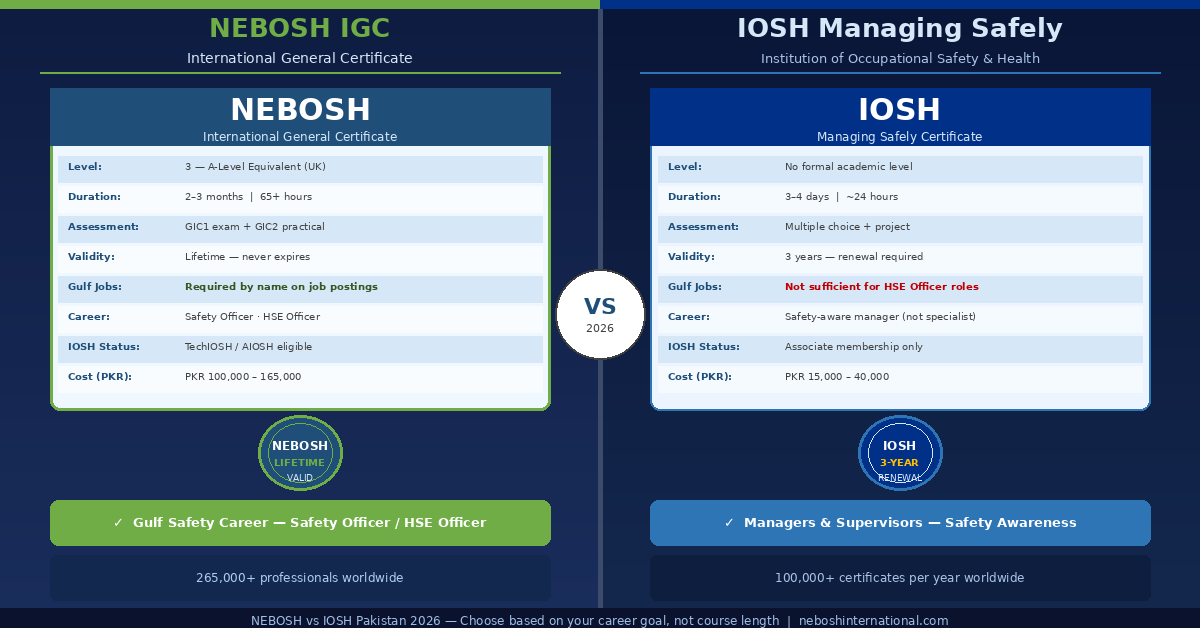
NEBOSH IGC is a widely used qualification for people developing professional HSE careers. IOSH courses can support safety awareness and management development. OSHA training is particularly relevant to US workplace safety frameworks and specific training needs.
The right option depends on your career objectives and employer requirements.
Should I do NEBOSH or IOSH first?
The right choice depends on your current experience and career goals.
If you are interested in developing a professional health and safety career, NEBOSH IGC may provide a more comprehensive starting qualification.
IOSH training can be suitable for people seeking introductory safety awareness or management-level knowledge.
Consider your intended job role before deciding.
Occupational Health and Safety
What is occupational health and safety?
Occupational health and safety refers to the policies, procedures, and practices used to protect workers from workplace injuries, illnesses, and other occupational risks.
It involves identifying hazards, assessing risks, implementing control measures, monitoring workplace conditions, and promoting a safe working environment.
Common HSE responsibilities include:
Workplace safety inspections.
Hazard identification and risk assessment.
Accident and incident investigation.
Toolbox talks and safety training.
Personal protective equipment monitoring.
Emergency preparedness.
Safety documentation and reporting.
These activities are important in construction, manufacturing, oil and gas, and other industrial sectors.
What skills are important for a Safety Officer in Pakistan?
A successful Safety Officer needs both technical knowledge and practical workplace skills.
NEBOSH can help develop foundational knowledge, but practical experience is equally important for professional growth.
Final Guidance for Pakistani NEBOSH Learners
Choosing the right NEBOSH qualification is an important step towards developing a career in occupational health and safety.
Before enrolling, compare training providers, verify their Learning Partner status, understand the complete course fee, and review the latest assessment requirements.
NEBOSH International is an independent information and referral platform that helps learners understand NEBOSH qualifications and explore suitable training providers. We do not provide NEBOSH training, award qualifications, or issue certificates.
Transparency Notice: NEBOSH International is an independent NEBOSH information and referral platform. It is not affiliated with NEBOSH, does not deliver accredited training, and does not issue NEBOSH qualifications. Any referral relationship with training providers should be disclosed transparently.